Night Vision NVG / Thermal

  • Want to keep track of this thread?
    Accounts can bookmark posts, watch threads for updates, and jump back to where you stopped reading.
    Create account
The $1000 gucci LARPerator admin light vs the $70 Streamlight Sidewinder + Velcro tape

You can rip it off, put it on your PC, clip it to a backpack strap, and then slap it back on the bump. It has 40 hours of battery life on two AA batteries and has red, white, and IR light.
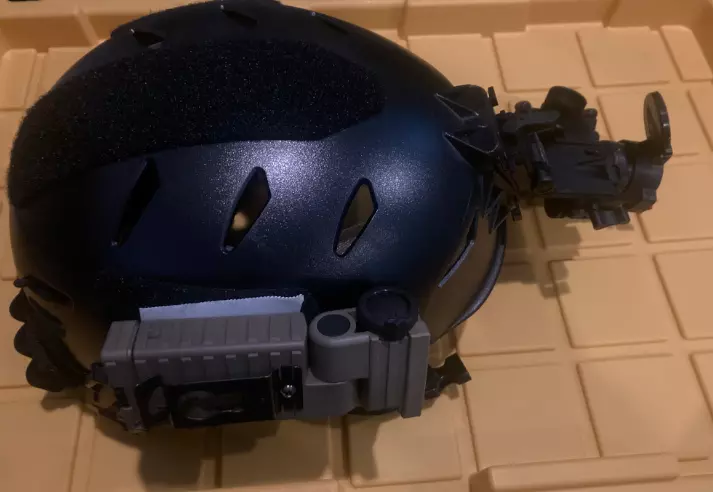
1749938163796.webp
The IR doesn't have much throw but might be useful for indoor environments.
 
The $1000 gucci LARPerator admin light vs the $70 Streamlight Sidewinder + Velcro tape

You can rip it off, put it on your PC, clip it to a backpack strap, and then slap it back on the bump. It has 40 hours of battery life on two AA batteries and has red, white, and IR light.
View attachment 7503880
The IR doesn't have much throw but might be useful for indoor environments.
Is there actually a $1,000 admin light?
 
A Surefire M340V costs around $500 and the rail mount itself is another $100.
There are cheaper tac / admin lights but of questionable quality. This setup just werks. If you need to look at something close up it gives you a lot of flexibility.
Gotcha. Wasn’t sure if you were being sarcastic or if there was one that cost $1000 (honestly I wouldn’t be surprised)

I spent $1000 on my IRIS
 
You can get 90% of the effect and less than half the weight with a Panobridge and only two tubes. The only thing to keep in mind is that you need collimated tubes, which means you have to buy them at the same time and tell the vendor that you intend to use them as a pair or pay to get them collimated.
I just stumbled on this thread so forgive me for digging up a year old post, but this part just makes no sense. You don't collimate tubes, you collimate eyepieces. There's an excentric offset built into the optical axis of the ocular (even the new cheap chinesium ones have it). Rotating the eyepiece on its thread (that comes with a stop ring for a reason) will move the image along a circle. To collimate two eyepieces, you try to find one of the two intersection points of their respective offset circles.
collimation.webp

When you run a bino or two bridged monos you want them to be collimated. But this can be done at home to a sufficient level by staring at the stars and turning the eyepieces until the images align and feel comfortable to your brain. Then you lock them down with the stop rings and never touch them again until you scavenge the bino for parts to feed your inevitable quad build.
For any panobridge that isn't an NV+ Arc Bridge, things get tricky: panning the monos outwards changes their interpupillary distance, so you have to flip them up slightly to increase IDP back to where it fits your eyes. But now the tubes are rotated outwards, so the collimation that was established in the straight-ahead binocular configuration will be off. In some cases this effect is negligible and the images stay aligned in such a way the brain can easily deal with. But if the horizontal axis of the images shift too much vertically, it will cause an uncomfortable image, where edges shift up or down depending on which tube you see it through.
For switching between bino and pano on the fly, the best option is to go for an in-between collimation that results in an acceptable image in both configurations and keeps the horizontal axis aligned as best as possible.
 
Last edited:
I'm seeing more NNVT tubes become publicly available for sale. They are Gen 2+ like Photonis. Anyone know anything about these or have experience with them?

Bonus: guide stolen from 4cuck /k/ for NOD IR modules
1753323098769852.webp
 
I'm seeing more NNVT tubes become publicly available for sale. They are Gen 2+ like Photonis. Anyone know anything about these or have experience with them?
Perfectly usable in high-to-medium light, will shit the bed in low light when american Gen 3 is just starting to struggle. May or may not come with distracting edge distortion free of charge, depending on if XinWanLi or XanWonLao assembled the fiber optical inverter that day. Same for the color, either it's actual white phos or more like blue-ish white phos. Their NVT Gen 3 tubes can keep pace for slightly longer in the gain department, but suffer from lack of contrast at that point and will wash out whatever detail you could easily discern with a 30yr old murican Gen 3.
The one compelling argument I found in favor of them, over grabbing village bicycle american Gen 3, is that you usually get them with 1-year warranty and a spec sheet (which may or may not be accurate, at the end of the day it's still chinese bughive salesmen you're dealing with).
 
Perfectly usable in high-to-medium light, will shit the bed in low light when american Gen 3 is just starting to struggle. May or may not come with distracting edge distortion free of charge, depending on if XinWanLi or XanWonLao assembled the fiber optical inverter that day. Same for the color, either it's actual white phos or more like blue-ish white phos.
Do you know how they are evaluating the FOM of the tubes themselves? I can't imagine that a Chinese manufacturer would have access to any of the Hoffman devices like the 126A, however for many Norinco tubes I've seen specific numbers listed from overseas wholesalers.
 
Do you know how they are evaluating the FOM of the tubes themselves? I can't imagine that a Chinese manufacturer would have access to any of the Hoffman devices like the 126A, however for many Norinco tubes I've seen specific numbers listed from overseas wholesalers.
I honestly don't doubt the values themselves. They obviously have some device accurate enough to determine them. I'm acquainted with a guy peddling their tube lineup and the values appear accurate, atleast as long as you can be sure the specsheet actually corresponds to the tube infront of you. They will randomly attach average specsheets to below-average tubes, despite offering a seperate fallout lineup where such tubes would fall. I think their resellers and customers are used to "NVT fallout = blems", so they gamble on low-gain and low-res tubes with copypasted specsheets flying under the radar.
2000+ FOM sure looks nice, as long as you're not limited by lack of ambient light, because gain/sensitivity has no influence on numerical FOM. But when you're deep inside a forest tunnel with full canopy on either side, you'll notice.
 
Anyone have an SMS HFXC and want to help a nigga out? I want to know how far the emitters are from the centerline of the picatinny mount. I'm considering mounting a LAM on a couple of weird guns with large fixed front sights and I'm concerned about the offset being enough to clear them. Some of them are about 1.5x-2x the width of an A2 front sight. I don't care about the built in white light clearing the FSP because I'll have a redundant WML on there.

Looking for a dimensions sheet like this one but for the HFXC
image_2025-09-08_072351999.webp
 
Been dicking around with my DIY digital-infrared binos and had a question for those of you with actual big boy not-made-of-hot-glue-and-toothpicks goggles; is double vision or a general trouble with getting a coherent single image out of both tubes a thing that occurs with analog devices?

I consistently fail to resolve a coherent single image when using both eyes at anything other than extreme close range, likely because my eyes are converging at the shallow depth of the displays hanging in front of my eyes rather than the intended subject. I don't have this issue with non-night-vision binoculars, which you look through instead of looking at, though - maybe analog NVGs are the same? I've only briefly experienced a PVS14 monocular, so I have nothing to compare against.

Frustratingly, none of the friends that have tried my DIY kit report this same problem so some part of it is clearly me, either in the eyes or in the brain. Currently trying to figure out if this is something I can train or habituate out of. What would be the point of splurging on some analog tubes down the line if I can't use them?
 
Been dicking around with my DIY digital-infrared binos and had a question for those of you with actual big boy not-made-of-hot-glue-and-toothpicks goggles; is double vision or a general trouble with getting a coherent single image out of both tubes a thing that occurs with analog devices?

I consistently fail to resolve a coherent single image when using both eyes at anything other than extreme close range, likely because my eyes are converging at the shallow depth of the displays hanging in front of my eyes rather than the intended subject. I don't have this issue with non-night-vision binoculars, which you look through instead of looking at, though - maybe analog NVGs are the same? I've only briefly experienced a PVS14 monocular, so I have nothing to compare against.

Frustratingly, none of the friends that have tried my DIY kit report this same problem so some part of it is clearly me, either in the eyes or in the brain. Currently trying to figure out if this is something I can train or habituate out of. What would be the point of splurging on some analog tubes down the line if I can't use them?
See this post further up. As long as you have atleast the latest version of chinese eyepieces or better, you can collimate both sides to align the image. Doing it by hand while looking at the stars to check the alignment works just fine for achieving an image that merges without headache during prolonged use.
 
See this post further up. As long as you have atleast the latest version of chinese eyepieces or better, you can collimate both sides to align the image. Doing it by hand while looking at the stars to check the alignment works just fine for achieving an image that merges without headache during prolonged use.
Here's a mockup visual for the double vision I get;
double.webp
Rotating the display assembly gets me this kind of deal, so that's not on the table;

doubletilt.webp
The eyepiece in question is a cheapo digital monitor;
s-l960.webp screen.webp

Just based on what collimated/not collimated looks like here I don't know that this is in scope. It looks to be for fairly minor deviations within a stone's throw of full coherency (but I have no idea).

Conceivably I could re-print the bridge with a fairly major converging/diverging angle to the cameras so each eye would get a completely unique picture except where I can force stack the overlap, but that seems really fucked up and also kills any shot at depth perception.
 
Here's a mockup visual for the double vision I get;
View attachment 7980145
[...]
Conceivably I could re-print the bridge with a fairly major converging/diverging angle to the cameras so each eye would get a completely unique picture except where I can force stack the overlap, but that seems really fucked up and also kills any shot at depth perception.
On analog NVG the collimation is done to account for slight misalignments, but the tubes are usually expected to point straight ahead in parallel. If the images are that far off like in your picture it looks more like your camera pods need some built-in mechanism for adjusting the angles the sensors are pointing so you can nudge them towards convergence with something like set screws.
 
On analog NVG the collimation is done to account for slight misalignments, but the tubes are usually expected to point straight ahead in parallel. If the images are that far off like in your picture it looks more like your camera pods need some built-in mechanism for adjusting the angles the sensors are pointing so you can nudge them towards convergence with something like set screws.
I hear what you're saying, but...
I played around with this and to remove the double vision entirely I have to put the two cameras at a 45 degree angle from each other and force the images to line up, creating an ultra-wide FOV setup. Ultra wide FOV sounds nice, so why not? Aside from having to redesign the entire assembly, and the fact that nobody does this (suggesting that this is not the correct approach), most importantly I create a flat image with zero depth perception except the narrow slice where both eye images overlap. If that's the outcome, I'm better off chopping the unit in half.

Behold my mspaint masterpiece:
stuff.png

A is what I get, both images remain separate and my brain can't parse it into binocular vision with depth perception.
B is what I think I'm supposed to get, where the brain realizes they are the same image, and sorts it out.
C is diverging the cameras, forming an ultrawide flat image and passing that image to my brain, with zero depth perception.

The two cameras as currently installed point straight ahead in parallel, or close enough per 3d printing tolerances. I would have room to shim or adjust, if that were the issue but the changes required are so far beyond that.

Anyway, found some convergence exercises I might practice, see if I get results over time.
 
I hear what you're saying, but...
I played around with this and to remove the double vision entirely I have to put the two cameras at a 45 degree angle from each other and force the images to line up, creating an ultra-wide FOV setup. Ultra wide FOV sounds nice, so why not? Aside from having to redesign the entire assembly, and the fact that nobody does this (suggesting that this is not the correct approach), most importantly I create a flat image with zero depth perception except the narrow slice where both eye images overlap. If that's the outcome, I'm better off chopping the unit in half.

Behold my mspaint masterpiece:
View attachment 7981439

A is what I get, both images remain separate and my brain can't parse it into binocular vision with depth perception.
B is what I think I'm supposed to get, where the brain realizes they are the same image, and sorts it out.
C is diverging the cameras, forming an ultrawide flat image and passing that image to my brain, with zero depth perception.

The two cameras as currently installed point straight ahead in parallel, or close enough per 3d printing tolerances. I would have room to shim or adjust, if that were the issue but the changes required are so far beyond that.

Anyway, found some convergence exercises I might practice, see if I get results over time.
That is indeed very interesting behavior. Because after all, analog NVG is also just an image projected onto a phosphor screen that is sitting close to your eyeballs. So it should in theory work the same way as your digital screen + ocular lens. I can't quite tell from your post if the images are *actually* aligned properly and your brain just refuses to merge them into a binocular view. In an analog bino it's quite obvious if there's an offset between the two eyes and it causes headaches pretty much immediately
But if you can't dial this out with the sensors aligned in parallel then I'd honestly just go for the ultrawide view. I found 65° pano with two monoculars pretty comfortable in terms of image merging. And only the intersecting area of the two tubes having depth perception was enough for me while navigating in dense forests off-trail, because that's the 5° FoV that you're focusing on the most anyway. The main reason I still went for a proper binocular bridge with 40° fixed FoV in the end was that the constant fiddling and re-tightening of the panobridge got on my nerves, and the weight of two entire PVS14s becomes pretty fucking obnoxious after an entire night of hiking.
 
Last edited:
The eyepiece in question is a cheapo digital monitor;
I know very little about digital NV, but from the listing on the product you shared, it looks like the OLED screen has significant borders around it. Is the diopter adjustable?
1759268443681.png
How close is the viewfinder to your eye?
 
go for the ultrawide view
Might give it a go then, thanks for your input. At least what's in my favor is that I won't have to angle the entire tube; I can just remodel and angle the tip of it where the camera sits.
This might be a good opportunity to upgrade the displays from the 0.39-inch, 800x600 to the 0.5 inch, 1024x768 since I'd have to redo the internal wiring anyway. Silver linings or something. Maybe better resolution will also help.
I know very little about digital NV, but from the listing on the product you shared, it looks like the OLED screen has significant borders around it. Is the diopter adjustable?
View attachment 7981983
How close is the viewfinder to your eye?
There is a pretty stark bounding box in the eyepiece and you'll never really get away from the sense of looking at a TV down a toilet paper tube. I'd say the outcome is pretty accurate to a pessimistic interpretation of youtube footage (PVS-69 in center: Runcam Night Eagle 3 + V-760 display). The actual off the shelf digi-NVGs have it pretty bad too, but usually have a much narrower field of view than the Night Eagle's 100 degrees.
compare.jpg
Comparison video
There is an adjustable diopter for image focus, focused when all the way backed out which is... fine I guess? but no macro adjustments to alter the perceived size of the screen. Eyepiece sits 3/4 to 1.5 inch out from my eyeball, with minimal impact on viewing comfort.
 
Runcam Night Eagle 3
FPV cameras are used in these types of setups?

Honestly I don't want to sound like a R*dditor but my advice is just to buy a proper analog tube. Unless this is just a fun electronics project, running around with something like that strapped to your head with that amount of lag sounds like its just going to cause problems. You can put together a NNVT PVS-14 with tube and housing under $2500 USD or even find something second hand for a similar price point. It won't be binos, but it will be far more performant then anything digital.
 
FPV cameras are used in these types of setups?

Honestly I don't want to sound like a R*dditor but my advice is just to buy a proper analog tube. Unless this is just a fun electronics project, running around with something like that strapped to your head with that amount of lag sounds like its just going to cause problems. You can put together a NNVT PVS-14 with tube and housing under $2500 USD or even find something second hand for a similar price point. It won't be binos, but it will be far more performant then anything digital.
It was just a fun electronics project while learning to solder. Bill of materials for the whole setup was less than $1000 CAD, the bulk of which was two cams + two displays with a random IR light off amazon.
The basics is that it's an FPV IR drone cam wired directly into an eye display with power delivery to the components via 5V from a USB battery bank. There isn't really noticeable lag... or I just don't notice it yet with all the double-vision stuff. Allegedly the off the shelf units do have the lag, but that could be because most of them are built with recording capability inducing a delay. Don't know, can't compare. Aside from Hop, no guntuber who can afford analog seems to bother to deep-dive digital.

In my mind, this is at least a fun novelty gadget, and at most a modern FP-45 Liberator.
(Plus I'm a fucking 🇨🇦 so no Gen 3)
 
Back
Top Bottom