
Stackbodiesbro
kiwifarms.net
- Joined
- Aug 19, 2020
Night Vision is often considered one of the most sought after pieces of equipment to own and to add a person's tactical kit. Because of that there is often many misnomers and misconceptions associated with them. If you already know the basics of NVGs feel free to disregard the paragraphs below and post away. If you are completely new to the world of night vision please feel free to read and ask any questions.
There are 3 common types of "Night Vision"; they are as follows:
1. Digital Night Vision most commonly seen in use with CCTV cameras and similar and although it is used by militaries often on vehicles it is not very practical for an individual to use. The bulk of personal use NVGs are a little more than toys and not practical at all. Though technology is rapidly increasing in this type of Night Vision.
2. Analog Night Vision is what most people would immediately think of as "Night Vision". This type of night vision amplifies ambient and near-infrared (IR) light into a visible spectrum orders of magnitude higher than can be seen with the naked eye. This type of night vison is the type most commonly used by military personnel all over the world.
3. Lastly, Thermal imaging (Thermals) are digital devices that can detect Infrared also know as heat and translates it into something visible for the end user. It is commonly used to defected the heat signatures of living organisms or the heat of a combustion engine. And, while it can be a powerful tool, it has its own short comings such as battery life and is not optimal in the use of personal navigation.
What to know before you buy:
Analog Night Vision is going to be the most practical type of NVGs for the average person and there are 3 generations of Analog NVG technology. Gen 1 was developed in the 60s and is often sold in cheap NVGs and is going to be practically useless and a waste of money due to how low quality and "dark" they are to use. Generation 2 was developed in the 70s and has increased light amplification over the pervious Generation but the clarity of the image left much to be desired. Generation 3 is currently the pinnacle of Analog Night Vision technology and has been in use by American armed forces and its allies for the past 3 decades.
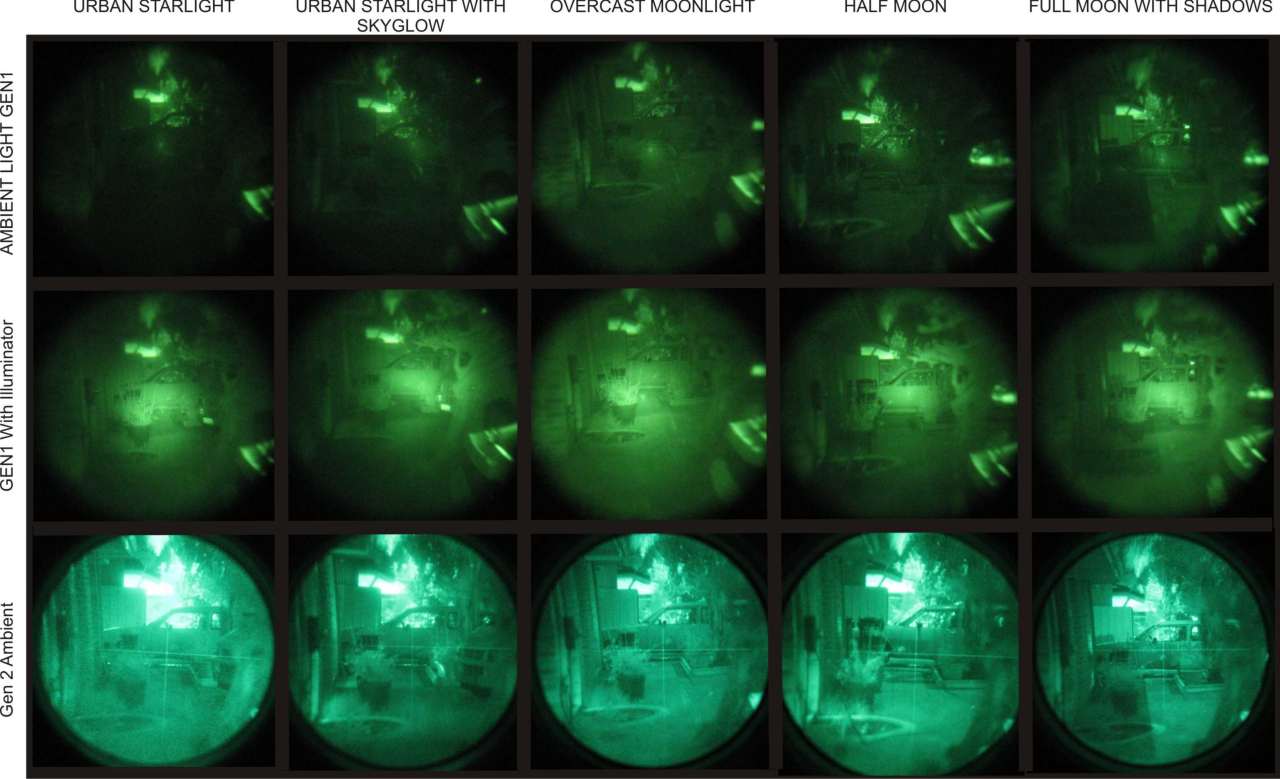
There are really only 2 types of Analog Night Vision to consider buying: Photonis (Improved Gen 2) and Gen 3 Night Vision. While there is much debate about which type of High end Night Vision is superior they are both going to be completely serviceable to the end user and out-perform other generations.

Types of NVG housing:
Monocular is going to be a single tube NVG and your cheapest type of high end Analog Night vision. The most common type of monocular is going to be the PVS-14. It has been the most commonly issued NVG for the US military and thus the cheapest and most readily available unit. They have a disadvantage of using 1 eye and can be disorienting due to the lack of depth perception, but with practice this can be overcome.
Binoculars are going to be at least twice as expensive as a PVS-14 for obvious reasons, but are the most popular type of NVGs by the majority of end users. While they do not offer much more of a field of view increase over a monocular, they offer depth perception and can make navigation and shooting at lot more "natural" and can often lesson eye fatigue allowing more extended wear. There are two types of Binocular Night Vision housings: Fixed bridge and Articulating. With fixed bridge NVGs, the tubes are unable to be moved independently and are marketed as more rugged and often slightly cheaper than articulated housings. Articulated housings allow the tubes to be able to swing out to the sides allowing the user the option of choosing which tube they want to look through at any given time.
Panoramic NVGs often use 4 tubes to increase the field of view 3X for the end user. However, they are exponentially more expensive than other NVGs and significantly heavier and bulkier than other options. They are often only used by Military for short term Urban combat missions or by LE SWAT teams or similar units.

Cost:
Generally speaking, Night vision is going to cost you around $3000 per tube or more. Deals can be made second hand especially if they are surplus models but there could be untold wear and tear on the unit and it could always potentially be stolen or have "fallen off the back of a military truck" and there are risks with owning a unit like that.
Additional Equipment:
Unfortunately, you will need additional equipment if you plan to use your night vision in any "tactical" capacity. You will need a helmet with some sort of NVG shroud. In addition to the helmet you will also need an NVG mount. The 2 most popular brands are Wilcox and Norotos. If you have a PVS-14 you will also need some sort of adaptor for your mount, and I always recommend getting the same brands for adaptor and mount. Lastly, one common accessory is some sort of aiming laser to mount to your weapon platform, preferably something with a IR flood light. It is also a good idea for have your optic on your weapon to be NVG capable with being on the lowest illumination setting or a dedicated NVG setting.
Again., this is something I quickly whipped up to get the thread rolling . If anyone has any other good Infographics or resources to add to the OP please feel free to shoot me a PM.
There are 3 common types of "Night Vision"; they are as follows:
1. Digital Night Vision most commonly seen in use with CCTV cameras and similar and although it is used by militaries often on vehicles it is not very practical for an individual to use. The bulk of personal use NVGs are a little more than toys and not practical at all. Though technology is rapidly increasing in this type of Night Vision.
2. Analog Night Vision is what most people would immediately think of as "Night Vision". This type of night vision amplifies ambient and near-infrared (IR) light into a visible spectrum orders of magnitude higher than can be seen with the naked eye. This type of night vison is the type most commonly used by military personnel all over the world.
3. Lastly, Thermal imaging (Thermals) are digital devices that can detect Infrared also know as heat and translates it into something visible for the end user. It is commonly used to defected the heat signatures of living organisms or the heat of a combustion engine. And, while it can be a powerful tool, it has its own short comings such as battery life and is not optimal in the use of personal navigation.
What to know before you buy:
Analog Night Vision is going to be the most practical type of NVGs for the average person and there are 3 generations of Analog NVG technology. Gen 1 was developed in the 60s and is often sold in cheap NVGs and is going to be practically useless and a waste of money due to how low quality and "dark" they are to use. Generation 2 was developed in the 70s and has increased light amplification over the pervious Generation but the clarity of the image left much to be desired. Generation 3 is currently the pinnacle of Analog Night Vision technology and has been in use by American armed forces and its allies for the past 3 decades.
There are really only 2 types of Analog Night Vision to consider buying: Photonis (Improved Gen 2) and Gen 3 Night Vision. While there is much debate about which type of High end Night Vision is superior they are both going to be completely serviceable to the end user and out-perform other generations.
Types of NVG housing:
Monocular is going to be a single tube NVG and your cheapest type of high end Analog Night vision. The most common type of monocular is going to be the PVS-14. It has been the most commonly issued NVG for the US military and thus the cheapest and most readily available unit. They have a disadvantage of using 1 eye and can be disorienting due to the lack of depth perception, but with practice this can be overcome.
Binoculars are going to be at least twice as expensive as a PVS-14 for obvious reasons, but are the most popular type of NVGs by the majority of end users. While they do not offer much more of a field of view increase over a monocular, they offer depth perception and can make navigation and shooting at lot more "natural" and can often lesson eye fatigue allowing more extended wear. There are two types of Binocular Night Vision housings: Fixed bridge and Articulating. With fixed bridge NVGs, the tubes are unable to be moved independently and are marketed as more rugged and often slightly cheaper than articulated housings. Articulated housings allow the tubes to be able to swing out to the sides allowing the user the option of choosing which tube they want to look through at any given time.
Panoramic NVGs often use 4 tubes to increase the field of view 3X for the end user. However, they are exponentially more expensive than other NVGs and significantly heavier and bulkier than other options. They are often only used by Military for short term Urban combat missions or by LE SWAT teams or similar units.
Cost:
Generally speaking, Night vision is going to cost you around $3000 per tube or more. Deals can be made second hand especially if they are surplus models but there could be untold wear and tear on the unit and it could always potentially be stolen or have "fallen off the back of a military truck" and there are risks with owning a unit like that.
Additional Equipment:
Unfortunately, you will need additional equipment if you plan to use your night vision in any "tactical" capacity. You will need a helmet with some sort of NVG shroud. In addition to the helmet you will also need an NVG mount. The 2 most popular brands are Wilcox and Norotos. If you have a PVS-14 you will also need some sort of adaptor for your mount, and I always recommend getting the same brands for adaptor and mount. Lastly, one common accessory is some sort of aiming laser to mount to your weapon platform, preferably something with a IR flood light. It is also a good idea for have your optic on your weapon to be NVG capable with being on the lowest illumination setting or a dedicated NVG setting.
Again., this is something I quickly whipped up to get the thread rolling . If anyone has any other good Infographics or resources to add to the OP please feel free to shoot me a PM.
Last edited:


