Eat The Bugs - Megathread - 🪱🪳🦗🪲

  • 🏰 The Fediverse is up. If you know, you know.
  • Want to keep track of this thread?
    Accounts can bookmark posts, watch threads for updates, and jump back to where you stopped reading.
    Create account
I think it's high time we create a separate thread just to throw in the unrelenting wave of articles, pushing for people to eat the bugs.

In the last few couple months, we've had articles like these:

Screenshot_20220130_152248.png


Screenshot_20220130_152649.png


You WILL eat ze bugs, goy.
 
I’ve noticed that restaurants have been quietly withdrawing their burger substitutes. They aren’t popular.
 
I'm seeing some new soyjak potential in this article's photos:


Insects find their way onto Italian plates despite resistance​

p0fzctr2.jpg
The BBC's Sofia Bettiza visits a cricket farm near Turin, Italy

By Sofia Bettiza
BBC News, Turin

In a small room near the Alps in northern Italy, containers filled with millions of crickets are stacked on top of each other.

Jumping and chirping loudly - these crickets are about to become food.

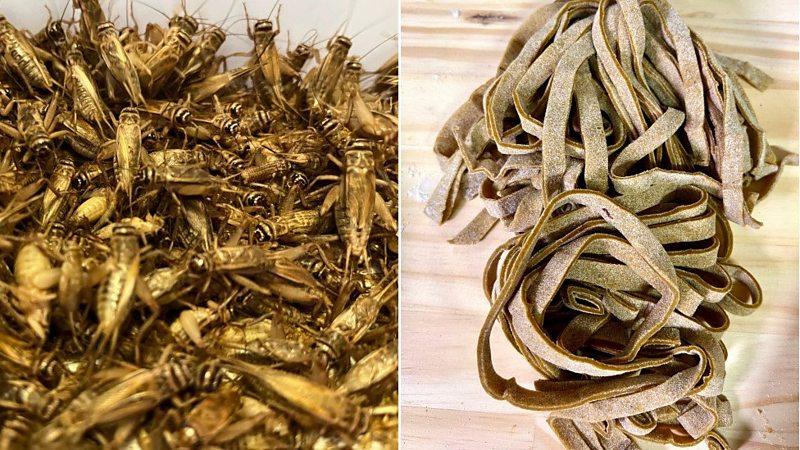
The process is simple: they are frozen, boiled, dried, and then pulverised.

Here at the Italian Cricket Farm, the biggest insect farm in the country, about one million crickets are turned into food ingredients every day.

Ivan Albano, who runs the farm, opens a container to reveal a light brown flour that can be used in the production of pasta, bread, pancakes, energy bars - and even sports drinks.

Eating crickets, ants and worms has been common in parts of the world like Asia for thousands of years.

Now, after the EU approved the sale of insects for human consumption earlier this year, will there be a shift in attitudes across Europe?

7016601a-f8f0-4fcc-9225-69968a0f1bb0.png
"What we do here is sustainable... the impact on the environment is almost zero"
Ivan Albano
Italian Cricket Farm

Well, nowhere in Europe is there more resistance to eating insects than in Italy, according to data from the global public opinion company YouGov, and the objections come right from the top - the government has already taken steps to ban their use in pizza and pasta production.

"We will oppose, by any means and in any place, this madness that would impoverish our agriculture and our culture," Deputy Prime Minister Matteo Salvini wrote on Facebook.

But is that all about to change? Several Italian producers have been perfecting cricket pasta, pizza and snacks.

"What we do here is very sustainable," says Ivan. "To produce one kilo of cricket powder, we only use about 12 litres of water," he adds, pointing out that producing the same quantity of protein from cows requires thousands of litres of water.

Farming insects also requires just a fraction of the land used to produce meat. Given the pollution caused by the meat and dairy industry, more and more scientists believe insects could be key to tackling climate change.

At a restaurant near Turin, chef Simone Loddo has adapted his fresh pasta recipe, which dates back nearly 1,000 years - the dough is now 15% cricket powder.

It emanates a strong, nutty smell.

Some of the diners refuse to try the cricket tagliatelle, but those who do - including me - are surprised at how good it tastes.

_130242567_09925a21-9467-4fe5-9a24-b496d5541ea4.jpg
Diners at the Turin restaurant that serves the insect pasta are trying cricket-based products out of curiosity

Aside from the taste, cricket powder is a superfood packed with vitamins, fibre, minerals and amino acids. One plate contains higher sources of iron and magnesium, for example, than a regular sirloin steak.

But is this a realistic option for those who want to eat less meat? The main issue is the price.

"If you want to buy cricket-based food, it's going to cost you," says Ivan. "Cricket flour is a luxury product. It costs about €60 (£52) per kilogram. If you take cricket pasta for example, one pack can cost up to €8."

That's up to eight times more than regular pasta at the supermarket.

For now, insect food remains a niche option in Western societies, as farmers can sell poultry and beef at lower prices.

_130309425_3ab0c156-3b78-408b-bc9b-f7e53f4aee0f.jpg
Cricket tagliatelle served with zucchini, zucchini cream, crispy bacon, parmesan and basil

"The meat I produce is much cheaper than cricket flour, and it's very good quality," says Claudio Lauteri, who owns a farm near Rome that's been in his family for four generations.

But it's not just about price. It's about social acceptance.

Across Italy, the number of people living to the age of 100 and beyond is rising fast. Many point to the Mediterranean diet as the Holy Grail for a healthy lifestyle.

"Italians have been eating meat for centuries. With moderation, it's definitely healthy," says Claudio.

He believes that insect food could be a threat to Italian culinary tradition - which is something universally sacred in this country.

"These products are garbage," he says. "We are not used to them, they are not part of the Mediterranean diet. And they could be a threat for people: we don't know what eating insects can do to our bodies.

"I'm absolutely against these new food products. I refuse to eat them."

_130242570_f697ec55-0f97-4a21-8b1e-2df995413212.jpg
Farmer Claudio Lauteri refuses to eat insect-based food and sees it as a threat to the Mediterranean diet

While insect farming is increasing in Europe, so too is hostility towards the idea.

The EU decision to approve insects for human consumption was described by a member of Italy's ruling far-right Brothers of Italy party as "bordering on madness".

Prime Minister Giorgia Meloni, who has referred to Italy as a "food superpower", created a Made in Italy ministry when she was elected, with the aim of safeguarding tradition.

"Insect products are arriving on supermarket shelves! Flour, larvae - good, delicious," she said in a tone of disgust in a video.

Amid concerns that insects might be associated with Italian cuisine, three government ministers announced four decrees aimed at a crackdown. "It's fundamental that these flours are not confused with food made in Italy," Francesco Lollobrigida, the agriculture minister, said.

_130242568_e8796889-274c-48a1-b21f-6aa3d14e5cd8.jpg
Chef Simone Loddo makes pasta using flour containing crickets to serve to customers at his restaurant near Turin

Insect food is not just dividing opinions in Italy.

In Poland, it has become a hot topic ahead of an election this year. In March, politicians from the two main parties accused each other of introducing policies that would force citizens to eat insects - the leader of the main opposition party, Donald Tusk, labelled the government a "promoter of worm soup".

Meanwhile, Austria, Belgium and the Netherlands are more receptive to eating insects. In Austria, they eat dried insects for aperitivo, and Belgians are open to eating mealworms in energy shakes and bars, burgers and soups.

"Unfortunately there's still a lot of misinformation about eating insects," says Daniel Scognamiglio, who runs the restaurant that serves the cricket tagliatelle.

"I have received hate, I have been criticised. Food tradition is sacred for many people. They don't want to change their eating habits."

But he has identified a shift, and says more people - often out of curiosity - are ordering cricket-based products from his menu.

With the global population now exceeding eight billion, there are fears that the planet's resources could struggle to meet the food needs of so many people.

Agricultural production worldwide will have to increase by 70%, according to estimates by the UN's Food and Agricultural Organisation.

Shifting to eco-friendly proteins - such as insects - might become a necessity.

Until now, the possibilities for producing and commercialising insect food had been limited. With the EU's approval, the expectation is that as the sector grows, the prices will decrease significantly.

Ivan says he already has a lot of requests for his products from restaurants and supermarkets.

"The impact on the environment is almost zero. We are a piece of the puzzle that could save the planet."
 
@The Mass Shooter Ron Soye

We've got an unstoppable force (bugmen's passion for Current Thing) meeting an immovable object (humans' primal concern about food purity). The aversion to eating insects is pretty intense. I realize, "some impoverished bush people love grubs" etc but when given the choice, almost everyone would choose a steak over deep fried crickets, and it isn't even close.

You can tell the "sustainable" line is horseshit, since that high price signals a large amount of capital, ie resources, being spent to produce this. Their only selling point is "12 litres of water per kilo of bug dust", they don't even pretend it's as nutritious as real food. But they always cherry pick these talking points- a factory full of crickets give nothing back to the environment, whereas a well managed herd of cattle turns water and sunlight into food for us and nourishment for the land. Proper rotational grazing has cattle build up plant health of the pasture by encouraging root growth and depositing nitrogen from their urine and manure.

As usual, the "problematic" parts of raising livestock comes from humans turning it into a factory, and concentrating the "waste products" which are only considered such because there's too much concentrated in one spot and natural processes are overwhelmed and can't process them.

From the grass-fed steer I get from my neighbour each year, I get: delicious beef to eat, obviously, but also organ meat for some hard-to-obtain nutrition, bones to make delicious stock, plus tallow for cooking and soapmaking. The only reason I don't use the hide is because I haven't started processing my own leather yet (it's on the list). Crickets offer NONE of these ancillary benefits, and require resource-intensive processing to make them minimally palatable.

As usual, Occam's Razor says our lizard people overlords just delight in humiliating us.

Physiognomy check: which of these two do you trust to provide healthy food to your family?
Delicious.JPG Mmmmbugs.JPG
 
Last edited:
Just throwing my take into the ring, but there's a reason that shows like I'm a Celebrity Get Me Out of Here, and all the various 'survival' ones, have eating insects as part of the gross, horror-filled challenges. It's not something that people want to do, and even with the promise of money, or other treats, its still difficult to do for the average person.
Also, meat substitutes are gross and I fall into the category of people who have an intolerence to soya and many of the 'beyond meat' type products. I tried a bit of one while ago and the results were less than pleasant, so no thanks, I'll stick to real meat which doesn't make me want to die on a toilet.
 
Crushing it up is dumb. You get full of chitin product.
Insects are loathed, and chitin is toxic and poses a serious allergy risk to anyone with shellfish allergies. None of them have complete protein. It just doesn’t make sense.
 
Insects are loathed, and chitin is toxic and poses a serious allergy risk to anyone with shellfish allergies. None of them have complete protein. It just doesn’t make sense.
Chitin is not toxic and has been part of human diet since humanity existed.
I just came back from a week of eating chitin heavy animals to preserve nature and all i can say is that Gumbo over a camp fire is fantastic.
For allergies, normal people dont have those and we shouldnt protect genetcal failures from nature.

The issue isnt that bugs are super bad, the issue is that they try to force them on us. I have no problem with having soyboys eating worms while i can have my schnitzel.
 
The water shit always pisses me off. They act like the water used to raise a cow is gone forever, instead of just passing through the animal and returning to the water cycle. Farms have been on the same land for decades, or longer, and they aren't running out of water. A large dairy farm probably ships 10,000,000 liters of milk a year, yet the wells don't run dry. Water is not a consumed resource.
 
The water shit always pisses me off. They act like the water used to raise a cow is gone forever, instead of just passing through the animal and returning to the water cycle. Farms have been on the same land for decades, or longer, and they aren't running out of water. A large dairy farm probably ships 10,000,000 liters of milk a year, yet the wells don't run dry. Water is not a consumed resource.
Yeah it's not a finite resource and is
renewed through the water cycle. Cows piss, people piss, and it all gets evaporated and comes back down to earth.

Not everyone lives in the desert so we don't have to worry about water. For dry coastal areas, they can use desalinization.
 
Chitin is not toxic
It actually is, over a long enough period, regardless of "genetic failure". Mammals don't produce chitin, while many parasites that infest mammals do, which means it won't ever be recognised as benign by mammalian immune systems. It stimulates an immune response every time you consume it or encounter it in sufficient quantities (such as by parasitic infection or exposure to an infested environment). Regular, long-term exposure to chitin inevitably results in an allergic reaction.
and has been part of human diet since humanity existed.
Insects have only ever been consumed as a dietary supplement, a delicacy, or as emergency food. Not as a staple. They can't be a staple because they are poor in nutrients and have a tendency to induce a potentially fatal immune response.

Shellfish and crustaceans, which you're referring to, are not consumed in the same way. While they have chitinous exoskeletons, the chitin itself isn't eaten except incidentally; you eat the meaty muscle. There are some of the toxic proteins present, which is why shellfish allergies exist, but they don't provoke the same immune response as insect chitin because they aren't consumed in remotely the same quantity.
 
Last edited:
These people who push bugs deserve an unusual punishment. I say tie them up and feed them chili peppers for breakfast, lunch and dinner and have their room full and saturated of black pepper dust.
 
Not to show my power level, but I'm religiously opposed to eating bugs because it'd effectively end a few thousand lives a year over the few deer I take and the livestock I buy at the local fair. How quickly they grow is irrelevant, even mealworms respond to pain.
 
Crushing it up is dumb. You get full of chitin product.
Insects are loathed, and chitin is toxic and poses a serious allergy risk to anyone with shellfish allergies. None of them have complete protein. It just doesn’t make sense.

From a nutritional standpoint, no it definitely does not make sense but when you consider that nutrition isn't the reason it's being pushed so hard then it does make sense.
 
i will note humans cant digest the chitin in our stomachs, though we do have gut bacteria that can and we would mostly rely on that as it gets through the body, but it still wouldnt be easily digestible. so its more of an insoluble fiber i guess? once again im still not opposed to the whole bug eating thing but it should just be an option not a full on replacement. they can make meat as expensive as they want it's still at least an option there
 
they can make meat as expensive as they want it's still at least an option there
Of course it’ll always be available, it’s just that you and 99% of other people will be priced out of it. I don’t understand why you think this is a good option.
 
Of course it’ll always be available, it’s just that you and 99% of other people will be priced out of it. I don’t understand why you think this is a good option.
it isnt, but as long as they still have meat on shelves in general, which they will, you'll still at least be able to have the option in general even if it's pricier. though i doubt they can stop people from fishing or hunting for wild game in general. youve to keep deer populations in check after all.
 
It actually is, over a long enough period, regardless of "genetic failure". Mammals don't produce chitin, while many parasites that infest mammals do, which means it won't ever be recognised as benign by mammalian immune systems. It stimulates an immune response every time you consume it or encounter it in sufficient quantities (such as by parasitic infection or exposure to an infested environment). Regular, long-term exposure to chitin inevitably results in an allergic reaction.

Insects have only ever been consumed as a dietary supplement, a delicacy, or as emergency food. Not as a staple. They can't be a staple because they are poor in nutrients and have a tendency to induce a potentially fatal immune response.

Shellfish and crustaceans, which you're referring to, are not consumed in the same way. While they have chitinous exoskeletons, the chitin itself isn't eaten except incidentally; you eat the meaty muscle. There are some of the toxic proteins present, which is why shellfish allergies exist, but they don't provoke the same immune response as insect chitin because they aren't consumed in remotely the same quantity.

Dats why you peel dem scrimps.

Have there been any real legit studies done on the risk of insects triggering shellfish allergies? If they pass out cricket burgers in school could some kid allergic to shellfish die?
 
Back
Top Bottom