Those were comic relief characters, it was supposed to be an absurd situation not something common.
40-year-old virgins are not common
now either. The point is adult virgin men are not a new concept. The fact that portrayals in pop culture were often comedic in nature is really irrelevant. Those comedy portrayals would fall flat if people hadn't met people like that day-to-day. Most people 20 years ago knew of someone --a coworker, a cousin or a friend of a friend-- who for whatever reason was unable to lose their virginity. That's what makes these portrayals funny.
As for the forever alone meme that was trendy mostly among middle school kids, if you were in your 20s and using that meme unironically it was cringe
There is absolutely a forever alone community consisting mainly of adult men on Reddit that started around 2010 and predates the term incel. It had tens of thousands of users even back then. You may have been a middle school kid who used the meme ironically back then, but there were adult men who it was quite real for and shared those memes as a coping mechanism. The Elliot Rodgers shooting itself was a decade ago now. This whole thing is not new.
No way in hell 20% of men between 18 and 30 were virgins in the mid 00's, given that radfem lunacy wasn't as prevalent as it is today those men would been far more vocal about their situation and media far more forgiving.
Let me correct myself. I was thinking of this chart showing the percentage of men 18-30 who haven't had sex in the last year. It is getting higher, and I would not disagree that it is a worrying trend, but you can see it's flirted with 20% at a couple points over the last 30 years, which I find people who often use it to push a certain narrative tend to ignore. This number has had peaks and valleys before. I don't think you can assume it's just going to keep going up into infinity.
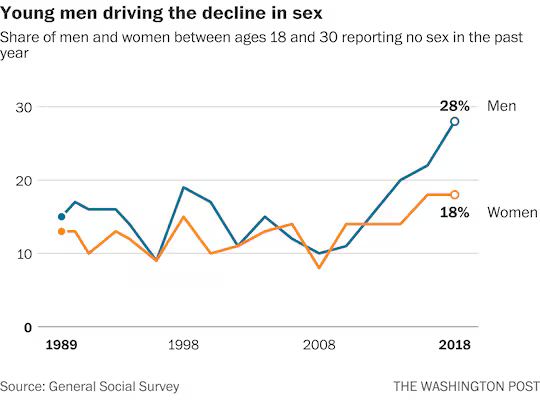
those men would been far more vocal about their situation and media far more forgiving.
I just want to point out that we were just talking about how adult virgin men were portrayed as comedic characters ripe for ridicule 20-30 years ago, and here you are saying the media would have been far more forgiving toward those men back then. No man, the idea that you think this is absolutely comical. Adult men who were virgins in the 2000s were treated like manbabies ala Buster Bluth on Arrested Development by their friends and families. We had a guy who was clearly a 30-year-old virgin who used to work on some of our electronic equipment at work back in those days and everyone regarded him with mild disdain. I think you're the one huffing compium if you think the society of 20-30 years ago would have been more forgiving to adult virgin men.
Not normal, anyone who says that age is normal is huffing concentrated copium.
You don't get to define what is normal; the statistics do. If the majority of men today are losing their virginity at 26, it absolutely is normal to lose your virginity at 26. It just wasn't normal 40 years ago.
This was my point about having children. It was normal to have kids in your early 20s 40 years ago, now it is more normal to have them at 30 or later. People's milestones are shifting to later in life.
I'm not pulling this out of my ass. There is data to support this. Check out this chart that shows a decline in people hitting several important milestones before the end of high school.
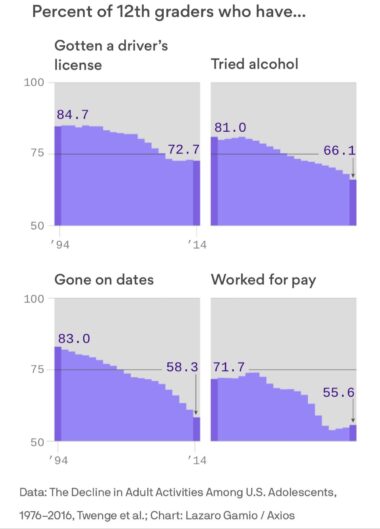
So the question is: is the same thing happening with young men losing their virginity?
Here's the often cited chart that is used in incel communities that shows 27% of males between 18-30 are virgins:
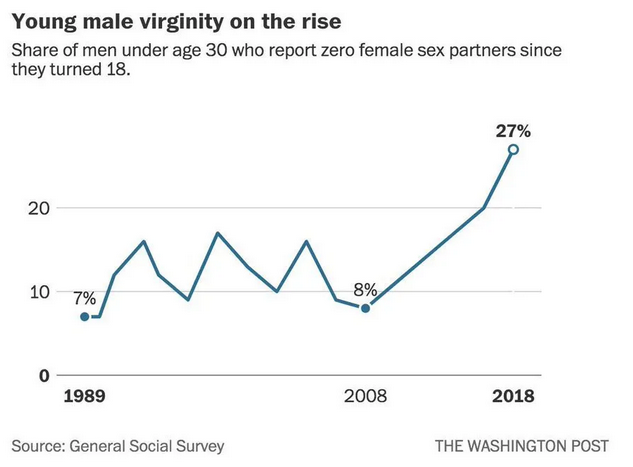
But the same dataset used to create that chart shows a steep drop off with men in their late 20s.
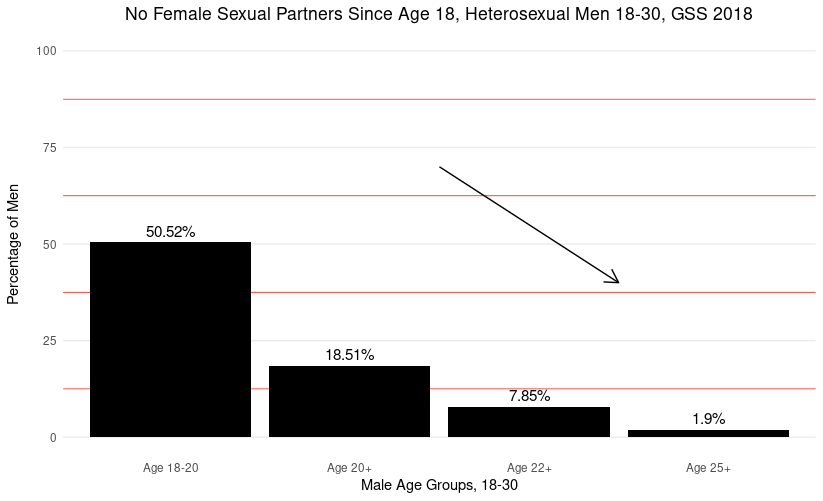
So by 25, less than 2% of men are virgins.
Here is another chart showing that huge spike in 18-19 year-olds who have not had sex since 18. It does show a rise in people in their early 20s who are virgins as well, but it is not as pronounced, and 24+ has been relativity flat with some slight variance up and down over the years. Note that the issue with this dataset is if someone had sex at 17, but wasn't able to have sex again by 22, they would be included in this number.
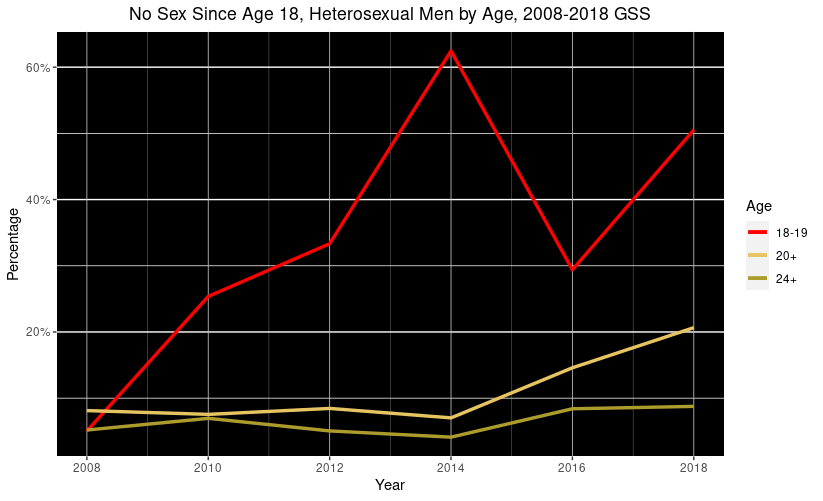
So while the data does show men are losing their virginity later, it also shows a very small number of men have not lost it at all by their late 20s.
Now again, I don't disagree it may be a problem. However, I do think it's less of a "Oh my god the house is on fire!" problem and more of a ,"We should probably fix that leaky pipe in the basement," problem.


