The Science Behind Long COVID, Visualized - Spoiler: It's just an infographic

  • 🏰 The Fediverse is up. If you know, you know.
  • Want to keep track of this thread?
    Accounts can bookmark posts, watch threads for updates, and jump back to where you stopped reading.
    Create account
Source: https://digg.com/coronavirus/link/the-science-behind-long-covid-visualized-QkAN7
Archive: https://archive.ph/bXNwL


The Science Behind Long COVID, Visualized​

Molly Bradley·1 hour ago·1.8k reads
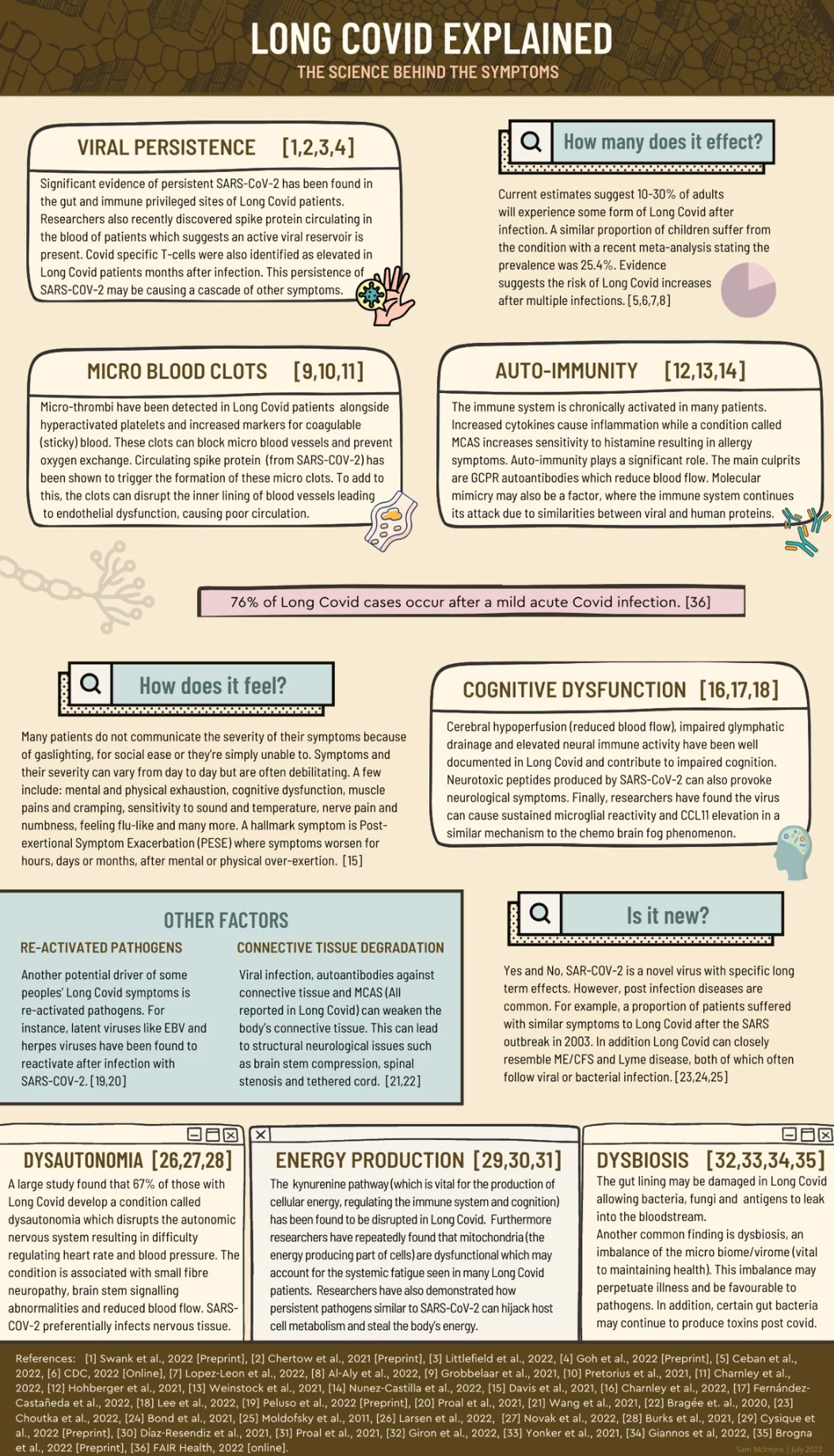
Sam McIntyre created an infographic to explain what we know so far about long COVID, from documented symptoms to factors that could contribute to it.

There's a lot we still don't know about long COVID — what causes it, why some people suffer from it and not others, and why affects the brain, nervous system, gut and more.
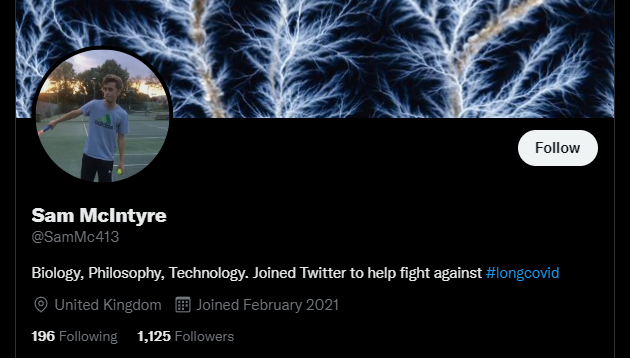
Sam McIntyre — @sammc413 on Twitter — created this infographic based on the research available so far after he himself struggled with long COVID. (Click the image to enlarge it.)
1657738441978.png

Key details:
  • 10–30 percent of adults will experience some form of long COVID after infection. For children, a recent meta-analysis suggested a prevalence of 25.4 percent.
  • Evidence suggests multiple infections can increase an individual's risk of long COVID.
  • Seventy-six percent of cases of long COVID happen after a mild COVID infection.
  • A common and persistent sympton of long COVID is cognitive impairment. A few factors that contribute to this have been identified: reduced bloodflow and elevated neural immune activity can affect cognition, and there are a series of symptoms (sustained microglial reactivity and CCL11 elevation) that create an effect similar to what chemo patients experience that we call "brain fog."

Via Sam McIntyre/Twitter.


The creator:
1657738720555.png
Tweet responses:
1657738780390.png


*Clicks speakerphone* @Drain Todger to the thread please, @Drain Todger to the thread. Thank you.
 
  • A common and persistent sympton of long COVID is cognitive impairment. A few factors that contribute to this have been identified: reduced bloodflow and elevated neural immune activity can affect cognition, and there are a series of symptoms (sustained microglial reactivity and CCL11 elevation) that create an effect similar to what chemo patients experience that we call "brain fog."

Did they check if the people werent retards before?
 
1) The only people that get "Long Covid" are people who are hardcore scared of Covid. Long Covid never happens to anyone except for the people who are coincidentially most obsessed with/afraid of Covid

2) The symtoms they describe for "Long Covid" are consistent with depression, hypochondria, anxiety, and other mental disorders.

Long Covid isn't real and anyone trying to meme it into reality is a retard. As I just said, the only basis for it even existing are symptoms that are consistent with various anxiety disorders, appearing in demographics that are (often by their own admission) prone to Covid-related anxiety.
 
I hadn't heard of Long Covid until about a month ago, but my wife got the coof in January and she still has occasional bouts of coughing. Really no clue if it's covid-related or because of the base-dose of vaccine, but I didn't catch it somehow and I haven't had any issues.

The neurological problems seem weird and interesting though. I've heard people use the "brain fog" thing as an excuse for stuff after having covid but I didn't believe it too much.
 
1) The only people that get "Long Covid" are people who are hardcore scared of Covid. Long Covid never happens to anyone except for the people who are coincidentially most obsessed with/afraid of Covid

2) The symtoms they describe for "Long Covid" are consistent with depression, hypochondria, anxiety, and other mental disorders.

Long Covid isn't real and anyone trying to meme it into reality is a retard. As I just said, the only basis for it even existing are symptoms that are consistent with various anxiety disorders, appearing in demographics that are (often by their own admission) prone to Covid-related anxiety.
According to published papers on the matter, Long COVID is very real. They also call it PASC, or Post-Acute Sequelae of COVID-19.


Potential contributors to PASC symptoms include consequences from acute SARS-CoV-2 injury to one or multiple organs, persistent reservoirs of SARS-CoV-2 in certain tissues, re-activation of neurotrophic pathogens such as herpesviruses under conditions of COVID-19 immune dysregulation, SARS-CoV-2 interactions with host microbiome/virome communities, clotting/coagulation issues, dysfunctional brainstem/vagus nerve signaling, ongoing activity of primed immune cells, and autoimmunity due to molecular mimicry between pathogen and host proteins. The individualized nature of PASC symptoms suggests that different therapeutic approaches may be required to best manage care for specific patients with the diagnosis.

Let's review every one of those claims in that infographic. Viral persistence in the gut and alterations to the gut microbiome? Yes.


Micro-clotting? Yes. In fact, Spike is amyloidogenic and the micro-clots may be amyloid fibrin clots.


Autoimmunity? Yes, certainly.


Persistent cognitive dysfunction and microglial activation in the brain? Yes, absolutely.


Reactivation of latent infections? Yes.


Dysautonomia? Yes.


Alterations to metabolism and energy levels? Yes.


Basically everything in that infographic is correct, from the perspective of published and peer-reviewed articles.
 
According to published papers on the matter, Long COVID is very real. They also call it PASC, or Post-Acute Sequelae of COVID-19.


Let's review every one of those claims in that infographic. Viral persistence in the gut and alterations to the gut microbiome? Yes.


Micro-clotting? Yes. In fact, Spike is amyloidogenic and the micro-clots may be amyloid fibrin clots.


Autoimmunity? Yes, certainly.


Persistent cognitive dysfunction and microglial activation in the brain? Yes, absolutely.


Reactivation of latent infections? Yes.


Dysautonomia? Yes.


Alterations to metabolism and energy levels? Yes.


Basically everything in that infographic is correct, from the perspective of published and peer-reviewed articles.

The microclot theory is interesting. My guess is that the covid spike protein is both highly inflammatory but also attracts platelets, so you have bits of spike protein floating around and spreading inflammation everywhere, but they can't be broken up due to the platelet clot around themselves. If that is the case, I would add a low-dose of aspirin to covid treatment regimens, maybe also a vitamin D and methylated B vitamin combo for good measure.

Of course, I also still think there's a significant psychosomatic component too.
 
The microclot theory is interesting. My guess is that the covid spike protein is both highly inflammatory but also attracts platelets, so you have bits of spike protein floating around and spreading inflammation everywhere, but they can't be broken up due to the platelet clot around themselves. If that is the case, I would add a low-dose of aspirin to covid treatment regimens, maybe also a vitamin D and methylated B vitamin combo for good measure.

Of course, I also still think there's a significant psychosomatic component too.
COVID-19 causes blood clots in a wide variety of ways. Basically all acutely-ill COVID-19 patients have alterations to D-dimer levels and prothrombin time:


The ACE2 proteins the Spike binds to are found primarily in vascular ECs and pericytes, which leads to the virus causing a vascular endotheliitis as it infects those cells:


This leads to endothelial cell activation and sloughing, endothelial dysfunction, elevated clotting factors like vWF, etc.


Not to mention, SARS-CoV-2 Spike itself gets chopped up by neutrophil elastase, and all those individual pieces can act as nuclei for amyloid fibrils, which can lead to amyloid-based clotting.


I discussed this face-to-face with a nurse on my commute over a year ago. He described a severely ill COVID-19 patient who needed both of her legs to be amputated from the knees down due to blood clots induced by the virus.

COVID-19 coagulopathy can, occasionally, be very serious. I definitely recommend people take aspirin for 6 months after recovery from the virus, if they can. Or nattokinase, or serrapeptase. Something to thin the blood a bit.
 
Back
Top Bottom