How nice of them to give you the permission to set the game before Finland was occupied by Russia in 1809. I agree, it's lazy and I blame the aversion of historians in the last few decades to attempts at putting together a coherent history of anything.
Norway and Sweden being in a personal union for most of the 19th century is another one of those details you shouldn't get hung up on, after all. Only Norwegians would try to claim Norway is in any way distinct from Sweden. Though if I had any actual social justice clout, I'd try to get the devs cancelled for Swedish imperialism.
See that is exactly the sort of information that would help me make the world come alive. There's the odd reference in adventures or text to things like "it could be Norwegian militants seeking independence" but I've no context for it and with the timeline so vague I don't know where to fit it. Bolting on information later in a campaign tends to damage suspension of disbelief. "So Finland is occupied by Russians? Why didn't that come up during our adventure in Finland? Was it a problem that our characters are all Swedish?"
You can pull a lot of this stuff from Wikipedia but the point of a book is that you don't have to that it also curates and draws out the interesting parts and weaves them into a coherent theme.
Also, in classic Free League style, look how much whitespace the pages have? There is lots of space for more information. Just an extra week of writing could have made the product far better with more historical information.

I'm kind of glad that I sperged out about this product now. Feels good to vent. The issue isn't so much that it is bad, but that it is disappointing. Bad products hurt less than "could have been good" products. A Folk Horror game has a lot of potential but this definitely needed more time in the oven and, for me, less of a "it doesn't matter, do what you want" approach. I know I can do what I want. But I could dispense with the entire book in that case - I'm buying it because I want to not make everything up.
Reading through Vaesen I couldn't help but recall TSR's old "For Faerie, Queen and Country" book for their Amazing Engine.
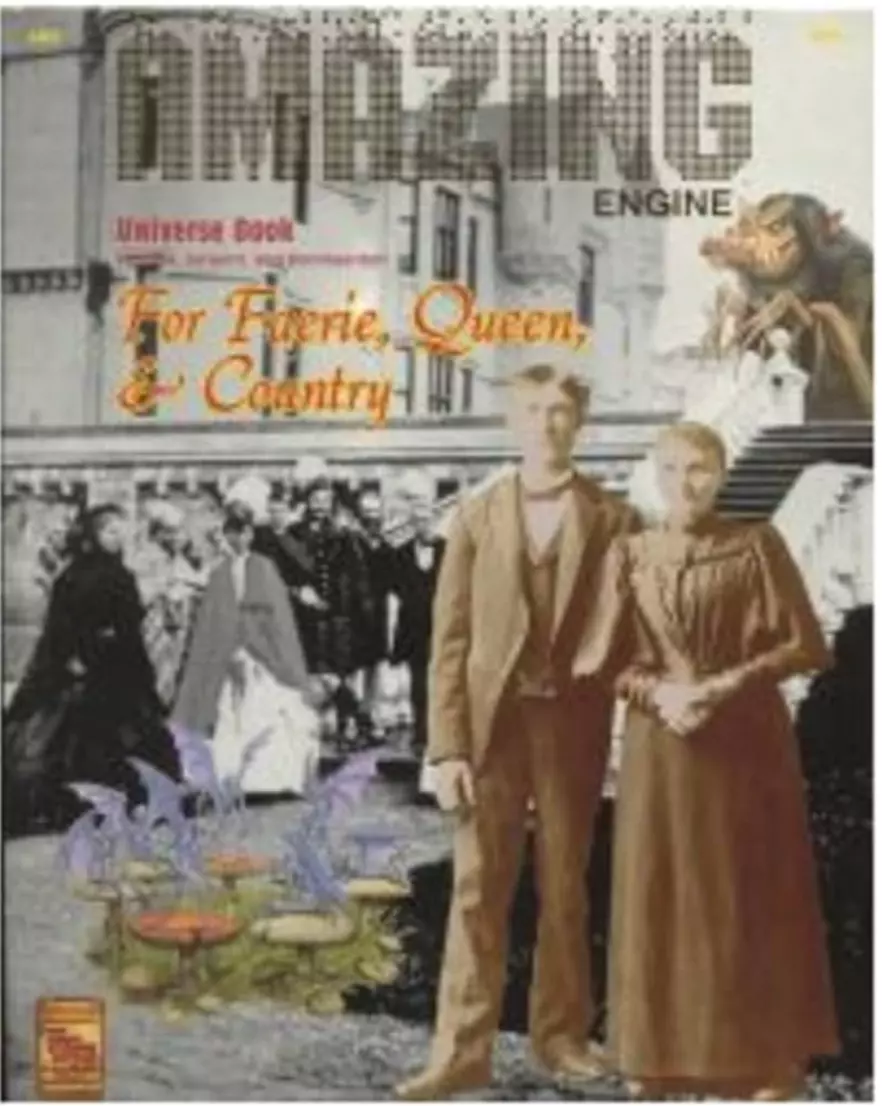
Amazing Engine was an early attempt at a multi-setting generic rules system. But it actually went beyond that in that your base character could be played in the different settings and XP gained in one would apply to others. Each setting had a small translation formula for implementing your character in each setting and they had a few others in the line though I don't think it really took off.
For Faerie, Queen and Country was a shockingly rich setting for a single supplement book with a surprisingly effective and flavourful magic system too. It was far ahead of its time.
I came across reviews of this when looking into free league stuff, and I have a dumb question none of them have answered.
Are the players meant to read the Monster Manual?
No. The Vaesen themselves are in the GM section of the book.
A YouTuber I like reviewed a bunch of a the adventures, and each of them seem to follow a similar format. As the players investigate, they learn the monster looks like A, has ability B, is targeting Cs. Therefore, it must be entity X, and we can defeat it by doing ritual Y.
Some even seemed designed to make you think it's entity X, but is actually entity Z behaving in an unusual manner due to plot.
The jump from ABC > X > Y seems to require knowledge of all the different Vaesen that players don't normally have. But I struggle to think how they get there without some heavy handed GMing.
Well the Vaesen are all creatures from myth so firstly the players and PCs will probably have some idea what a mermaid or a ghost is. Secondly, they're supposed to be investigating so they might learn things from books, from Old Olaf whose father once dealt with the troll in question. And GMs are encouraged to mix things up with each Vaesen listing variants and suggestions of different "secrets" (semi-game term in the book for the way a vaesen is disposed of).
And often you need to understand
why the Vaesen is behaving the way it is. Maybe a new foresting operation has riled the Wood Wife who lives there or felled the sacred ash tree that some pixies made their home. Knowing what a pixie is wont solve the problem (though it will help).
There's good stuff in the game. Hence the curse of "what might have been".
I'm in the minority here, but I hate that. Homebrew or published setting, doesn't matter. I don't care about your 1000 years of kings and rebellion and whatever the fuck unless it has a direct baring on the game. If there has been 1000 years of elves and dwarves fighting back and forth across the land, then just say so. I doubt it makes much difference if the dwarves took the castle in 759 or 762.
For something like Vaesen in a modern and real history in a time of significant change, a timeline helps. In The One Ring, it also really helps. You really want to know if an adventure is taking place before, during or after Balin's attempt to recapture Moria or something. It makes the world that much more real when the dwarfs you meet on the road aren't just dwarfs on the road but are on it heading East because they're answering Balin's call for people to join his quest to reclaim the mines. Makes the whole world come alive.
And it's rare that I think a decent timeline doesn't help. Even for my fantasy game I spent a little time working out the history of the world and putting some dates on things. Then when the party went to investigate some ruins they weren't just "generic ruins" but were from 700 years ago and you could see the symbol of the Old Kings carved onto keystone of the arch. The dragon boasting of his hoard says "Now this piece... made by the elves of Faranath, slaughtered by Men, these three-hundred years past. Its like never to be made again."
You can improvise a bunch on the fly but having a framework of this stuff helps it be all so much more coherent and deep. And it informs plots. Why does the sorcerer bare the symbol of those Old Kings? The elven prince hates the king because it was his line that slaughtered the elves of Faranath... Etc.
Rarely if ever does a good timeline feel restrictive. In fact the only time I recall it doing so is ironically in another Free League product - Aliens. You've got this long timeline and then a tonne of key events all squashed together in this narrow space of a few years.
A timeline helps put ancient things in different places in the game world. So in my ACKs campaign I know the dwarven mine is X years old, the magic artifact Y, the aqueduct Z. Older factions are "institutionalized" and newer factions are marginalized. The problems come when you have a lore dump. Lore is mostly there for the GM to make the world feel real. The founding of a great house should only be something monks, scholars, and the current heads of those houses would know. It isn't as necessary as the broad strokes, but it makes the world feel more real.
Very much this!


