KR North Korea Megathread - Dear Leader and his shenanigans

  • 🏰 The Fediverse is up. If you know, you know.
  • Want to keep track of this thread?
    Accounts can bookmark posts, watch threads for updates, and jump back to where you stopped reading.
    Create account
MOD NOTE:

c6611a9f49.jpg

There's so much news about North Korea right now and what Un is doing, I got a suggestion for a NK megathread, so here it is. Post the world's greatest nation's antics here. I'm merging a few of the more recent threads to continue discussion.


ORIGINAL POST:
--------------------------


https://www.yahoo.com/finance/news/south-korea-planning-war-decapitation-132232777.html

South Korean President Moon Jae-in has pushed for a new plan for a rapid war with North Korea and an overhaul of the country's defense industry to overwhelm and crush the North's government, the South Korean newspaper The Chosun Ilbo reported Tuesday.

Moon took office in May promising to attempt to engage diplomatically with North Korea and seek peace, but in the months since, the North has provoked the international community with missile tests at a blistering pace.

For some time, South Korea has been training a "decapitation force," reportedly with the help of the US Navy's SEAL Team 6, but now an increasingly bold North Korea may demand quicker action.

South Korea's new plan identifies more than 1,000 targets for precision missile fires and sites for marines to drop in and quickly kill North Korean leader Kim Jong Un, the paper reported.

The plan represents a more independent version of South Korea's current plan, which relies on support from US aircraft carriers. As it stands, no major military commander recommends military action against North Korea, which has a staggering array of conventional — and potentially nuclear — weapons pointed at Seoul, where 26 million call home.

But South Korea's new plan to quickly and decisively dominate the North relies on reforming the defense-acquisition process and cutting out wasteful spending to wield the full might of its economic dominance against Pyongyang, according to the report. For that reason, don't expect the plan to take effect anytime soon.
 
Last edited by a moderator:
It was probably real simple. North Korea is getting to the point of use it or lose it in terms of oil and their war machine, and were making open points about how they might just use it. Ironically, a well supplied North Korea is probably less dangerous and less likely to launch a full scale attack. And at this point, it wouldn't matter anyways, since conventionally, the South Koreans would crush them.
 
It was probably real simple. North Korea is getting to the point of use it or lose it in terms of oil and their war machine, and were making open points about how they might just use it. Ironically, a well supplied North Korea is probably less dangerous and less likely to launch a full scale attack. And at this point, it wouldn't matter anyways, since conventionally, the South Koreans would crush them.
Not after a good amount of casualties, mind you. There's still the matter of those artillery batteries lining the boarder between both countries.
 
While I applaud their actions to finally hit Kimmy with a shitton of sanctions, the cycnic in me assumes that this mainly means they will sell stuff secretly for a hugely inflated price.
:story:

According to german news radio, the Worst Koreans currently have a chinese ship in custody that apprently was used for one such transfer... and the oil it delivered was from Tokyo, so I assume Abe Shinzo and his cronies will be pissed.

China announced that they would "punish the ones that are guilty" basically pretending that this is just a group of rogue companies that betray the sanctions.
 
The Chinese only just started to apply sanctions, specifically buying Nork coal, that have been in place for years, if not decades. Good on the ROK navy for nabbing one of the oil ships.
 
imagine nk launches the nuke at a sec before midnight on new years, both ending and starting the new year with a bang
 
Not after a good amount of casualties, mind you. There's still the matter of those artillery batteries lining the boarder between both countries.
Eh... The ROK has thousands of modern K9s, K55A1s, and MLRS directed by Q-36/37 and ARTHUR-K firefinder radars. They have a massive technological advantage and can precisely deliver nearly every shot. The Norks will just be blindly shelling pre-targeted grid squares and hoping they hit something valuable. Those Nork artillery pieces that survive counter-battery fire are pretty much SOL on getting resupplied as the road and rail network north of the DMZ is going to be crippled by air power and SSMs. That rugged mountain terrain makes for some nasty transportation bottlenecks. Resupply, let alone follow-on waves, is not going to be feasible.

To summarize, the initial barrage is going to suck but it will all fairly quickly settle into a pretty one-sided ass-kicking with the US/ROK wearing the boots as the north does not have the technology to gain the upper hand nor the logistic capability to supply their forces for any length of time.
 
To summarize, the initial barrage is going to suck
The whole reason that nobody wants to actually start anything is because that initial barrage will suck. There's no doubt Best Korea would get totally flattened, but they're taking a bunch of South Korean civilians with them.
 
The whole reason that nobody wants to actually start anything is because that initial barrage will suck. There's no doubt Best Korea would get totally flattened, but they're taking a bunch of South Korean civilians with them.
The Norks have ~500 170mm Koksan guns and around the same number of 240mm rocket launchers. These are the only pieces the DPRK has that can hit Seoul. The northern outskirts of Seoul, btw, not the whole thing. But not all are placed on that part of the DMZ and you have those that are down for maintenance and there are those that are going to be held in reserve. We are looking at around 300-400 pieces actively engaging in a wartime scenario and attrition (especially of the rocket launchers that cannot fire from inside hardened shelters) and resupply issues are going to hamper their effectiveness.

If the folks in northern Seoul have taken proper civil defense measures, as they assuredly have, they should be alright for the most part. There will probably be many more dead DPRK artillerymen than Seoul civilians when it is over with.
 
Last edited:
And because he's suffering from bi-polar tendencies now (must be all that cheese, wine and radiation), is trying to get his South Korean neighbors to talk about the Olympics and diplomacy may or may not also be talked about.
http://www.bbc.com/news/world-asia-42545285
iirc DPRK has always been kinda schizo on "yeah you're all imperialist running dog lackeys who will be ground into dust like the pigs you are, but we're still on for the international sports meet next week right?"
 
iirc DPRK has always been kinda schizo on "yeah you're all imperialist running dog lackeys who will be ground into dust like the pigs you are, but we're still on for the international sports meet next week right?"
They really need to decide what they want to be.

That way it makes it easier to know whether we should definitively go to war with them or not.
 
Last edited:
The crazy fat boy hacked bitcoin

BITCOIN's rocketing value has transformed the cryptocurrency into a perfect target for North Korea as economic pressure weighs down the rogue nation.
By AURORA BOSOTTI
22:09, Tue, Jan 2, 2018 | UPDATED: 22:14, Tue, Jan 2, 2018

Edwin Chan: North Korea hackers are mining cryptocurrencies


Bitcoin has seen a 1,514 percent rise in value during 2017, trading at $963 in January 2017 and currently worth $14,968.43, according to Coindesk.com, on January 2, at 7.20pm GMT.

North Korea has been struggling under economic uncertainty after the United Nations unleashed a series of new sanctions to clamp down fears of World War 3, following ignored calls to end Pyongyang’s nuclear development programme.

Currency analysts have suggested North Korea could now be using cryptocurrency bitcoin to support its weapons development programme since cash flow to the country was cut off.

bitcoin-value-price-cryptocurrency-bitcoin-stock-north-korea-world-war-3-899289.jpg
GETTY

Bitcoin warning: North Korea linked to hacking exchanges to fuel nuclear programme
Bloomberg's Asia Technology editor Edwin Chan said bitcoin's digital nature made the cryptocurrency "more easily laundered," thus helping North Korea store hard cash to fuel its weapons programme.

Mr Chan said: "Cryptocurrencies are more easily laundered. And also the North Koreans are increasingly using third-party service systems to do the mining for them and the reason for doing that is because it’s an expensive process.

"North Koreans have been linked to attacks on cryptocurrency exchanges. We understand they do mining of their own but North Korea denies all such reports.

"However, Pyongyang needs high currency to fund its nuclear weapons development programme, allegedly."

But cybersecurity expert Luke McNamara said his company had noticed hackers previously linked to espionage activities for the North Korean government take a sudden interest in bitcoin early in the year.


Waltz on North Korea: Naval blockade must be considered


Pyongyang needs high currency to fund its nuclear weapons development programme

Edwin Chan

Mr McNamara said: "The fact that it has appreciated so much in value this year means that it’s attracting a lot of interest from various cybercriminals.

"We have noticed North Korean hackers actually pivot to start going after places like cryptocurrency exchanges in South Korea."

Officials in Seoul say they are keeping tabs on North Korea’s bitcoin-related activities, which analysts warn are being used to subvert international sanctions.

North Korea leader Kim Jong-un has warned a "nuclear button is always on my desk" as he threatened the US during his New Year's address in Pyongyang.

But he also appeared to extend an olive branch to neighbouring Seoul, suggesting Pyongyang could ultimately send a team to the Winter Olympics scheduled to take place in Pyeongchang in February 2018.
 
Somehow, this does not surprise me in the slightest.

And neither does him trying to fire off a record-shattering rocket on the country's 70th birthday:
http://www.defenseworld.net/news/21...____Largest_Missile_Ever____In_September_2018

And because I'm not in the mood to double post, turns out the first target of North Korea... was North Korea:
https://gizmodo.com/north-korea-accidentally-hit-its-own-city-during-missil-1821747406
 
Last edited:
https://gizmodo.com/north-korea-accidentally-hit-its-own-city-during-missil-1821747406

https://thediplomat.com/2018/01/when-a-north-korean-missile-accidentally-hit-a-north-korean-city/

North Korea conducted a missile test on April 28, 2017 that didn’t go quite as planned. In fact, we’re now learning that the Hwasong-12 missile that the country launched actually went astray and may have hit the North Korean city of Tokchon.

A Kookaburra 'Laughing' in Slow Motion is Your New Nightmare Fuel
12/27/2017
The Diplomat reports that a US government source with knowledge of the launch says the missile failed after just a single minute of airtime. It’s believed that the test missile hit some agricultural or industrial buildings and it’s not clear if there were any casualties associated with the mishap. The structural damage was independently confirmed by The Diplomat using publicly available satellite photos.


As The Diplomat notes, this particular missile launch didn’t get much attention in the US press at the time because all we really knew about it was the fact that it failed. The revelation that the missile hit an unintended target raises new questions about the possibility that North Korea could accidentally start a nuclear war if an errant missile were to hit a country like Japan or South Korea.

Liquid fuel missiles like the one that failed in April 2017 can cause large explosions, even without a warhead, when the hypergolic propellant and oxidizer mix on impact. But the true damage done to buildings is a guess at best given available satellite data.

The month of April 2017, the time of the failed missile test, was an already incredibly tense period for US-North Korea relations. President Trump said that he was “sending an armada” to the region, which turned out to be a lie. And while North Korea hadn’t successfully demonstrated an ICBM yet (that would happen later that summer with the Hwasong-14) there was a lot of heated rhetoric on both sides.


The US ambassador to the UN, Nikki Haley even explained in April that the US would conduct a military strike against North Korea if it tested an ICBM. Haley said, “if you see [Kim Jong-un] attack a military base, if you see some sort of intercontinental ballistic missile, then obviously we’re going to do that.”

That turned out to be an empty threat as well. North Korea launched its first ICBM back in July and the US did nothing but impose more sanctions. But the outlandish rhetoric continues on both sides, as President Trump and Kim Jong Un most recently compared the size of the buttons on their desks.

Experts warn that North Korea’s success with missile tests over the past two years is due largely to Kim Jong Un’s uncharacteristically cool acceptance of failure. Dictators get upset when things are done exactly as they like, but Kim understands that you’re going to have some duds when you’re working with rocket science. And that’s what makes the situation even more terrifying.


Experts on nuclear weapons continue to warn that this isn’t a game and that we’re facing some very real dangers in the months ahead. With any luck, both President Trump and Kim Jong-un will cool down their war of words and not start World War III, accidentally or otherwise. Do you feel lucky?

What happens when a North Korean ballistic missile test fails in flight and explodes in a populated area? On April 28, 2017, North Korea launched a single Hwasong-12/KN17 intermediate-range ballistic missile (IRBM) from Pukchang Airfield in South Pyongan Province (the Korean People’s Army’s Air and Anti-Air Force Unit 447 in Ryongak-dong, Sunchon City, to be more precise). That missile failed shortly after launch and crashed in the Chongsin-dong, in North Korean city of Tokchon, causing considerable damage to a complex of industrial or agricultural buildings.

According to a U.S. government source with knowledge of North Korea’s weapons programs who spoke to The Diplomat, the missile’s first stage engines failed after approximately one minute of powered flight, resulting in catastrophic failure. The missile never flew higher than approximately 70 kilometers. The location of the missile’s eventual impact was revealed exclusively to The Diplomat and evidence of the incident can be independently corroborated in commercially available satellite imagery from April and May 2017.

The April 28 failure merits close analysis, especially as North Korea continues to carry out flight-testing of its various ballistic missile platforms from a range of new test sites. In 2017, North Korea has introduced new sites for missile testing, arguably to demonstrate the flexibility of its Strategic Rocket Force. It has even carried out ballistic missile launches from a restricted area at Pyongyang’s Sunan Airport, which also serves as the country’s primary civil aviation facility and the entrypoint for most non-Chinese foreign visitors to North Korea. The potential for similar accidents occurring over Pyongyang, the country’s capital, or other populated regions remains high, especially with untested systems.

Enjoying this article? Click here to subscribe for full access. Just $5 a month.
These risks may even serve to explain why North Korea chose to use the seaside town of Sinpo as its initial test site for the first two failed Hwasong-12 launches in April. An early in-flight failure over the sea would have a lower chance of striking any human infrastructure — certainly populated urban areas. However, since April, North Korea has not carried out any further ballistic missile testing from Sinpo (with the exception of four submarine-launched ballistic missile ejection tests).

Anatomy of a Failed Hwasong-12 Launch

In April, most reports of the circumstances of this launch were sparse, noting only that North Korea launched a single missile that failed in flight. U.S. Pacific Command stated that the missile was launched from “near” Pukchang Airfield, a previously unused launch site for North Korean ballistic missile testing. As The Diplomat first reported in June, contrary to other reports at the time, the three missiles tested in April were not anti-ship ballistic missiles, but a new type of intermediate-range ballistic missile.

The April 28 test, in fact, was the third attempted flight-test of this new missile. The Hwasong-12, it would later emerge, was the fundamental building block for the Hwasong-14/KN20 intercontinental-range ballistic missile (ICBM) revealed later in the year. Despite the three failures in April, the Hwasong-12 would see its first successful flight-test just weeks later on May 14. (The Hwasong-12 and -14 family of missiles emerged from the so-called “March 18 revolution” engine, which was first tested on that day in 2017; the single thrust-chamber engine is used to power the first stage of both missiles.)

Later in the year, the North Korean regime provided more evidence regarding these April launches. At a concert held in July to celebrate the country’s first-ever successful test launch of the Hwasong-14 ICBM, North Korea showed an extensive slideshow detailing a history of the country’s ballistic missile program, with imagery dating back to Kim Il-sung — current North Korean Supreme Leader Kim Jong-un’s grandfather and the founder of North Korea — inspecting early Scud short-range ballistic missiles (SRBMs). (Those images have been cropped from the concert video and archived here.)

Toward the end of the slideshow, which was mostly shown in chronological order, the North Koreans helpfully included photographic evidence of Kim Jong-un inspecting all three of the failed April Hwasong-12 launches, including the April 28 launch out of Pukchang Airfield. These photographs are composed in a manner similar to the images North Korea publicly releases through its state media after successful launches; had the launches succeeded, it is likely that we would have seen these images in Rodong Sinmun immediately afterward.


Images from ICBM celebration concert showing the Hwasong-12 launch from Pukchang Airfield.

Using the images of the April 28 test from the Hwasong-14 ICBM celebration concert, we were able to geolocate one of the scenes to the southeastern entrance of of the underground hangar at the Pukchang Airfield. The scene above shows Kim Jong-un inspecting the new IRBM in an underground hangar (1), images of the launch and Kim Jong-un at his viewing position (2), and an image taken right outside of the underground hangar (3).


Geolocation analysis of Kim Jong-un at the Pukchang Airfield prior to the April 28 launch. Source: KCTV, Google Earth

In image 3 (above), we can see 4 of the 5 hangars that were added to the site sometime after July 2016, as Kim Jong-un is sitting in front of the entrance to the southeast underground hangar with the earth wall and mound feature present.

thediplomat-image5-790x475.png

Distance from Pukchang Airfield to the impact point in Tokchon. Source: Google Earth

From an area near the Pukchang Airfield, the missile flew approximately 39 km to the northeast where it struck a complex in the small city of Tokchon seen below. Had it completed its flight successfully, the missile may have been designed to land in the northern reaches of the Sea of Japan, near the Russian coast. North Korea used a similar splashdown location for its first successful Hwasong-12 flight-test in May 2017. (The launch, however, took place from Kusong, not Pukchang.)


Close-up imagery analysis of the impact point at Tokchon. Source: Google Earth

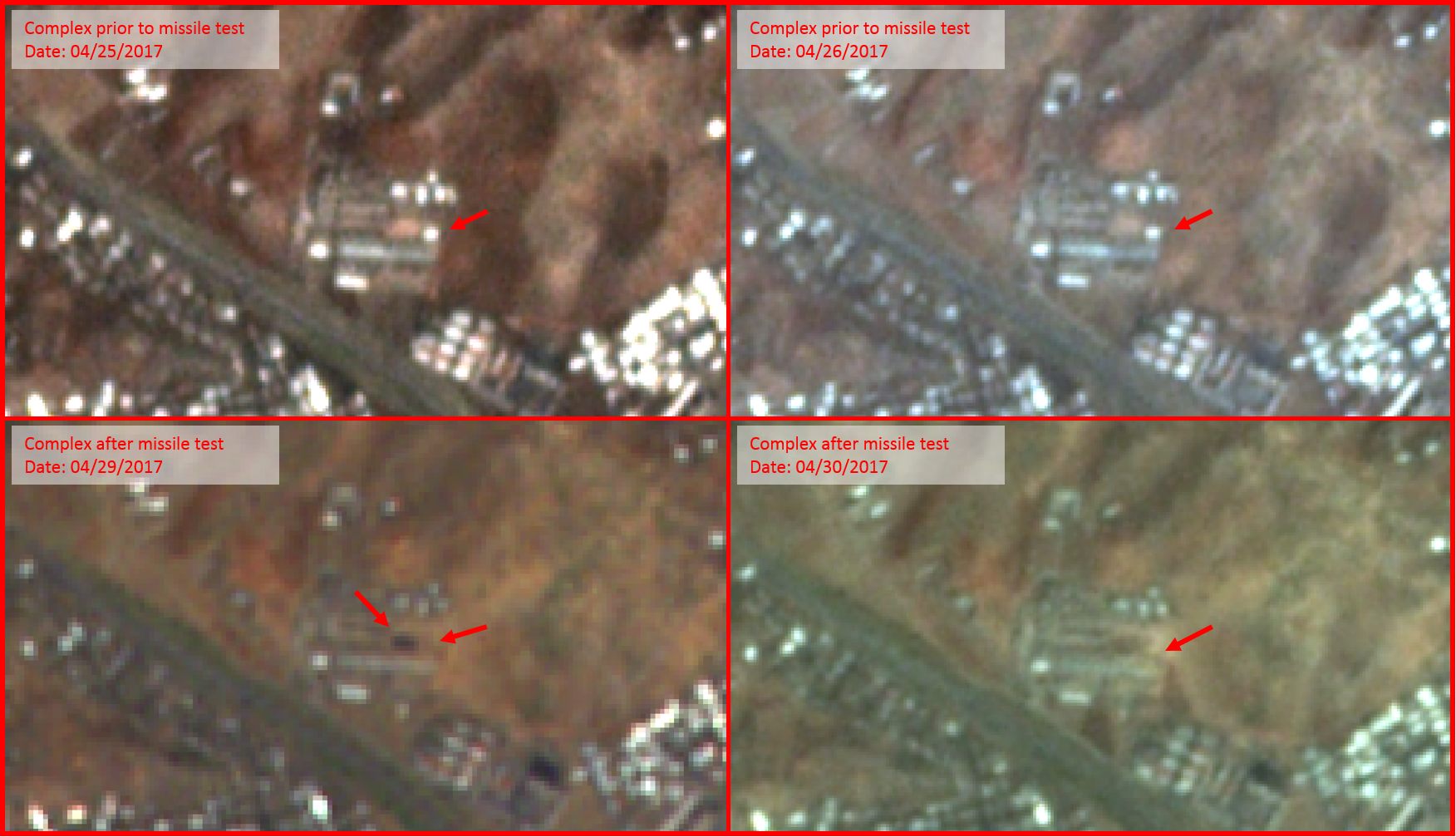
An image from Google earth of the complex show ground disturbances in an area that previously contained a building with fencing, also showing that a portion of the seasonal greenhouse had been damaged near the side of the complex where the debris fell. Using Planet Labs’ high frequency satellite images of this site, we can narrow down the date which this change occurred, which was sometime between the 26th and the 29th, or the two day window in which the test is known to have occurred.


The images above show the complex prior to and after the missile test, corroborating the reports that debris from the failed missile test struck a portion of this complex. Source: Planet Labs

Liquid-fuel missiles like the Hwasong-12, which use a highly volatile combination of hypergolic propellant and oxidizer (meaning that the two agents ignite spontaneously on contact), can produce massive explosions depending on how they fail. In this case, with the missile having survived its descent following an engine failure, it is likely that this facility at Tokchon experienced a large explosion upon impact. It’s impossible to verify if the incident caused any loss of life and, given the time of day the test occurred and the location of the impact, it may be likely that few, if any, casualties resulted from the incident.

However, as the Google Earth imagery of the incident demonstrates, the Tokchon facility is located adjacent to what appear to be residential and commercial buildings. A slight difference in trajectory may could have resulted in an even more catastrophic accident over a populated region.

To be sure, this North Korean incident is far from the first tragedy involving rocketry near a civilian area. In February 1996, a Chinese Long March CZ-3B satellite launch vehicle failed shortly after launch from the Xichang Satellite Launch Center in Sichuan. Raw video footage of the incident conveys the immense damage resulting from the explosion, which took place near a populated area. The Chinese government never released a full accounting of the loss of life resulting from the accident and public estimates vary.

Even beyond the human and economic damage potentially caused by such a failed launch, North Korea, since August 2017, has started launching ballistic missiles over Japanese territory. It has done so twice with the Hwasong-12, succeeding both times, with the reentry vehicles splashing down in the northern Pacific Ocean, clear of Japanese territory. But future successes are not guaranteed and should a future North Korean missile overflying fail at the wrong moment during its powered flight phases, its trajectory may come to resemble an attack on Japan. Even with a dummy payload, an incident like that could spark a serious crisis in Northeast Asia. North Korea’s missile tests, which violate its obligations under United Nations Security Council resolutions, come with no formal warning or notices to airmen, leaving regional states and the United States to their own devices in interpreting Pyongyang’s intentions once the engines are ignited.

Implications for the United States and Allies

Aside from the safety implications of North Korean launch practices, the few images associated with this test offer insight into the country’s pre-launch storage practices, with implications for U.S. and allied attempts at potential preemption and prevention. As seen in image 1, had the launch succeeded, Rodong Sinmun would likely have printed an image of Kim Jong-un standing in front of the transporter-erector-mounted IRBM in a hardened tunnel.

That would have (and now does) send a dire message to U.S. and allied military planners: North Korea’s missiles won’t be sitting ducks at known “launch pads,” contrary to much mainstream analysis. What’s more, the proliferation of newly constructed hangers, tunnels, and storage sites cannot be assumed to stop at the Pukchang Airfield. Similar facilities likely exist across the country. In 2017, not only has North Korea tested a massive variety of strategic weaponry, but it has done so from a more diverse list of launch sites — what the U.S. intelligence community calls “ballistic missile operating areas” — than ever before. Gone are the days of Kim Jong-un supervising and observing launches at a limited list of sites that’d include Sinpo, Sohae, Wonsan, and Kittaeryong.

It is true that missiles like the Hwasong-12, Hwasong-14, and even the new behemoth, the Hwasong-15, all use liquid fuels and must be fueled prior to launch. (North Korea’s Pukguksong-2 medium-range ballistic missile uses solid propellants and does not have this limitation.) Even with this fueling requirement, U.S. and allied intelligence would have at best a couple hours to detect launch preparations. Finally, though riskier, North Korea could fuel these missiles in a horizontal configuration within their hardened storage sites and use its road-mobile transporter-erector-launchers to launch them with fewer pre-launch signatures.

As North Korea’s production of now-proven IRBMs and ICBMs continues, it will have a large and diversified nuclear force spread across multiple hardened sites, leaving the preventive warfighter’s task close to impossible if the objective is a comprehensive, disarming first strike leaving Pyongyang without retaliatory options. The time is long gone to turn the clock back on North Korea’s ballistic missile program and its pre-launch basing options.
 
Back
Top Bottom