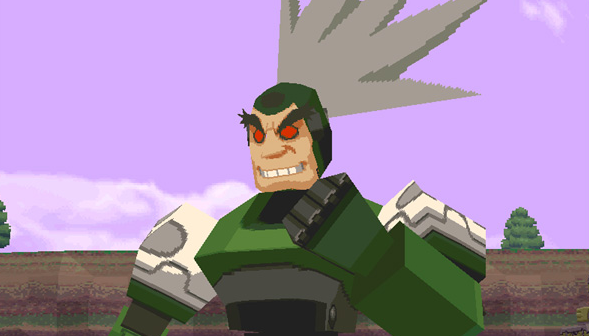
With a full-fledged show, they could've done the settings and the basic plot frameworks of each game a lot more justice. Day of Sigma was a treat, but I really hate how they make X into an ineffectual wimp until the very end. I don't wanna root for someone who acts like that and hesitates all the time. It's not like he ever killed someone by accident. Take a fucking shot, X. You're a cop. You signed up for this. I know it sucks, but your brother never let that stop him and I'm sick of your teary-eyed bleeding-heart bullshit.
Iwamoto ruined X with this crap, goddamn.
Nice meme though I guess
I guess when all you have to work with is "X has the revolutionary capacity to think, feel, and make his own decisions," then this is what you produce.
Kitamura's
original backstory for Mega Man is, to me, much more melancholic and interesting to explore in comparison:
Akita Kitamura on Mega Man (2011) said:
Time to Get Serious!
Ariga: Whenever I play Mega Man 2, I’m always struck by how awesome the music is. MM1 is a special game to be sure, but I especially love MM2. The backgrounds, too, are just perfect. It’s like, “this is the world I was waiting for someone to make!” However, in the later Mega Man games, the gameworld became more catchy, more pop, brighter somehow… Inafune was saying how Mega Man X took a darker turn in order to distinguish itself from that. For me, though, I feel like the Mega Man games gradually lost that cool, darker, more serious edge as time went on. I really felt that way when I received some criticism about my drawings of Mega Man: “Ariga, you draw Mega Man too seriously. The world is supposed to be lighter, more fun!”
Kitamura: Yeah, the “serious” quality you’re talking about is different from where Mega Man later went. I think I understand you. You know, just the image of Mega Man standing there: there’s a sadness to it. Even his sprite has a certain gravity and seriousness to it. How can I put this… for me, when I see a young child playing alone, in a park or in the middle of the street, playing by himself there… there’s something so sad about that sight, it can almost bring me to tears. And there’s something similarly lonely about Mega Man.
For example, in the backstory I wrote, Mega Man alone is equipped with the functionality to turn himself off. That very fact imbues him with a sadness. The other robot masters were made for some kind of specific job or work, so there’s no need for them to have an “off switch” they can control. However, a robot helper like Mega Man can make his own judgments, and therefore can decide whether he’s needed or not. That bit of backstory also reflects the serious feeling in the writing that you mentioned you liked. The sadness of being a robot is having this inorganic existence.
Ariga: I like that, the “sadness of the robot.” It’s part of what makes Mega Man who he is. At the same time, I also like the hope and futurism that robots embody.
Kitamura: The heroes I used to love were always strong figures that you could look up to. They were different from the heroes of today, who are drawn more sympathetically, and who you’re supposed to have something in common with. To me, a hero embodies the “virtue” that we all have in our hearts. We all have it, but most of us are too embarassed or scared to show it. In that sense there’s something childlike about heroism. Heroes are the people who are proud to show that side of themselves to others.
They have a lonely existence, and they will bear any burden—even when not being watched over by others—simply because it’s the right thing to do. I like heroes with that childlike purity and idealism. Someone who can still believe in what’s right, even when others says “that’s not realistic.” I think when a person encounters a hero like that in art, they can learn a lot from them. That’s the kind of hero I wanted to create in Mega Man.
That "sadness of being a robot", or of being a lone hero, is lost or muddled with X, because now he's not only supposed to be more edgy and relatable, but also the next leap in robotics: thinking, feeling, and independent, which are things you'd think the original Mega Man already had just by how he acted. So how does this make X special? Oh, he can cry and has "more" free will. Alright. Add to that Zero + a society of thinking, feeling Reploids that have the same rights as humans, and he's not so alone anymore either.
As an aside, it's kinda like comparing Kid Goku with Kid Gohan, now that I think about it.
So anyways, it's a completely different story, but they never seemed to go anywhere with his capacity for emotion, specifically his capacity for "worrying" that was supposed to make him stand out from the rest. Inafune tried to start rectifying this with MHX / Day of Sigma, which was a decent effort, but even if he did get to make MHX2-5, I don't think he could've come up with a satisfying answer to that. I'd rather just go back to the drawing board and rethink a little what makes X "X", while retconning Mega Man to have that off-switch.
What would the "X factor" be, besides armors and upgraded functionality? Does he even need more than that? I thought he was fine when he didn't talk so much and just got stronger. He never really had to make any tough decisions other than "Avoid shooting your partner or superior". Things got interesting with X4, but the whole overarching "X and Zero must fight" story that culminated in X5 always seemed strangely communicated to me. It's the sort of thing that, when I first played X3 and got to that line in the ending where it spells out, "X must kill Zero," I was baffled. Why? Of course we find out why in X4, but I imagine this is partly why people think the story in Mega Man (X) is a mess. Inafune just seemed to want to rush that shit to the finish, which was unfortunate.