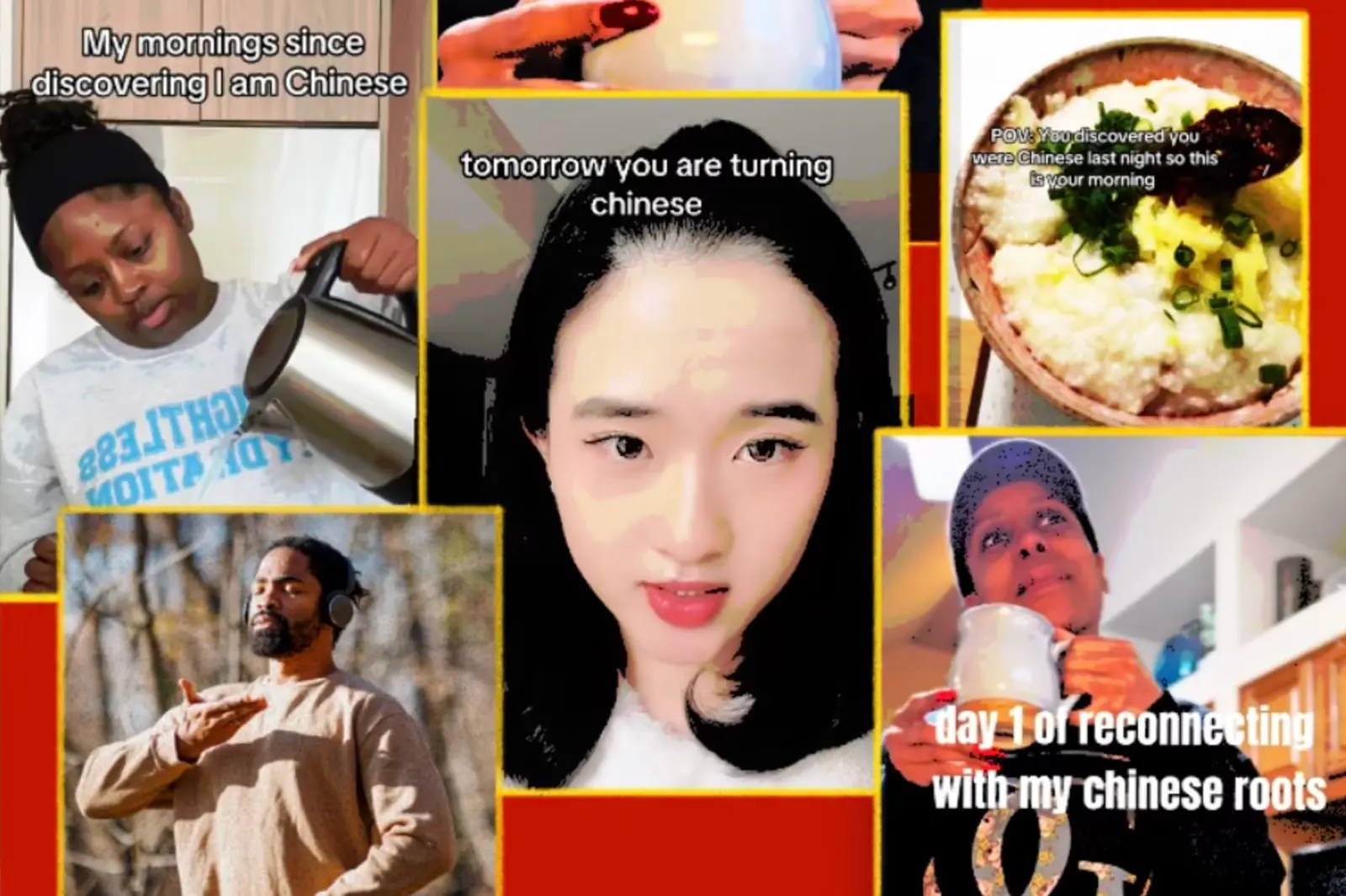
CN Chinamaxxing Megathread

  • 🏰 The Fediverse is up. If you know, you know.
  • Want to keep track of this thread?
    Accounts can bookmark posts, watch threads for updates, and jump back to where you stopped reading.
    Create account
The Wall Street Journal: The everyday Americans going all in on the Chinese lifestyle (MSN link - archive)

It’s not just Labubus. People are going crazy for congee, tai chi and boiled apples, leaving many Chinese Americans confused.​


Hannah Miao
Feb. 23, 2026

im-40741410.webp

Noë Bryant spent 41 years identifying as African American. This year, she became Chinese.

Inspired by viral videos on social media, Bryant dragged her husband and two children to their local Asian grocery store in Austin, Texas. She asked ChatGPT which Chinese pantry staples she should buy and spent around $200 stocking up on soy sauce, goji berries and other ingredients.

“I told ChatGPT, ‘I want to become a Chinese baddie,’” said Bryant, a stay-at-home mom.

These days, she starts her mornings with warm herbal tea. Congee is her go-to meal. She wears slippers around the house, and wants to try acupuncture next.

Across the U.S. and Western world, non-Chinese people are embracing Chinese lifestyles. In Gen Z parlance, they’re “Chinamaxxing”—becoming the most Chinese they can be.

Drink hot water, never cold beverages. Don’t walk around the house barefoot. Do longevity exercises. The newly converted Chinamaxxers are obsessing over daily habits that are as second-nature to many Chinese people as brushing their teeth.

For decades, China lacked cultural cachet on the world stage, even as it became an economic superpower. Now, the country is enjoying a soft-power boost, just as the U.S. is losing some of its global appeal.


The seeds were planted a year ago, when an impending TikTok ban in the U.S. pushed a flood of Americans onto the Chinese social-media platform Xiaohongshu, also known as RedNote. There, Chinese users and the self-declared TikTok refugees taught each other Mandarin and English, exchanged recipes and swapped notes on daily life in their respective countries.

Popular American streamers Darren Watkins Jr., known as IShowSpeed, and Hasan Piker both toured China last year, bringing visions of the country’s futuristic skylines to millions of viewers. Labubu dolls made by Chinese toy maker Pop Mart became a global craze.

Chinamaxxing memes began peppering the internet. “You met me at a very Chinese time in my life,” social-media users would say, riffing on a line from “Fight Club.”

Wellness influencers and regular people alike started adopting traditional Chinese medicinal practices.

Sherry Zhu, 23, helped popularize habits like drinking hot water, eating boiled apples and wearing slippers around the house. She wanted to share parts of her personal life growing up Chinese American in New Jersey. In TikTok videos that have racked up millions of views, Zhu tells people they are turning Chinese.

“I thought that it would just be funny,” said Zhu. “Now people are more exposed to Chinese culture, and they want to learn more.”


Crissa Jewel says Zhu’s videos got her back on track to becoming Chinese.

The 31-year-old therapist in North Carolina was among the TikTok refugees on RedNote last year, but eventually stopped checking the app or learning Mandarin on Duolingo. Now, she’s drinking hot beverages—and even has her dogs lapping up warm water, which she said has cured her dog Coco’s stomach issues. Drinking tea with goji berries and red dates has helped ease her period symptoms.

Friends and family are surprised by the sudden shift to hot drinks. “They think that I’m strange,” said Jewel.

For many, the interest has more to do with wellness than politics. The videos blew up around the new year, when people were looking for ways to improve their health.

Alexia Torres, 24, started drinking hot water and eating boiled apples at the start of the year. Inspired by qigong, a Chinese movement practice, she has been hopping up and down every morning, which she says helps drain her lymphatic system. She’s considering taking up tai chi. Living in Los Angeles, she often sees elderly people who look fit for their age practicing the slow movements in the park.

“They may be onto something,” she said.

China’s state media is thrilled, amplifying Chinamaxxing as a sign of the country’s growing global influence.


Many Chinese Americans, on the other hand, are confused. Those who were bullied as kids for being different, or faced anti-Chinese harassment during Covid, have mixed feelings about people now wanting to become Chinese.

At first, Karen Lin was excited to see people embracing Chinese culture. “All of a sudden, being Chinese is cool,” said Lin, 32, who was born and raised in New York’s Chinatown.

Then things started getting weird. It felt like people were turning her culture into a costume.

“If I eat Mexican food, I’m not going to say I’m Mexican now,” she said.

Chinamaxxing has been a hot topic in Armond Dai’s group chats with Asian American friends. “Everyone was like, ‘What is happening?’” said the 28-year-old in California.

He grew up drinking hot water and boiling fruit for soups to combat colds. To see these practices now going viral feels surreal.

Dai’s hope is that people embracing Chinese lifestyle habits will also respect Chinese people.

“You are at a Chinese time in your life,” said Dai. “I will be Chinese forever.”


ABC Radio National: Your Call: 'Chinamaxxing', dancing AI robots, and China's rising cultural popularity (archive)
 
Last edited:
Oh it's just women being retarded on the internet again.
Tbh I would love a Chinese style regime. State capitalism would see billionaires cut down to size and no longer able to influence politics, gays and degenerates would be arrested, clean streets and authoritarian rule would crush woke and feminism (both banned in China btw).
 
The average moron in the west really has no appreciation the extent that their life would change if they actually lived in a China style regime. They all think that they would be able to carry on the same type of shit talking, video game playing, consumerist lifestyle they enjoy in western countries with just the flag switching out for some reason.
Yeah for the average person very little would change other than now you’re relatively poorer. You just don’t whinge about your Government. Maybe if you’re unlucky you have some problem and you’re kind of fucked but for most people that’s not a thing.

Even freedom of speech is a meme for anybody who’s not American. I’m pretty sure there’s a guy who just got arrested in Australia for complaining about Jews and Jewish control. Most of the non-American world has NO freedom of speech and is working tirelessly to crack down on thoughtcrime.

At least if you were a chink you’d be satisfied in the knowledge that in 500 years China will still be full of chinks just like you. There’s no white person on earth who can think something similar.
 
IM CHINA MAXXXIN

>Smokes three packs a day.
>Spits nonstop
>Scratchs anus in public on the daily.


Ni hai my niggas.
 
Do they know that boba tea is... cold

The trend for Chinese to drink only hot water is kind of dying away now that bottled water is becoming so prevalent across the entire country.

A lot of it is just cope that you couldn’t trust a glass of water unless it was boiling hot, because it would make you shit your brains out.

Fake and gay ad campaign for the chink government. Next.

I seriously doubt it. Other than getting annually butthurt the Koreans refuse to call it CHINA NUMBAH WON New Year, the CCP has almost zero fucking interest in exporting cultural norms out of the country. Even if they did, I doubt party leadership is so braindead to think it can compete against the culture victory the US already won twenty years ago in the mainland.
 
I seriously doubt it. Other than getting annually butthurt the Koreans refuse to call it CHINA NUMBAH WON New Year, the CCP has almost zero fucking interest in exporting cultural norms out of the country. Even if they did, I doubt party leadership is so braindead to think it can compete against the culture victory the US already won twenty years ago in the mainland.
This propaganda's not meant to export culture, it's to bring retarded anti-american leftist zoomers to their side.
 
The whole china thing is just forced contrarianism out of people rejecting the US hegemony (because its fascist and problematic and "the american century of humiliation collapsing empire something something ChatGPT I need another buzzword" + its a nazi bar so on and so forth). The only credence the meme (as in as a memetic agent) has is that it implies a disparaging of America. Want Xi to stop fucking around and invade taiwan already so I can stop having to deal with retarded zoomers shilling this idea ad nauseam.
 
Propaganda used to be more undetectable
My theory is the CCP is so bad at propaganda because they have a mostly captive audience that has to listen and "believe" (lol) it regardless of how bad it is. Then they try the same shit on the rest of the world, and only the dumbest people can't spot what they're doing.

But some people claim propaganda exists to demoralize, not to convince. It's hard to be demoralized while you're laughing your ass off.
 

People are going crazy for congee, tai chi and boiled apples, leaving many Chinese Americans confused.​

Isn't congee just porridge/oatmeal but with rice instead of oats? And weren't Asian martial arts and forms of moving meditation like yoga, karate, taekwondo, etc. already popular?

This entire thing just seems like a nothingburger plus pointless exoticization of things that are basically the same as Western culture (porridge -> congee), just with a shallow """Asian""" aesthetic slapped on top.
 
Kinda? The most common story I hear in Taiwan is someone is having a problem and western medicine was not helping, but going to a traditional medicine Doctor got them sorted quickly. Usually you are just givin a herb mix that makes for some nasty tasting tea instead of given endless baggies of random pills like western medicine doctors. Some of it is real out there esoteric shit like rino horns and bear testicle, But most of it is just basic herbal treatments that do actually help. A comparison would be like instead of using an ointment for a burn you just use the sap straight from the Aloe vera plant.
These days there's also a healthy scoop of ground up antibiotics in the herbal mixture.
 
Isn't congee just porridge/oatmeal but with rice instead of oats? And weren't Asian martial arts and forms of moving meditation like yoga, karate, taekwondo, etc. already popular?
This is just the CCP desperate to find something they eat that foreigners like because all the Asian foods popular with Westerners aren't from the PRC. Everything is from another country: e.g. sushi (Japan), taiyaki (Japan), ramen (Japan), matcha drinks (Japan), wagyu beef (Japan), ube drinks (Philippines), kBBQ (Korea), boba tea (Taiwan), soup dumplings (Taiwan), Pho (Vietnam), etc.

No one is eating congee or boiled apples, that's just the CCP coping that their poorfag "cuisine" sucks compared to every other Asian cuisine, including Taiwanese and Chinese-American.
 
Noooooooooooo it's not just a CCP propaganda fad! It's heckin' organic!

CNN: Young Americans are embracing ‘Chinamaxxing’. That’s a soft power boost for Beijing (archive) (lite)

By Jessie Yeung, CNN
Wed February 25, 2026

gettyimages-2193251569-20260220063654510.webp
Domestic and foreign tourists in Chinese traditional costume visit the Palace Museum in Beijing, China, on January 10, 2025.

This article may be meeting you at a very Chinese time in your life.

At least, if you’ve spent enough time recently on social media, where the phenomenon of “Chinamaxxing” has swept feeds with videos of people sipping hot water, shuffling around the house in slippers and donning a viral Adidas jacket resembling historic Chinese fashion.

These things, content creators joke, will help you “become Chinese” – reflecting a growing Western fascination with Chinese culture and aesthetics.


“Morning routine as a new Chinese baddie,” one TikTok creator captioned a video in which he does a series of traditional Chinese exercises. Another video, viewed more than 2.4 million times as of late February, shows the creator boiling apples to make fruit tea – a supposedly old-school Chinese elixir for gut health.

We’ve seen this play out before as Asia steadily accumulated global cultural capital. K-dramas, K-pop and K-beauty have become beloved worldwide, while record numbers of tourists are flocking to Japan and gushing over its pristine streets and high-speed rail.

Now, it seems it is China’s turn.

gettyimages-2238729719.webp gettyimages-2257287173.webp
Left: A guest wears brown fur Labubu bag with Labubu charm attached, outside Dior, during the Womenswear Spring Summer 2026 as part of Paris Fashion Week in Paris, France, on October 1, 2025.
Right: A guest wears dark sunglasses, a mustard yellow suede Adidas Tang jacket with white toggle closures, oversized beige cotton trousers, and a bright yellow Vivienne Westwood heart-shaped leather handbag, outside Jeanne Friot, during the Menswear Fall/Winter 2026-2027 as part of Paris Fashion Week on January 20, 2026 in Paris, France.


“For the longest time, there was all this discussion about (how) China didn’t really have as much soft power vis-à-vis South Korea or Japan,” said Tianyu Fang, a PhD student at Harvard University’s Department of the History of Science.

“We see that changing quite a bit over the last few months – with Chinese video games, Chinese films, and even tiny things like Labubus that are really reshaping the cultural imagination of China in the US, and more broadly in the West.”

But this feels a little different from previous Asian cultural waves. For starters, South Korea and Japan are both democracies and staunch US allies, while China is an authoritarian state and major US rival.

The trend also marks a vibe shift within the American public.

Just a few years ago, the Covid-19 pandemic fueled a surge in deadly anti-Asian hate crimes. US President Donald Trump repeatedly used racist language, calling Covid “kung flu.” A trade war and other tensions deepened the widespread Sinophobia.

gettyimages-1231841621.webp
Sally Sha holds up a sign during a Stop Asian Hate rally at Discovery Green in downtown Houston, Texas, on March 20, 2021.

Against this backdrop, it can seem like something of a 180 for many Gen Z Americans to now embrace “becoming Chinese.”

But experts say the trend reveals deeper undercurrents like dissatisfaction among many Americans with life at home – from political turmoil, gun violence, immigration crackdowns and persistent racial tensions. All this has dulled the veneer of the US, driving curiosity for American youths to see what life is like on the other side.

It’s also about simple exposure, Fang pointed out. While Chinese products have long been ubiquitous across the planet, more Americans are now noticing Beijing’s dominance in many fields – especially in the competitive world of tech.

And increasingly, what they’re seeing is redefining their image of cool.

Has the US lost its ‘cool’ factor?​

This isn’t the first time China has drawn intrigue from the West. In the 2000s and early 2010s, as China began opening up to the world, more outsiders began learning Mandarin, and travel and immigration to and from China spiked.

gettyimages-1126286228-20260220063110593.webp
A group of American tourists from Minnesota wait for entry to the Forbidden City in Beijing, China, on 25 August 2003.

Much of the enthusiasm to engage with the Asian giant was economically driven, said Fang.

In the past decade, however, “China became more self-sufficient, it is much more inward-looking than it used to be, especially during Covid.”

Relations with the US also soured drastically as China turned increasingly authoritarian under leader Xi Jinping, instead of more democratic and liberal as Western leaders had hoped.

But now, it appears people are drawn to China not purely because of money – but because of the cool factor.

That may be partly fueled by China’s reopening post-Covid, which included relaxing some visa policies and encouraging more tourism – as well as the great migration of social media users to China’s Xiaohongshu (also known as RedNote) platform after the US government threatened to ban TikTok.

The influx of Americans to Xiaohongshu saw two vastly different populations – who normally exist in entirely separate online spaces – directly connecting like never before.

And it’s no coincidence the trend comes amid a broader decline in the US’ global image. Though it’s still the dominant cultural force globally, recent geopolitics and domestic turmoil have reshaped how people around the world view the superpower.

Just look at how the immigration crackdown has prompted many international students to go elsewhere for their studies; how research budget cuts have pushed top scientists to work in China instead; how Canadians, angered by a trade war, are boycotting US goods; or how Americans themselves are choosing to leave the country.

You can see this growing sense of disillusionment in the kinds of Chinese content young Americans are gravitating towards.

For instance, videos showing vertiginous skylines from Chinese metropolises like Chongqing and Shanghai have gone viral for depicting a futuristic vision of urban life, replete with seemingly clean streets and low levels of violent crime.

gettyimages-2175118628.webp gettyimages-2238596916.webp
Left: Chongqing Rail Transit Line 2 passes through Liziba Station, where the track runs directly through a residential building.
Right: A Serbian tourist has fun at the viewing platform around the Liziba Station of Chongqing Rail Transit in Yuzhong District of southwest China's Chongqing, on October 3, 2025.


Clips showing neon-lit skyscrapers, drone shows and jaw-dropping transport systems have been topping social media algorithms. Other popular videos highlight China’s electric vehicle advances and embrace of green energy.

In many ways, this romanticism of Chinese progress is oversimplified. For instance, while housing costs in China are lower than in the US, average wages are also far lower – one of many real-life challenges of life in China. Despite these problems, however, the viral videos present a seductive contrast to America’s aging infrastructure and high cost of living.

The current trend “tells us more about what Americans feel about America, than what Americans feel about China,” Fang said.

Is the future Chinese?​

With a long history of Sinophobia in the US and geopolitical tensions, it’s hard to say how long “Chinamaxxing” will last – and whether it’s a sign of an increasingly Chinese future.

Beijing has spent years cultivating its soft and hard power in parts of Africa, Latin America, Southeast Asia and the Pacific Islands. In certain countries, it’s common to see Chinese EVs and Huawei or Xiaomi smartphones – products that are far less visible in the US in part due to policy restrictions and import controls.

“A lot of Americans (are) slowly realizing that these are the things China has been producing and they’re pretty good,” said Fang. “There is a lag precisely because these things weren’t allowed in the US.”

gettyimages-2256817128.webp
An electric vehicle charges at a charging station in Yichang, Hubei, China, on January 21, 2026.

Even some of the US’ closest traditional allies are inching closer to China in the face of Trump’s volatile foreign policy. France’s Emmanuel Macron, Britain’s Keir Starmer, Finland’s Petteri Orpo and Canada’s Mark Carney all visited Beijing in recent months, and were hosted by Xi.

Internet culture moves fast, and viral memes fade quickly. For most users, “Chinamaxxing” was never that serious and meant to be used ironically or as a joke.

The trend has come under criticism too, with some members of the Chinese diaspora accusing it of being culturally appropriative and insensitive.

But for a brief moment, trends like these can offer an unlikely digital bridge between two cultures often divided by politics and the decisions of their leaders.

“I personally grew up or came of age in this decade when people in the US and people in China were interested in what each other had to say, and had to offer to the world,” Fang said.

“I’d like to see some of that revive in this day and age.”
 
Isn't congee just porridge/oatmeal but with rice instead of oats? And weren't Asian martial arts and forms of moving meditation like yoga, karate, taekwondo, etc. already popular?

This entire thing just seems like a nothingburger plus pointless exoticization of things that are basically the same as Western culture (porridge -> congee), just with a shallow """Asian""" aesthetic slapped on top.
asian martial arts overall have actually declined in prestige and popularity because MMA exposed most of their claims as baseless and fraudulent.
there has also been the opposite effect for some: muay thai has experienced a huge boost in popularity and respect because it's seen as very strong and effective by MMA fighters, but others like taekwondo, aikido and tai chi are now seen as 'bullshido' by many people, basically just larp shit that doesn't work.
 
asian martial arts overall have actually declined in prestige and popularity because MMA exposed most of their claims as baseless and fraudulent.
there has also been the opposite effect for some: muay thai has experienced a huge boost in popularity and respect because it's seen as very strong and effective by MMA fighters, but others like taekwondo, aikido and tai chi are now seen as 'bullshido' by many people, basically just larp shit that doesn't work.
MMA and HEMA pretty much destroyed any notion of far east Asian martial supremacy. They are more akin to dancing than legit self defence.
 
I like a succulent Chinese meal as much as the next guy, but miss me with drinking hot water. The Gauls brought tea to the Britons so they'd have the strength to fight off the Romans, I ain't going back to hot water (even with a splash of milk).
 
Wake me up when sheboon from the article starts eating bats and snakes and monkeys - that will be a fun one to post to the “Niggers eating cornstarch” thread.
 
I'm not seeing any hard numbers presented. As always, go with "this is fake and gay"

And says more about the political inclinations of those writing the stories and those quoted in the stories than about reality. As always
 
gettyimages-2175118628.webpgettyimages-2238596916.webp
Left: Chongqing Rail Transit Line 2 passes through Liziba Station, where the track runs directly through a residential building.
Right: A Serbian tourist has fun at the viewing platform around the Liziba Station of Chongqing Rail Transit in Yuzhong District of southwest China's Chongqing, on October 3, 2025.
LMAO they love this stupid train going through the building. They keep talking about it like it's evidence China lives in the future :story:
 
Back
Top Bottom