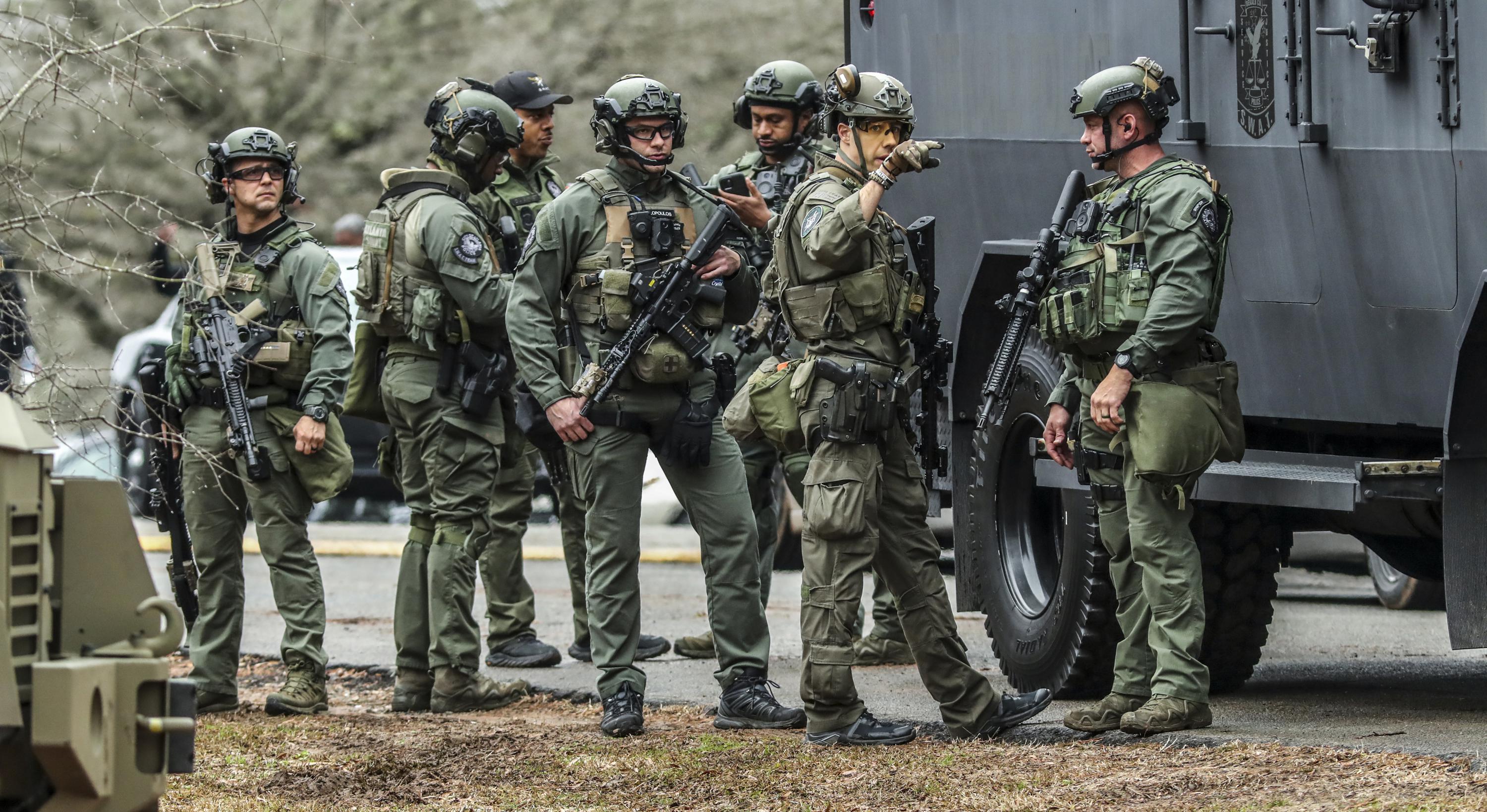
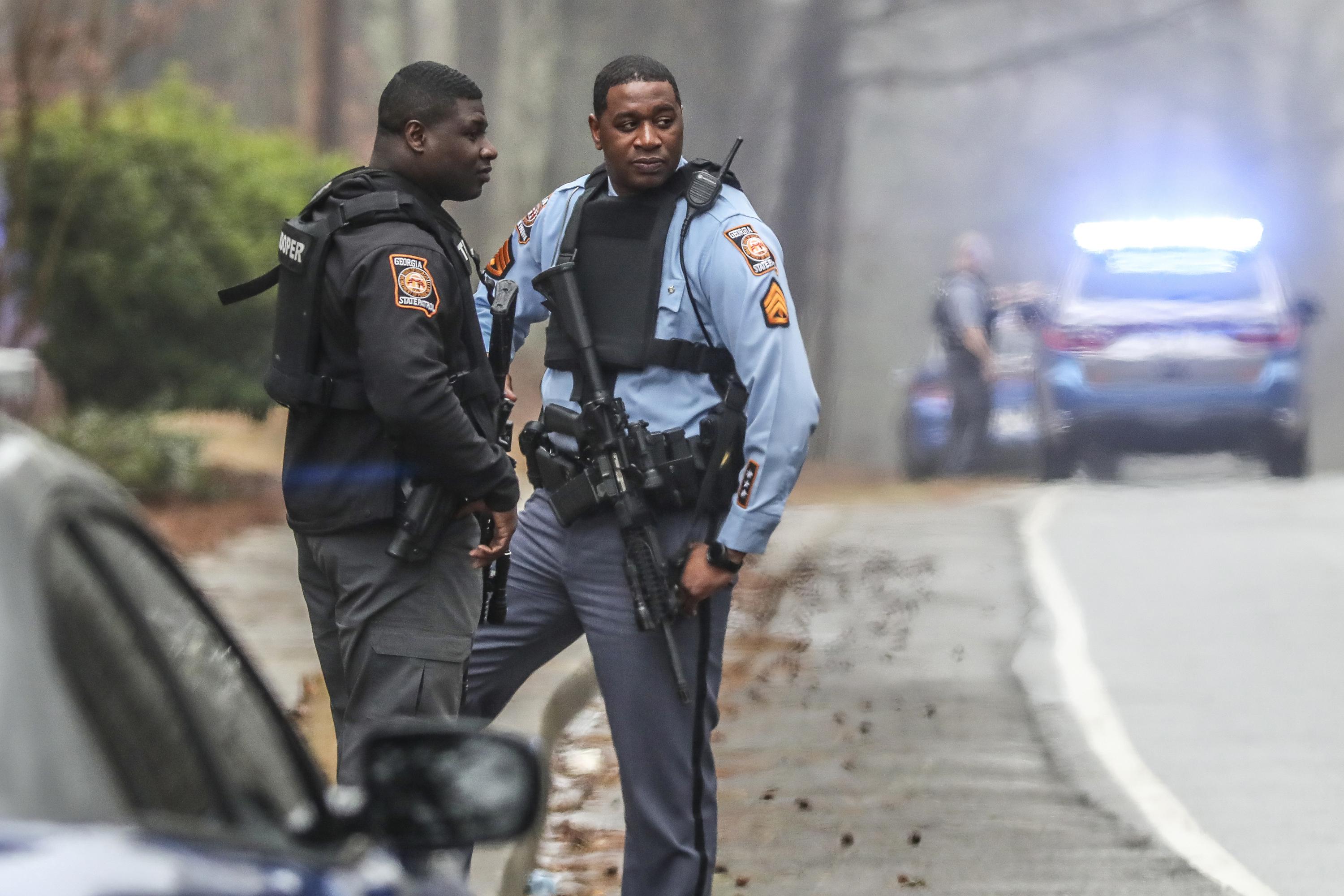
Time for some updates, from earlier in the month, up until a few days ago:
Autopsy: 'Cop City' protester had hands raised when killed
Associated Press (
archive.ph)
By R.j. Rico
2023-03-13 21:06:37GMT
DECATUR, Ga. (AP) — An environmental activist who was fatally shot in a confrontation with Georgia law enforcement in January was sitting cross-legged with their hands in the air at the time, the protester’s family said Monday as they released results of an autopsy they commissioned.
The family of Manuel Paez Terán held a news conference in Decatur to announce the findings and said they are filing an open-records lawsuit seeking to force Atlanta police to release more evidence about the Jan. 18 killing of Paez Terán, who
went by the name Tortuguita and used the pronoun they.
The family’s attorneys said the Georgia Bureau of Investigation, which has been probing the shooting for nearly two months, has prevented Atlanta police from
releasing additional evidence to the family. The wooded area where Paez Terán was killed has long been dubbed “Cop City” by opponents who occupied the forest there to protest the 85-acre (34-hectare) tract being developed as a massive police and firefighter training facility.
“Manuel was looking death in the face, hands raised when killed,” civil rights attorney Brian Spears said, citing the autopy’s conclusions. “We do not stand here today telling you that we know what happened. The second autopsy is a snapshot of what happened, but it is not the whole story. What we want is simple: GBI, meet with the family and release the investigative report.”
In a statement, the bureau said it’s preventing “inappropriate release of evidence” to preserve the investigation’s integrity.
Paez Terán’s death and their dedication to opposing the training center has vaulted the “Stop Cop City” movement onto the national and international stage, with leftist activists from across the country holding vigils and prompting some to travel and join the protest movement that began in 2021. A few protests have turned violent, including earlier this month when more than 150 masked activists left a nearby music festival and stormed the proposed site of the training center, setting fire to construction equipment and throwing rocks at retreating law enforcement officers.
Authorities have said officers fired on Paez Terán after the 26-year-old shot and seriously injured a state trooper while officers cleared activists from an Atlanta-area forest where officials plan to build the training center. The investigative bureau says it continues to back its initial assessment of what happened.
Paez Terán had been camping in the forest for months to oppose building “Cop City.” Their family and friends have said the activist practiced non-violence and have accused authorities of state-sanctioned murder.
The investigative bureau has said no body camera or dashcam footage of the shooting exists, and that ballistics evidence shows the injured trooper was shot with a bullet from a gun Paez Terán legally purchased in 2020.
Spears said the family commissioned a second autopsy after the DeKalb County Medical Examiner’s Office conducted an initial one. Officials have not released the DeKalb County report, so it’s unclear whether it reached a similar conclusion that Paez Terán had their hands raised, the palms facing inward at the time of the shooting.
“Manuel loved the forest,” their grieving mother, Belkis Terán, said. “It gave them peace. They meditiated there. The forest connected them with God. I never thought that Manuel could die in a meditation position.”
The family’s autopsy report describes Paez Terán’s body as being torn up, shot at least a dozen times and that “many of the wound tracks within his body converge, coalesce and intersect, rendering the ability to accurately determine each and every individual wound track very limited, if even impossible.”
The report also says it is “impossible to determine” whether the activist was holding a firearm at the time they were shot.
The autopsy was conducted by Dr. Kris Sperry, who was the investigation bureau’s longtime chief medical examiner until he abruptly resigned in 2015 after the
Atlanta Journal-Constitution reported that Sperry “claimed hundreds of work hours at the GBI when he actually was working for clients of his forensic-science consulting firm.”
Atlanta City Council approved building the proposed $90 million Atlanta Public Safety Training Center in 2021, saying a state-of-the-art campus would replace substandard offerings and boost police morale, which is beset by hiring and retention struggles in the wake of violent protests against racial injustice that roiled the city after George Floyd’s death in 2020.
In addition to classrooms and administrative buildings, the training center would include a shooting range, a driving course to practice chases and a “burn building” for firefighters to work on putting out fires. A “mock village” featuring a fake home, convenience store and nightclub would also be built for authorities to rehearse raids.
Paez Terán moved from Florida last year to join activists in the woods who were protesting by camping out at the site and building platforms in surrounding trees.
Self-described “forest defenders” say that building the training center would involve cutting down so many trees it would damage the environment. They also oppose investing so much money in a project which they say will be used to practice “urban warfare.”
Since Paez Terán’s death, numerous protests have been held in Atlanta, some of which have turned violent, including when masked activists on Jan. 21
lit a police car on fire and shattered the windows of a downtown skyscraper that houses the Atlanta Police Foundation and.
On March 5, a group threw
flaming bottles and rocks at officers as others torched heavy machinery at the construction site where the training center is expected to be built. Twenty-three people are facing domestic terrorism charges in connection with that attack. Activists maintain that those who were arrested were not violent agitators “but peaceful concert-goers who were nowhere near the demonstration.”
---
Muddy clothes? 'Cop City' activists question police evidence
Associated Press (
archive.ph)
By R.j. Rico
2023-03-23 18:03:24GMT
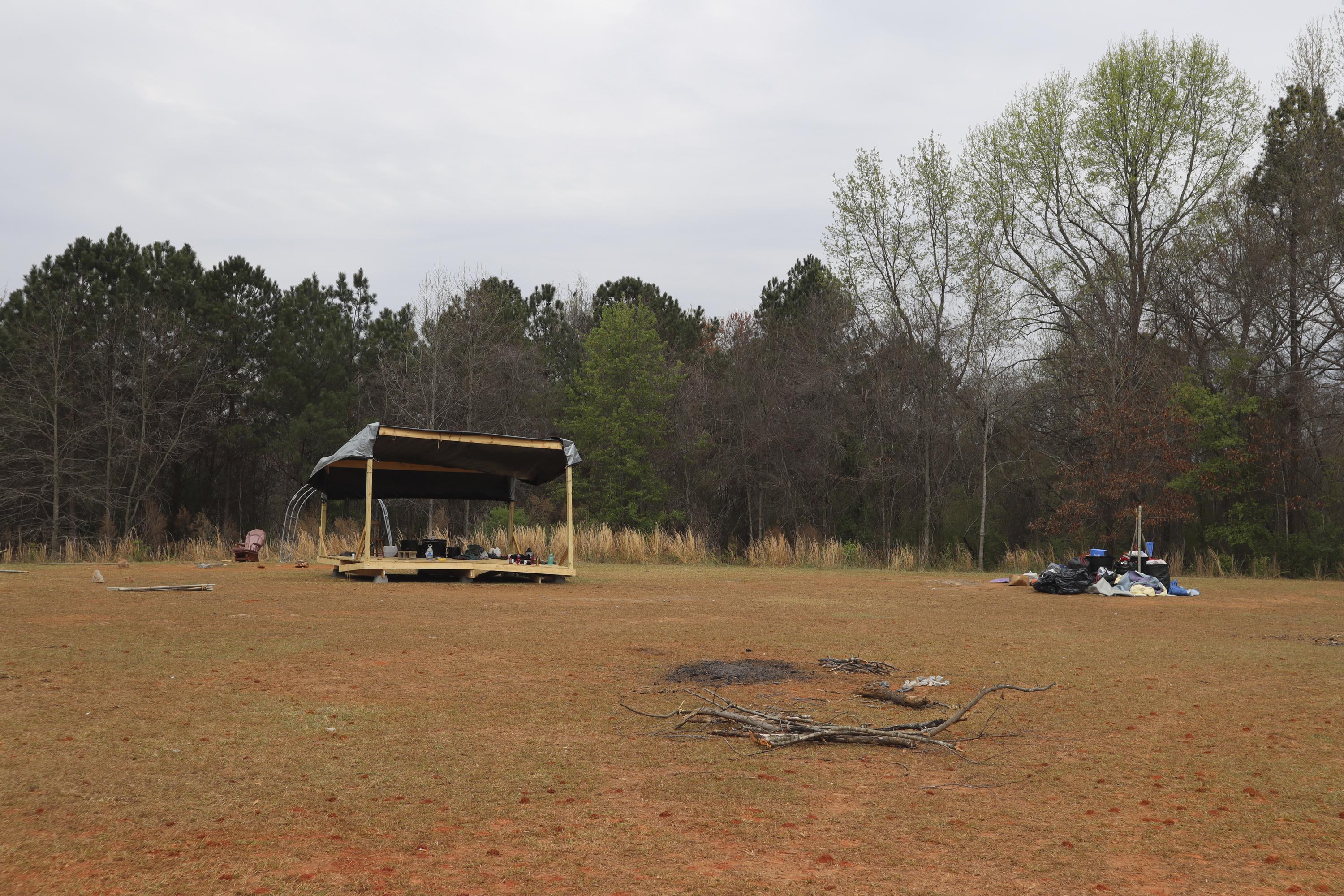 The stage used during the South River Music Festival is shown in DeKalb County, Ga. on March 9, 2023, four days after police stormed the event and arrested 23 people on charges of domestic terrorism in connection with the destruction of construction equipment. (AP Photo/R.J. Rico)
ATLANTA (AP) — When police stormed an Atlanta-area music festival two days after a rainstorm, they were looking for suspects wearing muddy clothing.
Authorities moved in on the South River Music Festival on the evening of March 5, over an hour after more than
150 masked activists attacked a construction site about three-quarters of a mile (1.2 kilometers) away, bashing equipment, torching a bulldozer and a police ATV, while throwing rocks and fireworks at retreating law enforcement officers, according to police surveillance footage.
Officials say many of the rioters trekked back to the festival ground, crossing a creek before changing out of their all-black or camouflage attire in the woods in order to blend in with the hundreds of peaceful concertgoers gathered to show their solidarity with the “Stop Cop City” movement — a decentralized campaign to halt the planned razing of an urban forest for the construction of a huge police and firefighter training center.
By the end of the night, 23 had been arrested, each facing between five and 35 years behind bars on domestic terrorism charges, even though none of the warrants accuses any of them of injuring anyone or vandalizing anything.
Civil liberties groups and defense attorneys say officials levied the disproportionate charges to scare off others from joining a movement that has only grown since January, when a
26-year-old known as Tortuguita was killed by a state trooper as authorities cleared activists from the South River Forest. Authorities said they fired in self-defense after the protester shot a trooper, but
activists have questioned that narrative
Officials say the protesters have attacked officers, destroyed property and
unleashed anarchy, causing terror in the community.
“You can’t make a criminal organization out of a political movement,” said defense attorney Eli Bennett, representing three people who were arrested at the festival. “That’s just not what we do in this country, I hope.”
Following the arrests, numerous activists told The Associated Press that they fear being detained on flimsy charges that could have huge ramifications. But they are committed to ensuring that what they refer to disparagingly as “Cop City” will never be built.
“If I am arrested with domestic terrorism charges for camping in a forest, that’s something I’m willing to go to court for,” said Sam Law, an anthropology doctoral student from Texas. “If I have to spend a few weeks in jail, that sounds like a deeply unpleasant experience, but I don’t think it’s a reason not to stand with other people of conscience doing what I feel like the historical moment calls us to do.”
Vanderbilt University law and political science research professor Samar Ali said domestic terrorism charges should be reserved for heinous crimes such as the 1996 Oklahoma City bombing, and that Georgia authorities’ use of such harsh laws only fans the flames of distrust between activists and authorities.
If the prosecutions succeed, Ali predicted, conservative states could replicate Georgia’s broad domestic terrorism statute and target left-wing movements, while liberal states could take a similar approach against white nationalists, further increasing division in the country.
“This is going to be a test case in terms of an application against environmental activists,” Ali said. “If there is a harsh sentence against environmental activists, we are likely going to see replication of this across states.”
In their arrest warrants, police allege 17 of the 23 suspects wore muddy clothing and carried shields — evidence that they were among the band of violent protesters and not mere festivalgoers. But the warrants for five of the other suspects do not list any specific details to explain why they were arrested.
One of the defendants, a Southern Poverty Law Center legal observer accused because of their muddy clothing, was released on bond a few days later. Fourteen other defendants spent at least two weeks in jail before being granted bond, while eight were denied bond Thursday.
Bennett said none of his clients had shields despite the warrants’ claims. He said it’s ridiculous to call muddy clothes evidence of wrongdoing, given that it had rained that week and there were many muddy patches around the festival site, including by the stage where festivalgoers had been moshing to punk music.
“I understand law enforcement has a big problem on their hands in identifying the actual ‘vandals’ here,” Bennett said. “But that doesn’t justify arresting people who had no involvement and were just there for a music festival that was in support of an environmental cause and an anti-militarization of the police cause.”
Atlanta police declined to comment on how many shields were recovered and where and when the arrests occurred, though jail records say all 23 were arrested at 7:45 p.m., more than two hours after Atlanta Police Chief Darin Schierbaum said the violence took place.
Ever since City Council approved the $90 million training center in 2021, the movement has brought together a whole host of leftists, including environmentalists and police abolitionists. They say officers at the 85-acre (34-hectare) center would be trained to become more militarized and quell dissent, all while hundreds of trees are cut down, damaging the climate and flood mitigation in a poor, majority-Black neighborhood.
Officials counter that the state-of-the-art campus would replace substandard offerings and boost police morale beset by hiring and retention struggles following violent protests against racial injustice after George Floyd’s death in 2020.
Georgia’s domestic terrorism law originally applied only to crimes that were “intended or reasonably likely to injure or kill not less than ten individuals.” But state lawmakers broadened the law in 2017, removing the 10-victim threshold and adding attempts to “disable or destroy critical infrastructure” with the intent to “alter, change, or coerce the policy of the government.”
For more than five years, the statute was rarely employed. That changed in December, when six self-described “forest defenders” were removed from the training center site. Since then, 35 other alleged members of the movement have been jailed on the charge, including seven who were arrested during the clearing operation when authorities killed Tortuguita, whose given name was Manuel Paez Terán.
Four days after the festival, dozens of activists remained in the nearby woods. Some were cleaning up trashed campsites, while others prepared lunch. The activists insisted they had the moral high ground and would not back down to “heavy-handed” police tactics.
Some conceded that facing a domestic terrorism charge could have huge personal implications.
Kira, an Atlanta-based technical writer who has served as a medic during “Stop Cop City” demonstrations, said she does not engage in violence, and that a domestic terrorism charge could ruin her career, even if it is later dropped. She left the festival after she heard that officers were on their way.
“My instincts told me, ‘OK, it’s time to get out,’” Kira said. “I’m middle-aged. I have a good job. I would take an arrest if I feel that it’s justified but I’m not going to get arrested out of collateral damage.”
Ashley Dixon, a local organizer with Showing Up for Racial Justice, said she and her friends didn’t realize the vandalism was going on and that she was shocked to see an officer holding a weapon running toward her.
“The officer tased someone right in front of me,” Dixon said. “I heard him yelling something, but I don’t know what he was yelling because I was in fight-or-flight mode. I was in fear for my life and I just kept running.”
But fear of being charged won’t stop her activism.
“If anything, it makes me want to fight harder because it just seems that much more important,” Dixon said. “If they’re already using this level of violence against protesters now, imagine what they will do if they have this militarized police training center.”
---
Reports provide new details in fatal shooting of activist at planned training site
The Atlanta Journal-Constitution (
archive.ph)
By Jozsef Papp
2023-03-24 19:10:23GMT
A Georgia state trooper fired pepper balls inside activist Manuel Paez Teran’s tent on the site of the proposed public safety training facility before gunfire erupted — wounding a trooper and killing Teran.
That description is in multiple Georgia Department of Public Safety use of force incident reports related to the Jan. 18 shooting that were released to The Atlanta Journal-Constitution on Friday through an open records request. The reports represent the most complete account of the deadly shooting provided by law enforcement to date.
The reports allege Teran was found inside a tent and briefly spoke to officers, refusing to leave before the pepper balls were fired inside the enclosure. The reports says Teran fired the first gunshot, and six officers returned fire.
One of the reports was written by a corporal over the special operations group within the Georgia Department of Public Safety. The names of all officers involved have been redacted.
Weeks before Jan. 18, the corporal noted he had been informed by his supervisors that the Department of Public Safety’s SWAT Team was requested to assist the GBI , along with other local law enforcement agencies, in the clearing of the property of protesters who were “unlawfully occupying the land,” according to the corporal’s report. Days before going into the forest, the corporal said he received the GBI’s tactical operations plan that outlined a proposed method of operation for clearing the site.
“Upon review of the document, I observed several pieces of information that stood out to me. To begin, a primary objective of the operation was to detect and arrest domestic terrorists that were currently criminal trespassing on the land while committing other crimes on the property,” the corporal wrote.
According to the corporal’s report, the GBI’s investigation had identified approximately 30 domestic terrorists still actively on the property who were “disrupting and intimidating contractors” working on the site.
“All the provided information leading up to January 18th, 2023, lead me to believe that the protestors/domestic terrorists unlawfully occupying the land were not only extremely dangerous and violent in general, but unusually hostile toward government employees, especially law enforcement officers,” the corporal wrote in the report.
Another of the reports was written by a sergeant on the state SWAT Team and served as second to the SWAT Commander. According to the sergeant’s report, the GBI was the lead investigating agency, had overall operational control and briefed all personnel the operational strategy of the operation on Jan. 18.
According to the corporal’s report, troopers were clearing the forest that morning when they encountered dozens of tents set up in no particular fashion.
As officers began clearing the tents and looking for protesters, a sergeant told him there was a person inside a tent that refused to leave. He asked for an officer equipped with pepper balls to force the person out of the tent.
The person inside the tent would later be identified as Teran, who is quoted in the report as telling officers: “No I want you to leave”.
“The way the suspect made his statement was a point of interest to me. It was very confident in manner, and it was immediately apparent to me that he had no intentions of cooperating,” the corporal wrote in the report.
Teran’s family has questioned the official accounts of the shooting — particularly the allegation that Teran owned a handgun and the bullet that wounded the officer was fired from it.
The report says the corporal warned Teran that he was going to shoot chemical agents into the tent. According to the report, Terán was going to be arrested for criminal trespassing after refusing to comply.
After being told of the charge by the sergeant on the scene, Teran unzipped a small section of the tent but did not open the tent door completely or unzip the mosquito net on the interior of the tent, the report says. Teran looked briefly at each person standing in front of the tent but the corporal could not see Teran’s entire face, according to the report.
Teran began to zip up the front of the tent when the corporal discharged pepper balls into the tent.
“I discharged a volley of pepper balls into the tent through the opening of the tent door through the mosquito net. I did not count how many rounds I discharged but believe it to be around five rounds,” the corporal wrote in the report. “I wanted to contaminate the rear of the tent with the chemical agent carried by the pepper ball to encourage the subject to exit the front of the tent peacefully without causing him any unnecessary discomfort by striking him with the pepper ball rounds.”
According to the report, gunfire erupted from inside the tent toward the three troopers moments after the last volley of pepper balls.
“I knew the suspect in the tent was shooting at us because I could hear the gun shots coming from inside of the tent. I could see the front of the tent door flapping as the bullets ripped through it and I could hear bullets striking the vegetation surrounding me,” the corporal wrote in the report.
The corporal said Teran was steadily shooting at them and didn’t know how many rounds were fired.
The corporal said he then drew his pistol and began shooting at Teran inside the tent.
“I continue to fire my weapon until it was readily apparent to me that the suspect within the tent was no longer trying to murder us,” the corporal wrote.
A sergeant on the scene wrote in a second report that he fired at the tent with his rifle. The report says Terán had a Smith and Wesson semi-automatic handgun, and that six officers returned fire.
“Inside, Teran was located suffering from multiple gunshot wounds and was unquestionably deceased from his wounds. A handgun was observed inside the tent near Teran’s body,” the sergeant wrote in his report.
In a statement, Teran’s family said the reports released by the Department of Public Safety show the GBI “conceived of, planned and led the operation” that resulted in Teran’s death and argues the narratives in the incident reports were drafted “weeks or, in some cases, moths after the incident.” The corporal’s report narrative was submitted on Feb. 13, while the sergeant’s report narrative was submitted on Feb. 24.
Other reports were submitted on March 17. The family argues officers had the opportunity to review publicly available video and press releases by the GBI before submitting their reports.
“The family urges the GBI to release all witness interviews taken in the immediate aftermath of the shooting and all forensic evidence it has obtained,” the family said in a statement. “These incident reports reveal that officers were fed a steady supply of hearsay and vague generalities about ‘domestic terrorists’ before entering the forest. It is clear that all law enforcement regarded any person in the forest as guilty of being a domestic terrorist.”
The family is asking the GBI to explain steps taken to preserve the investigation into its own operation and for all law enforcement agencies to produce evidence that show protesters who oppose the planned training site as domestic terrorists.
A private autopsy commissioned by Teran’s family showed the activist had been shot at least 14 times in multiple areas of the body. The autopsy found the 26-year-old suffered wounds from both handguns and a shotgun, with one lethally wound to the head likely occurring at the end of the volley, according to the report completed by Dr. Kris L. Sperry, the GBI’s former chief medical examiner.
The use of force report makes no mention of any troopers firing a shotgun at Teran.
The DeKalb County autopsy report has not been released.