War Developing and Upcoming Military Technology - Something new at least 3 times a week.

  • Want to keep track of this thread?
    Accounts can bookmark posts, watch threads for updates, and jump back to where you stopped reading.
    Create account
So, Yesterday was an exciting day for our floating friends.

So, let's jump right into the news then:
Expeditionary Fast Transport Undergoes First Fast-Tracked Integrated Sea Trials
USNI said:
In a move designed to hasten the speed of Spearhead-class expeditionary fast transports (EPFs) joining the fleet, the shipbuilder completed a first-ever integrated builder’s and acceptance trials at sea for the future USNS Puerto Rico (T-EPF-11).

Screen Shot 2019-08-27 at 3.43.33 AM.png

Conducting integrated trials enabled builder Austal USA to demonstrate to the Navy Puerto Rico’s operational capability and mission readiness of all ship systems during a single two-day underway, according to the Navy.

Puerto Rico is one of the last EPFs being built by Austal. The future USNS Newport (T-EPF-12) is under construction at the Austal USA yard in Mobile, Ala. Two more, the future USNS Apalachicola (T-EPF-13) and the yet-unnamed EPF-14, are on contract with the yard. Total orders for the class are worth more than $2 billion, according to the company’s financial statements.

Navy officials have previously stated that their shift to a Distributed Maritime Operations concept relies on having more smaller ships, such as the EPF, which can fulfill several missions.

EPFs such as Puerto Rico will have a crew of 26 civilian mariners. With airline-style seating, an EPF can carry 312 troops for intratheater lift.

“The EPF program continues to be an example of stable and successful serial ship production,” Capt. Scot Searles, the Strategic and Theater Sealift program manager within the Program Executive Office for Ships, said in a statement. “I look forward to seeing EPF-11 deliver in the fall and expand the operational flexibility available to our combatant commanders.”

Though the EPF line as it stands today may be coming to an end, the company has made a pitch for the Navy to consider using the hull as an ambulance ship. The Navy included in its Fiscal Year 2020 unfunded priorities list a request for $49 million to convert the last ship on contract, EPF-14, into an Expeditionary Medical Transport through an engineering change proposal to the contract with Austal.
USNI are good guys, do good work.

Further reading related to headline:
UPI said:
Screen Shot 2019-08-27 at 3.48.39 AM.png
Aug. 26 (UPI) -- The U.S. Navy's Expeditionary Fast Transport ship USNS Puerto Rico finished its first integrated sea trials after two days in the Gulf of Mexico.

The ship, designated EPF 11, completed its trials on August 22, and then returned to the Austal USA shipyard in Mobile, Ala., where it was built, the Naval Sea Systems Command announced on Friday.

Integrated trials combine builder's and acceptance trials, allowing a demonstration of the ship's operational capability and mission readiness to the Navy's Board of Inspection and Survey.

"The EPF program continues to be an example of stable and successful serial ship production," Capt. Scot Searles, Strategic and Theater Sealift program manager, Program Executive Office Ships, said in a press release. "I look forward to seeing EPF 11 deliver in the fall and expand the operational flexibility available to our combatant commanders."

The USNS Puerto Rico is a non-combatant vessel designed to operate in shallow-draft ports and waterways.

The Spearhead-class of EPF ships specializes in versatility, with operational flexibility for a wide range of activities including maneuver and sustainment, relief operations in small or damaged ports, flexible logistics support, and rapid transport. The ships are capable of carrying vehicles including a fully combat-loaded Abrams Main Battle Tank.

The Puerto Rico is the 11th Spearhead-class expeditionary fast transport and after its commissioning will be operated by the Military Sealift Command.
Defense Blog said:
Screen Shot 2019-08-27 at 3.51.59 AM.png
Austal shipyard has announced that the U.S. Navy newest Expeditionary Fast Transport (EPF ) ship, the future USNS Puerto Rico (EPF11), has successfully completed acceptance trials.

The shipyard reported that acceptance trials, conducted in the Gulf of Mexico, were unique in that they integrated formal Builder’s Trials with Acceptance Trials for the first time on an EPF vessel.

“By combining the two at-sea trials into one event, there are great efficiencies gained, enabling reduced costs and a shorter completion schedule,” according to Austal.


Austal CEO David Singleton congratulated Austal USA for achieving this critical program milestone.

“The future USNS Puerto Rico successfully completed and passed all tests – a clean sweep – and returned from sea earlier than scheduled, a testament to the effort and expertise of Austal USA’s professional shipbuilding team and the U.S. Navy’s Board of Inspection and Survey (INSURV),” he said.

“These trials involved the execution of intense, comprehensive testing by the Austal-led industry team while underway, which demonstrated to the U.S. Navy the successful operation of the ship’s major systems and equipment. Sea trials are the last milestone before delivery of the ship. The future USNS Puerto Rico is scheduled for delivery to the U.S. Navy before the end of the year and is the eleventh Spearhead Class ship in Austal’s 14-ship EPF portfolio.

“The flexibility and versatility of the EPF is becoming increasingly evident. From serving as a mother ship to test unmanned aerial and undersea systems in the Atlantic to performing as command ships in Pacific Partnership 2019 (an exercise that includes more than 500 military and civilian personnel from more than 10 nations), the EPF fleet is proving to be a great asset to the future 355-ship US Navy,” Mr Singleton said.

Austal’s EPF program is mature with ten ships delivered and three more under construction in Mobile, Alabama, in addition to the future USS Puerto Rico. The Spearhead-class EPF is currently providing high-speed, high-payload transport capability to fleet and combatant commanders.

The EPF’s large, open mission deck and large habitability spaces provide the opportunity to conduct a wide range of missions from engagement and humanitarian assistance or disaster relief missions, to the possibility of supporting a range of future missions including special operations support, command and control, and medical support operations. With its ability to access austere and degraded ports with minimal external assistance, the EPF provides unique options to fleet and combatant commanders.

According to the Navy, the ships are capable of operating in shallow-draft ports and waterways, interfacing with roll-on/roll-off discharge facilities and on/off-loading a combat-loaded Abrams Main Battle Tank (M1A2). The EPF includes a flight deck for helicopter operations and an off-load ramp that allow vehicles to quickly drive off the ship. The ramp is suitable for the types of austere piers and quay walls common in developing countries. The ship’s shallow draft (under 15 feet) will further enhance littoral operations and port access. This makes the EPF an extremely flexible asset for support of a wide range of operations including maneuver and sustainment, relief operations in small or damaged ports, flexible logistics support or as the key enabler for rapid transport.

In addition to the EPF program, Austal has also received contracts for 19 Independence-variant Littoral Combat Ships (LCS) for the U.S. Navy. Ten LCS have been delivered, five ships are in various stages of construction and four are yet to start construction.
Further reading about the Spearhead-Class:


U.S. Navy awards General Dynamics with $1.6 billion contract for newest expeditionary ships
Defense Blog said:
Screen Shot 2019-08-27 at 3.58.39 AM.png
General Dynamics NASSCO, a business unit of General Dynamics, was awarded a contract from the U.S. U.S. Navy for newest expeditionary ships as part of Expeditionary Sea Base (ESB) program.

The contract, announced by the Department of Defense, is worth more than $1.6 billion and covers the construction of the sixth and seventh ships of the ESB program, as well as an option for ESB 8.

“We are pleased to be building ESB 6 and 7 for our Navy,” said Kevin Graney, president of General Dynamics NASSCO. “ESBs have proven to be affordable and flexible, and as the fleet has gained experience with the platform, we have worked with the Navy and Marines to develop even more capabilities and mission sets.”

According to General Dynamics, named after famous names or places of historical significance to U.S. Marines, ESBs serve as a flexible platform and a key element in the Navy’s airborne mine countermeasures mission, with accommodations for up to 250 personnel and a large helicopter flight deck. The ship’s configuration supports special warfare and Marine Corps task-organized units.

Work on the two new ships of the ESB program is scheduled to begin in the first quarter of 2020 and continue to the second quarter of 2023, providing the opportunity to sustain and grow the workforce along San Diego’s working waterfront. NASSCO’s unique location along the historic San Diego Bay provides shipbuilders and skilled tradespeople with unparalleled access to the nation’s leading maritime support businesses, and highly-trained employees allow NASSCO to build and repair some of the world’s greatest ships in the most efficient manner possible.

In 2011, the Navy awarded NASSCO with a contract to design and build the first two ships in the newly created MLP program, the USNS Montford Point and USNS John Glenn. The program expanded with three more vessels, the USS Lewis B. Puller, USNS Hershel “Woody” Williams and the Miguel Keith, configured as ESBs. Following the delivery of the first four ships to the U.S. Navy, the fifth ship, the Miguel Keith, is scheduled for delivery in the fourth quarter of 2019.

Further reading related to headline:
UPI said:
GenDyn to build two Expeditionary Sea Base ships under $1B contract
Screen Shot 2019-08-27 at 4.00.45 AM.png

Aug. 26 (UPI) -- General Dynamics will build two ships for the U.S. Navy under a $1.08 billion contract announced by the Defense Department.

The company's National Steel and Shipbuilding Co. subsidiary, headquartered in San Diego, will build the sixth and seventh ships in the Navy's Expeditionary Sea Base program, the Pentagon announced on Friday. The deal includes an option to build an eighth ship, which would push the contract's value to $1.63 billion.

The vessels are regarded as seagoing platforms used across a broad range of military operations supporting multiple operational phases.

"ESBs have proven to be affordable and flexible," Kevin Graney, president of General Dynamics NASSCO, said in a press release. "As the fleet has gained experience with the platform, we have worked with the Navy and Marines to develop even more capabilities and mission sets."

Acting as a mobile sea base, the ships, originally called Mobile Landing Platform Afloat Forward Staging Bases, are part of the critical access infrastructure to support deployment of forces and supplies. Their design is modeled after Alaska-class crude oil carriers, another General Dynamics NASSCO product.

The first two ships in the program were started in 2011. The USNS Montford Point was launched in 2012, and the USNS John Glenn was launched in 2013.

The contract announced on Friday is a fixed-price-incentive modification to a prior contract. Most of the work will be performed in San Diego, with January 2025 targeted as the completion date.
Further reading on the Expeditionary Sea Base ships:

U.S. Coast Guard Cutter Kimball returns to homeport after final sea trials
Defense Blog said:
Screen Shot 2019-08-27 at 4.07.16 AM.png
Coast Guard Cutter Kimball (WMSL 756) returns to its homeport in Honolulu after conducting final sea trials near Hawaii Aug. 20, 2019.

According to U.S. Coast Guard Pacific Area, Kimball, the seventh National Security Cutter built for the Coast Guard, is scheduled for a unique dual-commissioning ceremony with Coast Guard Cutter Midgett (WMSL 757), the eighth NSC, at both cutters’ new homeport in Honolulu Aug. 24, 2019.

Known as the Legend-class, national security cutters are capable of executing the most challenging national security missions, including support to U.S. combatant commanders. They are 418 feet in length, 54 feet in beam and 4,600 long tons in displacement.

They have a top speed of more than 28 knots, a range of 12,000 nautical miles, an endurance of up to 90 days and can hold a crew of up to 150. These new cutters are replacing the high endurance Hamilton-class cutters (378 feet) that have been in service since the 1960s.

While national security cutters possess advanced capabilities, over 70 percent of the Coast Guard’s offshore presence exists in the service’s aging fleet of medium endurance cutters. Many of these ships are over 50-years-old and approaching the end of their service life. Replacing the fleet with new offshore patrol cutters is one of the U.S. Coast Guard’s top priorities.

The Kimball’s namesake, Sumner Kimball, served as superintendent of the Revenue Marine, establishing a training school that would later become the U.S. Coast Guard Academy. Kimball then was general superintendent of the Life-Saving Service (LSS) from 1878 until the LSS merged with the Revenue Marine to become the U.S. Coast Guard in 1915. The ship’s motto is Lead, Train, and Save.
It is a nice little ship.

Speaking of which:
U.S. Coast Guard commissions two newest national security cutters
Defense Blog said:
The United States Coast Guard commissioned two newest Legend-class national security cutters, during a ceremony in Honolulu, Hawaii, Aug. 24.
Screen Shot 2019-08-27 at 4.13.43 AM.png
According to a statement released by U.S. Coast Guard District 14 Hawaii Pacific, the Coast Guard Cutter Kimball (WMSL 756) and the Coast Guard Cutter Midgett (WMSL 757) were ‘brought to life’ during the rare dual-commissioning ceremony at Base Honolulu where the two cutters homeport. The Kimball and Midgett are the seventh and eighth legend-class national security cutters in the Coast Guard’s fleet.

“These national security cutters will continue our 150 years of partnership and commitment to the Pacific region – since September 1849, when Revenue Cutter Lawrence sailed into Honolulu Harbor escorted by Native Hawaiians in outrigger canoes,” said Schultz. “In today’s complex geostrategic environment with rising great power competition, the importance and demand for a strong Coast Guard presence in the Pacific has never been greater.”

The Kimball and Midgett, along with the three fast response cutters also homeported in Honolulu, will further advance the Coast Guard’s longstanding commitment to safeguard the nation’s maritime safety, security, and economic interests through critical deployments across the Indo-Pacific region.

Advanced command-and-control capabilities and an unmatched combination of range, speed and ability to operate in extreme weather enable these ships to confront national security threats, strengthen maritime governance, support economic prosperity, and promote individual sovereignty.

From the Bering Sea and the Arctic to patrolling known drug trafficking zones off Central and South America to working to strengthen the capabilities of our partners across the Indo-Pacific, national security cutters deploy globally to conduct essential Coast Guard missions.

Known as the Legend-class, national security cutters are capable of executing the most challenging national security missions, including support to U.S. combatant commanders. They are 418 feet in length, 54 feet in beam and 4,600 long tons in displacement. They have a top speed of more than 28 knots, a range of 12,000 nautical miles, an endurance of up to 90 days and can hold a crew of up to 150. These new cutters are replacing the high endurance Hamilton-class cutters (378 feet) that have been in service since the 1960s.

The Midgett’s transit to Hawaii was punctuated by two interdictions of suspected low-profile go-fast vessels in the Eastern Pacific Ocean, the first July 25 and a second July 31. The boardings resulted in a combined seizure of over 6,700 pounds of cocaine, estimated to be worth over $89 million.

National security cutters are responsible for 40 percent of the 460,000 pounds of cocaine interdicted by the Coast Guard in the fiscal year 2018. National security cutter crews have interdicted more than 92,000 pounds of cocaine to date in the fiscal year 2019.

Midgett is named to honor all members of the Midgett family who served in the Coast Guard and its predecessor services. At least ten members of the family earned high honors for their heroic life-saving efforts. Among them, the Coast Guard awarded various family members seven gold lifesaving medals, the service’s highest award for saving a life, and three silver lifesaving medals.

The Kimball is the third ship to bear that name, in honor of Sumner Kimball, who served as superintendent of the Revenue Marine and as general superintendent of the Life-Saving Service from 1878 until the two organizations merged in 1915 to become the modern-day U.S. Coast Guard.

“As you take to the seas, you will write the next chapters of the Kimball and Midgett legacies,” said Schultz, addressing the commands and crews of the two cutters. “I charge you with carrying out the operations of these ships in such a manner as to be worthy of the traditions of self-sacrifice, inspirational leadership, and unwavering dedication to duty – traits exemplified by these cutters’ distinguished and storied namesakes.”

Screen Shot 2019-08-27 at 4.14.16 AM.png

Screen Shot 2019-08-27 at 4.14.07 AM.png

Screen Shot 2019-08-27 at 4.13.55 AM.png

Further reading on the Legend-Class:

Low-rate initial production begins for Raytheon Evolved SeaSparrow Missiles
New guidance system has dual mode active and semi-active radar

Raytheon said:
TUCSON, Ariz., Aug. 26, 2019 /PRNewswire/ -- The U.S. Navy awarded Raytheon Company (NYSE: RTN) a $190 million low-rate initial production contract for ESSM Block 2 missiles featuring a new guidance system with a dual mode active and semi-active radar.

This award follows the Navy's decision to shift from development to production on the enhanced intermediate-range, surface-to-air missile, placing the Block 2 variant on track for initial operating capability in 2020.

The ESSM missile is the primary ship self-defense missile aboard Navy aircraft carriers and large deck amphibious assault ships. It is an integral component of the Navy's layered area and ship self-defense capability for cruisers and destroyers.

"ESSM plays a critical role in protecting navy sailors worldwide and our international partners share our commitment to evolve this missile," said Dr. Mitch Stevison, Raytheon Strategic and Naval Systems vice president.

ESSM is the foundation of several allied navies' anti-ship missile defense efforts and is operational on almost 200 naval platforms worldwide.

The ESSM program is a cooperative effort managed by a NATO-led consortium comprising 12 nations: Australia, Belgium, Canada, Denmark, Germany, Greece, The Netherlands, Norway, Portugal, Spain, Turkey and the United States.
Further reading on Evolved SeaSparrow Missile Block 2:
TL;DR: Sea Sparrow has its own radar illuminator now.

US Naval News Roundout:
Pentagon’s Investor-Industry Matchmaking Program Will Focus on Small UAS in First Event

USNI said:
THE PENTAGON – The Defense Department’s effort to connect sources of capital with small companies that need investment will begin with a focus on those that design and manufacture small unmanned aerial systems, the Pentagon’s acquisition chief told reporters today.

The Trusted Capital Marketplace, which USNI News first reported on in April, will begin with a first meeting of investors and tech companies in October, Ellen Lord said today in a briefing at the Pentagon.

That meeting will target the small UAS industry sector due to concerns that China currently dominates the market, she said.

“It’s because of where we are right now in terms of having our entire U.S. marketplace eroded, and also because it’s very intuitive – people can understand what these small quadcopters are,” she said when asked why the Trusted Capital Marketplace would kick off with a focus on small UAS.
“So essentially we don’t have much of a small UAS industrial base because (Chinese company) DJI dumped so many low-priced quadcopters on the market and we then became dependent on them, both from the defense point of view and the commercial point of view. And we know that a lot of the information is sent back to China from those, so it is not something that we could use.”

By bringing investors to meet with companies interested in designing and building small fixed-wing or quadcopter UAS in the United States, the American industrial base could regain that capability and, once Defense Department needs are satisfied, potentially compete American drones against Chinese ones on the commercial market.

Since announcing the public-private partnership earlier this year, Lord said a team has stood up to begin managing the vetting requirements for the trusted sources of capital – ensuring that money funding sensitive defense capabilities doesn’t come with ties to China, Russia or other potential adversaries – as well as beginning industry outreach and the industry/capital matching process.

Lord previously thought that DoD might be able to set up a matchmaking website of sorts, where citizens or companies interested in spending money to help shore up gaps in defense capability or capacity could be paired with tech companies working on critical defense needs for which there may not be much potential for profit in the commercial world or who otherwise need a cash infusion to continue working in the defense sector.

Instead, Lord said today, an initial model pointed to a “complicated and expensive website” and caused her team to change plans, instead opting for a series of events around the country instead of working through a website.

Lord said her office already has a list of other topics for tech investment focus areas, and after the October event on small UAS she hoped to have another event with a different focus area in January and then again every few months afterwards.

“The idea is, we do not promise business to any of the businesses that would be there [at these events], but these are areas where we definitely have a strong demand signal,” she said.
“What we’re working on right now is, how we as DoD can invest a little bit in many of these companies as well, so they could be branded as having DoD contracts? We think that would be helpful,” she added.

Additionally, Lord said during her media briefing that the Office of the Secretary of Defense was standing up an “Intellectual Property Cadre” to look at both how to manage intellectual property and data rights between the government and industry and also how to protect IP from China and others who may steal that data. That organization should be formally stood up by October.

“They will develop DoD policy within the whole-of-government effort to address concerns on data rights,” she said.
“[Defense Secretary Mark] Esper, [Secretary of State Mike] Pompeo and the president have all spoken about the impact Chinese intellectual property theft is having on our national security, American commerce and our defense industry. Again, we need to go on the offense to protect our technology versus merely acting defensively.”

Despite the urgency of the Chinese theft issue, she said the organization would primarily focus on IP and data rights between the government and the contractors it works with. That continues to be a challenge, as the military services want to own data rights so they can re-compete a program later on, build their own spare parts through additive manufacturing, and so on, while companies want to keep those rights to ensure they make money throughout the life of a program.

“My experience says that typically we have problems with intellectual property when we don’t clearly define what is owned by industry and what will be owned by government at the outset of a program. So a lot of this really has to do with good program planning,” Lord said, adding that the group will leverage work the Army has already done on the topic and seek to establish policy that everyone can live with going forward.

Lord noted that the establishment of an intellectual property cadre was mandated by the 2017 National Defense Authorization Act and that her office has been in close contact with Capitol Hill as the group nears being stood up.
Six Major Navy Commands Now Using Cloud-Based System for Financial and Supply Management
USNI said:
THE PENTAGON – Navy Enterprise Resource Planning (ERP), the service’s financial and supply chain management system, has migrated to a cloud computing system following a 10-month program replacing a server-based system.

The Navy ERP migration to cloud computing is part of a larger three-year, $100-million effort to upgrade Navy computing systems, James Geurts, assistant secretary of the Navy for research, development and acquisition, said during a media briefing last week. The cloud-based Navy ERP gives some 72,000 Navy users better access to data, such as the availability of parts, the status of supplies and the ability to quickly run reports.

“My experience has been, anytime you can increase transparency and ability for users – wherever they are in the system – to get as close to real-time actual data, then that adds efficiencies across the board,” Geurts said.

Since Navy ERP is in the cloud, Geurts said future expansions, upgrades and connections to other Department of Defense systems should be relatively simple to accomplish.

“Now that it’s on a cloud-based system, it gives us tremendous flexibility technically and from a business standpoint for the future – both being important – so we weren’t locked into a particular IT infrastructure or business arrangement,” Geurts said.

The Navy ERP is a Systems, Applications and Products (SAP) high-performance analytic appliance (HANA) cloud-based platform, managed by the Program Executive Office for Enterprise Information Systems’ (PEO EIS) Navy Enterprise Business Solutions program management office. The Navy’s legacy system was a SAP server-based Oracle platform.

Moving to the cloud is an essential step for the Navy to take because it allows the sea service to simplify and modernize its financial reporting process, Thomas Harker, the assistant secretary of the Navy for financial management and comptroller, said during the Friday briefing. Cloud computing helps the commands update data quicker and run reports more frequently.

“For example, there is one we only run on Sundays because the system is not being used, and it would take five or six hours to do; and they can now do that in about 30 minutes, and they’re doing it daily now. So it’s one where that increased accuracy has helped us with operations,” Harker said.

The goal is for all Navy financial systems to consolidate into a single general ledger within the next couple of years. Doing so is essential to producing accurate financial information, obtaining a clean audit opinion and improving the service’s analytics capability.

Six major Navy commands are now using Navy ERP. Naval Air Systems Command (NAVAIR), Naval Supply Systems Command (NAVSUP), Naval Sea Systems Command (NAVSEA), the Office of Naval Research (ONR), Strategic Systems Programs (SSP) and the Naval Information Warfare Systems Command (NAVWAR, formerly SPAWAR) are all using Navy ERP.

“The magnitude of this accomplishment is incredible,” Navy Secretary Richard V. Spencer said in a statement. “The Navy ERP tech refresh is our largest system cloud migration to date and will enhance the performance of our force.”

Geurts said his team initially planned for a 20-month process to build the system and migrate the six major commands. The work was accomplished in 10 months.

“I am proud of the team efforts to accomplish this on an accelerated schedule, cutting the projected timeline nearly in half,” Spencer’s statement said. “The team managed this through innovative approaches to problem solving and close collaboration with integration teams, network engineers and industry partners.”

Putting the ERP in the cloud also adds a layer of protection to the data, Geurts said. The Navy now has only one cloud-based depository of data to protect instead of a myriad of computing hardware.

“I think it is a widely accepted practice, if you can move from many different disparate systems that you’ve got to independently always be checking and protecting and dealing with vulnerabilities and get that into a more coherent single system that reduces the attack surface and allows you to much more efficiently ensure that you’re always keeping that infrastructure safe,” Geurts said.

The process of setting up Navy ERP could prove to be an essential pathway to use in the future as the Navy considers moving other systems to the cloud, Geurts said. For example, the Navy could follow a similar acquisition strategy with the use of small businesses and a similar process used to migrate the data to the cloud. Advanced Solutions Inc., a small-tech firm, is the prime contractor for the Navy ERP migration.

“You’ve heard me talk last year about how we see small businesses having big impacts on the Navy; this is a great example of that,” Geurts said. “Last year we did over $15 billion to small businesses as primes, and this is a great example of a small business as a prime.”
USNI News Fleet and Marine Tracker: Aug. 26, 2019

Screen Shot 2019-08-27 at 4.29.55 AM.png
**Warning Format cancer.**
USNI said:
These are the approximate positions of the U.S. Navy’s deployed carrier strike groups and amphibious ready groups throughout the world as of Aug. 26, 2019, based on Navy and public data. In cases where a CSG or ARG is conducting disaggregated operations, the chart reflects the location of the capital ship.

Total U.S. Navy Battle Force:
290
Ships Underway
Deployed Ships UnderwayNon-deployed Ships UnderwayTotal Ships Underway
463379
Ships Deployed by Fleet
Fleet Forces3rd Fleet4th Fleet5th Fleet6th Fleet7th FleetTotal
312231556100
In Yokosuka, Japan
5693689.jpg

Chief Aviation Boatswain’s Mate (Handling) Reginald Hobson, from San Antonio, signals the landing of a CV-22 Osprey from the Air Force’s 21st Special Operations Squadron on the flight deck aboard the Navy’s forward-deployed aircraft carrier USS Ronald Reagan (CVN-76) during low-light flight operations on Aug. 22, 2019. US Navy Photo
The Ronald Reagan Carrier Strike Group (CSG) has returned to its homeport of Yokosuka, Japan, after its summer patrol.

Carrier Strike Group 5
5693732.jpg

Capt. Pat Hannifin, the commanding officer of the forward-deployed aircraft carrier USS Ronald Reagan (CVN-76), holds an all-hands call in the hangar bay on Aug. 23, 2019. US Navy Photo
Aircraft carrier
USS Ronald Reagan (CVN-76), homeported in Yokosuka, Japan

Carrier Air Wing 5

5692501.jpg

Aviation Ordnancemen transfer missiles onto a F/A-18E Super Hornet on the flight deck aboard the Navy’s forward-deployed aircraft carrier USS Ronald Reagan (CVN-76) during flight operations Aug. 22, 2019. US Navy Photo
CVW 5, based at Naval Air Facility Atsugi and Marine Corps Air Station Iwakuni in Japan, is embarked aboard Ronald Reagan and includes a total of nine squadrons and detachments:

  • The “Royal Maces” of Strike Fighter Squadron (VFA) 27 from Marine Corps Air Station Iwakuni, Japan
  • The “Diamondbacks” of VFA-102 from MCAS Iwakuni, Japan
  • The “Eagles” of VFA-115 from MCAS Iwakuni, Japan
  • The “Dambusters” of VFA-195 from MCAS Iwakuni, Japan
  • The “Shadowhawks” of Electronic Attack Squadron (VAQ) 141 from MCAS Iwakuni, Japan
  • The “Tiger Tails” of Carrier Airborne Early Warning Squadron (VAW) 125 from MCAS Iwakuni, Japan
  • The “Providers” of Fleet Logistics Support Squadron (VRC) 30 from Naval Air Facility Atsugi, Japan
  • The “Golden Falcons” of Helicopter Sea Combat Squadron (HSC) 12 Naval Air Facility Atsugi, Japan
  • The “Saberhawks” of Helicopter Maritime Strike Squadron (HSM) 77 from Naval Air Facility Atsugi, Japan
U.S. 7th Fleet has not named all the escorts for the Reagan CSG, but it includes Japan-based guided-missile cruisers USS Chancellorsville (CG-62) and USS Antietam (CG-54).

In the Sea of Japan
5639273.jpg

USS Wasp (LHD-1) transits the Coral Sea on Aug. 1, 2019. US Navy Photo
The Wasp Expeditionary Strike Group is underway between Korea and Japan.

In the Gulf of Aqaba
5689246.jpg

An MH-60S Knight Hawk Helicopter Sea Combat Squadron (HSC) 21 sits on the flight deck of amphibious assault ship USS Boxer (LHD-4) as the ship transits the Red Sea on Aug. 20, 2019. US Navy Photo
The Boxer Amphibious Ready Group (ARG) with 11th Marine Expeditionary Unit (MEU) is in the Gulf of Aqaba.

Amphibious Squadron 5 (PHIBRON 5) is the ARG commander. In addition to the Wasp-class USS Boxer (LHD-4), the ARG also includes Whidbey Island-class USS Harper’s Ferry (LSD-49) and San Antonio-class USS John P. Murtha (LPD-26).

The ARG includes the “Blackjacks” of Helicopter Sea Combat Squadron 21, Assault Craft Unit 5, Naval Beach Group 1, Beachmaster Unit 1, Fleet Surgical Team 5, and Tactical Air Control Squadron 11.

The Camp Pendleton-based 11th MEU comprises Battalion Landing Team 3rd Battalion, 5th Marines; Marine Attack Squadron 214 equipped with AV-8B Harriers; Marine Medium Tiltrotor Squadron 163 (Reinforced); and Combat Logistics Battalion 11.

In the North Arabian Sea
5695082.jpg

Cmdr. Shannon Walker, the supply officer aboard the aircraft carrier USS Abraham Lincoln (CVN-72), observes an MH-60S Knight Hawk helicopter attached to the “Nightdippers” of Helicopter Sea Combat Squadron (HSC) 5 transports cargo from the Abraham Lincoln to the fast combat support ship USNS Cesar Chavez (T-AKE-14) during a replenishment-at-sea on Aug. 23, 2019. US Navy Photo
The Abraham Lincoln Carrier Strike Group is underway in the North Arabian Sea. Tensions remain high in the area in and around the Strait of Hormuz.

Carrier Strike Group 12
5695070.jpg

Electrician’s Mate (Nuclear) 3rd Class Cameron Neeley helps sort mail by department in the hangar bay of the aircraft carrier USS Abraham Lincoln (CVN-72) during a replenishment-at-sea on Aug. 23, 2019. US Navy Photo
Aircraft carrier
USS Abraham Lincoln (CVN-72), homeported in Norfolk, Va. (shifting to San Diego, Calif., upon completion of deployment)

Carrier Air Wing 7

5689333.jpg

An F/A-18E Super Hornet attached to the ‘Pukin’ Dogs’ of Strike Fighter Squadron (VFA) 143 makes an arrested landing on the flight deck of the aircraft carrier USS Abraham Lincoln (CVN-72) on Aug. 21, 2019. US Navy Photo
CVW 7, based at Naval Air Station Oceana, Va., is embarked aboard Lincoln and includes a total of nine squadrons and detachments:

  • The “Fist of the Fleet” of Strike Fighter Squadron (VFA) 25 from Naval Air Station Lemoore, Calif.
  • The “Sidewinders” of VFA-86 from Naval Air Station Lemoore, Calif.
  • The “Jolly Rogers” of VFA-103 from Naval Air Station Oceana, Va.
  • The “Pukin’ Dogs” of VFA-143 from Naval Air Station Oceana, Va.
  • The “Patriots” of Electronic Attack Squadron (VAQ) 140 from Naval Air Station Whidbey Island, Wash.
  • The “Bluetails” of Carrier Airborne Early Warning Squadron (VAW) 121 from Naval Station Norfolk, Va.
  • The “Rawhides” of Fleet Logistics Support Squadron (VRC) 40 from Naval Station Norfolk, Va.
  • The “Night Dippers” of Helicopter Sea Combat Squadron (HSC) 5 from Naval Station Norfolk, Va.
  • The “Griffins” of Helicopter Maritime Strike Squadron (HSM) 79 from Naval Air Station North Island, Calif.
Destroyer Squadron 2

5696798.jpg

Aviation Structural Mechanic Airman Danny Alano, assigned to the ‘Grandmasters’ of Helicopter Maritime Strike Squadron (HSM) 46, inserts a hose into an airbrush to paint aboard the guided-missile destroyer USS Bainbridge (DDG-96) on Aug. 22, 2019. US Navy Photo
The leadership of DESRON 2 is embarked aboard Lincoln and commands the guided-missile destroyers that are operating as part of the CSG.

  • USS Bainbridge (DDG-96), homeported in Norfolk, Va.
  • USS Mason (DDG-87), homeported in Norfolk, Va.
  • USS Nitze (DDG-94), homeported in Norfolk, Va.
  • ESPS Méndez Núñez (F 104), Ferrol Naval Base, Spain
Guided-missile Cruiser

  • USS Leyte Gulf (CG-55), homeported in Norfolk, Va.
In the Western Atlantic
5698580.jpg

Sailors assigned to the amphibious assault ship USS Bataan (LHD-5), direct a Landing Craft, Air Cushion into to the ship’s well deck on Aug. 24, 2019. US Navy Photo
The amphibious assault ship USS Bataan (LHD-5) and 26th MEU are conducting an ARG/MEU exercise near Camp Lejeune, N.C. The ARGMEUEX provides essential and realistic ship-to-shore training, designed to enhance the integration of the Navy-Marine Corps team prior to deployment.

5698508.jpg

Sailor directs a T-45C Goshawk training aircraft, assigned to Training Air Wing (TW) 2, as it launches off the flight deck of the aircraft carrier USS John C. Stennis (CVN-74) in the Atlantic Ocean on Aug. 23, 2019. US Navy Photo
USS John C. Stennis (CVN-74) is underway off Jacksonville, Fla., conducting carrier qualifications for pilots in training.

In addition to these major formations, not shown are thousands of others serving in submarines, individual surface ships, aircraft squadrons, SEALs, Special Purpose Marine Air-Gro
 
Oh hey speaking of Japan:
Lancer.jpg
U.S. Air Force B-1B Bomber Conducts Bilateral Training with JASDF Near Japan

A U.S. Air Force B-1B Lancer bomber flew from Andersen Air Force Base, Guam, to the vicinity of Japan to conduct integration training with the Koku-Jieitai, or Japanese Air Self-Defense Force (JASDF), on July 27, 2020.

B-1s are deployed to Guam from Ellsworth AFB, S.D., to conduct long-range, long-duration Bomber Task Force missions, which give aircrews opportunities to train alongside Allies and Partners in a joint environment and build interoperability to bolster their ability to support a free and open Indo-Pacific.

“The value these sorties have on our team’s confidence and readiness is immense,” said Lt. Col. Lincoln Coleman, Commander of the 37th Expeditionary Bomb Squadron. “We know these missions make us more prepared, more agile and most importantly, more lethal.”

During the mission, Koku-Jietai F-2s integrated with the bomber in the vicinity of Japan to enhance bilateral interoperability and mutual readiness between the U.S. and Japan.

“To maintain and strengthen a free and open Indo-Pacific, we, Koku-Jieitai, continue to seek out every opportunity to enhance our capabilities and operations with our Allied teams,” said Koku-Jieitai Lt Col. SHIROTA Takamichi, 204th Fighter Squadron commander. “Regular bi-lateral exercises further enhance each teams’ capabilities and interoperability.”

In line with the National Defense Strategy’s objectives of strategic predictability and operational unpredictability, the U.S. Air Force transitioned its force employment model to enable strategic bombers to operate forward in the Indo-Pacific region from a broader array of overseas and continental U.S. locations with greater operational resilience.

The flexibility and dependability of the multi-mission B-1 help make it the backbone of America’s long-range bomber force. It can rapidly deliver massive quantities of precision and non-precision weapons against any adversary, anywhere in the world, at any time.

________________________
Just one of many such exercises.

last bit for now:
US Army sets timeline for long-range assault helo prototypes
V-280 Valor.jpg
{The Bell V-280 Valor completes final key performance parameters within the Army's Joint Multi-Role technology demonstration program, proving it can conduct high-level, low-speed agility maneuver. Bell is competing against Sikorsky to design and develop a future long-range assault aircraft for the U.S. Army. (Courtesy of Bell)}

WASHINGTON — The U.S. Army is still considering two different paths to build prototypes for its future long-range assault aircraft following an industry day earlier this month, but is pushing toward a contract award in fiscal 2022, according to the service’s FLRAA program manager.

While the Army continues to sift through industry feedback to help it choose a route, the service remains on track to publish a draft request for proposals by the end of the year, followed by a finalized RFP in FY21, Col. David Phillips told reporters July 24.

The Army chose Bell and Lockheed Martin’s Sikorsky to enter into a competitive demonstration and risk reduction effort ahead of the start of the FLRAA program of record. The service is on a tight timeline to field a brand-new, long-range assault aircraft by 2030. The CDRR effort will consist of two phases that will last roughly one year each.

Bell and a Sikorsky-Boeing team respectively designed, built and flew technology demonstrator aircraft as part a Joint Multi-Role Technology Demonstration phase prior to entering the CDRR effort. The companies will deliver initial conceptual designs, an assessment of the feasibility of requirements and trade studies using model-based systems engineering.

“Due to the success of phase one (awarded on 16 March) the Army is looking at the scope of a second phase which would refine the digital designs from the system to subsystem level and further burn down risk as FLRAA enters into the [program of record,” Phillips said in a written statement to Defense News on July 27.

The Army provided two schedules to get through the design and prototyping phase in an RFI in May to gain industry feedback.

The first schedule lasts 52 months, putting the end of the prototyping period somewhere in the ballpark of early summer 2026. The schedule allows for a preliminary design review for just the air vehicle from the winning team — picked in the second quarter of FY22 — eight months after the contract award.

The team would then have another preliminary design review for the weapon systems 17 months past contract award, which roughly falls around August 2023.

The Army would hit the engineering and manufacturing development phase around October 2023, followed by a critical design review in early 2025. The first prototype would be delivered in the summer of 2025, with five more prototypes delivered through the summer of 2026.

The alternative schedule would allow for a preliminary design review for both the air vehicle and the weapon systems at the same time at roughly 10 months following a contract award. This approach aims to get to an engineering and manufacturing development decision around March 2023. A critical design review would follow at the start of 2024, with a first prototype delivery expected around February 2025. All six prototypes should be delivered to the Army by roughly March 2026.

The total time frame for the second option is 48 months post contract award.
Defiant.jpg
{ Sikorsky's and Boeing's Defiant sits on a tarmac in West Palm Beach, Fla. (Jeff Martin/Staff) }

While the difference in schedules is just roughly four months, every week counts as the Army works to field new capabilities as fast as possible. Army leaders have often said that schedule is king when it comes to fielding the service’s top modernization priorities. FVL is the third-highest priority, preceded only by a Next-Generation Combat Vehicle and Long-Range Precision Fires.

The Army is driving toward entering a production and deployment phase in 2028 ahead of the first unit receiving the aircraft in 2030.

“We believe FLRAA’s design and requirements approach is inverting the defense procurement paradigm. Our approach gives the Army multiple opportunities to optimize requirements through digital engineering prior to entering the design, build, and test of the weapons system,” Phillips told Defense News. “Making informed decisions on requirements through design optimization will enable the Army to ensure FLRAA capabilities are affordable; meet [Multi-Domain Operations] requirements; and deliver on an aggressive schedule that does not sacrifice rigor for speed.”

Multi-Domain Operations is the Army’s war-fighting doctrine designed to operate and fight against anticipated future adversaries across land, sea, air and cyberspace.

Bell and Lockheed are also competing head-to-head to design and build the Army’s future attack reconnaissance aircraft, which will follow a nearly simultaneous schedule as the FLRAA competition.
 
Fight China? get ready to clear out building which are not build for the convenience of the invading force. Fight Russia? Same problem. Fight North Korea? The Urban combat problem remains.
why should you fight the chinese house to house? you use bigger guns or bomber to take out hard points...

Yeah, motherfucker. That is why being able to rapidly disembark is a key capability. You know, so that the soldier inside the APC can get out and fight before the convoy is "made of dust." I guess that the enemy infantry carrying ATGMs and RPGs aren't vulnerable to small arms infantry fire either.
they will bring enough firepower that there is no time to disembark. we dont talk about sandnigger with old rpgs...

I agree, Guns that aren't full sized battle rifles do so much better. But if you want to make your APC taller and wider, go ahead.
the design flaws of the bradley are well known---
 
You'd think a German would want to avoid bigger guns and bigger bombs being used in urban combat after Dresden went up like a California wildfire. You also have issues of accurately targeting said hardpoints, non-permissive airspace thanks to fighters or SAMs, and the fact that dug in infantry are still a royal bitch and a half to eliminate even with all of the modern tools we've invented to do so. In addition, there's the issue of needing to replace the functions of whatever you've blown up, which can be anything from providing clean water to the town and your own soldiers, to something as basic as a warm roof for people to sleep under, both your men and the civilians, assuming you don't feel like displacing them into hostile territory at bayonet point.
 
last bit for now:
US Army sets timeline for long-range assault helo prototypes
View attachment 1482224
{The Bell V-280 Valor completes final key performance parameters within the Army's Joint Multi-Role technology demonstration program, proving it can conduct high-level, low-speed agility maneuver. Bell is competing against Sikorsky to design and develop a future long-range assault aircraft for the U.S. Army. (Courtesy of Bell)}

WASHINGTON — The U.S. Army is still considering two different paths to build prototypes for its future long-range assault aircraft following an industry day earlier this month, but is pushing toward a contract award in fiscal 2022, according to the service’s FLRAA program manager.

While the Army continues to sift through industry feedback to help it choose a route, the service remains on track to publish a draft request for proposals by the end of the year, followed by a finalized RFP in FY21, Col. David Phillips told reporters July 24.

The Army chose Bell and Lockheed Martin’s Sikorsky to enter into a competitive demonstration and risk reduction effort ahead of the start of the FLRAA program of record. The service is on a tight timeline to field a brand-new, long-range assault aircraft by 2030. The CDRR effort will consist of two phases that will last roughly one year each.

Bell and a Sikorsky-Boeing team respectively designed, built and flew technology demonstrator aircraft as part a Joint Multi-Role Technology Demonstration phase prior to entering the CDRR effort. The companies will deliver initial conceptual designs, an assessment of the feasibility of requirements and trade studies using model-based systems engineering.

“Due to the success of phase one (awarded on 16 March) the Army is looking at the scope of a second phase which would refine the digital designs from the system to subsystem level and further burn down risk as FLRAA enters into the [program of record,” Phillips said in a written statement to Defense News on July 27.

The Army provided two schedules to get through the design and prototyping phase in an RFI in May to gain industry feedback.

The first schedule lasts 52 months, putting the end of the prototyping period somewhere in the ballpark of early summer 2026. The schedule allows for a preliminary design review for just the air vehicle from the winning team — picked in the second quarter of FY22 — eight months after the contract award.

The team would then have another preliminary design review for the weapon systems 17 months past contract award, which roughly falls around August 2023.

The Army would hit the engineering and manufacturing development phase around October 2023, followed by a critical design review in early 2025. The first prototype would be delivered in the summer of 2025, with five more prototypes delivered through the summer of 2026.

The alternative schedule would allow for a preliminary design review for both the air vehicle and the weapon systems at the same time at roughly 10 months following a contract award. This approach aims to get to an engineering and manufacturing development decision around March 2023. A critical design review would follow at the start of 2024, with a first prototype delivery expected around February 2025. All six prototypes should be delivered to the Army by roughly March 2026.

The total time frame for the second option is 48 months post contract award.
View attachment 1482226
{ Sikorsky's and Boeing's Defiant sits on a tarmac in West Palm Beach, Fla. (Jeff Martin/Staff) }

While the difference in schedules is just roughly four months, every week counts as the Army works to field new capabilities as fast as possible. Army leaders have often said that schedule is king when it comes to fielding the service’s top modernization priorities. FVL is the third-highest priority, preceded only by a Next-Generation Combat Vehicle and Long-Range Precision Fires.

The Army is driving toward entering a production and deployment phase in 2028 ahead of the first unit receiving the aircraft in 2030.

“We believe FLRAA’s design and requirements approach is inverting the defense procurement paradigm. Our approach gives the Army multiple opportunities to optimize requirements through digital engineering prior to entering the design, build, and test of the weapons system,” Phillips told Defense News. “Making informed decisions on requirements through design optimization will enable the Army to ensure FLRAA capabilities are affordable; meet [Multi-Domain Operations] requirements; and deliver on an aggressive schedule that does not sacrifice rigor for speed.”

Multi-Domain Operations is the Army’s war-fighting doctrine designed to operate and fight against anticipated future adversaries across land, sea, air and cyberspace.

Bell and Lockheed are also competing head-to-head to design and build the Army’s future attack reconnaissance aircraft, which will follow a nearly simultaneous schedule as the FLRAA competition.

This is another development that I'm keenly looking forward to seeing how it shapes out. Both designs look solid, but I admit that I'm leaning more towards hoping the Bell entry wins out now that tilt-rotor technology is more seasoned and mature. Of course, the Sikorsky entry may be the better choice for air cav since it's more like "normal" helos in form factor and function and seems like it would be more survivable if it were to be hit during combat or a turbine went out while in the air, since it can still auto-rotate like a regular helo.

Either way, it does my black, shriveled little imperialist warmonger heart good to see our military getting equipped for the future.
 
why should you fight the chinese house to house? you use bigger guns or bomber to take out hard points...
Why didn't the Germans do this in Stalingrad? Oh wait, they did? How about the Russians at Grozny? They did too? How about the Americans at Fallujah. etc.

Yeah, it turns out that Tanks, Artillery, and Airstrikes alone don't allow you to take and hold a city. You see, even if you level a big building, it just turns into rubble, which is a hardpoint opportunity that is just as good for enemy infantry as their former building was. Fire support can definitely help the infantry, but you do have send the poor fuckers in.

they will bring enough firepower that there is no time to disembark.
Yeah, I am going to have to challenge your claim.

What you are saying is extremely unlikely, and to have it be your argument for what would happen in every near-peer convoy ambush is insane.

I would use reductio ad absurdum to prove my point, but you have already done it for me.

What you are saying is that every convoy ambush will be significantly more synchronized than the French GIGN snipers, while using far heavier weapons. Assuming everything else is perfect, which it won't even be close to, that position alone is radically stupid.

we dont talk about sandnigger with old rpgs...
What about Russians/Chinese with new RPGs?

the design flaws of the bradley are well known---
I know English isn't your first language, so I will cut you some slack.

I didn't say anything about the Bradley specifically, I was talking about every single make and model of IFVs and APCs. Fighting out of Puma, or a Fuchs, or a Boxer is worse with a longer rifle, than a shorter rifle.

As for the Bradley, the ones you saw feature predominately in "Pentagon Wars" is not the one we ended up with. Just watch until the end of the movie, and you see some of the many changes made before most any of the Bradley units were delivered. I certainly compares favorable to a Marder, a BTR-80, or a BMP variant especially when it come to the size and ergonomics of the exit. Core to the argument we are having: yes, the capability of a soldier to fight out of a Bradley is worse with a long gun, than it is a shorter gun, like with every other APC and IFV.

-
So I put this question to you, are you actually retarded or are you merely pretending?
 
Eglin AFB prepared, ready for F-15EX
EGLIN AIR FORCE BASE, Fla. (AFNS) -- In less than a year, Eglin Air Force Base takes possession of the Air Force’s newest fighter, the F-15EX. Big plans and procedures are underway so developmental and operational testing can begin as soon as possible when EX1 and EX2 arrive in 2021.

The Operational Flight Program Combined Test Force will manage the DT and OT planning and provisioning for the aircraft. The 40th Flight Test Squadron will take possession of EX1 and the 85th Test and Evaluation Squadron will own EX2. Squadron aircrews and testers will work together to complete the combined DT and OT simultaneously.

“The time has come to upgrade the aging F-15C/D fleet and that presents itself in the form of F-15EX, the most advanced F-15 ever created,” said Maj. Brett Hughes, 40th FLTS lead F-15EX DT pilot. “This represents years of iterative design and battle proven technologies. The 40th FLTS, a squadron full of developmental testers, is ready to meet the challenge of testing America’s newest fighter.”

The F-15 has been a dominant and proven fighter since it entered service in 1976. Currently, there are late 70s F-15 models on Eglin AFB’s ramp testing new aircraft capabilities with each flight. This is a testament to the airframe design, avionics and maintenance working on the aircraft. The F-15EX will continue to ensure that air superiority for decades ahead, according to Maj. Aaron Eshkenazi, 85th TES F-15EX OT lead pilot.

Both pilots agreed the EX design has the future in mind. Although the new aircraft looks like an F-15, its digital flight controls, advanced cockpit touch displays, new sensors and advanced computer technology take this Eagle well beyond its older brethren.

These upgrades make the F-15EX extremely capable and rapidly adaptable to new weapons and technologies. The F-15EX also has the ability to carry over three times the weapons payload of an F-35, which will make its presence critical on the battlefield, according to Eshkenazi.

To maintain these fighter advancements, select Airmen from the 96th Maintenance Group will undergo familiarization classroom academics and transfer to hands-on training upon the aircraft’s arrival here. These newly qualified technicians will become the trainers for the maintenance group.

Coordination between the 96th MXG and multiple F-15EX affiliated agencies is ongoing to resolve any issues and ensure the unit is ready to support the new F-15 variant, according to Senior Master Sgt. Craig Krebsbach, 96th MXG F-15EX lead.

The aircrew will also receive Boeing training as well as an F-15EX simulator, expected to arrive this year. This will provide many of the pilots with their first hands-on experience with the new aircraft’s design.

The transition for aircrew and maintenance is much simpler since certain elements of the F-15 remain the same with the biggest differences being engines, flight controls and displays. The intent is for all of the squadrons’ aircrew to be F-15EX trained.

This is only the practical side of the preparations for the new aircraft. Engineering and program-management personnel coordinated for the past year and a half to be ready.

“The combined Eglin (AFB) team participated in hundreds of preparatory events in order to help guide the F-15EX program’s success,” said Lt. Col. Christopher Wee, OFP CTF director of operations.

The EXs will roll off the assembly line with ET and OT emblazoned on their tail flash. Then, the aircraft undergo functional flight checks before military aircrews are allowed to strap in and finally bring them to Eglin AFB.

Upon arrival, the EX’s initial missions will be aircrew familiarization and local airspace flights. After that, aircrews begin test and evaluation of the aircraft’s Air Force-specific hardware, software and weapons. The EX build comes from F-15 models previously manufactured under foreign military sales contracts with other countries.

Initial testing will focus on ensuring the software and avionics systems integrate well with the aircraft’s features like the advanced cockpit and controls.

The goal of the integrated DT and OT is to ensure the EX meets the needs of the warfighter in its intended operational environment. This enables Eglin AFB’s testers to highlight any system issues early, so they can be fixed before the F-15EX’s increased production and ultimate delivery to the squadrons. The initial phase of tests will take approximately a year and a half.

“This program is a once-in-a-lifetime opportunity to test a new aircraft from the ground up and be a part of America’s future air dominance,” Hughes said.

The F-15 EX marks the third new Air Force aircraft assigned to Eglin AFB in just two years. The HH-60W Jolly Green and the MH-139A Grey Wolf are also in developmental testing at the installation.

U.S. to Remove 11,900 Troops from Germany

The United States is planning to remove 11,900 troops from Germany, Defense Secretary Dr. Mark T. Esper said during a news conference today at the Pentagon.

The move will reduce the number of U.S. military personnel in Germany from about 36,000 to 24,000. Repositioning could begin in weeks, he said, adding that with 24,000 American service members, Germany would still host the highest number of U.S. troops of any nation in NATO.

About 5,600 service members being moved out of Germany will stay within Europe. They will be moved to other NATO nations, Esper said. An additional 6,400 personnel will return to the United States, though Esper said this will not mean less support of NATO allies, because instead of having permanently stationed forces in Germany, other military units will begin rotational deployments farther east on the continent in more strategic locations, such as near the Black Sea region.

“Our aim is to implement these moves as expeditiously as possible consistent with the principles I set forth from the beginning, particularly being fair to, and taking care of our service members and their families,” the secretary said. “We could see some moves begin within weeks. Others will take longer. As anyone can see, the repositioning of our forces in Europe constitutes a major strategic and positive shift, wholly in line with the NDS and consistent with other adjustments the United States has made within NATO in previous times.”

Air Force Gen. Tod D. Wolters, commander of U.S. European Command and NATO’s supreme allied commander for Europe, spelled out some of the specific movements planned for forces in Europe.

The EUCOM headquarters and the associated U.S. Special Operations Command-Europe headquarters, for example, would move from Germany to Mons, Belgium, where they would be located with Supreme Headquarters Allied Powers Europe.

“This will improve the speed and clarity of our decision-making and promote greater operational alignment,” Wolters said, adding that a similar relocation could happen for U.S. Africa Command headquarters and the associated U.S. Special Operations Command-Africa, though no new location has been determined.

Wolters also said EUCOM intends to reposition three brigade-sized headquarters, an air defense artillery battalion, and an engineering battalion to Belgium from Germany, as well as move two smaller support and contracting organizations to Italy. He said the 52nd Civil Engineering Squadron, an Air Force unit, could be one of the first to move. The plan is to put that unit in Italy.

EUCOM also proposes relocating an F-16 fighter squadron and elements of a fighter wing to Italy. Esper said the move will put those units closer to the Black Sea region, better enabling them to support NATO in the southeast.

“The proposal to reposition forces back to [the United States], … with respect to the 2nd Cavalry Regiment, will allow those units to regain maximum U.S. at-home-station readiness and more effectively support global contingencies while still maintaining a keen focus on Europe,” Wolters said.

There are also plans to rotate forward the lead element of the Army’s 5th Corps headquarters to Poland, Esper said, contingent on Warsaw signing a defense cooperation agreement. There may also be other opportunities to move additional forces into Poland and the Baltics, the general said.

“This rebalance, consistent with the NDS, will align NATO and Eucom capabilities, better distribute forces across Europe and increase the use of rotational forces, thus bolstering our commitment to Europe,” said Air Force Gen. John E. Hyten, vice chairman of the Joint Chiefs of Staff. “It enhances deterrence and improves operational flexibility. Repositioning our forces and making consolidations will provide General Wolters, as the commander, increased ability to dynamically employ his force. This effort will increase opportunities to partner with and strengthen our bond with allies and partners in the region. It will also require additional planning and consultation with our allies.”

This is a headline I wasn't expecting:
Greece orders 50 Turkish drones

ANKARA, Turkey — A Turkish private drone manufacturer has won a contract to sell a batch of 50 miniature tactical drones to the Greek Ministry of Defence, the company announced July 28.

The company Assuva Savunma Sanayi said two Proton Elic RB-128 drones sent to Greece successfully passed acceptance tests. Remzi Basbug, president of Assuva, said this is the company’s first export deal to a country that is both a NATO and a European Union member.

“We have obtained all necessary export licenses for the export to Greece,” Basbug said, adding that the company has previously sold the same drone systems to Turkish, Chinese and Sri Lankan armed forces.

The Assuva miniature tactical drone can be used for search and rescue missions. It can also detect underground bunkers, explosives, land mines and chemical material. Featuring a thermal camera, it can capture imagery from a distance of up to 1 kilometer, and 50 meters underground.

The company says its drone is the product of domestic engineering and software.
_
That's all the article says, still interesting due to the political tensions.
 
Why didn't the Germans do this in Stalingrad? Oh wait, they did?
they wanted to, but they didnt had the means to do so anymore. the Problem in Stalingrad was the collapse of the flanks.

How about the Russians at Grozny?
The Bombardment won in the end, its not the magical bullet to win instantly.

They did too? How about the Americans at Fallujah. etc.
another shitshow. also they just used some bombs.

Yeah, it turns out that Tanks, Artillery, and Airstrikes alone don't allow you to take and hold a city. You see, even if you level a big building, it just turns into rubble, which is a hardpoint opportunity that is just as good for enemy infantry as their former building was. Fire support can definitely help the infantry, but you do have send the poor fuckers in.
Tanks are very useless in that case.
and rubble is a much weaker hardpoint, there are also alot of ways to deal with a rubble field, like napalm, or just blasting it again.
yes you have to send in Infantry at some point, but you can use more firepower in rubble field than in a house.
If you have to storm a building just use the equipment designed for that task, aka a Flamethrower.


What you are saying is that every convoy ambush will be significantly more synchronized than the French GIGN snipers, while using far heavier weapons. Assuming everything else is perfect, which it won't even be close to, that position alone is radically stupid.
The Russians are pretty good at it. they have been doing it in Georgia, Ukraine, Syria and Russian mercs are doing it in libya right now.

Core to the argument we are having: yes, the capability of a soldier to fight out of a Bradley is worse with a long gun, than it is a shorter gun, like with every other APC and IFV.
If the Bradley isnt as shit as i said, why does an inch or 2 make so much difference?
 
I've always hated how people have loved to try shoving a big fat bullet like a .458 or a .50 into something designed for 5.56mm rounds.
You put a big fat bullet in front of a small case to make a high energy subsonic round. .458 SOCOM and 9x39 are subsonic and hit like freight train, but have approximately the external ballistics as a .45 ACP. Using a VSS on guards must have been nerve-racking to say the least.

On Monday, the Commander, U.S. 2nd Fleet press release said that the U.S. Navy Expeditionary Sea Base, USS Hershel “Woody” Williams (ESB 4), departed Naval Station Norfolk, Va. Jul. 27, on the ship’s inaugural deployment following its commissioning in March.
I'm almost disappointed they changed the ESBs from USNS to USS. I was going to have a lot of fun posting MGS memes when somebody finally started bitching about a non-commissioned ship conducting offensive operations.

Why didn't the Germans do this in Stalingrad? Oh wait, they did? How about the Russians at Grozny? They did too? How about the Americans at Fallujah. etc.

Yeah, it turns out that Tanks, Artillery, and Airstrikes alone don't allow you to take and hold a city. You see, even if you level a big building, it just turns into rubble, which is a hardpoint opportunity that is just as good for enemy infantry as their former building was. Fire support can definitely help the infantry, but you do have send the poor fuckers in.
He's German. He can't help but masturbate to Leopard 2s and rant about how armor is the answer to everything until it's not and then it's 'bomb zem into oblivion.'

I'm not sure which 6.8mm round the Army settled on. I don’t think it was the telescoped round. It's either the polymer cased round (True Velocity, I think?) or the SIG round that uses a two-piece metal case with the base being made of steel and the rest made of brass. SIG is already bringing their new case design to the civilian market with a new proprietary cartridge along with .308 Win, 6.5 Creedmoor, and others using their new two-piece case. It's supposed to offer lighter weight with higher velocities/energy over the same calibers using traditional one-piece brass cases. That gives me hope that we will see civilian offerings for this new 6.8mm cartridge/rifle, even if Big Green doesn't adopt it.
It's currently a 3 way completion between SIG's bimetal case, General Dynamics' polymer case, and Textron's telescoped case.
WHICH WEAPON COULD BE THE ARMY'S NEW RIFLE & LIGHT MACHINE GUN?
07/13/2020 02:03 AM | by Chris Eger
Share
XM8 Carbine and XM320 attached, the other has the XM8 sharpshooter OCIW

Despite past programs such as SPIW, ACR, and OCIW that left the U.S. Army still fielding successive generations of Eugene Stoner’s AR platform at the end of the day, today’s NGSW program could be different. The above shows the XM-8 prototype, an OCIW program hopeful, in 2004. (All Photos: U.S. Army Program Executive Office Soldier)
The U.S. Army’s new Next Generation Squad Weapon program is moving right along and its competitors read like a who’s who of modern rifle, ammo and optics makers. Names like Beretta, Heckler & Koch, Leupold, Sig Sauer, Vortex, and Olin-Winchester are enumerated among the current vendors of what could end up as the most revolutionary small arms award of the 21st Century thus far.
The NGSW search goes back to at least 2016 and heated up two years ago when the Army launched a program seeking companies to develop a suppressed light machine gun– deemed an automatic rifle– along with a companion suppressed rifle sharing a common 6.8mm cartridge. At the time, Chief of Staff of the Army Gen. Mark A. Milley said the new round would penetrate any existing body armor or body armor expected to exist over the next 25 years.
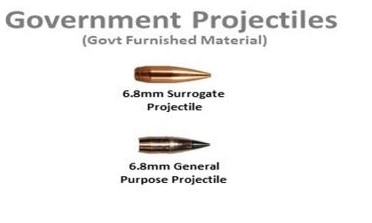
Next Generation Squad Weapons NGSW Projectiles

The 6.8mm common cartridge for the NGSW program uses an Army-developed bullet and competitors have forward-looking solutions to supply hybrid rounds that are lighter up to 20 percent lighter in weight than today’s, offering bi-metallic, telescoping and polymer-cased options.
The idea behind the 6.8 caliber is to step up the effective range and energy currently delivered by the Army’s current 5.56mm loads past 300 meters, and replace the M4 Carbine and M249 Squad Automatic Weapon in front line units with the new platform family. Likewise, the program would select a Fire Control optic system or the catchy NGSW-FC in Army-speak, that would be used on both the rifle and automatic rifle variant.
Last September, three competitors were greenlighted to supply rifle and automatic rifle platforms for initial testing. These included New Hampshire-based Sig Sauer, which has developed an in-house solution for each; Maryland-based AAI Corporation/Textron Systems; and Vermont-based General Dynamics-Ordnance & Tactical Systems. The limited buy was for a small batch of prototypes the Army would subject this year to a “diagnostic test to inform the weapon and ammunition vendors on their current performance and feed another design iteration.”
THE TEAMS:
Next Generation Squad Weapons NGSW Sig Sauer

Sig Sauer’s belt-fed MG 6.8mm machine gun, which is submitted as the NGSW-AR, is billed as being 40 percent lighter than the M249 but with “dramatically reduced felt recoil.” It has ambidextrous AR-style ergonomics, quick detach magazines, increased M1913 rail space, and a quick-detach Sig-developed suppressor. Meanwhile, Sig’s MCX Spear rifle, submitted as the NGSW-R rifle, has a fully collapsible and folding stock, rear and side charging handle, free-floating reinforced M-LOK handguard, fully ambi controls, and a quick-detach suppressor. The cartridge is a bi-metallic hybrid.
General Dynamics-OTS has been working with Maryland-based firearms icon Beretta, to produce their RM277 NGSW platform which uses True Velocity’s 6.8mm composite-cased cartridge. The only bullpup design in the program, it uses 20-round polymer mags.

General Dynamics-OTS has been working with Maryland-based firearms icon Beretta, to produce their RM277 NGSW platform which uses True Velocity’s 6.8mm composite-cased cartridge. The only bullpup design in the program, it uses 20-round polymer mags.
AAI/Textron has subcontracted with ammo maker Winchester-Olin and firearms maker Heckler & Koch, to design their own unique NGSW contender.

AAI/Textron has subcontracted with ammo maker Winchester-Olin and firearms maker Heckler & Koch, to design their own unique NGSW contender. Notably, it uses a telescoped-cased cartridge.
OPTICS
When it comes to the NGSW-FC, two competitors are being evaluated through an Other Transaction Authority (OTA) agreement, an award type traditionally used to fund innovative prototype procurement and development of forward-looking technology. The systems tapped are developed by a team on one side consisting of defense contractor L3Harris Technologies and optics-maker Leupold & Stevens versus a fire control unit submitted by Wisconsin-based Vortex Optics.
Vortex has made public its NSGW-FC is a 1-8x first focal plane optic with an integrated rangefinder and overlaid display while L3/Leupold has been quieter about the specifics of their submission.

Vortex has made public its NSGW-FC is a 1-8x first focal plane optic with an integrated rangefinder and overlaid display while L3/Leupold has been quieter about the specifics of their submission.
While testing is currently being done at Fort Drum through August by the PEO’s Product Manager Next Generation Weapons, a second prototype test is set to begin 2QFY21. The Army hopes to field the first selected NGSW platforms to field units in FY2022, a potentially huge award in which the winner could stand to deliver 250,000 NGSWs and 150 million rounds of ammo plus options for further contracts.
DON’T COUNT THE M4 OUT JUST YET
Past ultra-modern small arms programs run by the Army such as SPIW, ACR, and OICW spanned decades and, while interesting, left the service with nothing more than updated AR platforms to fall back on, a standard the military has maintained since the 1960s. With that being said, it should be noted that, while the Army is developing the NGSW, they are also hedging their bets when it comes to M4s as numerous multiyear contracts are still current with established U.S.-based carbine makes such as Colt and FN. Additionally, Picatinny Arsenal is still conducting steady R&D on potential updates to the existing platform including patenting an innovative new helically fluted M4 heavy barrel, designed to better endure extended cyclical fires. Meanwhile, the Marines, who are also looking to the NGSW program while stocking up on their own new M27 IAR system, are refurbishing their legacy supplies of ACOG optics.
 
He's German. He can't help but masturbate to Leopard 2s and rant about how armor is the answer to everything until it's not and then it's 'bomb zem into oblivion.'
I thought that was the US's whole schtick, just replace the Leo 2 with the Abrams. Although we have "Bomb them into oblivion" be Step 1 of our attack plans instead of the last resort, so maybe that's where the difference is? As to the subsonic ammo part of the discussion, according to this lazy chart that was the first search result on Bing, .458 SOCOM really isn't subsonic, not unless you use one of the super-heavy rounds for it that exit the barrel below 350 m/sec. As far as I know it, like all those other big-ass rounds, were there so specialists could get massive stopping power out of the AR-15 platform, which they do incredibly well at, but the necessary compromises have tended to outweigh the benefits, with a 20 round mag of 7.62x51 being far more versatile while still delivering the necessary punch in the form of a double-tap than a 9 round mag of .458 or similar.
 
As to the subsonic ammo part of the discussion, according to this lazy chart that was the first search result on Bing, .458 SOCOM really isn't subsonic, not unless you use one of the super-heavy rounds for it that exit the barrel below 350 m/sec.
Well fuck, you are very correct. I'll blame posting past my bedtime on that one. I'm not even sure what round I was thinking of at this point.
 

Chinese Type 075 Big Deck Amphib Preparing for Sea Trials
Type-075.jpg
{The lead Chinese Type-075 preparing for sea trials. Note the smoke stains near the stern. Photo via Twitter }

The Chinese Navy’s newest amphibious warfare asset, the Type 075 LHD (Landing Helicopter Dock) is setting sail for the first time, according to ship spotter reports.

The vessel, which was built in Shanghai, has been fitting out since it was floated on September 26, 2019. Candid photos surfacing on the Chinese language internet show it being fueled, and tugs readied.

The Type-075 represents a step-change in the People’s Liberation Army Navy (PLAN) amphibious warfare capabilities. It will enable better over-the-horizon landing capabilities and improve air cover. And there are already rumors of the follow-on Type-076 LHD which is expected to include EMALS (Electromagnetic Aircraft Launch System) for unmanned combat aerial vehicles or crewed aircraft. At this stage, these rumors should be treated with caution. But they do give an indication of the direction PLAN amphibious capabilities are going.

In addition to the well-deck for Type 726 hovercraft (generally equivalent to the U.S. Navy’s Landing Craft Air Cushion), the LHD will have a large rotor-wing component. This will include the Z-8 transport helicopter which is based on the French SA 321 Super Frelon. More modern types seen aboard, in mock-up form, include the naval variant of the Harbin Z-20 — an apparent copy of the Sikorsky S-70 Black Hawk-Sea Hawk family.

There are also small rotor-wing UAVss including a Ka-27/28 HELIX anti-submarine warfare helicopter model aboard for deck tests.
Comparison.jpg
{ Comparison of similar sized big deck amphibious ships. }

Images in the public domain show a range of rotor-craft models aboard the Type 075. This is a common practice aboard Chinese warships and is a strong leading indicator of the operational air wing.

The ship suffered a fire on April 11, 2020. Although the fire was quickly put out and damage appeared minimal, smoke stains are still visible in the aft port-side near to the ramp.

The Hudong-Zhonghua yard in Shanghai where the lead Type 075 has been built has already launched a second ship. And analysis of commercial satellite imagery suggests that module for a third may be on its way. At the moment the yard is building the Type 054A frigate for the Pakistan Navy and, it appears, a Type 071 LPD for Thailand.

The PLAN began development of the Type 075 in 2011 as a helicopter carrier that would displace about 35,000 tons — smaller than the U.S. 45,000-ton Wasp and America-class big decks. The unnamed ship launched last year.

A version of this post originally appeared on Naval News. It’s been republished here with permission.

_____________________________
If the LHD lives up to Chinese claims, it might very well be a potent amphibious warfare asset. However, in the realm of LHDs it is still a quite small fish. It can only carry helicopters which means that it cannot hope to operate independent of air-support from a Carrier or from land bases. This does mean that China is still moving ever closer to having some semblance of a real amphibious assault force.

I just hope Taiwan continues to come back to the reality of having to defend themselves from the PRC, for their sake.

In other news the Gerald R. Ford continues to hit milestones in preparation for full service:
Ford’s Conducts First Air Intercept Control Event
Air controller.jpg
{ Photo By Seaman Riley McDowell | Operations Specialist 1st Class David Geary, an air intercept controller, assigned to USS Gerald R. Ford's (CVN 78) operations department, stands watch at his console inside the ships Combat Direction Center (CDC) July 30, 2020. Ford is conducting carrier qualifications in the Atlantic Ocean. (U.S. Navy photo by Mass Communication Specialist Seaman Riley McDowell) }

USS Gerald R. Ford (CVN 78) completed an Air Intercept Control (AIC) event on July 30. A first for the crew, this accomplishment was another milestone of Ford’s operational progress as she passes the half-way point of her 18-month Post-Delivery Test and Trials (PDT&T).

AIC missions are required to increase the Combat Direction Center’s proficiency through training. AIC missions are also an opportunity to demonstrate integration with Carrier Strike Group (CSG) 12 as part of the air defense mission to defend Ford and the rest of the force.

Lt. Shane Welsh, the air defense officer for the Ticonderoga-class cruiser USS Leyte Gulf (CG 55) training with Ford’s operations team, said the mission was a collaborative effort between Ford and Carrier Air Wing (CVW) 7 and CVW-8.

“The Ford is considered an air defense unit (ADU),” said Welsh. “The Air and Missile Defense Commander (AMDC) assigned Ford the mission to control defensive counter air assets. If we had other ADUs in the area, the AMDC would coordinate with them and would report information to the battle watch in the Tactical Flag Command Center.”

Ford’s Air Intercept Controller, Operations Specialist 1st Class David Geary, from Davenport, Iowa, controlled two separate AIC events. Both were Defensive Counter Air missions designed to protect a high value asset against several waves of "red air" threats. First were two F/A-18E Super Hornets, attached to the “Jolly Rogers” of Strike Fighter Squadron (VFA) 103, followed by four F/A-18F Super Hornets from the VFA-213 Black Lions. Despite being outnumbered by the threat, the Jolly Rogers and Black Lions integrated with Ford’s AIC and employed TOPGUN recommendations to successfully defend Ford.

“We were simulating an air defense scenario,” said Geary. “We were controlling the fighter to intercept, escort and if necessary kill the inbound threat aircraft.”

The AIC is the third wingman in the fighter community. The AIC’s job is to paint a mental picture for the pilots in the air via voice and data link communication.

“I am in voice communication with all the fighters,” said Geary. “As the fighters and threats close, I must put together a specific timeline to ensure they have best situational awareness possible to enhance lethality and increase survivability.”

“It was an excellent event,” said Welsh. “It’s a new ship, new crew, new strike group. Getting that continuity together where it’s all second nature, that’s what’s important.”

Gerald R. Ford is a first-in-class aircraft carrier and the first new aircraft carrier designed in more than 40 years. Ford is underway in the Atlantic Ocean conducting carrier qualifications during an independent steaming event.
__________________________
A ship so nice, we are building it twice.... still, progress is being made. The working up and post delivery problems should be nowhere near as debilitating in the follow-up ships in the class.
 
Speaking of Taiwan:
Air Defense: Taiwan Gets A Refresh

August 2, 2020: Taiwan recently ordered $620 million worth of missiles and upgrades for its seven U.S. built Patriot SAM (Surface to Air) Missile batteries. Much of this upgrade is for refurbishing older PAC-3 missiles that are reaching the end of their shelf-life. Most military missiles are never fired and are built to retain their effectiveness for a decade or more. This is called shelf-life. Missiles are monitored electronically, and some are built to have a few components (batteries and some electronics) replaced regularly. But after 10-20 years the missiles require replacement or major refurbishments to “like-new” condition. Taiwan has the facilities and skilled personnel to do most of this work in Taiwan, using components and some technical services purchased from the United States.

Taiwan obtained its first Patriot three Patriot PAC-2 batteries in 1997 and these batteries were upgraded to add anti-missile capabilities using the PAC-2 missile. The more effective PAC-3 anti-missile missile entered service in 2003 and Taiwan eventually added that capability to its Patriot batteries. In 2009 Taiwan purchased four more Patriot batteries and hundreds of additional PAC-3 missiles. Taiwan uses Patriot mainly as an anti-missile system. Anti-aircraft duties are performed by a combination of recent Taiwan developed SAMs and upgrades of older American Hawk SAM batteries.

The Patriot has been in service since 1984 but did not shoot down its first manned aircraft until 2014, when an Israeli Patriot shot down a Russian made Su-24. Patriot didn’t get its first combat use until 1990, when it was used against Iraqi ballistic missiles. There the success rate was 70 percent against missiles fired at Saudi Arabia and 40 percent against those fired at Israel. The relatively low success rate here had to do with the crude modifications Iraq made to its SCUD missiles to give them more range. This caused them to come apart while making their descent to the target. This showed up as multiple incoming warheads. Another problem was that when a missile was intercepted over an urban area, the large bits of missile debris caused casualties. Do you count that as a successful intercept? Even against aircraft, if you destroy it the debris are going to come down in fatal velocities in dangerously large fragments. This is an issue that does not get much media attention even though it has been the reality since ground based antiaircraft weapons were first used to defend urban areas during World War I (1914-18).

Israeli Patriot batteries have had more combat experience than anyone else but have shot down more ballistic missiles, cruise missiles and UAVs than manned aircraft. Israel has six Patriot batteries, enough to cover all 1,280 kilometers of land and coastal borders. Patriot is not infallible but it is effective enough to be regularly used to intercept short-range ballistic missiles. Since 2015 Saudi Arabia has used its Patriot batteries to intercept over a hundred Iranian ballistic missiles fired from Yemen.

Each Patriot battery is manned by about a hundred troops, and each contains a radar and four launchers. A battery can fire two types of Patriot missile. The $7 million PAC 3 missile is smaller than the anti-aircraft version (PAC 2), thus a Patriot launcher can hold sixteen PAC 3 missiles, versus four PAC 2s. The less expensive PAC 2 missile weighs about a ton, about three times more than a PAC 3. A major difference with the PAC 2 is range. PAC 3 has a shorter range (about 30 kilometers) versus 160 kilometers for the PAC 2 anti-aircraft version, which is also used against UAVs.

The Patriot system was in development since the early 1960s and is expected to remain in service until the 2040s. Over 10,000 Patriot missiles (about 25 percent of them PAC-3) and over 1,500 launchers have been produced so far. Most of those missiles served for decades and then were refurbished or retired and scrapped unused. PAC-3 missiles are more likely to be refurbished. Many PAC-3 missiles are now approaching the end of their shelf-lives and most owners want them refurbished.

The island nation of Taiwan, which China has claimed as a rebellious province since the late 1940s, has been able to avoid Chinese conquest with its own well-armed military and a military alliance with the United States. Taiwan has one of the most advanced technology economies on the planet, despite having a relatively small (24 million) population compared to 1.4 billion in China. Despite enormous economic growth by China since the 1980s, per-capital GDP in Taiwan is still 2.5 times that of China. However. China has much larger armed forces and the second highest defense budget in the world. On paper China ought to be capable of quickly conquering Taiwan. The reality is different. Chinese military analysts often discuss openly the problems and risks of such an attack. The current Chinese strategy towards Taiwan is more threat than reality but that threat is backed by a lot of ballistic missiles, more than Taiwan can intercept.

Since the 1990s Taiwanese defense analysts and military planners have noted the growing number of Chinese ballistic and cruise missiles deployed in nearby China for use against Taiwan. China currently has over 2,700 of these missiles and about half are within range of Taiwan. The basic Chinese strategy appears to be the immediate use of over a thousand ballistic and cruise missiles against Taiwanese military targets. Most of these missiles are based on the coast opposite Taiwan (180 kilometers away across the Taiwan Straits). The Chinese missiles carry one ton or half ton conventional (high explosive or cluster bomb) warheads and are expected to be used to cripple Taiwanese air force and navy, as well as attacking headquarters and communications targets. Almost simultaneously, China would try to invade with airborne and amphibious forces. Without those missiles, Taiwan's air and naval forces would make it very difficult, if not impossible, for the invasion force to cross the straits. Military analysts have examined various targeting strategies, and defensive moves the Taiwanese could take. In most cases, the Chinese succeed. The barrage of missiles can do serious damage to Taiwanese air and naval forces, giving Chinese air and naval forces an opportunity to get ground forces ashore. If Taiwan keeps improving its defenses, China remains unenthusiastic about attempting an invasion.
______________________
Nothing too earth-shattering here, just "re-manufacturing" old PAC-3 Patriot Missiles, into new PAC-3 Patriot Missiles.

Though this did come with some RoC weirdness. You see, what we are being told happened is some "lower ranking" military personnel put in a request for approval for a possible sale of the new missiles with the US Defense Security Cooperation Agency (The guys that handle a lot of Foreign Military Sales paperwork). This "apparently" happened with no knowledge of this purchase request making its way to the upper echelons of the Taiwanese government until the request was approved and publicly displayed by the US Government.

So the upper leadership of the RoC said that they would totally look into punishing those responsible for this, but in the mean time they have an "obligation" to follow through with the deal.

Is this a ploy to keep the CCPs feathers unruffled? Probably, but I though I would pass on what I heard through the grape vine.


8 Missing After AAV Sinking Presumed Dead as Search Off California Ends
AAV-P7-A1.jpg
{Marines with Bravo Company, Battalion Landing Team 1/4, 15th Marine Expeditionary Unit, operate AAV-P7/A1 assault amphibious vehicles onto the well deck of the amphibious landing dock USS Somerset (LPD-25) on July 27, 2020. US Marine Corps Photo }

The seven Marines and sailor missing after their amphibious assault vehicle sank off the California coast are presumed dead as search and rescue operation ended, I Marine Expeditionary Force said in a late Saturday statement.

“The 15th [Marine Expeditionary Unit and the [Makin Island Amphibious Ready Group] leadership determined that there was little probability of a successful rescue given the circumstances of the incident,” the statement reads.
“All eight service members are presumed deceased.”

Fifteen Marines and the sailor were aboard the AAV were returning to amphibious warship USS Somerset (LPD-25) after operating on San Clemente Island when the AAV began to take on water, Marine officials told reporters on Friday.

Eight Marines were rescued. One Marine later died from his injuries. As of Friday, two more Marines were in critical condition at Scripps Memorial Hospital in La Jolla, Calif. The other five have returned to their unit.

IMEF is withholding the names of the Marines and sailor until 24 hours after next of kin notification.

Now the Marines and the Navy are working to recover the bodies of the missing service members and find the AAV that sank in hundreds of feet of water off San Clemente Island.

_______________
Damn.
 
Last couple of things, and that is all for tonight:
U.S. Army wants new 155mm artillery system
Truck Gun.jpg


The U.S. Army this week took another step toward replacing the current fleet of towed howitzers, releasing a request for proposals for more mobile, lethal, and survivable 155mm artillery systems.

The Pentagon is looking for industry solutions that are able to meet U.S. Army future requirements of the 155mm mobile howitzer program.

On Jul. 30, the Army posted a solicitation on the U.S. government’s main contracting website, for vendors to participate in a Shoot-Off Evaluation concerning the future of the Army’s mobile howitzer effort at Yuma Proving Ground, Arizona in FY2021.

Also added that the United States Government recognizes the risk of US ammunition compatibility with foreign cannon systems, so the USG will provide a M776 Cannon Assembly, currently used on M777 Towed Howitzer and qualified with all US ammunition, to vendors who wish to utilize it in their Shoot-off Evaluation system. Providing the M776 Cannon as Government Furnished Equipment is contingent upon the contractor having a viable integration concept for its use.

At the same time, a collaborative team from AM General and The Mandus Group developing new 155mm forward recoiling howitzer mounted on an FMTV ( Family of Medium Tactical Vehicles), called the Brutus.

Howitzer is capable of using a wide range of ammunition for deployment against protected and unprotected targets, to create counter-mobility obstacles to block the manoeuvres of enemy armoured forces and to obscure or illuminate an area.

No further details on the howitzer have been released but noted that the U.S. Army interested in new, more mobile, lightweight artillery pieces.

_
Don't make too much of this, we are still in the middle of the Extended Range Cannon Artillery program after all. This is just a feeler being put out to the industry to survey capabilities. Unless something truly spectacular pops up, don't expect much.
____________________________________________
LAW.jpg

The U.S. Army has finalized its requirements for M72-series light rocket launchers.

The solicitation, released Jul 31 on Federal Business Opportunities, states that the U.S. Army Contracting Command issues the subject solicitation for the manufacturing, testing and delivery of the M72 Light Assault Weapon (LAW) variants and components for Shoulder Launched Munitions (SLM) training systems.

In 2019, the Army Contracting Command announced it is conducting market research to fund information from industry for production program supporting Army and Marine Corps ammunition stockpile requirements for M72 LAW and its variants, the M72AS Sub-caliber Trainer Launcher, the M72AS Sub-caliber Trainer Rocket, and the Components for Shoulder Launched Munitions Training Systems (SLM).

According to notice, the Army Contracting Command requires:

  1. M72A7 LAW with Graze Fuze Function and Night Vision Device (NVD) Mount. The M72A7 LAW utilizes a shaped charge warhead, is used against light armored targets and can only be fired in the open field environment.
  2. M72E8 LAW Fire from Enclosure and NVD Mount. The M72E8 LAW utilizes a shaped charge warhead with base detonating fuze, is used against light armored targets and can be fired from within an enclosure.
  3. M72A9 LAW Anti-Structure Munition and NVD Mount. The M72A9 LAW has the capability to penetrate brick, adobe, concrete block, and urban terrain walls, doors and windows in most common Military Operations and can only be fired in the open field environment.
  4. M72E10 LAW Fire from Enclosure Anti-Structure Munition and NVD Mount. The M72E10 LAW contains an enhanced explosives warhead with base detonating fuze, has the capability to penetrate brick, adobe, concrete block, and urban terrain walls and can be fired from within an enclosure.
  5. M72AS Trainer Launchers. The M72AS trainer launcher is the training system for the M72 weapon system.
  6. M72AS 21mm Subcaliber Training Rockets. The 21mm Training rocket is the ammunition for the M72AS training system
  7. M72AS 21mm Subcaliber Inert Trainer. The Inert Training rocket is a classroom tool for the M72AS training system.
  8. Components for Shoulder Launched Munitions Training Systems (various)
The M72 LAW is a portable one-shot 66-mm unguided anti-tank weapon that is issued as a round of ammunition.
_
You know, they have been trying to kill the LAW for decades.

Replacements have come and gone home in shame.

The LAW never dies...
 
The U.S. Army this week took another step toward replacing the current fleet of towed howitzers, releasing a request for proposals for more mobile, lethal, and survivable 155mm artillery systems.
what does that even mean? sounds alot like how you would describe the M109...


Howitzer is capable of using a wide range of ammunition for deployment against protected and unprotected targets, to create counter-mobility obstacles to block the manoeuvres of enemy armoured forces and to obscure or illuminate an area.
ohh yes, going back to WW1... We all know that this kind of tactic doesnt work because the enemy will just shift forces to one point and break through there...

the French couldnt hold a super defensive line with superior numbers and superior material. the only good thing about this is that the CCP outlawed the word ghost, so we will see no chinese ghost division---
 
I don't even know where to begin with your idiocy, Stoneheart. The Maginot was set up explicitly to force the Germans to go around it, ideally to a pre-established defensive line on Belgium's river border with German, and alternately through the Ardennes forest. If it wasn't for a few cockups by the ever-incompetent French general staff the Blitzkrieg never would have happened thanks to that traffic jam you guys had in there.

As to the actual quality posting, first, with the new landing ships China might be capable of forcing a landing against the island fortress otherwise known as Taiwan... in twenty years of training and upgrades, assuming the Taiwanese never upgrade their own capabilities. From my admittedly limited understanding of the situation that whole strait is one giant navigational hazard, and Taiwan's got enough layered defenses set up on all those tiny islands to make Omaha Beach look like the early days of Barbarossa.

And the LAW... it works. Its as idiot-proof as a steel tube with a rocket inside will ever be, and its light weight, cheap, and is possibly the most versatile thing in a squad's toolbox of fun when it comes to urban combat, aside from the blocks of Composition C-4 they all have.
 
So, I have an F-16 Triple Threat here:
Eglin four-ship conducts advanced radar test
f-16-1.jpg
{ Lt. Col. Benjamin Wysack, Lt. Col. Stephen Graham, Jack Harman, and Maj. Justing Eagan evaluate the first-ever formation of F-16 Fighting Falcons equipped with Active Electronically Scanned Array radars over Eglin Air Force Base, Fla., July 2. This mission included F-16s and F-15s with fighter pilots representing civilian, contractor, Reservist, Guard, and Active Duty components conducting combined developmental and operational testing. (U.S. Air Force photo by Jack Harman) }
f-16-2.jpg
{ Four F-16 Fighting Falcons from the 96th Test Wing and the 53rd Wing stand ready for takeoff at Eglin Air Force Base, Fla., July 2, 2020. This mission tested the new APG-83 Active Electronically Scanned Array radar before fielding this capability to the Air Force’s F-16 fleet. (U.S. Air Force photo by Master Sgt. Tristan McIntire) }
f-16-3.jpg
{ Maintainers from the 96th Test Wing prepare an F-16 Fighting Falcon for a flight test at Eglin Air Force Base, Florida, July 2, 2020. This mission tested the new APG-83 Active Electronically Scanned Array radar before fielding this capability to the Air Force’s F-16 fleet. (U.S. Air Force photo by Master Sgt. Tristan McIntire) }
f-16-4.jpg
{ Four F-16 Fighting Falcons from the 96th Test Wing and the 53rd Wing stand ready for takeoff at Eglin Air Force Base, Fla., July 2, 2020. This mission tested the new APG-83 Active Electronically Scanned Array radar before fielding this capability to the Air Force’s F-16 fleet. (U.S. Air Force photo by Master Sgt. Tristan McIntire) }
f-16-5.jpg
{ Four F-16 Fighting Falcons from the 96th Test Wing and the 53rd Wing stand ready for takeoff at Eglin Air Force Base, Fla., July 2, 2020. This mission tested the new APG-83 Active Electronically Scanned Array radar before fielding this capability to the Air Force’s F-16 fleet. (U.S. Air Force photo by Master Sgt. Tristan McIntire) }


EGLIN AIR FORCE BASE, Fla. --
A combined developmental and operational test team successfully tested a new F-16 radar capability during a four-ship formation of F-16s here July 2.

The mission was the first of its kind to test the APG-83 Active Electronically Scanned Array radar on four fighter aircraft at the same time. The Operational Flight Program Combined Test Force, 40th Flight Test Squadron and the 85th Test and Evaluation Squadron were responsible for fielding the radar for the Air Force’s F-16 fleet.

The radar equips F-16s with 5th generation radar capabilities similar to F-22s and F-35s. The system is used in the suppression or destruction of enemy air defenses, to include targeting radars and surface-air-missiles. It also improves existing air-to-air capabilities and enhances air-to-ground mapping.

“This capability allows us to target the northwest corner of a small building or the cockpit of an aircraft from several miles away, beyond line-of-sight,” said Jack Harman, 40th FLTS F-16 fighter test pilot. “[The radar] improves our ability to identify the threat prior to us being targeted – we no longer have to be inside a threat envelope in order to detect it.”

By testing four AESA radars at the same time, the team assessed whether the aircraft experience interference and evaluated if the signal improved or degraded while operating together. The four-ship is the basic fighting formation of fighter aircraft, allowing testers to see how the radar responds in a combat scenario.

“From an F-16 standpoint, we haven’t received significant hardware in years,” said Harman. “We’re undergoing at least 13 new programs for the aircraft and it’s happening almost simultaneously.”

The OFP CTF specializes in managing the integration of developmental and operational tests allowing for combined test teams to fully field requirements under one commander.

“Not only do we go out and fly the hardware and test it – we’re responsible for making sure it’s suitable and meets the needs and requirements of operators,” said Lt. Col. Ben Wysack, F-16 Test division director. “We’re always updating the software, making it better, fixing bugs and adding new capabilities.”

As the lead subject matter expert for the F-16 AESA radar, Wysack teaches other pilots across the Air Force how to use the radar and works on the curriculum for the next software version.

This radar test included F-16 and F-15 personnel representing civilian, contractor, Reserve, National Guard and active duty components. Additionally, the 309th Software Maintenance Wing out of Hill AFB, Utah, produced the code for the test software.

“From a program manager’s perspective, this has been a rewarding journey – from managing the program at Wright-Patterson to test and fielding here at Eglin,” said Lt. Col. Alec Spencer, 40th FLTS director of operations.”

While the radar will continue to be tested here for the foreseeable future, the system is expected to be operational across the F-16 fleet later this year.

“Accomplishing this, especially under COVID-19 conditions, was a herculean effort. We’re seeing flexibility from different organizations in order to make it happen,” said Harman. “This test alone is a huge win for the F-16 community.”

___________________________________

03.08.2020
Joint Helmet Mounted Cueing System (JHMCS) II Undergoes Flight Testing Aboard F-16V

FORT WORTH, TEXAS – AUGUST 3, 2020 – JHMCS II, the newest member of the Joint Helmet Mounted Cueing System family of products, is being flight tested aboard the Lockheed Martin F-16V aircraft in the United States. This follows the completion of JHMCS II safety qualification testing, including windblast, tower and sled tests.

These flight tests are part of the U.S. Air Force’s Military Flight Release (MFR) for the F-16V launch customer, a critical milestone that signifies the aircraft and its subsystems have met specification performance, safety, reliability, and maintainability criteria. The JHMCS II is the only Helmet Mounted Display (HMD) integrated and tested on the F-16V.

JHMCS II incorporates key new technological advancements while drawing on the strong legacy of the JHMCS family of HMDs. It features visor-projected symbology, an optical/inertial tracker and up-look reticles that fully exploit high off-boresight visual cueing and targeting for advanced weaponry, avionics and sensors. A day display module and a night module enabling modified -4949 Aviator Night Vision Goggles provide symbology in all flight conditions with one-handed in-flight switching capability.

“JHMCS II is designed to increase lethality, mission effectiveness and pilot safety,” said Raanan Horowitz, President and CEO of Elbit Systems of America. “The helmet mounted display’s improved center of gravity reduces neck strain which increases pilot safety and comfort.”
WP_Joint-Helmet-Mounted-Cueing-System-II-Undergoes-Flight-TestingAboard-F-16V.jpg


As the formal baseline Helmet Mounted Display (HMD) of F-16V and F-16 block 70/72 aircraft, the JHMCS II already has been selected by several international customers. In addition, variants of JHMCS II were selected by other air forces worldwide to equip a wide range of fighter aircraft. More than 6,000 JHMCS HMDs have been supplied to military pilots in dozens of countries.

“Flight testing is the next milestone as we partner with Collins Elbit Vision Systems on the JHMCS II, and we look forward to continued collaboration,” says Danya Trent, Vice President, F-16 for Lockheed Martin. “We are incredibly proud to support F-16 pilots with this cutting-edge technology, enabling their critical missions around the world.”

The JHMCS II is manufactured and delivered through Collins Elbit Vision Systems (CEVS), a joint venture between Collins Aerospace and Elbit Systems of America.

~cut out legalese~
--------------------------------------------------------
U.S. Air Force F-16 flew its first-ever operational flight carrying new Legion Pod

A U.S. Air Force F-16 Fighting Falcon fighter aircraft flew its first-ever operational flight carrying a new multi-function sensor system, according to Eglin Air Force Base Public Affairs 1st Lt. Savannah Bray.

On 13 July, an F-16 Fighting Falcon piloted by Lt. Col. Jeremy “Clutch” Castor, from the 85th Test and Evaluation Squadron, flew its first-ever operational flight carrying the Legion Pod that supports collaborative targeting operations in radar-denied environments.

Use of the Legion Pod and its IRST capabilities allows a pilot to have another sensor that integrates with the aircraft and builds a more complete picture of the battlespace. Because of its use of infrared, it provides the ability to identify, track, and shoot enemy aircraft in a RADAR jamming environment to include stealth aircraft that a traditional radar may not see.


“The men and women of the 84th TES continue to push the bounds of Developmental and Operational Test and Evaluation, advancing USAF and DoD (Department of Defense) objectives in leaps and bounds across the multi-domain warfighting spectrum,” said Lt. Col. Zachary Probst, Commander, 84th TES.

The Operational Flight Program Combined Test Force is known for its ability to significantly reduce the test timeline by integrating developmental and operational test from start to finish, requirements to fielding. This approach allows operational flight programs, and the hardware that integrates with them, like the Legion Pod, to be expeditiously fielded to the Combat Air Forces. The F-16 Legion Pod integration leveraged the previous achievements on the F-15C which reduced the test timeline on the F-16 from four years to only six months and saved the Air Force over $1 million in software design and integration costs, effectively “Bringing the Future Faster.”

---------_______________--------------_______________---------
These upgrades and more will allow the Viper to continue to be one of the most lethal multi-role fighters in existence.
 
Last couple of things, and that is all for tonight:
U.S. Army wants new 155mm artillery system
View attachment 1494161


The U.S. Army this week took another step toward replacing the current fleet of towed howitzers, releasing a request for proposals for more mobile, lethal, and survivable 155mm artillery systems.

The Pentagon is looking for industry solutions that are able to meet U.S. Army future requirements of the 155mm mobile howitzer program.

On Jul. 30, the Army posted a solicitation on the U.S. government’s main contracting website, for vendors to participate in a Shoot-Off Evaluation concerning the future of the Army’s mobile howitzer effort at Yuma Proving Ground, Arizona in FY2021.

Also added that the United States Government recognizes the risk of US ammunition compatibility with foreign cannon systems, so the USG will provide a M776 Cannon Assembly, currently used on M777 Towed Howitzer and qualified with all US ammunition, to vendors who wish to utilize it in their Shoot-off Evaluation system. Providing the M776 Cannon as Government Furnished Equipment is contingent upon the contractor having a viable integration concept for its use.

At the same time, a collaborative team from AM General and The Mandus Group developing new 155mm forward recoiling howitzer mounted on an FMTV ( Family of Medium Tactical Vehicles), called the Brutus.

Howitzer is capable of using a wide range of ammunition for deployment against protected and unprotected targets, to create counter-mobility obstacles to block the manoeuvres of enemy armoured forces and to obscure or illuminate an area.

No further details on the howitzer have been released but noted that the U.S. Army interested in new, more mobile, lightweight artillery pieces.

_
Don't make too much of this, we are still in the middle of the Extended Range Cannon Artillery program after all. This is just a feeler being put out to the industry to survey capabilities. Unless something truly spectacular pops up, don't expect much.
____________________________________________
View attachment 1494174

The U.S. Army has finalized its requirements for M72-series light rocket launchers.

The solicitation, released Jul 31 on Federal Business Opportunities, states that the U.S. Army Contracting Command issues the subject solicitation for the manufacturing, testing and delivery of the M72 Light Assault Weapon (LAW) variants and components for Shoulder Launched Munitions (SLM) training systems.

In 2019, the Army Contracting Command announced it is conducting market research to fund information from industry for production program supporting Army and Marine Corps ammunition stockpile requirements for M72 LAW and its variants, the M72AS Sub-caliber Trainer Launcher, the M72AS Sub-caliber Trainer Rocket, and the Components for Shoulder Launched Munitions Training Systems (SLM).

According to notice, the Army Contracting Command requires:

  1. M72A7 LAW with Graze Fuze Function and Night Vision Device (NVD) Mount. The M72A7 LAW utilizes a shaped charge warhead, is used against light armored targets and can only be fired in the open field environment.
  2. M72E8 LAW Fire from Enclosure and NVD Mount. The M72E8 LAW utilizes a shaped charge warhead with base detonating fuze, is used against light armored targets and can be fired from within an enclosure.
  3. M72A9 LAW Anti-Structure Munition and NVD Mount. The M72A9 LAW has the capability to penetrate brick, adobe, concrete block, and urban terrain walls, doors and windows in most common Military Operations and can only be fired in the open field environment.
  4. M72E10 LAW Fire from Enclosure Anti-Structure Munition and NVD Mount. The M72E10 LAW contains an enhanced explosives warhead with base detonating fuze, has the capability to penetrate brick, adobe, concrete block, and urban terrain walls and can be fired from within an enclosure.
  5. M72AS Trainer Launchers. The M72AS trainer launcher is the training system for the M72 weapon system.
  6. M72AS 21mm Subcaliber Training Rockets. The 21mm Training rocket is the ammunition for the M72AS training system
  7. M72AS 21mm Subcaliber Inert Trainer. The Inert Training rocket is a classroom tool for the M72AS training system.
  8. Components for Shoulder Launched Munitions Training Systems (various)
The M72 LAW is a portable one-shot 66-mm unguided anti-tank weapon that is issued as a round of ammunition.
_
You know, they have been trying to kill the LAW for decades.

Replacements have come and gone home in shame.

The LAW never dies...

It'll be really interesting to see if the US Military starts looking seriously at those scramjet equipped rounds that the Israelis have been messing around with for tanks and field artillery. It definitely gives a huge range boost to artillery and would make them a cheaper, more viable alternative to expensive missile systems. The technology could even be upscaled and make naval arty more viable for modern warscapes, especially combining smart weapon technology and the scramjet range/speed boost into the same projectile. It would definitely be great for softening up coastlines for beach landings by Marines, something the old battleships excelled at and a role the Navy would be smart to fill again.
 
Interesting technology, stupid clickbait article name (because everything that is additive manufacturing is 3D printing these days.):
The Marines 3D-Printed a Rocket Launcher Shelter in 36 Hours
Meet the newest tool in their arsenal: a 3,800-pound beast named the Vulcan.
Bunkermachine.jpg
  • The Marine Corps recently tested a 3D printer capable of fabricating entire buildings within hours.
  • The shelter was built to accommodate a HIMARS multiple launch rocket system.
  • 3D printing promises stronger, more durable structures for a more mobile Marine Corps.

The U.S. Marines recently tested a 3D printer capable of constructing entire buildings with quick-drying concrete. In just 36 hours, ICON's Vulcan 3D printer whipped up a concrete structure that can hold a HIMARS truck-mounted multiple rocket launcher system.

The result is a durable structure that can be built virtually anywhere the Marines deploy, sheltering personnel, vehicles, and supplies from the weather. See the printer in action here:


The Vulcan is a 3,800-pound beast that's designed to spray layers of proprietary Lavacrete, which is a fast-curing polymer concrete that can be ready for use as soon as 12 to 24 hours after printing. Lavacrete has a strength rating of 6,000 pounds per square inch (psi).

Concrete with a psi rating of 5,000 or above is used when “high impact resistances, very low wear rates, or extreme conditions are expected.” Plus, 6,000-psi concrete blocks radiation, leading to its use in the construction of nuclear power plants.

The Vulcan printer works by spraying down layers of the Lavacrete that harden into horizontal cross-sections of the building. Engineers can then lift the cross-sections upright and assemble them into a complete building. The process is akin to building a salami stick out of individually made slices.
Bunkermachine-2.jpg
{ The Vulcan 3D printer printing one of four arches. Once the arches were completed, they were raised upright and assembled into a single structure. }

In a recent test at Marine Corps Base Camp Pendleton in southern California, the Marines built a shelter for a M142 HIMARS multiple launch rocket system in just a day and half. The Marines printed four 26-by-13-by-15-foot arches, then assembled them together to create a single building.

Once the building was complete, the Marines rolled the truck-mounted weapon system inside for a fit check. The result was a weatherproof shelter that can protect Marines and their equipment from the elements, including tropical weather, enemy weapons fire, and even radiation.

The Vulcan, which operators control with a tablet, can print an 8.5-by-28-foot structure at a rate of 5 to 7 inches a second. It can print structures up to 2,000 square feet and has been used to build complete houses in the U.S. and Mexico. The Vulcan is fed by ICON’s Magma material delivery system, which mixes the Lavacrete ingredients to produce a building material tuned to temperature, altitude, and humidity.
Bunkermachine-3.jpg
{ A HIMARS rocket launcher rolls off a LCAC hovercraft during exercise Ssang Yong 14. On small islands HIMARS vehicles will not be able to maneuver away from enemy fire and will need protection to survive. }

A system like Vulcan is right up the alley of the new, leaner Marine Corps. The Marine Corps is in the midst of a reorganization designed with China in mind, reorienting from a second land army to an island-hopping force capable of operating in the South China Sea. Once the Marines seize an island from the enemy, they'll have to dig in to repel enemy air, missile, and ground counterattacks.

A shelter made of Lavacrete could protect Marine Corps forces from artillery, rocket, and missile barrages in ways wooden structures and trenches can’t. Vulcan could also conceivably be used to build fortifications, including aircraft shelters, bunkers, and revetments to store ordnance, supplies, and protect weapon systems.

The Marines’ experiment is part of the Defense Innovation Unit (DIU) Construction Scale Additive Manufacturing effort.

"DIU's role is to accelerate commercial technology into the Department of Defense and with this demo, a technology that empowers military personnel to operate robotic systems to construct buildings and fortifications, as well as bridges, culverts, and anti-vehicle obstacles. After this successful demonstration, we will be working to scale this technology across the Department to the other Services," said Jeremiah Diacogiannis, DIU program manager.
_______________

It will be interesting to see what this technology develops into when it matures.
 
Back
Top Bottom