
Candidate No 7
kiwifarms.net
- Joined
- Sep 10, 2023
UK Cosmopolitan, which for some reason is as transphiliac as Vogue, has come up with a big feature about the UK Supreme Court's judgement last year in the For Women Scotland case and its consequences. (As someone who contributed £10 to FWS's crowdfund I can honestly say I've rarely had more entertainment for my money.)
One Year On: 13 people on the ruling that changed their lives [Link / archive]
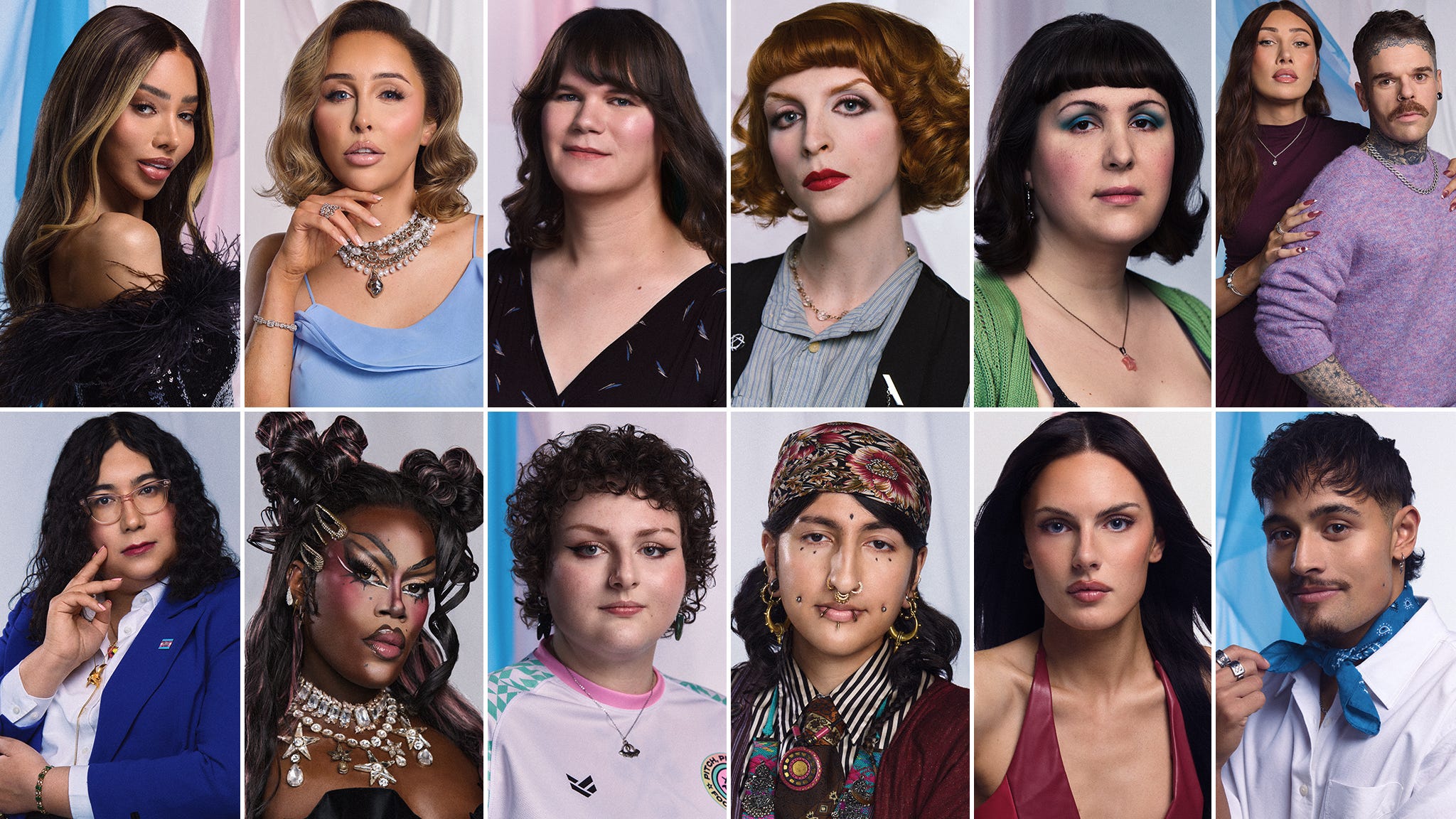
As is usual with a glossy women's magazine, there has been a photoshoot - and what a photoshoot. No Shon Faye this time but to my great joy they have glammed up gruesome unfunny comedian Jen Ives (2nd from right, top row)
This is much to long to screenshot the whole thing but here is the text. It's the same nonsense and made up statistics you're read a hundred times.
I like the minimalist take on pronouns here:

This person can never be the subject of a sentence. Please respect this.
One Year On: 13 people on the ruling that changed their lives [Link / archive]
As is usual with a glossy women's magazine, there has been a photoshoot - and what a photoshoot. No Shon Faye this time but to my great joy they have glammed up gruesome unfunny comedian Jen Ives (2nd from right, top row)
This is much to long to screenshot the whole thing but here is the text. It's the same nonsense and made up statistics you're read a hundred times.
For some, the news was expected – the dread that had been building in their stomachs was suddenly cemented. For others, it came as a shock.
They knew there were hateful people in this country; they’d seen them in their comment sections, heard them on the street. But they didn’t realise that this hate could be quite so loud, and that it would become enshrined in law.
In April last year, the Supreme Court ruled that, for the purposes of the Equality Act, a person’s sex is their biological sex (what is recorded on their original birth certificate). It came after widespread debate over who should be allowed to enter single-sex spaces, such as changing rooms, toilets, domestic abuse refuges and hospital wards. Anti-trans ‘activists’ celebrated, while others sobbed.
cover of cosmopolitan magazine featuring diverse individuals
Vic Lentaigne//Hearst Owned
How exactly the decision would be put into practice, however, was unclear. At the time of writing, that uncertainty remains. Most public bodies are still waiting for the Equality and Human Rights Commission to say how this should be enacted. A few companies moved quickly to bar transgender people from using toilets of their lived gender, while others remain in limbo. They don’t want to act, but fear they may be forced to do so. In the meantime, individual lives have been upended. The court has been clear that trans people are still protected under the Equality Act against discrimination and harassment. But that has not stopped many from living in terror.
Campaigners have claimed this ruling as a feminist act that protects cis women. Some paint trans women as a predatory danger whom we did not want in our spaces. But this is a smokescreen many see through, including Cosmopolitan. We have always been clear in our stance: we support and back the trans community and strive to continue to tell their stories of joy, pain, strength and everything in between. So, we wanted to show the reality of this decision, to give a platform to the community so they can describe what the past year has really been like for those most affected.
And, to be clear, it’s a decision that doesn’t only affect trans people. It’s one that says: if you don’t look how society expects a woman to look, you will be challenged, you will be harassed. But what you read in these pages does not paint the full picture; there were many who could not share their stories, out of fear of attack. Those who had once been out, being slowly driven back into the closet. When you force people to hide who they really are, the impact can be catastrophic. A first-of-its-kind study, carried out by The Trevor Project, found that anti-transgender laws cause an increase of up to 72% in suicide attempts among transgender and non-binary youth. The study was carried out on the LGBTQ+ population in the US, and while similar research is yet to be carried out in the UK, it is known that 48% of trans people here have attempted suicide.
Everyone's clicking on...
For those reading who feel they don’t or can’t have a voice, who feel lost, let this be a reminder that you’re not alone. We’ll keep fighting, together.
If you’re struggling with the issues raised in this feature, Switchboard is the national LGBTQIA+ support line. They’re confidential, and available on 0800 0119 100 or switchboard.lgbt
‘This has shown our human rights are fragile’
Munroe Bergdorf (she/her), 38, from London, is a model and activist. Her latest book, Talk To Me, is a guide for young adults, encouraging them to use their voice. It’s out now
I’d been braced for this. It’s been 16 years since my transition and, through my campaigning, over the years, I’ve been watching the patterns, how whenever there’s progress, there’s always a swing back. Ultimately, we’ve been sold this idea that transphobia is something experienced on an individual basis, rather than a system of oppression, so, understandably, this came as a shock to many. It’s been a wake-up call.
Living in the UK, there’s an arrogance that we’ve been brought up with; we just assume our human rights are always going to be there. This has shown that they are fragile and if you allow them to be removed for one portion of the population, it leaves the door open for everyone’s rights to be attacked. As, for trans people, this is proposed segregation – and it’s being used so freely without any kind of flinching. They’re talking about separate wards, separate spaces for us, trans people are being forced out of fear to not go to certain places… If you replace transgender with any other identity, people would not think that was okay.
At the moment, the proposed guidance has just been put out there, for companies to decide themselves what to do with it. When you ask how this is going to be implemented, there’s not really a clear answer. Are there going to be cisgender people waiting at the door to check whether everybody that enters is trans or cisgender? How would they do that? What does a trans person look like, as opposed to a cisgender person?
Trans people make up about 1% of the population, so these anti-trans rules are going to be affecting mainly cisgender women who are perceived to not be ‘woman’ enough. We are seeing women deemed to be ‘too beautiful’, or if they’ve had a lot of cosmetic work, being accused of being trans. Or they’re too tall, or they have a broad back. But we can’t allow being trans to be turned into a slur, as there’s nothing wrong with being trans. We also can’t fall into the trap where accusations of being trans are treated as more of an egregious offense than harassing an actual trans person, which seems to be fair game right now.
In June last year, the Lemkin Institute for Genocide Prevention announced a red-flag warning that the UK was showing the first signs of genocidal intent against its trans and intersex population. The stakes are so high and, with that, what I’m seeing is that we are pulling together. London Trans Pride grows every year and is now the biggest Trans Pride in the world; as a community we’re much more organised, much more empathetic to each other’s feelings and realities.
We’ve seen that one of the key tactics our opponents rely on is divide and conquer. They blame others for their failings and want us to turn on one another. I can see how they’re using women’s fears, around men and rising rates of violence, and diverting them on to us. All of this is a deliberate distraction, diverting society’s attention away from that escalating crisis and the fact that people can’t feed their children and they can’t heat their homes. Allowing ourselves to be divided is a sure-fire way to us being conquered. We have to keep sticking together and speaking up for each other.
‘I was pushed out of bathrooms’
Zelah Glasson (he/him), 25, from south London, was the first trans man to be cast on the ITV reboot of the reality TV show Big Brother
Waiting to leave the Big Brother house, I was worried as to how I had been perceived. I had only seen the same faces for five weeks, and now I was about to go out and face a live audience, with no idea how I had been portrayed. I was scared of getting it wrong. It’s unfair, but, as a trans person, you’re often expected to represent the entire community.
Especially as I’d had some tough conversations in the house. They were challenging at the time, but rewatching the conversations I am grateful that they were shown. I can understand why people have fallen for hatred when they haven’t met a trans person. Whereas, when you sit down with someone, their beliefs can start to shift, as here’s this person, whom this affects, sitting in front of you. Television can be a powerful way to bridge that gap.
The Supreme Court’s decision has affected me and will continue to do so – but trans women are the ones who will be targeted the most. I can use the men’s bathroom, and no one challenges me in the way they would challenge both trans and cis women. When I was a masculine lesbian, I was a woman going into women’s bathrooms and I was constantly being pushed out, sometimes physically. I’m hearing from friends that this behaviour has become significantly worse in the past year.
The agenda that’s being pushed – that trans people are an invasive presence, or that they’re a danger to women – is simply not true. The majority of us are just trying to live our lives but now are simply terrified. We just want to go about our days. So, to see JK Rowling seeming to celebrate the suffering of others has been very hard to watch.
‘Men will match with me on dating apps simply to be cruel’
Bel Priestley (she/her), 22, from London, began her career documenting her transition on TikTok and YouTube. She is also an actress who appeared on the second season of Heartstopper
A few months after the ruling, I was in a taxi that got stuck in traffic beside a group of protesters. They were the people who had campaigned for this. Listening to them, it was clear that they genuinely think trans people are a threat to society. I was tempted to go and have a conversation with them. But I don’t believe in fighting fire with fire, so I decided not to charge out. I’d have loved for them to understand how much this has affected us.
My life is now restricted: I get changed before I go to the gym, if I haven’t got makeup on I won’t go to the toilet and I would never travel at night. The rise in hate crimes has been extraordinary – even in cities that have previously been safe places to be queer. Most of my friends have experienced hate crime recently. As a well-known trans person, I am continually sent hate mail. Men will match with me on dating apps simply to be cruel. I see it getting worse before it gets better. Unless you’re a rich, white cis man, you’re on the chopping block to a certain degree. Women are not safe, and trans women are part of that. It’s why we need to pull together. I wouldn’t have been able to get through past year if it wasn’t for my tribe.
‘I’ll be going out with friends and think, “Do I need to email the pub and check the situation?”’
Alexandra Parmar-Yee (she/her), 35, from east London, works in digital marketing and is a volunteer at Trans+ Solidarity Alliance
I got an earful of transphobic abuse on the Tube soon after the judgment was announced, and I remember thinking, ‘Oh god, is it open season on us now?’ I considered leaving the country, it was that bad. It affects my social life. I’ll be going out with friends and think, ‘Do I need to email the pub and check the situation?’ It was difficult to go into the office after the judgment – not just because of the bathroom situation, but going outside, travelling to work. It affects the basic elements of your life.
But the judgment galvanised me, as well. I didn’t want to get beaten down and let this become normal. I poured myself into my work at Trans+ Solidarity Alliance, a volunteer organisation that does lobbying work for trans rights. Last June, I organised a mass lobby of parliament, where we brought 900 trans people and allies to speak face to face with their MPs. We believe it’s the largest lobby of its kind in history, followed closely by one against Section 28 in the 1980s.
My campaigning has put the fire in me – the same fire I get when I think about my mother. She passed away a couple of years ago, and she was so passionate about volunteering and her community. I’d like to think I’m carrying her spirit with me; I changed my middle name to hers. I often wish I could ask for her advice, but I think she’d be proud of me.
It can be exhausting. I sometimes put as many hours into volunteering as I do into my actual job. But I think doing something to fight back has helped me get through it. I want to do everything I can to work towards hope.
‘In order to be disappointed with the ruling, I’d have to have expectations to disappoint’
Jazmeen Qureshi (they/she), 26, is a Pakistani Muslim non-binary trans woman currently working as a writer, ecologist and facilitator, based in south London
When people ask me how the Supreme Court ruling has affected my life, I find it difficult to know what to tell them. It has affected me, for sure; I don’t want to act like it wasn’t a serious event. But what I want to draw attention to is that many of us – by ‘us’, I mean Black and brown trans women – have never had meaningful access to the protections that have been jeopardised. We’re already often excluded, in practice, from the limited legal protections offered to women. In order to be disappointed with the ruling, I’d have to have expectations to disappoint. The legal judgment itself is narrow in its focus. But so many corporations folded and adopted exclusionary policies when pressure was put on their funding. When your existence is an obstruction to the world view of people with money and power, excluding you is profitable.
The judgment ended the presumption that trans women might be becoming publicly normalised. There’d been a modest decrease in public transphobia: a small amount of trans people benefited a little, but only if they were white, straight enough, gender-conforming enough and conventionally attractive enough – only then they could maybe gain some acceptance.
But Black and brown trans women were never included in that small, precarious sphere of acceptance. People often know so little about racialised trans women, about how many of them are incarcerated or abandoned, or are deprived of housing, of jobs, of food, of medical care.
Emotionally, I think the biggest effect of the ruling is that it’s exposed me to more of what’s happening. There is so much transphobia in our society that it can be completely overwhelming. It feels like I have fewer layers of skin between me and that hostile stuff now. It’s been quite psychologically disturbing.
I’d like to see people respond to the ruling by listening to and uplifting Black and brown trans women, racialised and poor trans women, and trans people who don’t fit narrow ideas of visual palatability; those who express ideas in ways that might be stereotyped as messy or spiky. If you only listen to people who appear in easily digestible and comfortable ways, you’re rarely going to be confronted by ideas that radically challenge how you see the world. You won’t hear from the people who are most in touch with how bad things really are.
‘I was petrified to go to the gym’
Ella Morgan (she/her), 32, from Bristol, is the first transgender woman to appear on multiple shows, including Married At First Sight, Celebs Go Dating and Celebrity Come Dine With Me. She is a presenter and a charity patron raising money and awareness for Switchboard LGBT+
As soon as the ruling happened, I stopped going to the gym. I found I was absolutely petrified to go to this place I had once known and loved. There’s no disabled facility and I thought, ‘Well, where can I change?’ I’d always used the women’s changing rooms, because I am a woman.
But it felt like now I was being told I’d have to go into the men’s, which wasn’t going to happen. There was this overwhelming anxiety, it felt easier to just not go. That had a huge knock-on impact on my eating, body image and mental health. My eating disorder, which I thought I’d managed to conquer, made its return. I decided, just this week, to go back. I’ve booked in a session with my personal trainer and will change before going, so I feel safe.
It’s a step towards not letting this beat me down, because the day the ruling was announced, it was like a dark cloud came over us all. It’s the first time I’ve felt truly afraid since my transition.
Most of the time, when people have had opinions about me, I could roll my eyes. I know I can’t change everyone’s mind; we are all allowed to have different views. But this is very different. This is going to court to deny the rights of a small community. I’m seeing a lot more hate and threatening DMs. I get messages every single day calling me a man, as that’s what these haters love to use against us. It’s like, ‘Honey, I know I was born with a penis.’ I have never once said that I’m a biological woman; physically that is not possible. But equally, I am not going to stand biologically as a man. I am a woman; I am just a woman who happens to be trans.
The emphasis has been to attack trans women and paint us as a threat, as if we’re predators. But, when you look at the statistics when it comes to violence against women, the issue is men, not trans people. I get angry, as we’re still referred to and discussed as if we are men. Even when people think they’re being nice, it’s there.
I’ll be chatting to someone and they’ll say, ‘I have lots of gay friends’ and it’s like, ‘I’m not a gay man, I’m a woman.’ Or it’s, ‘You look just like a woman.’ What they’re really saying is that they still see me as a man.
I’m so worried about young trans people and I just want to say to them that, wherever your transition takes you, physically, spiritually, mentally, never give up. There are always going to be people who are against you. There are also so many people who will be there for you, who will support you and build you up. It’s so much better to get to live your life as your true self than to spend it hiding and fearing who you are.
‘I’m a cisgender woman with PCOS and people now yell slurs at me’
Hannah (she/her), 31, works in the public sector
I’m 6ft tall, broad-shouldered and I have had multiple incidents in the past year where I’ve been called slurs and questioned about my gender. It’s often from younger people. It’s ironic to hear people bluster that these policies are supposed to protect cis women and women’s sports: this anti-trans culture has led to gender policing that punishes women who don’t conform and makes us all less safe – but especially my trans sisters. If I presented as straight and feminine, I’d get less stick than I do.
I play football and softball on mixed-gender inclusive teams that welcome queer and trans people. I’ve never had any issues. Quite the opposite – it’s been a joy. I’m built like a brick shithouse and I can play with a five-foot-nothing speedster, and no one gets hurt. I have higher testosterone levels than many of the trans women I play with, and it’s fine! This imagined sharp division between cis and trans women on the field isn’t there for those of us who actually play.
A close friend of mine died of a treatable cancer a few years ago, she was in her twenties. Waiting for treatment cost her her life; she was a trans woman forced to wait for a bed on a ward after doctors couldn’t agree where she should go. This issue is not low priority; it can literally be the difference between life and death.
‘Why should I bother conforming to a society that doesn’t want me?’
Jude (her), 20s, is an artist from Leeds
The Supreme Court judgment sent a clear message: the state isn’t going to protect me or care about me. It’s not interested in what I want. So, what would make me happier?
It made me think deeply about my own life. My hair was waist-length, I’d been growing it for years. Trans women can be judged for not having ‘conforming’ symbols of womanhood, such as long hair. I cut it short, into a flapper-style bob. I then pushed forwards, more publicly, with my art. In the weeks after the judgment, I started receiving harassment from high-profile anti-trans figures after someone posted about my work. It was scary and disorientating. But I’m not going to let anyone stop me from living my life, or from making my art. It’s more important than ever to express ourselves the way we want to.
I’m known for wearing vintage clothes and covering radical history. There’s a saying in the vintage community: ‘vintage style, not vintage values’. It’s useful: we can appreciate the aesthetics of the past while rejecting historical racism and sexism. But I think there are vintage values we can use now: what about the anarchist, communist, punk movements of the last century? We can draw on these anti-authoritarian precedents. If the people who harass us drive us back into lives of conformity and fear, they get what they want.
‘We are defiant in our love for each other’
Alexis (she/her), 32, and Liam Blake (he/him), are based in Doncaster and have been a key voice as a married couple around transgender rights
alexis and liam posing together in a stylized photo shoot with a blue fabric backdrop
Vic Lentaigne//Hearst Owned
Alexis: I was 15 when I came out as transgender. I was on the path to hormones, but society led me to rethink. I pulled back. Over the next 12 years, I built an incredible dancing career and travelled all over the world. Then I fell in love. We met in September and Liam proposed in May. Despite it all, I still wasn’t happy. Everything I had pushed back down just came back out.
I’d always thought that if I transitioned, no one would want me. But I must have known, deep down, that the love Liam and I had would withstand it all, and I was right. When I told him in August, just months after his proposal, he was cool as a cucumber - he said, ‘Okay, how do we make that happen?’
We were planning our wedding when the ruling was announced. The scariest thing was the fear of the unknown; it was so hazy. I was thinking, ‘What does that mean for my job? For our marriage? Does this mean they’ll make us get married as two men?’ I got straight on the phone to our celebrant and they were amazing. Our wedding was the most incredible day, celebrating who we are.
But that was just one day. The repercussions of the decision are still unfolding. I’m privileged because I can pass. I can go about my day and blend in. I know that’s not the case for everyone; that’s not fair. I get comments like, ‘But you look like a woman’ and it’s like, ‘What if I didn’t? Would you not like me then?’ People shouldn’t be penalised if they can or can’t pass, as that depends on so much, from finances to how comfortable people feel about surgery. Overall, that feeling of, ‘I don’t belong in here’ has been amplified.
Perhaps I was naïve, but I thought our rights would just get better – just look at gay rights throughout our lives – then there’s been this sudden U-turn. It really opened my eyes into thinking I must be defiant and raise my voice. I spent 30 years hating myself and the past four years have made me love myself. No one can undo everything I’ve done to get here.
Liam: When Alexis came out, I had just made her a sandwich! We were in Greece, and she said, ‘Babe, I think I’m transgender.’ It was a shock, but, in the moment, my love for her just overrode everything. On our platforms, all we’re trying to do is show who we are: we’re a normal Yorkshire couple. We are trying to advocate for trans rights in our way – it’s educational but also funny. We are showing who we are, our love, and I want people to look at us and think, ‘Oh, okay, so people like that exist. Maybe we shouldn’t be scared.’
‘I was signed off work because of the stress’
Johanna Kirkpatrick (she/her), 28, is a singer from Glasgow who works as an administrator
The week the judgment was publicised, I remember going to football practice – I play for a trans football team in Glasgow – and seeing everyone just look at each other. It felt almost like a joke, for a while, to ask people at practice how they were: how do you think we are? We all had this shared understanding, but it was also difficult to articulate and process things, because everything was so uncertain.
Things that hadn’t bothered me as much before started to eat away at me; it felt like my womanhood was being questioned and challenged at every turn, and that there was always a risk that someone would have a problem with me. My workplace told me that I could continue to use the women’s facilities, but if someone complained, they might have to reassess their policy. I felt constantly anxious. Were people watching me? Was someone getting ready to complain? What would happen if they did – would I be punished in some way? It’s very difficult to do your job under those conditions. It feels like having an axe suspended above your head. I ended up being signed off work for months because of the stress.
I’m back at work; things are going better and I consider myself lucky, as my managers have been understanding. But I want people to understand how psychologically draining being trans is under these conditions. Every basic thing that makes up your life can become harder.
‘We exist and what we’re facing is real’
Nyongbella (she/her), 26, from London, is the third transgender contestant to appear on Drag Race UK
Since appearing on Drag Race, my world has opened up. This is such a blessing, but it’s also so scary, because I’m going into unfamiliar territory, so I’ll be walking to venues, in new places, with no idea how I will be treated. But then, I also know from the show just how many people support me and the trans community. I am jovial, bubbly, whimsical and unabashedly feminine, and I’ve been told, by so many, that I’ve inspired others to be themselves. I was also raised Black, before I was raised trans. By the time I first grew to understand I was queer, I had already had all kinds of bigotry and microaggressions. I know how to handle it and let it roll off as best as I can.
But it can get to even the strongest of people, and it does weigh me down. It’s okay to admit that. Anyone struggling right now should know their feelings are valid. I’ve found that, sometimes, when people are attempting to offer support to marginalised communities, they can try to act like it’s not a big deal. As if by pretending the issues aren’t there, they’ll go away. But we exist, and what we’re facing is real. We can acknowledge that while also trying our best to not hyper-focus on the bleakness. I’ve found that looking for the joys in my life, day to day, and making my life worth living, helps me to persevere. I know that the best day of my life is yet to come.
‘The suffocating atmosphere made me more insular’
Jen Ives (she/her), 35, is a writer from London
When the ruling hit, it was on the news non-stop. It’s very disappointing seeing institutions swallow obviously disingenuous and harmful messaging. I don’t like being this blunt about it, but the rhetoric about trans women and women’s spaces is pushing the idea that trans women are all potential rapists. That’s a transphobic lie that’s not healthy for us to hear day in, day out.
I’ve been out and transitioning for 15 years. I’ve always been very steadfast; I’m a resilient person. My initial response was, ‘I’m just going to keep doing what I’ve been doing.’ But the suffocating atmosphere really started to get to me. I’ve become more insular. I’ve found myself, at times, avoiding the women’s toilets and using the intersex toilet (there’s only one of them on my floor and it’s always occupied) and I had to take a month off work, which
I’ve never done before. I worry a lot about the younger generation. I’m a strong person, so if this has sometimes made me want to stop doing things I’ve been doing for years, then what will it do to those who haven’t yet had the chance to build up their resilience?
When I started transitioning, the expectation was that you needed to pass the ‘real-life test’ before you could access transition care. You had to live for years, in public, as a woman, using women’s facilities, before they would give you hormones. If you avoided using women’s spaces,it was seen as proof that you weren’t serious about transition. It’s degrading to be ‘tested’ like that; I’m very glad that it’s less common now. But it feels very galling to be punished for asserting yourself as a woman and punished for not doing so. It feels like I signed a social contract, and that the contract’s been torn up.
I like the minimalist take on pronouns here:
This person can never be the subject of a sentence. Please respect this.
Last edited:


