
- Joined
- Feb 10, 2020
Because it's there.
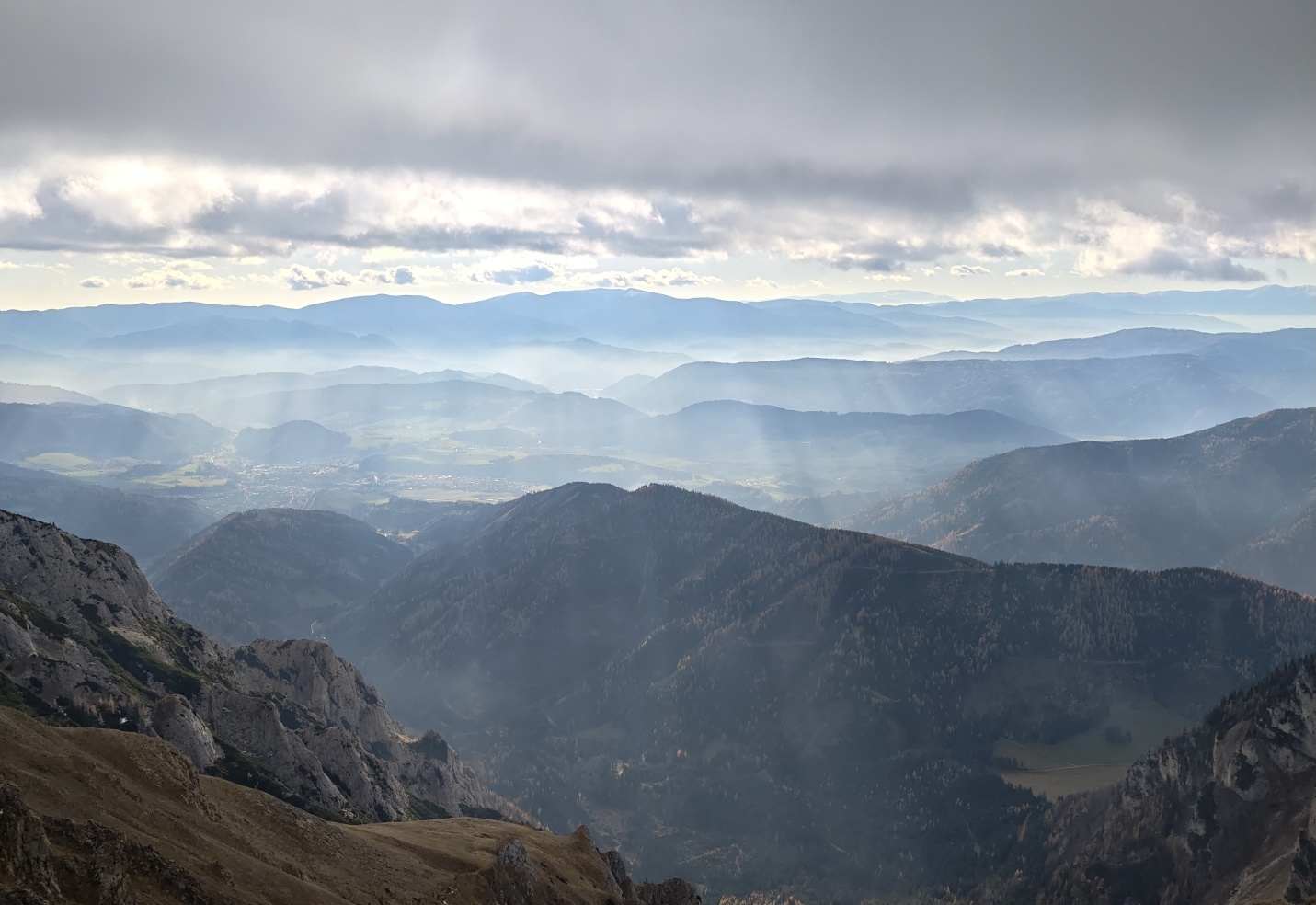
Just over a decade ago, @Strelok 2.0 created the Hiking / Camping Thread and I'm attempting a revival with a proper OP (in progress)
Planning a hike is easier than ever, thanks to applications like "Komoot" which allow you to drop a pin anywhere in the world and see where other people have gone before you. With modern GPS, getting lost is practically a thing of the past. Even if you don't feel particularly fit, there is a good chance you might find your body far more capable than you think once your feet have gone for a while - and who knows who you'll meet along the way:
A young iberian mountain goat learns that thistles are not delicious
HE'S FAT
Besides facilitating the discussion of hardcore grass touching, the OP will contain some info for people who are interested in getting out but have no idea where to start.
While unfortunately this can turn what should be a nature-centric hobby into a huge consoomfest, gear does play a role and I'll touch on it heavily - while I am trying to make this as general as possible, I come from a mountaineering perspective and this no doubt prejudices me in one way or another.

A woman's A-B Hanwag “Tatra Light Lady” and a man’s Garmont “Ascent” C – even though they are both US 8.5, the man's Garmont are 5mm shorter and taper considerably narrower.
Boots and shoes are categorized into A / B / C / D which correspond to B0/B1/B2/B3
These primarily denote the stiffness of the footwear in question and thus how suitable they are to tackling different terrain, with C/D – B2/B3 boots denoting compatibility with (semi)automatic crampons meant to tackle steep snow and hard ice. The added stiffness adds both weight and makes them less pleasant to walk in for longer periods of time.
Footgear generally comes in Low, Mid and High – a low cut shoe will provide little ankle support, meaning that it is entirely possible for a misplaced foot to keel right over, potentially leading to all kinds of unpleasantness. At the same time, a high boot, while incredibly supportive, will add a lot of weight and less flexibility to every step, making it less practical for scrambling and more tiring to walk in. Frankly, for most people, a mid cut Category B / B1 presents the most sensible middle ground between flexibility, support and weight for anyone who intends to hike more than the most well kept trails (in which case, a trailrunner is fine). Some models come in both synthetic and leather uppers, with the latter being more hard wearing but adding weight (and requiring the occasional leather care) and a break in period during which the shoe will be less pleasant to wear – only you can decide where your priorities lie in this regard.
But Bloitz, there’s a million B/B1 shoes out there – which model is best for me ?
In recent years, almost all major brands specializing in hiking footwear (Lowa, La Sportiva, Scarpa, Hanwag, Meindl, Salomon, Garmont to name a few) have incorporated the most modern membranes, (mid)soles and uppers into their footgear, so that the number one thing that really matters is simply – does it fit your foot?
Grab a piece of paper, put it up against the wall, position your heel at the back edge of the paper alongside the wall, then mark a line at the foremost edge of your big toe. Measure this distance and you have the so called “mondopoint” – the length of your foot. All decent manufacturers will have a table detailing their sizing, including mondopoint, which then translates to a highly variable US / UK / EU size that is borderline meaningless - which is why knowing the length of your foot is so important. If you intend to wear thick wool socks and perhaps insoles, size up at least 1 full size from what the mondopoint indicates. If you're only walking in warm weather, a half size nonetheless, as your foot will swell as you walk - downhill, this also prevents your toes from banging into the front of the shoe.
Nonetheless, as feet vary wildly in shape and width, there is no real getting around trying a shoe on (with the socks and insoles you intend to use) – luckily, brands tend to stick to a particular cut so that once you have found a brand that fits you properly, chances are that brand will continue to fit you in future. If you’re a gentleman with narrow feet, consider checking out the lady’s section – conversely if you’re a gal with a broad forefoot, you might be more comfortable in a man’s shoe.

A properly adjusted backpack allows for both ventilation and a secure fit
15L for a day, 25L for up to a week if you’re overnighting indoors, 38L for hiking in perpetuity. Note that I am referring to the size of the main compartment – there’s an unfortunate tendency with some manufacturers to inflate their sizing by adding the maximum fill of side pockets, mesh pockets and even waist pockets to the number they put out. The reality is that no one fills every pocket to the exact brim, rendering this metric utterly meaningless. Consequently, I’ve had Chinese 35+10L backpacks (the + denotes a main compartment with a rolltop that can be extended) capable of carrying more than an Osprey marketed as 55L. Check the specifications to find the size of the main compartment, everything else is nonsense.
So why not just grab the biggest pack and use it all the time?
Even without taking into consideration the higher weight of larger backpacks, every backpack is designed around bearing a certain load – if severely underloaded, the backpack will not sit properly on your back and be uncomfortable.
To find your backpack size, lean your head forward, then run your hand along your spine – you will find one vertebra noticeably sticking out just below your neck (C7). Put your hand on your hip like a sassy lady and feel where the uppermost part of your hipbone (iliac crest) is. The distance between these two points (straight down) is your back length. Some backpacks are height adjustable but many – particularly those that don’t weigh a ton, come in different sizes.
While at first glance, a backpack with many pockets, zippers and accessories looks tempting, in the field, it leads to items being hard to reach and makes them easier to misplace, as well as adding failure points. Instead, sort items into smaller, color coded dry bags and zipper pouches by purpose and pack your backpack with the most important ones in easiest reach, such as in the front mesh/net or the very top of the pack. In general, place heavy items in the bottom and middle, and lightweight items on top. Keep in mind which gear you will probably only take out at the end of the day and put that in first.
Always fit your backpack when fully loaded – trying on a backpack empty is pointless. Load the pack with at least 5kg (11lbs), then adjust the hip belt so its center sits on the center of your hip bone. Cinch the waist belt tight, then adjust the shoulder strap width and cinch the chest and bottom shoulder strap tight. Most of the weight should be carried by your hips, not your shoulders. During the process, part of the waist belt might ride up and over your hip bone slightly – this is normal. Finally, grab the load lifters and adjust them to approx. 90 degrees. When in difficult terrain, pull the load lifters until the pack becomes one unit with your body. When in easy terrain, adjust load lifters so that your back is ventilated without the backpack feeling loose.
If your backpack feels uncomfortable, adjust until it does not. If the backpack still feels uncomfortable, get a different one – just like with footwear, some backpacks fit some people better than others.
Women that find their body shape to be distinctly female should look into women's specific backpacks which tend to be curved differently as to not compress the bust and feature more adjustable waist straps.

Even though it's only 14C / 57F when this photo is taken, the act of moving generates enough heat to make tank tops and shorts a viable choice when the wind isn't blowing
New hikers tend to overestimate the amount of clothes they require. Before you set out, wear your intended clothes and go for a light jog for at least a few minutes. There is a decent chance you might overheat. Adjust accordingly.
While there are many approaches to layering for a variety of temperatures, most people tend to arrive at the following scheme independently, assuming it is not the height of summer:
Wool base layer – light or heavy depending on the season. Once in motion, a 240g wool shirt will keep you going until just above freezing without issue. Wool will take a much longer time to smell funky, compared to synthetics.
Fleece mid layer – nowadays often Alpha Direct or Primaloft Evolve, these are incredibly lightweight fleeces that allow air to permeate, meaning even a tiny bit of wind will wisk away the warmth it provides. What might at first sound like a downside, allows one to easily regulate body temperature by simply opening or closing the windbreaker's main zipper.
Windbreaker – layered either over just the base layer when it’s above freezing but windy, or above the fleece if it’s around freezing and windy.
Rain jacket or Poncho – self explanatory. Silpoly Ponchos are available around 35$ nowadays from Aliexpress and include a belt and zipper. While less agile and elegant than a jacket, they provide superior coverage for both person and backpack and can be equipped without ever taking the backpack off.
Insulation – Whilst remaining static at freezing temperatures or in extreme wind, down jackets (and pants) reign supreme for their weight and compressibility. While much has been made of the superiority of goose down over duck down, the reality is that the few independent papers on the subject suggest their durability and capabilities being pretty much equal, given equal fill power. Most sources that laud the superiority of goose tend to trace back to manufacturers of goose down equipment (which command a higher price).
Pants – For most things, lightweight, breathable polyester is fine. Softshell is not a necessity unless one does a lot of scrambling in alpine terrain where other pants might tear. It’s a nice material in just-above-freezing temperatures or below, as it is somewhat windproof, somewhat rainproof and somewhat insulating. Unless you intend to use it in deep winter and at high altitudes, a lightweight softshell without extra insulation is the best choice as one can always add wool long johns for extra warmth when temperatures drop below freezing.
Remember that along your route, you will need to source water, which will allow you to clean your clothes - there's no need for half a dozen boxers if you can clean and dry the pair that you're not using atm. If you are stuck below freezing or in persistent rain where clothes simply do not dry for days on end - well, priorities will probably lie elsewhere.
Avoid cotton at all costs.

A lagoon at high altitude - often a mess of algae and legionella
The three most popular approaches to carrying water are the hydration pack, soft flasks and smart water bottles in the US. The hydration pack is super convenient at normal temperatures, but fails at below freezing temperatures as even with an insulating pouch, the water in the hose ultimately ends up as solid ice. It's also slightly annoying to refill, as one usually has to take out all other contents of one's backpack to be able to stuff it back in once full. Carrying multiple half liter soft flasks or smart water bottles allows for the water’s weight to be distributed in your backpack however you want, they take up little space once empty and they are less susceptible to freezing when carried inside insulation pouches.
Assuming water sources are not infected by viruses, modern water filters like those by Sawyer (Mini) or Lifestraw (Peak), which screw into a standard bottle thread (28mm) are lightweight and easy solutions to purifying water on the go – all use a set of superfine membranes that are simply too tight to allow sediment and bacteria to pass through. Fill a bottle with water, thread on the filter, push water through slowly and presto, you have clean drinking water. Just mark your dirty water bottle accordingly and regularly backflush the filter with clean water – if they are not going to be in use for a few weeks, fill with and store in saline solution or water with a few drops of bleach inside a container.
A trekking pole tent in winds exceeding 50 mp/h or 75 km/h at approx 3000m - as the ground was hard, all guylines had to be anchored using rocks.
The three approaches to overnighting beneath the sky are Tents, groundcloth and tarp combo, or bivy bag (with or without tarp).
Tents come in double wall or single wall – double wall indicating a flysheet attached to a separate inner tent. The fundamental difference lies in the superior management of condensation – the temperature difference within the tent and the outside, as well as sweating and breathing, causes dew to form on the outermost wall of whatever it is you are sleeping in, if ample ventilation is not provided. With double wall tents, this collects outside the inner tent and consequently will not bother you. With single wall tents, condensation can collect and potentially drip down or collect at the footend and get your sleeping bag all wet. This can be managed by ventilation or simply wiping down the tent in the morning.
Tents are generally given structure either through the use of trekking pole(s) or aluminium, plastic or carbon poles. The former saves weight since you’re carrying those anyway, the latter allow you to pick up the tent (freestanding) and move it around before pegging it down. I have used trekking pole tents in extreme winds at altitude, and they have kept me safe and dry – however if you are sure you’ll primarily encounter adverse conditions, freestanding is almost certainly the way to go.
A groundcloth coupled with a tarp provide a flexible alternative but there are close to no weight savings these days compared to a modern single wall tent. As such, the main reason to choose this solution is precisely because it lacks a completely enclosed shelter and thus gives an unobstructed view of the natural world around you, weather permitting. If you know the weather will be pleasant, a groundcloth or mesh bivy can be a nice way to keep critters off you while cowboy camping. Adding a tarp to it will push the weight into the area of (some) single wall tents.
Proper, fully enclosed bivy bags that protect you from rain and storm are sometimes used by bikepackers and seem great at first glance, being lightweight and stormproof. Unfortunately, they are simply not sensible for overnighting in humid areas or higher temperatures. Breathable membranes that allow water vapor to escape operate best in dry environments with a large temperature difference between the inside of the bag and the outside - the positive air pressure from the warmer air forces humidity outwards. Consequently, and no bivy bag is exempt from this, there will be a ton of condensation inside a closed bivy bag when used in mild weather in humid conditions, leading to both person and gear getting soaked. On the flipside, a bivy bag is ideal for alpine terrain, where during spring, autumn and winter, temperatures will usually be on the colder side and the air is not usually as humid.
All proper shelters employ pegs to anchor them – while pegs come in many shapes and sizes, all my research and experiences indicate that with few exceptions, the primary factor that matters is simply how deeply submerged the peg is. If the ground is hard, either make a loop around a small rock, then place a large rock in front and on top of your wind rope, or jam the peg in-between some solid slabs of rock to keep your shelter anchored.


Pulled pork is dehydrated, added to water which, once boiled, is left to sit in a cozy for 15 minutes, resulting in a highly nutritious meal on the go with minimal fuel and weight.
With modern tech, the most effective way of having nourishing meals on the go is to do all the cooking ahead of time. Anything that does not involve a high fat content can be pre-prepared, dehydrated and packed up with little weight - this includes things like tomato sauce (which turns into a leathery consistency), thai curries and most meat dishes. Once you are ready to eat, bring water to a boil, throw it in, stir, then put your pot into a DIY pot cozy to save on fuel for 15 minutes or so.
Unless you harbor a strong distrust or dislike for canisters, gas is the way to go for boiling water efficiently. The alternative is alcohol, which is less efficient and involves a more exposed flame. However, if you are travelling to a different country, you might find it much easier to quickly find some Ethanol compared to gas canisters. Ethanol is also far easier to measure out, allowing you to bring the exact amount you need for any given trek.
I have never had to take bears into consideration - if someone wants to write a post on that subject, I'll gladly add it to the OP as it is a highly relevant topic for NA hikers.
Experiences, adventures, anecdotes, survival tips, questions and perhaps even photos or footage - share 'em
Last edited:


