John Burn-Murdoch
Published yesterday
© FT montage/Getty Images
On Wednesday we learnt that the UK birth rate has fallen to a record low, joining the US, France, Italy and dozens of other countries this year.
Concern over declining births — long considered an unhealthy hobby of the conservative right — is spreading. It featured prominently in the presentations given by central bankers Christine Lagarde, Andrew Bailey and Kazuo Ueda at Jackson Hole last week, due to the deleterious economic impacts of ageing populations.
But one section of society that continues to steer clear of the topic is the left. To progressives, worrying about birth rates is an inherently conservative concern. This seems valid enough. Wanting people to have more children can imply constraining individual freedom and setting back women’s progress. More humans also means more emissions heating an already sweating planet.
But take a closer look at the evidence and it’s less clear that the logic holds. In fact, it’s possible that in ceding the floor to the right on this issue, progressives may themselves be ushering in a more conservative, less green future.
Let’s start with the environmentalist argument that falling birth rates are good for the planet. This may appear obviously true, but the reality is less clear.
Total emissions volumes are a function of two things: the number of people emitting, and how much each person emits. The former may be more palpable, but the latter has a vastly larger impact. Technological progress and green policies have dramatically shrunk the average westerner’s carbon footprint over recent decades, meaning countries such as Britain, France and the US have steeply reduced their overall emissions even as populations have climbed. In Japan, however, the retreat from clean nuclear energy after the Fukushima disaster saw emissions rise even as birth rates trended ever lower.
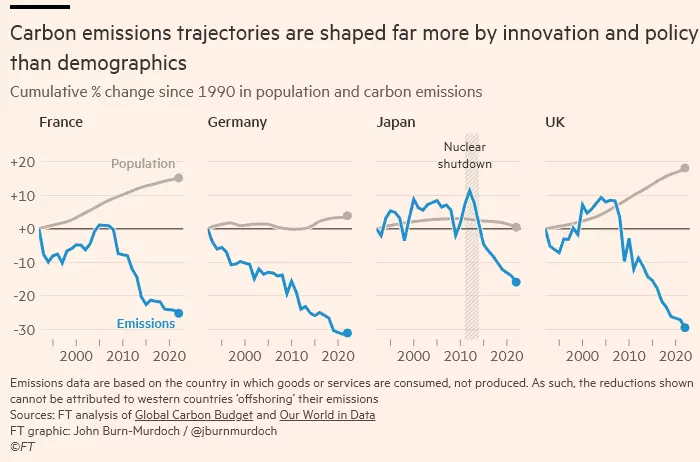
It’s not just that innovation swamps demographics: the two are linked. Countries with older populations are generally less innovative and more conservative, both of which can slow the energy transition and broader greening of their economies and societies.
A striking study published this year by a group of US researchers comes to a similar conclusion. At best, falling birth rates will have a negligible impact on global temperatures and come far too late to affect climate goals. At worst, the net effect is to slow progress, putting the planet on a dirtier, warmer path.
This brings me to the second part of the progressive population paradox. Recent studies find that the left’s lack of concern over falling birth rates is likely to be pushing societies in a more conservative direction. Extending previous analysis of the interplay between political ideology and family formation, I find that the assumption that birth rates are falling across society in general is not really true. From the US to Europe and beyond, people who identify as conservative are having almost as many children as they were decades ago.
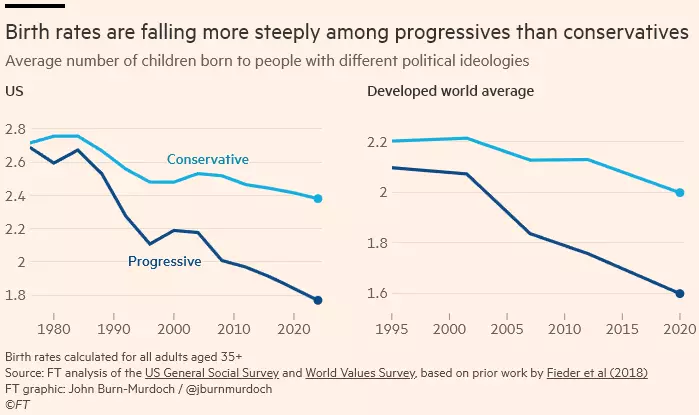
The decline is overwhelmingly among those on the progressive left, in effect nudging each successive generation’s politics further to the right than they would otherwise have been. This may ultimately mean more curtailing of individual freedoms, not less.
Of course, children do not inherit their parents’ politics wholesale, and each successive generation has historically tended to be more liberal than the last on social issues. But it is well established that children’s values are strongly shaped by those of their parents. A growing left-right birth rate gap will slow that liberalising conveyor belt, and could result in societies and politicians that are less liberal and less concerned with the environment than would otherwise be the case.
Everyone should be empowered to have the number of children they desire, and zero is as legitimate a choice as any. There are many other ways to contribute to society, after all. But if part of one’s rationale for not having any is that it’s the right choice for the planet, or that it embodies progressive values, it’s not clear the evidence bears this out.
The greatest trick the right ever pulled was convincing the left that talking about families and children is conservative-coded. Rather than worrying about adding more carbon footprints, maybe progressives should embrace the prospect of raising the people who invent the technologies or elect the governments that deliver net zero.
 to include more recent data. Both surveys ask respondents how many children they have, as well as where they would place themselves on a political scale from left to right.
Source (Archive)
Published yesterday
© FT montage/Getty Images
On Wednesday we learnt that the UK birth rate has fallen to a record low, joining the US, France, Italy and dozens of other countries this year.
Concern over declining births — long considered an unhealthy hobby of the conservative right — is spreading. It featured prominently in the presentations given by central bankers Christine Lagarde, Andrew Bailey and Kazuo Ueda at Jackson Hole last week, due to the deleterious economic impacts of ageing populations.
But one section of society that continues to steer clear of the topic is the left. To progressives, worrying about birth rates is an inherently conservative concern. This seems valid enough. Wanting people to have more children can imply constraining individual freedom and setting back women’s progress. More humans also means more emissions heating an already sweating planet.
But take a closer look at the evidence and it’s less clear that the logic holds. In fact, it’s possible that in ceding the floor to the right on this issue, progressives may themselves be ushering in a more conservative, less green future.
Let’s start with the environmentalist argument that falling birth rates are good for the planet. This may appear obviously true, but the reality is less clear.
Total emissions volumes are a function of two things: the number of people emitting, and how much each person emits. The former may be more palpable, but the latter has a vastly larger impact. Technological progress and green policies have dramatically shrunk the average westerner’s carbon footprint over recent decades, meaning countries such as Britain, France and the US have steeply reduced their overall emissions even as populations have climbed. In Japan, however, the retreat from clean nuclear energy after the Fukushima disaster saw emissions rise even as birth rates trended ever lower.
It’s not just that innovation swamps demographics: the two are linked. Countries with older populations are generally less innovative and more conservative, both of which can slow the energy transition and broader greening of their economies and societies.
A striking study published this year by a group of US researchers comes to a similar conclusion. At best, falling birth rates will have a negligible impact on global temperatures and come far too late to affect climate goals. At worst, the net effect is to slow progress, putting the planet on a dirtier, warmer path.
This brings me to the second part of the progressive population paradox. Recent studies find that the left’s lack of concern over falling birth rates is likely to be pushing societies in a more conservative direction. Extending previous analysis of the interplay between political ideology and family formation, I find that the assumption that birth rates are falling across society in general is not really true. From the US to Europe and beyond, people who identify as conservative are having almost as many children as they were decades ago.
The decline is overwhelmingly among those on the progressive left, in effect nudging each successive generation’s politics further to the right than they would otherwise have been. This may ultimately mean more curtailing of individual freedoms, not less.
Of course, children do not inherit their parents’ politics wholesale, and each successive generation has historically tended to be more liberal than the last on social issues. But it is well established that children’s values are strongly shaped by those of their parents. A growing left-right birth rate gap will slow that liberalising conveyor belt, and could result in societies and politicians that are less liberal and less concerned with the environment than would otherwise be the case.
Everyone should be empowered to have the number of children they desire, and zero is as legitimate a choice as any. There are many other ways to contribute to society, after all. But if part of one’s rationale for not having any is that it’s the right choice for the planet, or that it embodies progressive values, it’s not clear the evidence bears this out.
The greatest trick the right ever pulled was convincing the left that talking about families and children is conservative-coded. Rather than worrying about adding more carbon footprints, maybe progressives should embrace the prospect of raising the people who invent the technologies or elect the governments that deliver net zero.
Data sources and methodology
Birth rates for people with different political views were calculated using the US General Social Survey and the World Values Survey, extending prior work by Fieder et al (201 to include more recent data. Both surveys ask respondents how many children they have, as well as where they would place themselves on a political scale from left to right.Source (Archive)


