L | A (Translated with ChatGPT)
By Takeshi Yamawaki

The Kanji Museum, located right next to Yasaka Shrine in Kyoto - Gion Town, Higashiyama Ward, Kyoto City.
In this series "Considering Global Education," we have been following educational movements connecting Japan and the world, but this time, I would like to reflect on the "Japanese language," which forms the foundation of education in Japan.
Right after the end of World War II, the General Headquarters of the Allied Forces (GHQ), which occupied Japan, attempted to abolish kanji (Chinese characters) and replace them with the Latin alphabet.
The treatment of the Japanese language, especially kanji, was a major postwar issue that involved not only linguists but also intellectuals. By reviewing the history of the "Kanji Abolition Theory" and the "Kanji Restriction Theory," we will consider the significance of using Japanese for thought.
The area around Yasaka Shrine in Kyoto's Gion is known for the sight of women dressed in kimonos. Many of these vibrant kimonos are rented from shops, and there are particularly many tourists from China.
Near Yasaka Shrine is the "Kanji Museum" (Kanken Kanji Museum and Library), which was established in 2016 by the Japan Kanji Aptitude Testing Foundation, the organization behind the Kanji Proficiency Test (Kanken), taken by over 2 million people annually. As you walk through the two-story building, you can easily grasp the history of how kanji, hiragana, and katakana came to be used.
One of the most fascinating parts of the exhibit is the history of how the General Headquarters of the Allied Forces (GHQ), which occupied Japan, attempted to abolish kanji. The "American Education Mission," dispatched from the U.S. at the request of the GHQ, was composed of 27 university presidents, professors, and educational administrators.
They believed that Japanese should be written in the Latin alphabet, and that the time spent learning kanji should be redirected to studying foreign languages and mathematics. In 1946, they published the "Report of the United States Education Mission to Japan" (a Japanese translation is available in the Kodansha Academic Library).
The report states, "From the standpoint of historical fact, education, and language analysis, this mission believes that kanji should eventually be completely abolished as a general writing system, and a phonetic alphabetic system should be adopted."

The exhibits inside the Kanji Museum are arranged in a way that allows visitors to understand the development of kanji, hiragana, and katakana in chronological order.
So why is kanji still in use today? Tetsuji Atsuji, Professor Emeritus at Kyoto University and Director of the Kanji Culture Research Institute, which has an office inside the Kanji Museum, explains the background behind the decision not to abolish kanji.
"GHQ believed that kanji contributed to Japan's march toward war. They also thought that phonetic scripts, like the English alphabet, were more advanced than ideographic characters like kanji."
The American Education Mission attempted to prove that Japan’s low literacy rate was due to the difficulty of kanji and ordered a nationwide survey.
Conducted in August 1948 with about 17,000 people across Japan, the survey was scored out of 90 points, where each correct answer earned one point. When converted to a 100-point scale, the average score was 78, and only about 2% of the participants were completely illiterate (scoring zero).
This result was vastly different from the mission’s expectations, and thus the idea of abolishing kanji was not pursued.
Kanji Abolition Theory was not unique to the GHQ era; it existed before World War II as well.
A famous example is Maejima Hisoka, the "father of the postal system" during the Meiji period. Maejima advised the last shogun of the Edo period, Tokugawa Yoshinobu, to spread education using kana characters.
In the early Meiji era, the first Minister of Education, Mori Arinori, proposed making English the official language. Shortly after the war, writer Naoya Shiga even argued that French should be made the official language.
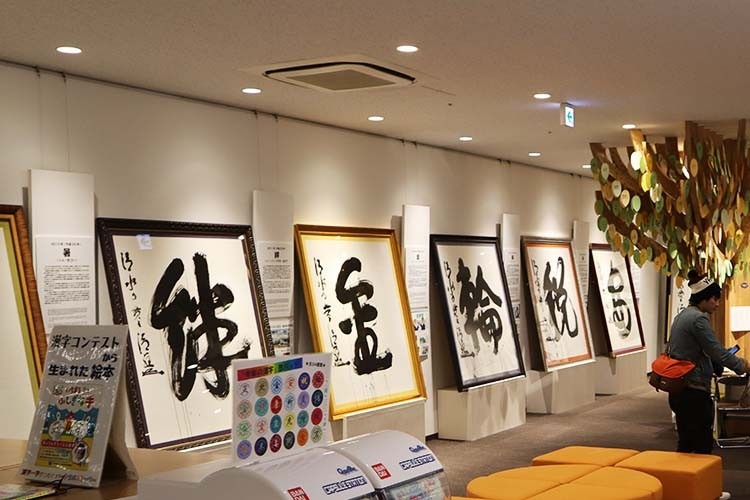
Inside the Kanji Museum, there is a display showcasing the "Kanji of the Year," where the Japan Kanji Aptitude Testing Foundation invites the public to submit a kanji that represents the state of society for that year. The most popular character is then calligraphed by the head priest of Kiyomizu Temple. This exhibit features the chosen kanji.
Even though advocating for French as an official language was an extreme idea, there was a period after the war when the National Language Council saw the "Kana Faction" or "Phonetic Script Faction" gain significant influence.
One of its leaders was Itō Chūbē II (1886–1973), a prominent businessman who laid the foundation for Itochu Corporation and Marubeni. Although he was also a cultural figure who enjoyed writing haiku, he was actively involved in the pre- and post-war movement to abolish kanji, co-founding the "Kana Script Society," which promoted the use of horizontal katakana writing.
Atsuji points out that the rise of the "Phonetic Script Faction" stemmed from a sense of inferiority among some intellectuals and businessmen. One of the driving reasons for Chubei Ito’s promotion of the katakana movement was the inability to type Japanese characters quickly on devices like English typewriters.
Ryūzō Sejima and the Kana Typewriter
Setsuzo Kosaka, chairman of the Japan Kanji Aptitude Testing Foundation, joined Itochu Corporation in 1959. Initially assigned to the Osaka headquarters, he transferred to the Tokyo office a few years later. He recalls that during his time at Itochu, the company used a typewriter for katakana, known as a "kana typewriter."
"However, it wasn't something used by everyone, including younger staff. I didn’t have a kana typewriter at my desk, but the executives used them."

Setsuzo Kosaka, chairman of the Japan Kanji Aptitude Testing Foundation
Within the company, there was a department responsible for printing. For important handwritten documents, typesetters would pick up type and print using letterpress, resulting in the documents being printed as official records. However, preparing handwritten documents for printing took time.
Itō Chūbē aimed to streamline this process by making important company documents available in a format similar to Western-style typing, which could be done quickly with an English typewriter. To this end, he had executives use the kana typewriter for important documents. Since English typewriters and kana typewriters have different arrangements of characters, some training was necessary to use them effectively.
At that time, Setsuzo Kosaka was part of the Business Planning Department in Osaka and Tokyo. His superior was Ryūzō Seshima, an army veteran who had been interned in Siberia for 11 years and later became the chairman of Itochu.
Kōsaka's first overseas business trip took him to the United States and Europe. Seshima’s predecessor had become the European coordinator stationed in Paris. Seshima entrusted Kosaka with a handwritten letter on scrolls to be delivered to his successor.
Upon receiving it in Paris, the coordinator, with a wry smile, remarked, “Seshima-san always makes things difficult,” and typed a reply on the kana typewriter, which was then sent back to Kosaka. Despite being an executive at Itochu, Seshima either could not or did not use the kana typewriter.
Itō Chūbē, in his role as an advisor, sometimes appeared in the Business Planning Department. Kosaka remembers him saying to a few people, “Think of using the kana typewriter as my last will.”
However, after Itō passed away in 1973, the kana typewriter gradually fell out of use within Itochu. Kōsaka, who served as a managing director at Itochu before becoming chairman of Kurita Industrial, assumed the role of chairman of the Japan Kanji Aptitude Testing Foundation in 2011. Kosaka's brother was Masayoshi Kosaka, a prominent international political scholar and professor at Kyoto University.
It is a curious turn of events that Kosaka, who practiced kanji abolition within Itochu, became the chairman of the Japan Kanji Aptitude Testing Foundation, an organization dedicated to enhancing kanji proficiency.
The “Kanji Restriction Theory” Promoted by Writer Yūzō Yamamoto
While the “kanji abolition theory” faded in the 1960s, the “kanji restriction theory,” which aimed to minimize the number of usable kanji, remained influential until the 1970s.
A leading proponent of the “kanji restriction theory” was Yūzō Yamamoto (1887–1974), known for his novel “Rohō no Ishi” (The Stone on the Road).
After the war, following GHQ’s recommendations, the Ministry of Education established the “Kanji Principal Committee for the Reexamination of the Standard Kanji List” (hereafter referred to as the Principal Committee) within the National Language Council. Yamamoto was appointed as the committee chairman. Yamamoto had advocated for the abolition of furigana and significant restrictions on kanji since before the war.
Toshiro Yasuda’s book “The National Language Council” (Kōdansha Gendai Shinsho) details these events. Yamamoto was also a central figure in the “National Language Movement Federation,” formed in March 1946.
This organization, which included members who advocated for the colloquialization of the Japanese Constitution, was instrumental in achieving that goal. The founding groups of this federation included 33 organizations, such as the “Kana Character Society” established by Itō Chūbē and others.
The federation’s precursor was the “Institute for Language Culture,” which was established following a visit by a GHQ Navy lieutenant to Yamamoto’s home.
Confronted with the complexity of the Japanese language from the hallway, Yamamoto and others, drawing on their previous advocacy, sought to consolidate private organizations with the help of GHQ. Yasuda notes that, in this regard, “It would be a lie to say that GHQ’s influence was not felt behind Yamamoto.”
In the 1946 Principal Committee, Yamamoto sought and succeeded in changing the term from “Jōyō Kanji” (commonly used kanji) to “Tōyō Kanji” (kanji for practical use). Yamamoto intended for the list to be revised every few years according to social conditions and to eventually align with a separate “Educational Kanji List” (881 characters within the Tōyō Kanji List to be mastered during compulsory education).
Born in 1964, I am part of the generation that learned kanji based on the “Tōyō Kanji List” during elementary and junior high school. At the time, I did not understand the meaning of “Tōyō,” but it seems to have meant “for everyday use.”
The Emergence of Word Processors and Changing Trends
The “Tōyō Kanji” list began with 1,850 characters and did not increase in number for a quarter of a century. Moreover, Yamamoto’s insistence on the abolition of furigana was also implemented for the “Tōyō Kanji.”
The “Usage Notes” for the “Tōyō Kanji List” specify that “furigana should not be used as a general rule.” Even after the influence of the “kanji abolition theory” waned, the “kanji restriction theory” continued to have a significant impact until the 1970s.
Atsuji, director of the Kanji Culture Research Institute, states, “The trend was changed by technological innovation.” He believes that the advent of Japanese word processors diminished the power of the kanji restriction theory.

Atsuji Tetsuji, Director of the Kanji Culture Research Institute and Emeritus Professor at Kyoto University, at the Kanji Museum
At the Kanji Museum, the first-generation word processor made by Toshiba is on display. Released in February 1979, it weighs over 200 kilograms. When it was first released, it cost 6.3 million yen, but the price of word processors soon dropped rapidly.
The name "Tōyō Kanji" (Temporary Kanji) was changed to "Jōyō Kanji" (Common Use Kanji), and the number of characters increased by 95 to a total of 1,945 in 1981, two years after the advent of the word processor. "Jōyō Kanji" serves as a guideline for kanji use in everyday life, allowing for the use of furigana as needed. In the 2010 revision, the number of "Jōyō Kanji" characters was significantly expanded to 2,136.
In his book Nihongo (Revised Edition) (Iwanami Shoten, 198 , the linguist Kaneda Haruhiko writes:
"Immediately after the end of World War II, the Ministry of Education, among other things, implemented strict kanji restrictions. It was said that in the West, a typewriter could write faster and more neatly than hand-writing.
In contrast, Japanese was difficult to type due to the combined use of kanji and kana. While a typewriter that only used katakana was relatively simple, it was hard to read, and a typewriter that handled both kanji and kana was extremely inefficient. It was thought that Japan could not keep up with advanced Western culture under these conditions. Japanese people had to reduce the number of kanji as much as possible.
Consequently, 1,850 'Tōyō Kanji' characters were decided upon, and all official documents from government agencies were to use these characters, with the general public also encouraged to follow this standard.
At that time, I was a consultant at the Ministry of Education's Language Division, and I unconditionally supported the Ministry, discussing the kanji restriction theory on the radio and in magazines. However, about thirty years later, I abandoned this view due to the invention of the word processor."

The first-generation word processor released in 1979 weighed over 200 kilograms and cost 6.3 million yen. — At the Kanji Museum in Sakyo Ward, Kyoto.
Now, the times have advanced even further, and we live in an era where anyone can easily use complex kanji with computers and smartphones.
Atsuji criticizes the fact that when the Tōyō Kanji List was created, kanji were simplified excessively, making it difficult to understand their origins and leading to a loss of meaning in some cases.
For example, in the characters "臭" (odor) and "突" (thrust), the lower part used to be "犬" (dog) in the old form, not "大" (big). By removing this small dot (点), the etymology is lost, even though only one stroke is reduced.
Additionally, there is an issue with Jōyō Kanji in that commonly used characters are often not included, leading to cases where mixed writing (a mix of kana and kanji) becomes prevalent.
Words like "飛翔" (flight), "唾液" (saliva), "斡旋" (mediation), "邁進" (press forward), and "混沌" (chaos) often have characters that fall outside the standard set, causing people to write them in forms like "飛しょう" (hisho), "だ液" (daeki), "あっ旋" (assenn), "まい進" (maishin), and "混とん" (konton).
Now that computers have significantly reduced the effort of writing kanji, I also think it is worth considering reverting to the old characters to make the etymology clearer or increasing the number of Jōyō Kanji to prevent unnatural mixed writing.
The Meaning of Using Japanese for Thought
Revisiting the U.S. Education Mission Report, which advocated for the abolition of kanji and the adoption of romanization:
Had the Japanese followed this report and adopted the use of romanization, forsaking kanji and kana, the Japanese language would have been fundamentally transformed. It takes a great deal of time for Japanese people to write good sentences in their language.
If they had instead used that time to learn English, Japan’s proficiency in the language would likely have improved, and the transmission of knowledge and ideas across borders may have been more convenient.
The U.S. State Department categorizes Japanese as a "Category 5" language—the most difficult to learn—in its diplomatic training programs. For foreigners, Japanese written in roman letters might have been a much easier language to master.
However, I don't believe it would have been better if postwar Japanese had adopted romanization.
While it is true that being proficient in English makes it easier to work globally in today's era of globalization, I once joked with a researcher at a Washington think tank, saying, "Americans really have it easy since their native language is English." She responded earnestly, "Many Americans can only speak English, which means they struggle to understand the world’s diversity. It’s actually a huge handicap."
Given the vast differences between Japanese and English in writing and structure, it's no wonder Japanese people struggle to learn English. Yet, her perspective is also valid. Japanese people, by mastering their intricate language with its mixture of kanji, katakana, and hiragana, are able to relativize the world and develop their own unique thought processes, culture, and aesthetic sensibilities.
Ryōji Noyori, who won the Nobel Prize in Chemistry, emphasized the importance of Japanese in science in an interview with Kyōiku Shimbun in January.
He observed that translating foreign terms into kanji since the Edo period advanced the understanding of "abstract concepts," raising the general public's grasp of science.
"While English is a foreign language and a 'tool,' Japanese as a native language is 'spiritual.' I hope people understand this," he said. "The intellectual capacity of Japanese for conveying ideas is overwhelmingly high, so I urge people to continue making the utmost effort in reading and writing."
Similarly, in a conversation with journalist Akira Ikegami in this year’s special New Year issue of Shūkan Bunshun, Jun’ichi Yamagiwa, the president of Kyoto University, noted that the "meson theory" developed by Japan’s first Nobel laureate, Hideki Yukawa, connects with the philosophy of Kitarō Nishida.
"Nishida’s philosophy is a theory of 'intermediary'—the 'and' between 'me and you.' I think this represents a uniquely Japanese way of thinking, which wouldn’t have occurred to Westerners," he remarked.
Language forms the core of thought. I believe it's fortunate that Japanese writing did not transition to romanization and that the invention of word processors helped preserve many kanji.
However, it's unfortunate that furigana (phonetic guides for kanji) were essentially abolished in the Tōyō Kanji List after the war.
Having furigana alongside kanji helps children remember difficult characters more easily and prevents them from misremembering how to read them. I also think the educational refinement of intellectuals in prewar Japan benefited significantly from the utility of furigana. Using furigana more liberally would likely also make it easier for foreigners to learn Japanese.
I want to preserve the beauty of the Japanese language. At the same time, I don't believe it needs to remain an especially difficult or isolated language.
By Takeshi Yamawaki
The Kanji Museum, located right next to Yasaka Shrine in Kyoto - Gion Town, Higashiyama Ward, Kyoto City.
In this series "Considering Global Education," we have been following educational movements connecting Japan and the world, but this time, I would like to reflect on the "Japanese language," which forms the foundation of education in Japan.
Right after the end of World War II, the General Headquarters of the Allied Forces (GHQ), which occupied Japan, attempted to abolish kanji (Chinese characters) and replace them with the Latin alphabet.
The treatment of the Japanese language, especially kanji, was a major postwar issue that involved not only linguists but also intellectuals. By reviewing the history of the "Kanji Abolition Theory" and the "Kanji Restriction Theory," we will consider the significance of using Japanese for thought.
The area around Yasaka Shrine in Kyoto's Gion is known for the sight of women dressed in kimonos. Many of these vibrant kimonos are rented from shops, and there are particularly many tourists from China.
Near Yasaka Shrine is the "Kanji Museum" (Kanken Kanji Museum and Library), which was established in 2016 by the Japan Kanji Aptitude Testing Foundation, the organization behind the Kanji Proficiency Test (Kanken), taken by over 2 million people annually. As you walk through the two-story building, you can easily grasp the history of how kanji, hiragana, and katakana came to be used.
One of the most fascinating parts of the exhibit is the history of how the General Headquarters of the Allied Forces (GHQ), which occupied Japan, attempted to abolish kanji. The "American Education Mission," dispatched from the U.S. at the request of the GHQ, was composed of 27 university presidents, professors, and educational administrators.
They believed that Japanese should be written in the Latin alphabet, and that the time spent learning kanji should be redirected to studying foreign languages and mathematics. In 1946, they published the "Report of the United States Education Mission to Japan" (a Japanese translation is available in the Kodansha Academic Library).
The report states, "From the standpoint of historical fact, education, and language analysis, this mission believes that kanji should eventually be completely abolished as a general writing system, and a phonetic alphabetic system should be adopted."
The exhibits inside the Kanji Museum are arranged in a way that allows visitors to understand the development of kanji, hiragana, and katakana in chronological order.
So why is kanji still in use today? Tetsuji Atsuji, Professor Emeritus at Kyoto University and Director of the Kanji Culture Research Institute, which has an office inside the Kanji Museum, explains the background behind the decision not to abolish kanji.
"GHQ believed that kanji contributed to Japan's march toward war. They also thought that phonetic scripts, like the English alphabet, were more advanced than ideographic characters like kanji."
The American Education Mission attempted to prove that Japan’s low literacy rate was due to the difficulty of kanji and ordered a nationwide survey.
Conducted in August 1948 with about 17,000 people across Japan, the survey was scored out of 90 points, where each correct answer earned one point. When converted to a 100-point scale, the average score was 78, and only about 2% of the participants were completely illiterate (scoring zero).
This result was vastly different from the mission’s expectations, and thus the idea of abolishing kanji was not pursued.
Kanji Abolition Theory was not unique to the GHQ era; it existed before World War II as well.
A famous example is Maejima Hisoka, the "father of the postal system" during the Meiji period. Maejima advised the last shogun of the Edo period, Tokugawa Yoshinobu, to spread education using kana characters.
In the early Meiji era, the first Minister of Education, Mori Arinori, proposed making English the official language. Shortly after the war, writer Naoya Shiga even argued that French should be made the official language.
Inside the Kanji Museum, there is a display showcasing the "Kanji of the Year," where the Japan Kanji Aptitude Testing Foundation invites the public to submit a kanji that represents the state of society for that year. The most popular character is then calligraphed by the head priest of Kiyomizu Temple. This exhibit features the chosen kanji.
Even though advocating for French as an official language was an extreme idea, there was a period after the war when the National Language Council saw the "Kana Faction" or "Phonetic Script Faction" gain significant influence.
One of its leaders was Itō Chūbē II (1886–1973), a prominent businessman who laid the foundation for Itochu Corporation and Marubeni. Although he was also a cultural figure who enjoyed writing haiku, he was actively involved in the pre- and post-war movement to abolish kanji, co-founding the "Kana Script Society," which promoted the use of horizontal katakana writing.
Atsuji points out that the rise of the "Phonetic Script Faction" stemmed from a sense of inferiority among some intellectuals and businessmen. One of the driving reasons for Chubei Ito’s promotion of the katakana movement was the inability to type Japanese characters quickly on devices like English typewriters.
Ryūzō Sejima and the Kana Typewriter
Setsuzo Kosaka, chairman of the Japan Kanji Aptitude Testing Foundation, joined Itochu Corporation in 1959. Initially assigned to the Osaka headquarters, he transferred to the Tokyo office a few years later. He recalls that during his time at Itochu, the company used a typewriter for katakana, known as a "kana typewriter."
"However, it wasn't something used by everyone, including younger staff. I didn’t have a kana typewriter at my desk, but the executives used them."
Setsuzo Kosaka, chairman of the Japan Kanji Aptitude Testing Foundation
Within the company, there was a department responsible for printing. For important handwritten documents, typesetters would pick up type and print using letterpress, resulting in the documents being printed as official records. However, preparing handwritten documents for printing took time.
Itō Chūbē aimed to streamline this process by making important company documents available in a format similar to Western-style typing, which could be done quickly with an English typewriter. To this end, he had executives use the kana typewriter for important documents. Since English typewriters and kana typewriters have different arrangements of characters, some training was necessary to use them effectively.
At that time, Setsuzo Kosaka was part of the Business Planning Department in Osaka and Tokyo. His superior was Ryūzō Seshima, an army veteran who had been interned in Siberia for 11 years and later became the chairman of Itochu.
Kōsaka's first overseas business trip took him to the United States and Europe. Seshima’s predecessor had become the European coordinator stationed in Paris. Seshima entrusted Kosaka with a handwritten letter on scrolls to be delivered to his successor.
Upon receiving it in Paris, the coordinator, with a wry smile, remarked, “Seshima-san always makes things difficult,” and typed a reply on the kana typewriter, which was then sent back to Kosaka. Despite being an executive at Itochu, Seshima either could not or did not use the kana typewriter.
Itō Chūbē, in his role as an advisor, sometimes appeared in the Business Planning Department. Kosaka remembers him saying to a few people, “Think of using the kana typewriter as my last will.”
However, after Itō passed away in 1973, the kana typewriter gradually fell out of use within Itochu. Kōsaka, who served as a managing director at Itochu before becoming chairman of Kurita Industrial, assumed the role of chairman of the Japan Kanji Aptitude Testing Foundation in 2011. Kosaka's brother was Masayoshi Kosaka, a prominent international political scholar and professor at Kyoto University.
It is a curious turn of events that Kosaka, who practiced kanji abolition within Itochu, became the chairman of the Japan Kanji Aptitude Testing Foundation, an organization dedicated to enhancing kanji proficiency.
The “Kanji Restriction Theory” Promoted by Writer Yūzō Yamamoto
While the “kanji abolition theory” faded in the 1960s, the “kanji restriction theory,” which aimed to minimize the number of usable kanji, remained influential until the 1970s.
A leading proponent of the “kanji restriction theory” was Yūzō Yamamoto (1887–1974), known for his novel “Rohō no Ishi” (The Stone on the Road).
After the war, following GHQ’s recommendations, the Ministry of Education established the “Kanji Principal Committee for the Reexamination of the Standard Kanji List” (hereafter referred to as the Principal Committee) within the National Language Council. Yamamoto was appointed as the committee chairman. Yamamoto had advocated for the abolition of furigana and significant restrictions on kanji since before the war.
Toshiro Yasuda’s book “The National Language Council” (Kōdansha Gendai Shinsho) details these events. Yamamoto was also a central figure in the “National Language Movement Federation,” formed in March 1946.
This organization, which included members who advocated for the colloquialization of the Japanese Constitution, was instrumental in achieving that goal. The founding groups of this federation included 33 organizations, such as the “Kana Character Society” established by Itō Chūbē and others.
The federation’s precursor was the “Institute for Language Culture,” which was established following a visit by a GHQ Navy lieutenant to Yamamoto’s home.
Confronted with the complexity of the Japanese language from the hallway, Yamamoto and others, drawing on their previous advocacy, sought to consolidate private organizations with the help of GHQ. Yasuda notes that, in this regard, “It would be a lie to say that GHQ’s influence was not felt behind Yamamoto.”
In the 1946 Principal Committee, Yamamoto sought and succeeded in changing the term from “Jōyō Kanji” (commonly used kanji) to “Tōyō Kanji” (kanji for practical use). Yamamoto intended for the list to be revised every few years according to social conditions and to eventually align with a separate “Educational Kanji List” (881 characters within the Tōyō Kanji List to be mastered during compulsory education).
Born in 1964, I am part of the generation that learned kanji based on the “Tōyō Kanji List” during elementary and junior high school. At the time, I did not understand the meaning of “Tōyō,” but it seems to have meant “for everyday use.”
The Emergence of Word Processors and Changing Trends
The “Tōyō Kanji” list began with 1,850 characters and did not increase in number for a quarter of a century. Moreover, Yamamoto’s insistence on the abolition of furigana was also implemented for the “Tōyō Kanji.”
The “Usage Notes” for the “Tōyō Kanji List” specify that “furigana should not be used as a general rule.” Even after the influence of the “kanji abolition theory” waned, the “kanji restriction theory” continued to have a significant impact until the 1970s.
Atsuji, director of the Kanji Culture Research Institute, states, “The trend was changed by technological innovation.” He believes that the advent of Japanese word processors diminished the power of the kanji restriction theory.
Atsuji Tetsuji, Director of the Kanji Culture Research Institute and Emeritus Professor at Kyoto University, at the Kanji Museum
At the Kanji Museum, the first-generation word processor made by Toshiba is on display. Released in February 1979, it weighs over 200 kilograms. When it was first released, it cost 6.3 million yen, but the price of word processors soon dropped rapidly.
The name "Tōyō Kanji" (Temporary Kanji) was changed to "Jōyō Kanji" (Common Use Kanji), and the number of characters increased by 95 to a total of 1,945 in 1981, two years after the advent of the word processor. "Jōyō Kanji" serves as a guideline for kanji use in everyday life, allowing for the use of furigana as needed. In the 2010 revision, the number of "Jōyō Kanji" characters was significantly expanded to 2,136.
In his book Nihongo (Revised Edition) (Iwanami Shoten, 198
, the linguist Kaneda Haruhiko writes:"Immediately after the end of World War II, the Ministry of Education, among other things, implemented strict kanji restrictions. It was said that in the West, a typewriter could write faster and more neatly than hand-writing.
In contrast, Japanese was difficult to type due to the combined use of kanji and kana. While a typewriter that only used katakana was relatively simple, it was hard to read, and a typewriter that handled both kanji and kana was extremely inefficient. It was thought that Japan could not keep up with advanced Western culture under these conditions. Japanese people had to reduce the number of kanji as much as possible.
Consequently, 1,850 'Tōyō Kanji' characters were decided upon, and all official documents from government agencies were to use these characters, with the general public also encouraged to follow this standard.
At that time, I was a consultant at the Ministry of Education's Language Division, and I unconditionally supported the Ministry, discussing the kanji restriction theory on the radio and in magazines. However, about thirty years later, I abandoned this view due to the invention of the word processor."
The first-generation word processor released in 1979 weighed over 200 kilograms and cost 6.3 million yen. — At the Kanji Museum in Sakyo Ward, Kyoto.
Now, the times have advanced even further, and we live in an era where anyone can easily use complex kanji with computers and smartphones.
Atsuji criticizes the fact that when the Tōyō Kanji List was created, kanji were simplified excessively, making it difficult to understand their origins and leading to a loss of meaning in some cases.
For example, in the characters "臭" (odor) and "突" (thrust), the lower part used to be "犬" (dog) in the old form, not "大" (big). By removing this small dot (点), the etymology is lost, even though only one stroke is reduced.
Additionally, there is an issue with Jōyō Kanji in that commonly used characters are often not included, leading to cases where mixed writing (a mix of kana and kanji) becomes prevalent.
Words like "飛翔" (flight), "唾液" (saliva), "斡旋" (mediation), "邁進" (press forward), and "混沌" (chaos) often have characters that fall outside the standard set, causing people to write them in forms like "飛しょう" (hisho), "だ液" (daeki), "あっ旋" (assenn), "まい進" (maishin), and "混とん" (konton).
Now that computers have significantly reduced the effort of writing kanji, I also think it is worth considering reverting to the old characters to make the etymology clearer or increasing the number of Jōyō Kanji to prevent unnatural mixed writing.
The Meaning of Using Japanese for Thought
Revisiting the U.S. Education Mission Report, which advocated for the abolition of kanji and the adoption of romanization:
"Romanization will greatly contribute to the growth of democratic civic spirit and international understanding."
"Now is the perfect opportunity to take this monumental first step in language reform."
"The Japanese people are moving in a new direction, needing a simple and efficient means of communication, both for domestic life and for international thought."
"The adoption of romanization will significantly contribute to the transmission of knowledge and ideas across borders."
Had the Japanese followed this report and adopted the use of romanization, forsaking kanji and kana, the Japanese language would have been fundamentally transformed. It takes a great deal of time for Japanese people to write good sentences in their language.
If they had instead used that time to learn English, Japan’s proficiency in the language would likely have improved, and the transmission of knowledge and ideas across borders may have been more convenient.
The U.S. State Department categorizes Japanese as a "Category 5" language—the most difficult to learn—in its diplomatic training programs. For foreigners, Japanese written in roman letters might have been a much easier language to master.
However, I don't believe it would have been better if postwar Japanese had adopted romanization.
While it is true that being proficient in English makes it easier to work globally in today's era of globalization, I once joked with a researcher at a Washington think tank, saying, "Americans really have it easy since their native language is English." She responded earnestly, "Many Americans can only speak English, which means they struggle to understand the world’s diversity. It’s actually a huge handicap."
Given the vast differences between Japanese and English in writing and structure, it's no wonder Japanese people struggle to learn English. Yet, her perspective is also valid. Japanese people, by mastering their intricate language with its mixture of kanji, katakana, and hiragana, are able to relativize the world and develop their own unique thought processes, culture, and aesthetic sensibilities.
Ryōji Noyori, who won the Nobel Prize in Chemistry, emphasized the importance of Japanese in science in an interview with Kyōiku Shimbun in January.
He observed that translating foreign terms into kanji since the Edo period advanced the understanding of "abstract concepts," raising the general public's grasp of science.
"While English is a foreign language and a 'tool,' Japanese as a native language is 'spiritual.' I hope people understand this," he said. "The intellectual capacity of Japanese for conveying ideas is overwhelmingly high, so I urge people to continue making the utmost effort in reading and writing."
Similarly, in a conversation with journalist Akira Ikegami in this year’s special New Year issue of Shūkan Bunshun, Jun’ichi Yamagiwa, the president of Kyoto University, noted that the "meson theory" developed by Japan’s first Nobel laureate, Hideki Yukawa, connects with the philosophy of Kitarō Nishida.
"Nishida’s philosophy is a theory of 'intermediary'—the 'and' between 'me and you.' I think this represents a uniquely Japanese way of thinking, which wouldn’t have occurred to Westerners," he remarked.
Language forms the core of thought. I believe it's fortunate that Japanese writing did not transition to romanization and that the invention of word processors helped preserve many kanji.
However, it's unfortunate that furigana (phonetic guides for kanji) were essentially abolished in the Tōyō Kanji List after the war.
Having furigana alongside kanji helps children remember difficult characters more easily and prevents them from misremembering how to read them. I also think the educational refinement of intellectuals in prewar Japan benefited significantly from the utility of furigana. Using furigana more liberally would likely also make it easier for foreigners to learn Japanese.
I want to preserve the beauty of the Japanese language. At the same time, I don't believe it needs to remain an especially difficult or isolated language.


