When a Telescope Is a National-Security Risk
The Atlantic (archive.ph)
By Ross Andersen
2024-12-02 17:02:03GMT
Olivier Bonin / SLAC National Accelerator Laboratory
In the early months of 2023, the astronomer Željko Ivezić found himself taking part in a highly unusual negotiation. Ivezić is the 59-year-old director of the Vera Rubin Observatory, a $1 billion telescope that the United States has been developing in the Chilean high desert for more than 20 years. He was trying to reach an agreement that would keep his telescope from compromising America’s national security when it starts stargazing next year.
This task was odd enough for any scientist, and it was made more so by the fact that Ivezić had no idea with whom he was negotiating. “I didn’t even know which agency I was talking to,” he told me on a recent video call from his field office in Chile. Whoever it was would communicate with him only through intermediaries at the National Science Foundation. Ivezić didn’t even know whether one person or several people were on the other side of the exchange. All he knew was that they were very security-minded. Also, they seemed to know a great deal about astronomy.
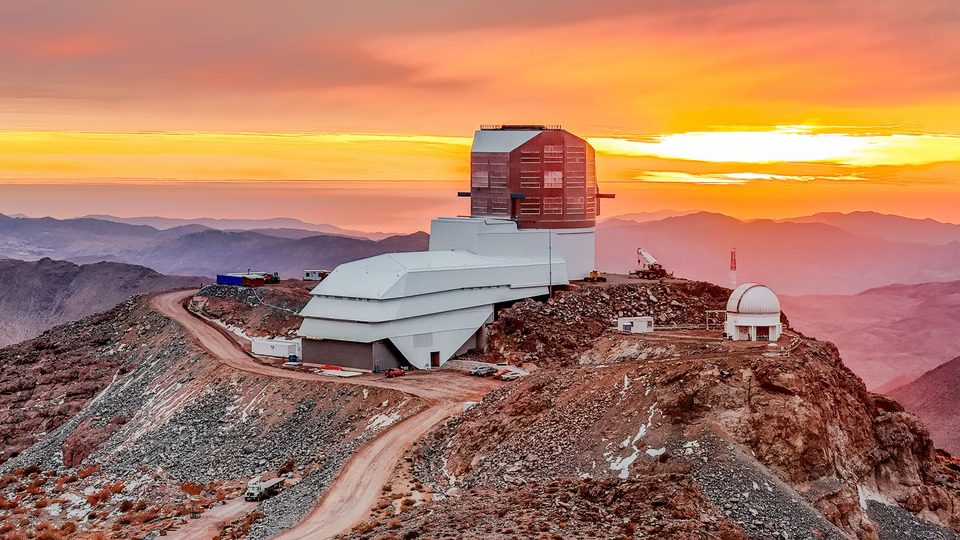
The Vera Rubin is housed in a sleek building on a mountaintop in the Atacama Desert. The chamber that holds its primary mirror juts up from the end of the elongated structure like the head of a sphinx. The observatory represents a freakish augmentation of human vision. Like the James Webb Space Telescope that NASA launched a few years ago, it will be able to see to the far edge of the universe. But the Webb can observe only a tiny region of sky. The Vera Rubin will be able to lock onto a tile of sky that is much larger and, after 30 seconds, return an image of that tile that extends 13 billion light-years into space. Then it will pan over and lock onto an adjacent tile of sky and do the same thing. After just three nights of going tile-by-tile like a handyman redoing a bathroom wall, it will have captured a deep image of the entire sky.
National-security types worry about what the Vera Rubin will be able to see. Ivezić told me that each of its full-sky images will contain more than 40 billion objects. That’s several times more than all previous surveys of this sort combined. When the Vera Rubin sees an object that it hasn’t seen before, it will alert astronomers. If a star explodes billions of light-years away, an algorithm will spot it, and the community will be notified. If a near-Earth asteroid comes hurtling right toward us, scientists will know to zoom into it, immediately, with other observatories. The problem is, if a spy satellite, or some other secret spacecraft, moves into view, that too could get flagged and have its location distributed, in real time, to people all across the world.
The Pentagon doesn’t like much of anything to be known about its satellites. During the Cold War, the United States was more secretive about what it did in space than what it did in the nuclear realm, says Aaron Bateman, a historian at George Washington University and the author of Weapons in Space. The U.S. acknowledges the general contours of its nuclear arsenal—how many weapons and delivery vehicles it has—but tends to be far more circumspect about its military space capabilities. Bateman told me that the very existence of the National Reconnaissance Office, the agency responsible for developing U.S. spy satellites, was classified until 1992. The NRO still operates a fleet of these satellites, but exact details about how many, and what kind, remain secret.
The Vera Rubin Observatory will likely make awkward eye contact with some of them. Many of them are telescopes in their own right, but instead of tilting up toward the sky, they point down at Earth. This dual nature of the telescope dates back to its inception; after inventing his, Galileo wrote to the ruler of Venice about its ability to spy enemy ships. He also vowed to keep the device a secret. During the early Cold War, the British government monitored Soviet satellites and missile tests with the Jodrell Bank Observatory, in Manchester.
Assistance of this kind has also flowed in the opposite direction, from the spies to the civilians. During the Apollo missions, NRO spy satellites captured images of potential landing sites on the moon. They also inspected damaged panels on SkyLab, NASA’s first space station. In 1981, during the space shuttle’s maiden flight, a NASA astronaut flipped the shuttle over so that an NRO satellite could grab a close-up of its heat shield, to see how it had held up through the atmospheric friction. Only a few people at the agency were aware of the operation.
The public learns about the true extent of the government’s seeing powers only after a long lag. The space historian Dwayne Day recently told me that the intelligence community operated large optics in space before NASA even started working on the Hubble, in 1977. He said that the technology helping today’s ground-based observatories see through the blur of the atmosphere was first developed by the military, and then later shared with civilian astronomers. The NRO may have all kinds of telescopes. In 2012, the agency even gave NASA a Hubble-class observatory as a surprise gift. It had just been lying around.
Ivezić knew that the Vera Rubin Observatory would need to avoid revealing the full extent of America’s space-based surveillance apparatus. He agreed to set up a system that would remove classified information from the telescope’s images, but he and his mysterious interlocutors did not initially agree about how it should work. Some of their concerns were easy to assuage. The Defense Intelligence Agency sometimes asks to be informed when foreign nationals use America’s most powerful radio observatories, in case those people were to point them at something sensitive, presumably. No such protocols would be necessary for the Vera Rubin’s Chilean operators, because the telescope has a fixed, 10-year observation plan. Ivezić said he showed it to his government counterparts and assured them that no one would be able to deviate from it.
Ivezić was most worried about the possibility that he would be made to adopt a system like one that he said the Air Force had imposed on a much less powerful astronomical survey called Pan-STARRS, about a dozen years ago. The images taken by that project’s telescopes in Hawaii were routed to a military facility—“the dark side,” as Ivezić put it—where they were edited before being sent on to astronomers. The edits weren’t especially surgical. “You would get back your image, and all the military assets would be blacked out,” Ivezić told me. “It looked like someone had streaked a marker across it, and it had a huge impact on the science that people were able to do.”
After some back-and-forth, Ivezić said, he and his counterparts came up with a less invasive way to remove secret American assets from the observatory’s instant alerts. A government agency—no one told him which one—would chip in $5 million for the construction of a dedicated network for moving sensitive data. Each time the telescope were to take one of its 30-second tile images of the sky, the file would be immediately encrypted, without anyone looking at it first, and then sent on to a secure facility in California.
Next, an automated system would compare the image with previous images of the same tile. It would cut out small “postage stamp” pictures of any new objects it finds, be they asteroids, exploding stars, or spy satellites. It would filter out the postage stamps that might depict secret U.S. assets and, one minute later, send all the rest, together with their coordinates, to an alert service available to astronomers worldwide. Three days and eight hours later, the entire tile image would be released to astronomers, untouched by black marker or any other technology of redaction.
By then, the spy satellites would likely have gone somewhere else. They are elusive, after all. Their orbits are irregular, and they shift direction often. Not even the world’s most accomplished astronomers would be able to infer their present locations from a line of light streaking through a three-day-old image.
Ivezić told me that the length of the data embargo was the most difficult term to work out. He had initially asked for the full images to be released after 10 hours. He said that his negotiating partners wanted it to be closer to seven days. In the end, Ivezić was happy with the middle ground that they settled on.
This account of the negotiation comes primarily from Ivezić. National Science Foundation and Department of Energy staff confirmed some of the general outlines of his story but would not disclose with whom he’d been negotiating, or the name of the agency that paid for the encrypted network. The Space Force declined to comment on the process. The NRO said that it had no information to offer me about any observatories.
Ivezić had nothing bad to say about his mysterious interlocutors. To the contrary, he told me that they seemed genuinely concerned about the risk of compromising the Vera Rubin’s science mission. “They did not come and say, ‘The law is on our side; you must do this, and that’s the end of it,’” Ivezić said. “After all, we are spending $1 billion of the government’s money,” he added, with a laugh.
The Atlantic (archive.ph)
By Ross Andersen
2024-12-02 17:02:03GMT
Olivier Bonin / SLAC National Accelerator Laboratory
In the early months of 2023, the astronomer Željko Ivezić found himself taking part in a highly unusual negotiation. Ivezić is the 59-year-old director of the Vera Rubin Observatory, a $1 billion telescope that the United States has been developing in the Chilean high desert for more than 20 years. He was trying to reach an agreement that would keep his telescope from compromising America’s national security when it starts stargazing next year.
This task was odd enough for any scientist, and it was made more so by the fact that Ivezić had no idea with whom he was negotiating. “I didn’t even know which agency I was talking to,” he told me on a recent video call from his field office in Chile. Whoever it was would communicate with him only through intermediaries at the National Science Foundation. Ivezić didn’t even know whether one person or several people were on the other side of the exchange. All he knew was that they were very security-minded. Also, they seemed to know a great deal about astronomy.
The Vera Rubin is housed in a sleek building on a mountaintop in the Atacama Desert. The chamber that holds its primary mirror juts up from the end of the elongated structure like the head of a sphinx. The observatory represents a freakish augmentation of human vision. Like the James Webb Space Telescope that NASA launched a few years ago, it will be able to see to the far edge of the universe. But the Webb can observe only a tiny region of sky. The Vera Rubin will be able to lock onto a tile of sky that is much larger and, after 30 seconds, return an image of that tile that extends 13 billion light-years into space. Then it will pan over and lock onto an adjacent tile of sky and do the same thing. After just three nights of going tile-by-tile like a handyman redoing a bathroom wall, it will have captured a deep image of the entire sky.
National-security types worry about what the Vera Rubin will be able to see. Ivezić told me that each of its full-sky images will contain more than 40 billion objects. That’s several times more than all previous surveys of this sort combined. When the Vera Rubin sees an object that it hasn’t seen before, it will alert astronomers. If a star explodes billions of light-years away, an algorithm will spot it, and the community will be notified. If a near-Earth asteroid comes hurtling right toward us, scientists will know to zoom into it, immediately, with other observatories. The problem is, if a spy satellite, or some other secret spacecraft, moves into view, that too could get flagged and have its location distributed, in real time, to people all across the world.
The Pentagon doesn’t like much of anything to be known about its satellites. During the Cold War, the United States was more secretive about what it did in space than what it did in the nuclear realm, says Aaron Bateman, a historian at George Washington University and the author of Weapons in Space. The U.S. acknowledges the general contours of its nuclear arsenal—how many weapons and delivery vehicles it has—but tends to be far more circumspect about its military space capabilities. Bateman told me that the very existence of the National Reconnaissance Office, the agency responsible for developing U.S. spy satellites, was classified until 1992. The NRO still operates a fleet of these satellites, but exact details about how many, and what kind, remain secret.
The Vera Rubin Observatory will likely make awkward eye contact with some of them. Many of them are telescopes in their own right, but instead of tilting up toward the sky, they point down at Earth. This dual nature of the telescope dates back to its inception; after inventing his, Galileo wrote to the ruler of Venice about its ability to spy enemy ships. He also vowed to keep the device a secret. During the early Cold War, the British government monitored Soviet satellites and missile tests with the Jodrell Bank Observatory, in Manchester.
Assistance of this kind has also flowed in the opposite direction, from the spies to the civilians. During the Apollo missions, NRO spy satellites captured images of potential landing sites on the moon. They also inspected damaged panels on SkyLab, NASA’s first space station. In 1981, during the space shuttle’s maiden flight, a NASA astronaut flipped the shuttle over so that an NRO satellite could grab a close-up of its heat shield, to see how it had held up through the atmospheric friction. Only a few people at the agency were aware of the operation.
The public learns about the true extent of the government’s seeing powers only after a long lag. The space historian Dwayne Day recently told me that the intelligence community operated large optics in space before NASA even started working on the Hubble, in 1977. He said that the technology helping today’s ground-based observatories see through the blur of the atmosphere was first developed by the military, and then later shared with civilian astronomers. The NRO may have all kinds of telescopes. In 2012, the agency even gave NASA a Hubble-class observatory as a surprise gift. It had just been lying around.
Ivezić knew that the Vera Rubin Observatory would need to avoid revealing the full extent of America’s space-based surveillance apparatus. He agreed to set up a system that would remove classified information from the telescope’s images, but he and his mysterious interlocutors did not initially agree about how it should work. Some of their concerns were easy to assuage. The Defense Intelligence Agency sometimes asks to be informed when foreign nationals use America’s most powerful radio observatories, in case those people were to point them at something sensitive, presumably. No such protocols would be necessary for the Vera Rubin’s Chilean operators, because the telescope has a fixed, 10-year observation plan. Ivezić said he showed it to his government counterparts and assured them that no one would be able to deviate from it.
Ivezić was most worried about the possibility that he would be made to adopt a system like one that he said the Air Force had imposed on a much less powerful astronomical survey called Pan-STARRS, about a dozen years ago. The images taken by that project’s telescopes in Hawaii were routed to a military facility—“the dark side,” as Ivezić put it—where they were edited before being sent on to astronomers. The edits weren’t especially surgical. “You would get back your image, and all the military assets would be blacked out,” Ivezić told me. “It looked like someone had streaked a marker across it, and it had a huge impact on the science that people were able to do.”
After some back-and-forth, Ivezić said, he and his counterparts came up with a less invasive way to remove secret American assets from the observatory’s instant alerts. A government agency—no one told him which one—would chip in $5 million for the construction of a dedicated network for moving sensitive data. Each time the telescope were to take one of its 30-second tile images of the sky, the file would be immediately encrypted, without anyone looking at it first, and then sent on to a secure facility in California.
Next, an automated system would compare the image with previous images of the same tile. It would cut out small “postage stamp” pictures of any new objects it finds, be they asteroids, exploding stars, or spy satellites. It would filter out the postage stamps that might depict secret U.S. assets and, one minute later, send all the rest, together with their coordinates, to an alert service available to astronomers worldwide. Three days and eight hours later, the entire tile image would be released to astronomers, untouched by black marker or any other technology of redaction.
By then, the spy satellites would likely have gone somewhere else. They are elusive, after all. Their orbits are irregular, and they shift direction often. Not even the world’s most accomplished astronomers would be able to infer their present locations from a line of light streaking through a three-day-old image.
Ivezić told me that the length of the data embargo was the most difficult term to work out. He had initially asked for the full images to be released after 10 hours. He said that his negotiating partners wanted it to be closer to seven days. In the end, Ivezić was happy with the middle ground that they settled on.
This account of the negotiation comes primarily from Ivezić. National Science Foundation and Department of Energy staff confirmed some of the general outlines of his story but would not disclose with whom he’d been negotiating, or the name of the agency that paid for the encrypted network. The Space Force declined to comment on the process. The NRO said that it had no information to offer me about any observatories.
Ivezić had nothing bad to say about his mysterious interlocutors. To the contrary, he told me that they seemed genuinely concerned about the risk of compromising the Vera Rubin’s science mission. “They did not come and say, ‘The law is on our side; you must do this, and that’s the end of it,’” Ivezić said. “After all, we are spending $1 billion of the government’s money,” he added, with a laugh.


