Link (Archive)
Nirit Anderman
Jul. 11, 2021

Hollywood has always loved Adolf Hitler. Cinema, in general, has always loved him. Try and count how many times you’ve seen the image of the Nazi leader on film – fictional or documentary, in movies and TV series, in films about World War II and ones that insert the character into different times and places. Dramas, comedies, war movies, even fantasy and science fiction – anything goes.
The leader of the Third Reich who brought the human race to alarming depths of madness, cruelty, racism and nationalism, has proved too great a temptation for filmmakers. Many could not overcome it – or perhaps they didn’t really want to.
Documentaries on the Nazi leader have exhausted every conceivable angle, the film claims: Who Hitler was, who his friends were, the women he loved, his relationship with his dogs, the failure of his art career, psychological perspectives, and of course, his affinity for drugs. If Wikipedia were to add an “In Popular Culture” section to its entry on Hitler, its server would crash.
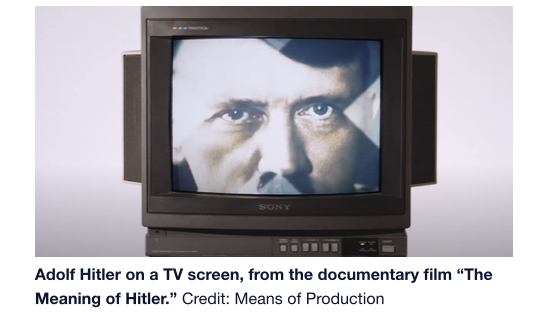
They emphasize how the Nazi documentation machine, the propaganda that was created to enshrine the achievements of the Third Reich, is still prominently featured on big screens today.
The filmmakers clearly show how almost every documentary film relating to Germany during World War II makes use of Nazi footage. “Triumph of the Will,” the documentary filmed and directed by Leni Riefenstahl at Hitler’s behest, is one of the most quoted films of all time and has received the greatest number of tributes in the history of the cinema, including in “The Lion King,” “Star Wars,” “The Great Dictator,” “Conan the Barbarian,” and more.
Epperlein and Tucker’s film asks if history has lost all meaning. Contemporary filmmakers use images and pictures the Nazis left behind, repackage propaganda as reality, infuse scenes with meaning and in doing so the Nazi past undergoes normalization. In an interview conducted on Zoom last week, the filmmakers emphasize the outrageous lack of balance in the filmed images that remain from the period of the Holocaust and World War II.
“The Meaning of Hitler’’ was inspired by the best-selling book of the same name written by the German historian and journalist Sebastian Haffner in 1978. Haffner sought to demythologize the leader of Nazi Germany by portraying him as a madman who ultimately dragged an entire nation into an immoral abyss in pursuit of his own racist theories. Alongside some illuminating quotes from the book, the directors take aim at Hitler’s image, seeking to crack the secret of his enduring fascination for so many.
In the process, they examine the spread of fascism and Nazi ideology in our time, the disturbing presence of Hitler’s teachingsin contemporary culture, Holocaust denial and modern-day leaders who distort the truth, just as he did, to suit their agendas. All of this comes together in a tight, well-edited cinematic work that manages to condense a lot of information in an accessible and interesting way, one that even younger viewers can digest. Interviews with two leading Holocaust researchers – Israel Prize winners Saul Friedlander and Yehuda Bauer – add context and provide commentary, which helps, among other things, in comparing and contrasting the current reality to the one that scarred the world in the 1930s and 1940s. The similarities are, of course, disturbing.
No way back
Epperlein and Tucker, who have been living and working together for more than three decades, make clear that the global rise of far-right movements in recent years motivated them to make the film.
“During the last 10 years or so we witnessed a rise of fascism, antisemitism, to a level going back to 1989 after the Berlin Wall fell. This supposed end of history, we never thought something like that would happen again on this scale. I didn’t think that. So, while we were witnessing it, we thought we should do something about it. Because, you know, as British novelist Martin Amis says, every serious person should think about Hitler,” says Epperlein.
The pair recounts that while filming in Dresden in January 2015, masses took to the streets in support of the right-wing German organization Pegida (“Patriotic Europeans Against the Islamization of the Occident”). The organization was protesting immigration to Germany and the “Islamization of Europe.”
“What was actually extremely disturbing, I mean everything is disturbing about that, but they actually used language which the Nazis used in the 30’s. They called us the ‘lying press,’ the Nazis coined that. That impressed us a lot so we thought something needs to be done,” says Epperlein.
“I’m American, and when I was growing up, in the 70’s, Neo-Nazis were kind of like comic book characters. It was like some stupid white trash people go out and they wear a swastika and everyone knows they’re stupid and ridiculous but we’ll give them free speech because that’s what we do in America,” Tucker says. “But what we witnessed in Germany, 5-6 years ago, you really actually felt scared. These are not just 10 people or 20 or 100 people. These are, literally, tens of thousands of people who suddenly feel like they can express this hatred. And that sort of sparked it. And of course when we were finally deciding to do the film Charlottesville happened. And there was no stopping it after that.”
But you decided to make a film about Hitler, not just on the rise of fascism and antisemitism today.
Epperlein: “So we discussed it at length and ultimately we decided not to focus just on these right-wing movements but to tackle the subject from a more philosophical background, a little bit more from a distance. Because, of course, over the last 70 years or so, Hitler’s image was created or was enforced. There is a fan base. And you can almost think that the media is feeding a certain fandom – like the imagery and the whole mythology created by the Nazis themselves is being broadcasted in the world over and over and over again. Although there is commentary on it, it’s still there. So there are images [that they] produced by themselves, and they have longevity which is… it’s stunning. So we decided to discuss the whole subject matter from a little bit farther away, rather than just focusing on the rise of the Neo-Nazis.”
Tucker: “Once you open the subject matter, you do realize, especially here in Germany, there is this whole industry around Hitler and Nazism. On the one hand everyone is saying ‘yes we’re against Hitler and Nazism.’ But on the other hand, you turn on the television and it’s all Hitler and Nazis all the time. If that’s supposed to be a remedy to Antisemitism or to fight fascism or to fight nationalism feelings, then why are there movements becoming more powerful? It’s almost like the last 80 years of History has been sort of for nothing, if we’re back to where we’ve started. And why is that?”
There are so many documentaries about Hitler. And you’ve made another one. What did you decide to do to make your film different?
Epperlein: “Well I wouldn’t say we actually made a film about Hitler. We travel around, we talk about problems with the rise [of fascism], about making films about Hitler. The media is one subject matter, right? And then again, not a subject matter. For instance, it’s like, places in connection with Hitler, or the Nazis per se, are all over the place. How do you deal with them? People deal with them very differently. They are afraid of them. So we decided to explore that and also we decided to talk to many of these experts, these historians and writers, who have spent much more time thinking than we did and discuss with them, how should we deal with it? As Mike just said, for 80 years we discussed all of this, we looked at Hitler’s biography, and all the other Nazis’ biographies, but what we ultimately learned was how we actually process, how we deal with the rise of many of those ideas. That was more the intent, not a film about Hitler. “
Between Hitler and Trump
Almost 80 years have passed and Hitler remains a difficult historical phenomenon – perhaps even a frightening one – to understand. “Everything is missing from this life, from beginning to end,” the filmmakers quote from Haffner’s book, “everything which would normally give a human life depth, warmth and dignity: education, career, love and friendship, marriage, parenthood.”
Tucker recalls that in the 1970s, Germany experienced a “Hitler wave,” a period during which the Nazi leader’s image was ubiquitous and the Hitler character starred in novels, films, dramas and other media. “Hitler was sort of being reconsidered. He was almost like a pop star at that moment. There was this obsession with his biography, these little details, to try to analyze him, to put him on the couch. When that’s not really necessary, it’s just simply in front of you. When Haffner’s book came out, one of his oldest suggestions was that the most important thing was simply to understand that Hitler was a murderer,” he says.
Former U.S. President Donald Trumpmakes several appearances in the film. Here, in the 21st century, there’s a leader who doesn’t hesitate to incite hatred and racism and spread lies; a capricious megalomaniac who acts according to his personal whims even if they could devolve into another world war at any moment.

“Right before we started, Charlottesville happened. Who would have predicted Trump? How do you explain what just happened in America? It was just as insane as what happened in Germany in the early 1930’s. As we were finishing this film all these things were happening,” Tucker says.
The film shows how the two leaders harnessed new technology to incite the masses. In Hitler’s case, it was a new sort of microphone. Until the 1920s, microphones required the seeker to stand very close by. By the 1930s, technology had been developed that let the user stand at a distance, enabling someone like Hitler to raise his arms, to move back and forth and to vary his voice from a shout to a whisper. The result electrified his audiences. In Trump’s case, it was social media networks.
“The Meaning of Hitler” navigates between a variety of speakers and issues, focusing on a topic that has already been so thoroughly investigated that the world seems too small to contain it. Yet, the film manages to remain interesting throughout. The historian Prof. Deborah Lipstadt, for example, pulls the rug out from under theories that attempt to locate the source of Hitler’s antisemitism amid psychological studies, as if something in his childhood could explain what led a man to get up one morning and order the extermination of millions of people. It’s irrelevant if his mother had been harmed by Jewish people, Lipstadt explains. Antisemitism is irrational. “When we try to understand the source of Hitler’s antisemitism, we are attempting to rationally explain the irrational.“
One of the film’s most chilling moments is when the two directors meet controversial historian David Irving. Irving sued Lipstadt in 1998 for calling him a Holocaust denier, and lost. They follow him as he leads tourists through the Treblinka concentration camp, where 900 thousand Jews were murdered. He tells the tourists that Jews have a tendency of inflating numbers, and comments that the Jews who were murdered there never asked themselves ‘why us’? As the filmmakers joke with him that Jews were not used to doing heavy lifting, Irving says “Jews don’t like labor, only writing invoices.”

The directors admit that they were initially ambivalent about including Irving in the film. When they discovered that he spends his summers giving tours of concentration camps in Poland – which he refers to as “trips through the real history” – all under the auspices of the Polish government, they decided to include him.
Tucker explains that Irving himself doesn’t necessarily interest them. “It had less to do with Irving and more to do with how is it possible in this world that the Poles allow him to go do that.” Tucker says, “We went to Poland, met him at the parking lot in Treblinka, where he had probably two dozen people with him, there was no one there to stop him, no one watching. We’ve filmed a lot of things. We’ve filmed wars, we’ve filmed all sorts of things. And I think that was probably one of the most difficult things I’ve ever experienced. Who’s to stop them? Baltic states have banned him, because he was also going up there. If it’s a byproduct that maybe someone will take notice [and put an end to it], it would be a good thing.”
What Made Hitler Antisemitic?
The creators of a new documentary on Adolf Hitler wonder how to deal with the rebirth of the ideology the Nazi dictator representedNirit Anderman
Jul. 11, 2021
Hollywood has always loved Adolf Hitler. Cinema, in general, has always loved him. Try and count how many times you’ve seen the image of the Nazi leader on film – fictional or documentary, in movies and TV series, in films about World War II and ones that insert the character into different times and places. Dramas, comedies, war movies, even fantasy and science fiction – anything goes.
The leader of the Third Reich who brought the human race to alarming depths of madness, cruelty, racism and nationalism, has proved too great a temptation for filmmakers. Many could not overcome it – or perhaps they didn’t really want to.
His image has also proved tantalizing for many documentary filmmakers. “If you switch on German TV, you have a 95 percent chance of getting a Hitler documentary,” says one of the speakers in the new documentary film, “The Meaning of Hitler.” The film is screening this week at the Tel Aviv Cinematheque as part of the DocAviv festival that opened last Thursday, as well as on the festival’s streaming site.It is not as if something in Hitler's childhood could explain what led a man to order the extermination of millions of people
Documentaries on the Nazi leader have exhausted every conceivable angle, the film claims: Who Hitler was, who his friends were, the women he loved, his relationship with his dogs, the failure of his art career, psychological perspectives, and of course, his affinity for drugs. If Wikipedia were to add an “In Popular Culture” section to its entry on Hitler, its server would crash.
The duo behind “The Meaning of Hitler,” Petra Epperlein and Michael Tucker, a German and an American, respectively, devote the first section of their film to how Hitler charmed filmmakers (and others) all over the world, a phenomenon that persists over 75 years after his death.When they discovered that David Irving spends his summers giving tours of concentration camps – which he refers to as 'trips through the real history' – they decided to include him in the film
They emphasize how the Nazi documentation machine, the propaganda that was created to enshrine the achievements of the Third Reich, is still prominently featured on big screens today.
The filmmakers clearly show how almost every documentary film relating to Germany during World War II makes use of Nazi footage. “Triumph of the Will,” the documentary filmed and directed by Leni Riefenstahl at Hitler’s behest, is one of the most quoted films of all time and has received the greatest number of tributes in the history of the cinema, including in “The Lion King,” “Star Wars,” “The Great Dictator,” “Conan the Barbarian,” and more.
Epperlein and Tucker’s film asks if history has lost all meaning. Contemporary filmmakers use images and pictures the Nazis left behind, repackage propaganda as reality, infuse scenes with meaning and in doing so the Nazi past undergoes normalization. In an interview conducted on Zoom last week, the filmmakers emphasize the outrageous lack of balance in the filmed images that remain from the period of the Holocaust and World War II.
“There is such an imbalance in the images we actually have from that time,” says Epperlein. “It’s all Nazis, the Nazis marching in their uniforms and doing whatever, we have plenty of that. And people are fascinated by that, they love watching it for whatever reason. So, we had this discussion with Friedlander, ultimately these images they live on forever while the other images don’t even exist. The images of the atrocities and the crimes. So, what part of the story is actually being told in eternity? And I think this is a real problem that needs to be discussed more and more. I hope we can start a discussion about this with this film also.”'Once you open the subject matter, you do realize, especially here in Germany, there is this whole industry around Hitler and Nazism'
“The Meaning of Hitler’’ was inspired by the best-selling book of the same name written by the German historian and journalist Sebastian Haffner in 1978. Haffner sought to demythologize the leader of Nazi Germany by portraying him as a madman who ultimately dragged an entire nation into an immoral abyss in pursuit of his own racist theories. Alongside some illuminating quotes from the book, the directors take aim at Hitler’s image, seeking to crack the secret of his enduring fascination for so many.
In the process, they examine the spread of fascism and Nazi ideology in our time, the disturbing presence of Hitler’s teachingsin contemporary culture, Holocaust denial and modern-day leaders who distort the truth, just as he did, to suit their agendas. All of this comes together in a tight, well-edited cinematic work that manages to condense a lot of information in an accessible and interesting way, one that even younger viewers can digest. Interviews with two leading Holocaust researchers – Israel Prize winners Saul Friedlander and Yehuda Bauer – add context and provide commentary, which helps, among other things, in comparing and contrasting the current reality to the one that scarred the world in the 1930s and 1940s. The similarities are, of course, disturbing.
No way back
Epperlein and Tucker, who have been living and working together for more than three decades, make clear that the global rise of far-right movements in recent years motivated them to make the film.
“During the last 10 years or so we witnessed a rise of fascism, antisemitism, to a level going back to 1989 after the Berlin Wall fell. This supposed end of history, we never thought something like that would happen again on this scale. I didn’t think that. So, while we were witnessing it, we thought we should do something about it. Because, you know, as British novelist Martin Amis says, every serious person should think about Hitler,” says Epperlein.
The pair recounts that while filming in Dresden in January 2015, masses took to the streets in support of the right-wing German organization Pegida (“Patriotic Europeans Against the Islamization of the Occident”). The organization was protesting immigration to Germany and the “Islamization of Europe.”
“What was actually extremely disturbing, I mean everything is disturbing about that, but they actually used language which the Nazis used in the 30’s. They called us the ‘lying press,’ the Nazis coined that. That impressed us a lot so we thought something needs to be done,” says Epperlein.
“I’m American, and when I was growing up, in the 70’s, Neo-Nazis were kind of like comic book characters. It was like some stupid white trash people go out and they wear a swastika and everyone knows they’re stupid and ridiculous but we’ll give them free speech because that’s what we do in America,” Tucker says. “But what we witnessed in Germany, 5-6 years ago, you really actually felt scared. These are not just 10 people or 20 or 100 people. These are, literally, tens of thousands of people who suddenly feel like they can express this hatred. And that sort of sparked it. And of course when we were finally deciding to do the film Charlottesville happened. And there was no stopping it after that.”
But you decided to make a film about Hitler, not just on the rise of fascism and antisemitism today.
Epperlein: “So we discussed it at length and ultimately we decided not to focus just on these right-wing movements but to tackle the subject from a more philosophical background, a little bit more from a distance. Because, of course, over the last 70 years or so, Hitler’s image was created or was enforced. There is a fan base. And you can almost think that the media is feeding a certain fandom – like the imagery and the whole mythology created by the Nazis themselves is being broadcasted in the world over and over and over again. Although there is commentary on it, it’s still there. So there are images [that they] produced by themselves, and they have longevity which is… it’s stunning. So we decided to discuss the whole subject matter from a little bit farther away, rather than just focusing on the rise of the Neo-Nazis.”
Tucker: “Once you open the subject matter, you do realize, especially here in Germany, there is this whole industry around Hitler and Nazism. On the one hand everyone is saying ‘yes we’re against Hitler and Nazism.’ But on the other hand, you turn on the television and it’s all Hitler and Nazis all the time. If that’s supposed to be a remedy to Antisemitism or to fight fascism or to fight nationalism feelings, then why are there movements becoming more powerful? It’s almost like the last 80 years of History has been sort of for nothing, if we’re back to where we’ve started. And why is that?”
There are so many documentaries about Hitler. And you’ve made another one. What did you decide to do to make your film different?
Epperlein: “Well I wouldn’t say we actually made a film about Hitler. We travel around, we talk about problems with the rise [of fascism], about making films about Hitler. The media is one subject matter, right? And then again, not a subject matter. For instance, it’s like, places in connection with Hitler, or the Nazis per se, are all over the place. How do you deal with them? People deal with them very differently. They are afraid of them. So we decided to explore that and also we decided to talk to many of these experts, these historians and writers, who have spent much more time thinking than we did and discuss with them, how should we deal with it? As Mike just said, for 80 years we discussed all of this, we looked at Hitler’s biography, and all the other Nazis’ biographies, but what we ultimately learned was how we actually process, how we deal with the rise of many of those ideas. That was more the intent, not a film about Hitler. “
Between Hitler and Trump
Almost 80 years have passed and Hitler remains a difficult historical phenomenon – perhaps even a frightening one – to understand. “Everything is missing from this life, from beginning to end,” the filmmakers quote from Haffner’s book, “everything which would normally give a human life depth, warmth and dignity: education, career, love and friendship, marriage, parenthood.”
Tucker recalls that in the 1970s, Germany experienced a “Hitler wave,” a period during which the Nazi leader’s image was ubiquitous and the Hitler character starred in novels, films, dramas and other media. “Hitler was sort of being reconsidered. He was almost like a pop star at that moment. There was this obsession with his biography, these little details, to try to analyze him, to put him on the couch. When that’s not really necessary, it’s just simply in front of you. When Haffner’s book came out, one of his oldest suggestions was that the most important thing was simply to understand that Hitler was a murderer,” he says.
Former U.S. President Donald Trumpmakes several appearances in the film. Here, in the 21st century, there’s a leader who doesn’t hesitate to incite hatred and racism and spread lies; a capricious megalomaniac who acts according to his personal whims even if they could devolve into another world war at any moment.
“Right before we started, Charlottesville happened. Who would have predicted Trump? How do you explain what just happened in America? It was just as insane as what happened in Germany in the early 1930’s. As we were finishing this film all these things were happening,” Tucker says.
The film shows how the two leaders harnessed new technology to incite the masses. In Hitler’s case, it was a new sort of microphone. Until the 1920s, microphones required the seeker to stand very close by. By the 1930s, technology had been developed that let the user stand at a distance, enabling someone like Hitler to raise his arms, to move back and forth and to vary his voice from a shout to a whisper. The result electrified his audiences. In Trump’s case, it was social media networks.
“The Meaning of Hitler” navigates between a variety of speakers and issues, focusing on a topic that has already been so thoroughly investigated that the world seems too small to contain it. Yet, the film manages to remain interesting throughout. The historian Prof. Deborah Lipstadt, for example, pulls the rug out from under theories that attempt to locate the source of Hitler’s antisemitism amid psychological studies, as if something in his childhood could explain what led a man to get up one morning and order the extermination of millions of people. It’s irrelevant if his mother had been harmed by Jewish people, Lipstadt explains. Antisemitism is irrational. “When we try to understand the source of Hitler’s antisemitism, we are attempting to rationally explain the irrational.“
One of the film’s most chilling moments is when the two directors meet controversial historian David Irving. Irving sued Lipstadt in 1998 for calling him a Holocaust denier, and lost. They follow him as he leads tourists through the Treblinka concentration camp, where 900 thousand Jews were murdered. He tells the tourists that Jews have a tendency of inflating numbers, and comments that the Jews who were murdered there never asked themselves ‘why us’? As the filmmakers joke with him that Jews were not used to doing heavy lifting, Irving says “Jews don’t like labor, only writing invoices.”
The directors admit that they were initially ambivalent about including Irving in the film. When they discovered that he spends his summers giving tours of concentration camps in Poland – which he refers to as “trips through the real history” – all under the auspices of the Polish government, they decided to include him.
Tucker explains that Irving himself doesn’t necessarily interest them. “It had less to do with Irving and more to do with how is it possible in this world that the Poles allow him to go do that.” Tucker says, “We went to Poland, met him at the parking lot in Treblinka, where he had probably two dozen people with him, there was no one there to stop him, no one watching. We’ve filmed a lot of things. We’ve filmed wars, we’ve filmed all sorts of things. And I think that was probably one of the most difficult things I’ve ever experienced. Who’s to stop them? Baltic states have banned him, because he was also going up there. If it’s a byproduct that maybe someone will take notice [and put an end to it], it would be a good thing.”


