By Katherine J. Wu
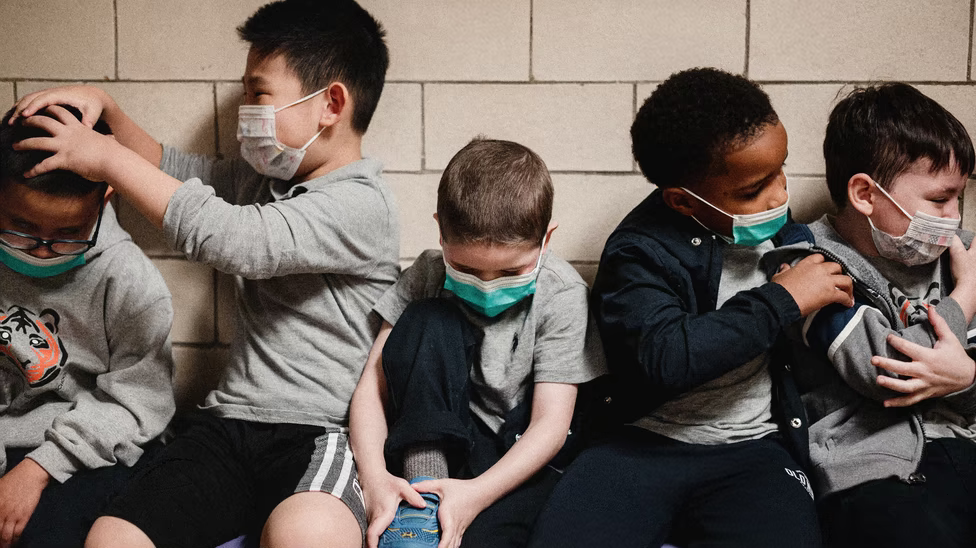
Hannah Yoon / NYT / Redux
DECEMBER 5, 2022
In the spring of 2021, Brett Finlay, a microbiologist at the University of British Columbia, offered the world a bold and worrying prediction. “My guess is that five years from now we are going to see a bolus of kids with asthma and obesity,” he told Wired. Those children, he said, would be “the COVID kids”: those born just before or during the height of the crisis, when the coronavirus was everywhere, and we cleaned everything because we didn’t want it to be.
Finlay’s forecast isn’t unfounded. As James Hamblin wrote in The Atlantic last year, our health relies on a constant discourse with trillions of microbes that live on or inside our bodies. The members of the so-called microbiome are crucial for digesting our food, training the immune system, even greasing the wheels of cognitive function; there does not seem to be a bodily system that these tiny tenants do not in some way affect. These microbe-human dialogues begin in infancy, and the first three or so years of life are absolutely pivotal: Bacteria must colonize babies, then the two parties need to get into physiological sync. Major disruptions during this time “can throw the system out of whack,” says Katherine Amato, a biological anthropologist at Northwestern University, and raise a kid’s risk of developing allergies, asthma, obesity, and other chronic conditions later in life.
The earlier, more intense, and more prolonged the interruptions, the worse. Infants who receive heavy courses of antibiotics—which can nuke microbial diversity—are at greater risk of developing such problems; the same is roughly true for babies who are born by C-section, who formula feed, or who grow up in nature-poor environments. If pandemic-era mitigations re-create even an echo of those effects, that could spell trouble for a whole lot of little kids who may have lost out on beneficial microbes in the ongoing effort to keep nasty ones at bay.
More than a year and a half after Finlay’s original prediction, children are back in day care and school. People no longer keep their distance or avoid big crowds. Even hygiene theater is (mostly) on the wane. And if the wave of respiratory viral illness now slamming much of the Northern Hemisphere is any indication, microbes are once again swirling between tiny hands and mouths. But for the circa-COVID kids, the specter of 2026 and Finlay’s anticipated chronic-illness “bump” still looms—and it’ll be a good while yet before researchers have clarity on just how much of a difference those months of relative microbial emptiness truly made.
Read: A year without germs
For now, “we are in the realm of speculation,” says Maria Gloria Dominguez Bello, a microbiologist at Rutgers. Scientists don’t understand how, or even which, behaviors may affect the composition of our inner flora throughout our life span. Chronic illnesses such as obesity and asthma also take time to manifest. There’s not yet evidence that they’re on the rise among children, and even if they were, researchers wouldn’t expect to see the signal for at least a couple of years, perhaps more.
Finlay, for one, stands by his original prediction that the pandemic will bring a net microbiome negative. “We underwent a massive societal shift,” he told me. “I am sure we will see an effect.” And he is not the only one who thinks so. “I think it’s almost inevitable that there has been an impact,” says Graham Rook, a medical microbiologist at University College London. If the middle of this decade passes without incident, Rook told me, “I would be very surprised.” Other researchers, though, aren’t so sure. “I don’t think we have doomed a generation of kids,” says Melissa Manus, an anthropologist and microbiome researcher at the University of Manitoba. A few scientists are even pondering whether the pandemic’s ripple effects may have buoyed the microbiomes of the COVID kids. Martin Blaser, a microbiologist at Rutgers University, told me that, “with any luck,” rates of asthma and obesity might even dip in the next few years.
When it comes to the pandemic’s potential fallout, researchers agree on just one thing: COVID babies undoubtedly had an unusual infancy; on average, their microbiomes are bound to look quite different. Different, though, isn’t necessarily bad. “It’s not like there is one golden microbiome,” says Efrem Lim, a microbiologist at Arizona State University. Take Liz Johnson’s sons, born in March 2018, August 2020, and March 2022. All three were born vaginally, in the same hospital, with the assistance of the same midwife; all of them then breastfed; and none of them has undergone an early, concerning antibiotic course. And still, “they all started off with different microbiomes,” she told me. (As a microbiome researcher at Cornell focused on infant nutrition, Johnson can check.)
That’s probably totally fine. Across the human population, microbiomes are known to vary wildly: People can carry hundreds of bacterial species on and inside their bodies, with potentially zero overlap from one individual to the next. Bacterial communities aren’t unlike recipes—if you don’t have one ingredient on hand, another can usually take its place.
Johnson’s middle son, Lucas, had a starkly different birth experience from that of his older brother—even, in many ways, from that of his younger brother. Lucas was born into a delivery room full of masked faces. In the days after his arrival, no family members came to visit him in the hospital. And although his brothers spent several of their early months jet-setting all around the world with their mother for work trips, Lucas stayed put. “Hardly anybody even knew he was born,” Johnson told me. But throughout his first two years, Lucas still breastfed and had plenty of contact with his family at home, as well as with other kids at day care; he romped in green spaces galore. Yet Johnson and others can’t say, precisely, whether all of that outweighs the sanitariness and the uncrowdedness of Lucas’s earliest days. There would have been a cost to both overcaution and under-caution, “so we just tried to balance everything,” Johnson said. When it comes down to it, scientists just don’t know how much microbial exposure constitutes enough.
Read: Pregnant? Breastfeeding? The vaccine might protect you and your baby
Among COVID babies, microbiome mileage will probably vary, depending on what decisions their parents made at the height of the pandemic—which itself hinges on the sorts of financial and social resources they had. Amato worries most about the families that may have packaged a bunch of sanitizing behaviors together with more established cullers of microbiome diversity: C-sections, formula-feeding, and antibiotic use. Meghan Azad, an infant-health researcher at the University of Manitoba, told me that some new parents might have found it far tougher to breastfeed during the pandemic’s worst—a time when in-person counseling resources were harder to access, and employment was in flux. Chronically poor diets and stress, which many people experienced these past few years, can also chip away at microbiome health.
Part of the problem is that many of these risk factors, Rook told me, will disproportionately coalesce among people of lower socioeconomic status, who already tend to have less diverse microbiomes. “I worry this will further increase the health disparity between the rich and the poor,” he said. Even SARS-CoV-2 infections themselves, which have continued to concentrate among essential workers and in crowded living settings, appear to alter the microbiome—a shift that may be temporary in adults, but potentially less so in infants, whose microbiomes haven’t yet matured into a stable state.
Many families exist in a gray zone. Maybe they bleached their households often, but found it easier to breastfeed and cook healthful meals while working from home. Maybe their kids weren’t mingling with tons of other toddlers at day care, but they spent much more time rolling around in the backyard, coated in their pandemic puppy’s drool. If all of those factors feed into an equation that sums up to healthy or not, scientists can’t yet do the math. They’re still figuring out how to appropriately weigh each component, and how to identify others they’ve missed.
Even in the absence of extra outdoorsiness or dog slobber, Lim isn’t very concerned about the behavioral mitigations people picked up. We’re all “exposed to thousands of microbes all the time,” Lim, who has a 1-and-a-half-year-old daughter, told me. Some extra hand-washing, masking, and time at home is nothing compared with, say, an antibiotic blitzkrieg. Even kids who stayed pretty cloistered “were not living in a bubble.” Some of the social sacrifices kids made may even have strange silver linings. Children no longer attending day care or preschool might have skirted a whole slew of other viral infections that would otherwise have gotten them inappropriate and microbiome-damaging antibiotics prescriptions. Antibiotic use in outpatient settings dropped substantially in 2020, compared with the prior year. Stacked up against the relatively minor toll of pandemic mitigations, Blaser told me, the plus of avoiding antibiotics might just win out. When antibiotic use declines, for example, so do asthma rates.
Finlay and others are still keeping an eye out for signals that might start to appear in the next few years. Perhaps most at risk are kids whose families went into “hyper-hygiene mode” in the first couple months of their lives, when microbes are crucial for properly calibrating the immune system’s anti-pathogen alarms. Miss out on those opportunities, and our body’s defensive cells might end up mistaking enemies for allies, or vice versa, sparking particularly severe infections or autoimmune disease. Once wired into a developing child, Finlay said, such changes might be difficult to reverse, especially for the youngest of the COVID cohort. But other experts are hopeful that certain microbial losses can still be recouped through some combination of diet, outdoor play, and socialization (with people who aren’t sick)—restorative interventions that, ideally, happen as early as possible. “The sooner we fix it, the better,” Blaser said.
Read: The pandemic broke the flu … again
No one can choose precisely which microbes to be exposed to: Tactics that halt the transmission of known pathogens have a way of halting the transmission of benign bugs too. But context matters. It’s possible for microbe-inviting behaviors, such as outdoor play, to coexist alongside microbe-shunning tactics, such as ventilating indoor spaces when there’s a massive respiratory outbreak. The fact that we can influence microbial colonization at all is powerful. During the pandemic, mitigations that kept COVID at bay also cratered rates of flu and RSV. Now that those viruses are back, experts are pointing out that we already know how they can once again be stopped. And the choices that people made, and continue to make, to protect their families from pathogens shouldn’t be viewed as some harmful mistake, says Ariangela Kozik, a microbiologist at the University of Michigan.
Pandemic kids can get on board with that concept too. Kozik’s now-7-year-old son was a toddler when the pandemic began; even amid society’s hygiene craze, he learned the joys of tumbling around in the dirt and playing with the family’s two dogs. “We talk about how not all germs are the same,” Kozik told me. Her son also picked up and maintained an infection-quashing habit that makes his mom proud: Every day, when he comes home from school, he makes a beeline for the sink to wash his hands. “It’s the first thing he does,” Kozik told me, “even without being asked.”
Source (Archive)
Hannah Yoon / NYT / Redux
DECEMBER 5, 2022
In the spring of 2021, Brett Finlay, a microbiologist at the University of British Columbia, offered the world a bold and worrying prediction. “My guess is that five years from now we are going to see a bolus of kids with asthma and obesity,” he told Wired. Those children, he said, would be “the COVID kids”: those born just before or during the height of the crisis, when the coronavirus was everywhere, and we cleaned everything because we didn’t want it to be.
Finlay’s forecast isn’t unfounded. As James Hamblin wrote in The Atlantic last year, our health relies on a constant discourse with trillions of microbes that live on or inside our bodies. The members of the so-called microbiome are crucial for digesting our food, training the immune system, even greasing the wheels of cognitive function; there does not seem to be a bodily system that these tiny tenants do not in some way affect. These microbe-human dialogues begin in infancy, and the first three or so years of life are absolutely pivotal: Bacteria must colonize babies, then the two parties need to get into physiological sync. Major disruptions during this time “can throw the system out of whack,” says Katherine Amato, a biological anthropologist at Northwestern University, and raise a kid’s risk of developing allergies, asthma, obesity, and other chronic conditions later in life.
The earlier, more intense, and more prolonged the interruptions, the worse. Infants who receive heavy courses of antibiotics—which can nuke microbial diversity—are at greater risk of developing such problems; the same is roughly true for babies who are born by C-section, who formula feed, or who grow up in nature-poor environments. If pandemic-era mitigations re-create even an echo of those effects, that could spell trouble for a whole lot of little kids who may have lost out on beneficial microbes in the ongoing effort to keep nasty ones at bay.
More than a year and a half after Finlay’s original prediction, children are back in day care and school. People no longer keep their distance or avoid big crowds. Even hygiene theater is (mostly) on the wane. And if the wave of respiratory viral illness now slamming much of the Northern Hemisphere is any indication, microbes are once again swirling between tiny hands and mouths. But for the circa-COVID kids, the specter of 2026 and Finlay’s anticipated chronic-illness “bump” still looms—and it’ll be a good while yet before researchers have clarity on just how much of a difference those months of relative microbial emptiness truly made.
Read: A year without germs
For now, “we are in the realm of speculation,” says Maria Gloria Dominguez Bello, a microbiologist at Rutgers. Scientists don’t understand how, or even which, behaviors may affect the composition of our inner flora throughout our life span. Chronic illnesses such as obesity and asthma also take time to manifest. There’s not yet evidence that they’re on the rise among children, and even if they were, researchers wouldn’t expect to see the signal for at least a couple of years, perhaps more.
Finlay, for one, stands by his original prediction that the pandemic will bring a net microbiome negative. “We underwent a massive societal shift,” he told me. “I am sure we will see an effect.” And he is not the only one who thinks so. “I think it’s almost inevitable that there has been an impact,” says Graham Rook, a medical microbiologist at University College London. If the middle of this decade passes without incident, Rook told me, “I would be very surprised.” Other researchers, though, aren’t so sure. “I don’t think we have doomed a generation of kids,” says Melissa Manus, an anthropologist and microbiome researcher at the University of Manitoba. A few scientists are even pondering whether the pandemic’s ripple effects may have buoyed the microbiomes of the COVID kids. Martin Blaser, a microbiologist at Rutgers University, told me that, “with any luck,” rates of asthma and obesity might even dip in the next few years.
When it comes to the pandemic’s potential fallout, researchers agree on just one thing: COVID babies undoubtedly had an unusual infancy; on average, their microbiomes are bound to look quite different. Different, though, isn’t necessarily bad. “It’s not like there is one golden microbiome,” says Efrem Lim, a microbiologist at Arizona State University. Take Liz Johnson’s sons, born in March 2018, August 2020, and March 2022. All three were born vaginally, in the same hospital, with the assistance of the same midwife; all of them then breastfed; and none of them has undergone an early, concerning antibiotic course. And still, “they all started off with different microbiomes,” she told me. (As a microbiome researcher at Cornell focused on infant nutrition, Johnson can check.)
That’s probably totally fine. Across the human population, microbiomes are known to vary wildly: People can carry hundreds of bacterial species on and inside their bodies, with potentially zero overlap from one individual to the next. Bacterial communities aren’t unlike recipes—if you don’t have one ingredient on hand, another can usually take its place.
Johnson’s middle son, Lucas, had a starkly different birth experience from that of his older brother—even, in many ways, from that of his younger brother. Lucas was born into a delivery room full of masked faces. In the days after his arrival, no family members came to visit him in the hospital. And although his brothers spent several of their early months jet-setting all around the world with their mother for work trips, Lucas stayed put. “Hardly anybody even knew he was born,” Johnson told me. But throughout his first two years, Lucas still breastfed and had plenty of contact with his family at home, as well as with other kids at day care; he romped in green spaces galore. Yet Johnson and others can’t say, precisely, whether all of that outweighs the sanitariness and the uncrowdedness of Lucas’s earliest days. There would have been a cost to both overcaution and under-caution, “so we just tried to balance everything,” Johnson said. When it comes down to it, scientists just don’t know how much microbial exposure constitutes enough.
Read: Pregnant? Breastfeeding? The vaccine might protect you and your baby
Among COVID babies, microbiome mileage will probably vary, depending on what decisions their parents made at the height of the pandemic—which itself hinges on the sorts of financial and social resources they had. Amato worries most about the families that may have packaged a bunch of sanitizing behaviors together with more established cullers of microbiome diversity: C-sections, formula-feeding, and antibiotic use. Meghan Azad, an infant-health researcher at the University of Manitoba, told me that some new parents might have found it far tougher to breastfeed during the pandemic’s worst—a time when in-person counseling resources were harder to access, and employment was in flux. Chronically poor diets and stress, which many people experienced these past few years, can also chip away at microbiome health.
Part of the problem is that many of these risk factors, Rook told me, will disproportionately coalesce among people of lower socioeconomic status, who already tend to have less diverse microbiomes. “I worry this will further increase the health disparity between the rich and the poor,” he said. Even SARS-CoV-2 infections themselves, which have continued to concentrate among essential workers and in crowded living settings, appear to alter the microbiome—a shift that may be temporary in adults, but potentially less so in infants, whose microbiomes haven’t yet matured into a stable state.
Many families exist in a gray zone. Maybe they bleached their households often, but found it easier to breastfeed and cook healthful meals while working from home. Maybe their kids weren’t mingling with tons of other toddlers at day care, but they spent much more time rolling around in the backyard, coated in their pandemic puppy’s drool. If all of those factors feed into an equation that sums up to healthy or not, scientists can’t yet do the math. They’re still figuring out how to appropriately weigh each component, and how to identify others they’ve missed.
Even in the absence of extra outdoorsiness or dog slobber, Lim isn’t very concerned about the behavioral mitigations people picked up. We’re all “exposed to thousands of microbes all the time,” Lim, who has a 1-and-a-half-year-old daughter, told me. Some extra hand-washing, masking, and time at home is nothing compared with, say, an antibiotic blitzkrieg. Even kids who stayed pretty cloistered “were not living in a bubble.” Some of the social sacrifices kids made may even have strange silver linings. Children no longer attending day care or preschool might have skirted a whole slew of other viral infections that would otherwise have gotten them inappropriate and microbiome-damaging antibiotics prescriptions. Antibiotic use in outpatient settings dropped substantially in 2020, compared with the prior year. Stacked up against the relatively minor toll of pandemic mitigations, Blaser told me, the plus of avoiding antibiotics might just win out. When antibiotic use declines, for example, so do asthma rates.
Finlay and others are still keeping an eye out for signals that might start to appear in the next few years. Perhaps most at risk are kids whose families went into “hyper-hygiene mode” in the first couple months of their lives, when microbes are crucial for properly calibrating the immune system’s anti-pathogen alarms. Miss out on those opportunities, and our body’s defensive cells might end up mistaking enemies for allies, or vice versa, sparking particularly severe infections or autoimmune disease. Once wired into a developing child, Finlay said, such changes might be difficult to reverse, especially for the youngest of the COVID cohort. But other experts are hopeful that certain microbial losses can still be recouped through some combination of diet, outdoor play, and socialization (with people who aren’t sick)—restorative interventions that, ideally, happen as early as possible. “The sooner we fix it, the better,” Blaser said.
Read: The pandemic broke the flu … again
No one can choose precisely which microbes to be exposed to: Tactics that halt the transmission of known pathogens have a way of halting the transmission of benign bugs too. But context matters. It’s possible for microbe-inviting behaviors, such as outdoor play, to coexist alongside microbe-shunning tactics, such as ventilating indoor spaces when there’s a massive respiratory outbreak. The fact that we can influence microbial colonization at all is powerful. During the pandemic, mitigations that kept COVID at bay also cratered rates of flu and RSV. Now that those viruses are back, experts are pointing out that we already know how they can once again be stopped. And the choices that people made, and continue to make, to protect their families from pathogens shouldn’t be viewed as some harmful mistake, says Ariangela Kozik, a microbiologist at the University of Michigan.
Pandemic kids can get on board with that concept too. Kozik’s now-7-year-old son was a toddler when the pandemic began; even amid society’s hygiene craze, he learned the joys of tumbling around in the dirt and playing with the family’s two dogs. “We talk about how not all germs are the same,” Kozik told me. Her son also picked up and maintained an infection-quashing habit that makes his mom proud: Every day, when he comes home from school, he makes a beeline for the sink to wash his hands. “It’s the first thing he does,” Kozik told me, “even without being asked.”
Source (Archive)


