By The Editorial Board
July 17, 2022 6:31 pm ET

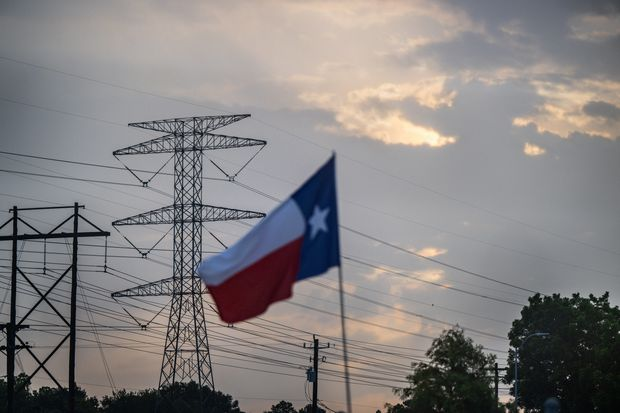
Power lines are seen during a heat wave in Dallas, June 12.
PHOTO: SHELBY TAUBER/REUTERS
Soaring oil and natural gas prices. Electricity grids on the brink of failure. Energy shortages in Europe, with worse to come. The free world’s growing strategic vulnerability to Vladimir Putin and other dictators.
These are some of the unfolding results in the last year caused by the West’s utopian dream to punish fossil fuels and sprint to a world driven solely by renewable energy. It’s time for political leaders to recognize this manifest debacle and admit that, short of a technological breakthrough, the world will need an ample supply of carbon fuel for decades to remain prosperous and free.
Consider the costly consequences of misguided climate regulation, subsidies and mandates:
July 15, 2022 6:49 pm ET
ERCOT (Electric Reliability Council of Texas) is urging Texans to voluntarily conserve power due to extreme heat potentially causing rolling blackouts.
PHOTO: BRANDON BELL/GETTY IMAGES
California transplants who moved to Texas no doubt thought they had escaped electric power outages. Think again. Texans this week were told to crank up their thermostats amid a brutal heat wave to avoid rolling blackouts. Some ultimatum: Swelter, or bake without power.
Temperatures in Texas climbed into the triple digits this week but this isn’t unusual. The problem is that wind power faltered, as it often does during hot spells. Wind accounts for about 30% of Texas’s power supply, but unlike fossil-fuel powered generators, wind can’t provide power when it doesn’t blow. Then gas-powered plants have to pick up the slack.
But gas plants alone couldn’t compensate for wind and meet surging demand for power. Texas’s grid operator had to urge residents to conserve electricity. Bitcoin miners were asked to power down to free up 1,000 megawatts of electricity—enough to power about 200,000 homes on a hot day. Soaring power prices gave them an incentive to do so.
Manufacturers also reported curtailing production owing to grid strains and surging prices. Toyota said Thursday it scaled back production at its San Antonio plant. Reuters reported that Toyota is considering stopping production most days before 2 p.m.—when demand for power increases—and shortening night shifts through mid-August.
One of Texas’s selling points to businesses has been its cheap and reliable energy. Under former Republican Gov. Rick Perry, the state invested heavily in building transmission lines to carry heavily subsidized wind power from West Texas to big cities. For a time, wind pushed down prices in the state’s deregulated power market.
But coal and nuclear plants have struggled to turn a profit running at reduced capacity, causing many to retire. As a result, the grid has become more dependent on gas-fired generators to compensate for unreliable renewables. Meantime, demand for power is increasing as Texas’s population grows. All of this pushed the state’s grid to a near-breaking point.
Gas and power prices are also increasing as regulatory obstacles to building new pipelines constrain supply. Texas’s residential electric rates have surged 70% since last June, costing the typical family $80 more per month.
It’s no surprise that Democratic candidate Beto O’Rourke is using this against incumbent Gov. Greg Abbott, who isn’t leading in the polls by as much as he probably imagined. Texas needs to fix its emerging power problems lest it become California.
Source (Archive)
July 17, 2022 6:31 pm ET
Power lines are seen during a heat wave in Dallas, June 12.
PHOTO: SHELBY TAUBER/REUTERS
Soaring oil and natural gas prices. Electricity grids on the brink of failure. Energy shortages in Europe, with worse to come. The free world’s growing strategic vulnerability to Vladimir Putin and other dictators.
These are some of the unfolding results in the last year caused by the West’s utopian dream to punish fossil fuels and sprint to a world driven solely by renewable energy. It’s time for political leaders to recognize this manifest debacle and admit that, short of a technological breakthrough, the world will need an ample supply of carbon fuel for decades to remain prosperous and free.
Consider the costly consequences of misguided climate regulation, subsidies and mandates:
- People even in affluent countries are learning they can no longer take reliable electric power for granted. Texas’s grid operator this month told residents not to use major appliances to avoid rolling blackouts amid a heat wave that brought wind power to a near standstill. Sluggish wind power also contributed to a week-long power outage amid freezing temperatures in February 2021.
The North American Electric Reliability Corporation recently warned that two-thirds of the U.S. could experience blackouts this summer. Blame shrinking baseload power generation, which has been replaced by unreliable renewable energy. Regulators can’t command the sun to shine or wind to blow.
A third of the nation’s coal power and 10% of its nuclear capacity has shut down over the past decade owing to stricter environmental regulation and competition from cheap natural gas as well as heavily subsidized renewables. Natural gas generators have picked up some of the slack. But they are under stress from having to ramp up and down to balance intermittent renewables.
Ironically, grid operators are having to keep coal plants scheduled to retire on life support. Super-green California plans to buy electricity from diesel generators when supply is tight. Grids in Texas and California are teetering, with renewables making up about a third of generation. And President Biden wants the national grid to run on carbon-free power by 2035, as if he can command it to be so. - The rushed green transition is driving up energy prices across the board. Peak-time electricity wholesale prices this summer are projected to more than double in the Northeast, Mid-Atlantic and Midwest, according to the Energy Information Administration. Blame the left’s war on pipelines, which has constrained natural gas production even as demand grows.
Surging energy prices are causing some steel and aluminum manufacturers to idle plants. In desperation, manufacturers are urging the Biden Administration to limit liquefied natural gas exports to Europe to lower energy prices, though Europe needs the LNG to avoid freezing this winter.
Retail consumers in much of the U.S. have largely been shielded so far because states limit utility rate increases. But average residential electricity prices in Texas’s deregulated power markets have climbed 70% over the past year. Americans can look forward to similar increases in the years ahead—either that, or utilities will go bankrupt as many have in Europe. - Supply shortages. When European power prices soared last summer as wind power slowed, Mr. Putin took advantage by slowing gas pipeline deliveries. That pushed up prices even more, causing some European manufacturers to suspend production. Now Mr. Putin seems ready to cut off all gas supplies.
Europeans are drafting emergency plans to ration supply to manufacturers. But German leaders are still shutting down their three operating nuclear plants by year’s end. To quote the final word of “The Bridge on the River Kwai”: “madness.” Germany must resort to burning coal and oil, as its trillion-dollar investment in wind and solar can’t make up for Russian gas.
Berlin is contemplating a bailout of power retailer Uniper. The French government recently announced plans to nationalize its financially struggling nuclear giant Electricite de France SA . The U.K. this spring announced a government takeover of
National Grid’s transmission system to manage its chaotic shift away from fossil fuels.
During Australia’s power crisis last month—the culprit again was too many coal plant retirements—its grid operator suspended wholesale markets and imposed price controls. Failed climate policies are becoming an excuse for more government control of energy production. - Empowering dictators. Europe’s climate obsession made itself vulnerable to the Kremlin, but Mr. Putin isn’t the only dictator smiling at the West’s energy woes. President Biden had to beg the Saudis for more oil production, and his Administration may ease sanctions on Venezuelan dictator Nicolás Maduro for more barrels of production. Iran may be liberated to export oil next.
Do Western leaders recognize or care that their climate monomania is endangering living standards in democracies and empowering authoritarians? Historian Arnold Toynbee argued that civilizations die from suicide, not murder. The West’s climate self-destruction may prove him right.
California Power Problems Hit Texas
Another state where unreliable renewable energy leads to power outages.
By The Editorial BoardJuly 15, 2022 6:49 pm ET
ERCOT (Electric Reliability Council of Texas) is urging Texans to voluntarily conserve power due to extreme heat potentially causing rolling blackouts.
PHOTO: BRANDON BELL/GETTY IMAGES
California transplants who moved to Texas no doubt thought they had escaped electric power outages. Think again. Texans this week were told to crank up their thermostats amid a brutal heat wave to avoid rolling blackouts. Some ultimatum: Swelter, or bake without power.
Temperatures in Texas climbed into the triple digits this week but this isn’t unusual. The problem is that wind power faltered, as it often does during hot spells. Wind accounts for about 30% of Texas’s power supply, but unlike fossil-fuel powered generators, wind can’t provide power when it doesn’t blow. Then gas-powered plants have to pick up the slack.
But gas plants alone couldn’t compensate for wind and meet surging demand for power. Texas’s grid operator had to urge residents to conserve electricity. Bitcoin miners were asked to power down to free up 1,000 megawatts of electricity—enough to power about 200,000 homes on a hot day. Soaring power prices gave them an incentive to do so.
Manufacturers also reported curtailing production owing to grid strains and surging prices. Toyota said Thursday it scaled back production at its San Antonio plant. Reuters reported that Toyota is considering stopping production most days before 2 p.m.—when demand for power increases—and shortening night shifts through mid-August.
One of Texas’s selling points to businesses has been its cheap and reliable energy. Under former Republican Gov. Rick Perry, the state invested heavily in building transmission lines to carry heavily subsidized wind power from West Texas to big cities. For a time, wind pushed down prices in the state’s deregulated power market.
But coal and nuclear plants have struggled to turn a profit running at reduced capacity, causing many to retire. As a result, the grid has become more dependent on gas-fired generators to compensate for unreliable renewables. Meantime, demand for power is increasing as Texas’s population grows. All of this pushed the state’s grid to a near-breaking point.
Gas and power prices are also increasing as regulatory obstacles to building new pipelines constrain supply. Texas’s residential electric rates have surged 70% since last June, costing the typical family $80 more per month.
It’s no surprise that Democratic candidate Beto O’Rourke is using this against incumbent Gov. Greg Abbott, who isn’t leading in the polls by as much as he probably imagined. Texas needs to fix its emerging power problems lest it become California.
Source (Archive)


