L | A

The Roman Empire is the most well-known period of our Ancient History. We are told that, once upon a time there were stone age cavemen. Then came the Sumerians in what is today known as Iraq, then the Egyptians with their Pyramids, then the Greeks, then the Romans, then the middle ages, finally the Industrial Revolution 150 years ago and here we are today. Civilization, they tell us, happened in the last couple thousands of years.
You’ve learned about it in school, saw it in movies and documentaries. Ancient Rome defines us inasmuch the conveniences of modern civilization (roads, hospitals, plumbing, sofas, postal services, defense, etc.) can be traced back to that great World Empire.
Put “Roman Empire” into Google and you get 288 Million results. Surely with that much information on it, it must have existed. On the page of movies about Ancient Rome I counted 182 productions, mostly Hollywood films. Surely they wouldn’t make that many movies about something that never was?
During a recent vacation I read a German-language book titled “Die Irrealitaet des Roemischen Reiches” – “The Unreality of the Roman Empire“. Contrarian books are fun! This is me at the airport, reading it:

As the book has not been translated into English, I’ll provide a summary.
Did the Romans build roads while invading enemy territory?
The author, Gernot Geise, a fun guy I’ve personally had the pleasure to meet back in the 1990s, first looks into the “historical fact” of Roman Soldiers crossing the Alps (the mountains leading from Italy across Austria and Switzerland) to conquer France and Germany against enemy armies of “barbarian hordes”. At the same time, they are carrying supplies and also building roads and cities in conquered land within a fairly short time. He asks how, while advancing into enemy territory across roadless mountains, they had the manpower and ability to build all these roads, fortresses and walls and also ward off the native “barbarians” in Germany and France while additionally farming for food and carrying all their supplies. According to his calculations they didn’t have enough soldiers to accomplish such a feat.
If indeed the Romans “built the roads” in the countries they were conquering, then why didn’t they build them wide enough to have three soldiers march beside each other? The roads are so narrow that a procession of Romans must have gone for dozens of miles, making them vulnerable to attacks. This and many other questions remain un-answered according to Geise.
The idea that one city in Italy (Rome) and it’s approximately 30 000 able-bodied men (subtracting old men and boys) created an army that conquered the entirety of Europe seems questionable. According to Geise, passing the Alps was also extremely difficult if roads did not yet exist prior to the Romans. He believes the “Romans” did not built the roads, they were already there and possibly built by the Celts. It is known that the Celts, who were said to have lived in Europe long before Rome, had advanced Wagons and Chariots. Their wagons required good roads to already have existed. If you don’t have good roads, you don’t build chariots. So the idea that proper roads didn’t exist before Roman times is debunked by the fact that good wagons existed before Roman times, not only by the Celts but also the Greeks, Egyptians and Sumerians.

The Wagon above, dated to 600 B.C., Strettweg, Austria.
How would a chariot as above (photo added by me, not Geise) navigate through the rocky Alpine terrain of Austria without roads?
The author says that the Celts were not the Barbarians as shown in History Class. He asks “Who would start building streets during an all-out war?” No war of recent memory had the warring parties build continent-spanning roads during combat, even with modern technology. The streets must have been built in peaceful times for peaceful purposes, before the Romans arrived.
The author claims there is no evidence or documentation on who built the roads. Certain roads that are dug up out of the mud, are labeled “Roman roads” without documentation. Because all we know is “Roman Empire” we label anything we dig up as “Roman”. There is only one document, called Tabula Peutingeriana that is taken as evidence of Roman road building. But the document is from the 12th Century, long after the “Roman Empire” had passed away, if it ever existed. The document refers to a time a thousand years prior but any documents it is based on are “missing”.
That’s a common problem when trying to prove the Roman Empire existed – the documents proving it are from a time long after the supposed Empire had disappeared.
Why were the “Romans” mostly French, German and Celtic?
As other authors before him (such as Russian scholar Anatoly Fomenko), Geise asks why the majority of “Roman soldiers” ethnically consisted of Celts, Germans and Frenchmen (Gauls) – the countries they were supposedly invading?
And why do many of the “Caesars” (Rulers, Emperors) come from places in France, Britain and Germany? Aren’t these the countries the “Romans” were invading? Shouldn’t the Roman army and ruling class have consisted mostly of ethnic Italians, Spaniards or Southern Europeans? And if the Romans recruited their soldiers locally, surely the Commanders must have at least originated from Italy or Rome? In his book, Geise provides long lists of “Roman” rulers that are Celts, Gauls and Germans.
He posits that there is no discernable difference in the knighthood of the ancient celts to the knights outfits and tools of the middle ages to the behavior and outfit of Roman Soldiers. They might as well be the same. In digging up helmets and swords, an archaeologist would be hard pressed to identify his discovery as belonging to a medieval Knight, a Celtic warrior or a Roman soldier. It used to be assumed that any Celtic artifact dug up was part of loot, stolen by the “barbarians”. Meanwhile it’s accepted that the Celts themselves were capable of making pottery, weapons, sophisticated wagons and much more. The difference between a Roman and a Celtic helmet perhaps does not denote a difference of culture but simply a different fashion from a different time.
The rulers of the Roman Empire were called Caesar, which is in fact a German word. C was pronounced K. It’s the exact same sound as the German word Kaiser, which means Ruler. Gernot Geise says that the Roman Empire is really an Iberian-Celtic-Germanic Empire.

Similar to Anatoly Fomenko, he says that there were actually two “Romes”. Around the year 1000 there was a cataclysm or flood that destroyed the civilization of Europe or the Mediterranean. Some of it was rebuilt from the ruins and memory of what it used to be. The Romans post-flood were the Celtic-Germanic-French-Iberian people. The Romans pre-flood were Greek. This is why so many of the dug-out structures labeled “Roman” could just as well have been labeled “Greek”, while the more medieval looking structures, such as castles and fortresses, were not submerged.
The word “Celts” comes from the Greek word Keltoi. It means “the Brave” and “the Exalted”. An alternative Greek meaning is “the ones who arrived”, which would make them the immigrants.
In 600 B.C. the area of Italy was apparently populated by Greeks and Etruscans. “Roman Architecture” is simply a mere continuation of Greek architecture with Etruscan influences. It is even possible that the pre-flood Greeks are the same as the post-flood Celts. In fact, 400 B.C. Italy was called “Gallia. The Gallia people were the Gauls (Celts) that populated England, Belgium, Netherlands and France at the time.
Interestingly the ancient Greeks called their army Italia. At one point the entire Greek Empire (not just the region known as Italy today) was called Italia. The Greek letters developed from Runes. Runes were the magical symbols of Northern Europe.
The author has collected evidence from several sources and languages that the word Rome refers to “troops”, “soldiers” and “army”, not to a people or nation. He says that “Roman” is a profession within Celtic society, not an Empire. Thus, a “Roman” could work as border patrol, a customs official, police or military. Later on, “Roman” was the word for military fortresses and bases across Europe.
Etruscan Architecture
Even mainstream Academia now agrees that some things previously assigned to the “Roman Empire” really belong to a more ancient people called the Etruscans. Paintings, Architecture and Sculptures of which I learned in school were “Roman” have meanwhile quietly been relabeled Etruscan. You’d think that this fact would be published worldwide, but most people don’t know this and mainstream media has given up any real journalism long ago. False knowledge, taught for centuries, takes a while to be updated. Thus, in the last 40 years, we’ve slowly shifted from teaching that the “Romans” founded Italy, to “the Etruscans” founding it.

But didn’t the Romans build the famous waterways called Aqueducts? And weren’t these genius feats of engineering, helping people to use waterways instead of roads to transport goods and people? It amounts to transporting goods for free, no carrier needed.
That’s what was officially taught in school, but there is a growing body of evidence that aqueducts were also built by the Etruscans. Meanwhile, there is also evidence that they built waterways not only in Italy but all over Europe. Officialdom (Wikipedia) still says that aqueducts were built by the Romans but I expect the info to be updated in the coming years.

Meanwhile we even have evidence of the Assyrians and Mayans building aqueducts (see links provided).

Source
If “Roman architecture” was built by the Greeks and Etruscans, where does that leave the “Romans”? Perhaps it leaves them in the fictional universes dreamed up by Hollywood.
In my older books I have associated these Etruscans and Iberians with ancient Atlantis.
Many people may also be surprised to learn that most of the archaeological discoveries of “Roman” artifacts weren’t dug up in Italy, the supposed center of the Empire. But where then? In France and Germany. When archaeologists dig up an item they often lazily assign it to the same people and time-period as similar looking items dug up in the past. In this way, if there was an error, all the subsequent similar items are erroneously assigned to wrong places and times.
All Roads lead to Rome
The city we know today as Rome wasn’t even called Rome in ancient times. It was called Palatium. The word Palat means “sky” in Etruscan and “palace” in Greek.
According to Greek History, the founder of Palatium was King Euandros, who also invented the Latin language, to be used by Elites, not understood by commoners. He and the Pelsagians (Greeks) travelled to Italy and founded the town. Greek History says that Euandros expanded his Kingdom throughout all of Italy. Originally he had to pay the Etruscans who lived there for using the land. But later, after controlling the country, he no longer had to pay them.
Rome was not called Rome, but many cities across Europe were called Rome.
The German cities Trier, Landsberg, Mainz, Bamberg and Aachen for example, were all once called “Rome” because they were military Forts. There’s even a town in Sweden on the Island of Gotland that is still called Rome today.

There is a small city in Germany called Landsberg. On it’s old seal or flag it is called Roma. Aachen is a city in Germany, formerly Netherlands and Belgium. It was called Roma Renovata, which, probably means “Rome Renewed”. Its old city seal says “Romanorum”. The German city of Mainz has on its city flag “Romane”. How is it that all these places were called Rome? One could argue that these titles denoted their belonging to the Roman Empire, but Geise says it is because Rome simply denotes military bases. Otherwise thousands of other towns would also have to be denoted as being part of the Empire.
The name of Constantinople (formerly Byzantium, today Istanbul) was Nova-Roma. Carthage was called the African Rome. There’s an entire country called Rome, it’s Romania. All kinds of places were called Rome, but just not the place today known as Rome! Today’s city of “Rome” wasn’t even called so 1000 years after Christ. It was a small Greek village of 10 acres. It was only made the capital of Italy in 1870, before that, Milano was the capital. In 1337 the writer Francesco Petrarca called the area around Rome a place full of ruins. Perhaps it’s no coincidence that roman History was mostly written down not in Latin but in Greek.
The city of Trier, Germany, still exists today. It was once called Belgica Roma (Belgian Rome). According to Geise, this and not today’s “Rome” is the oldest known “Roman” city. It is mentioned in writings dating back to the year 250, but the city is even older than that. There are Caeasers that lived in a Palace in the town of Konz (a suburb of Trier), from which Britannia, Gallia and Germania were ruled.
The old townhall of trier has an inscription from 1684, in golden letters: “Rome-Trier has stood for 3000 years, may its peace last forever”.

If Rome-Trier stood for “3000 years” before 1684 it would mean it existed in 1316 B.C. But the Roman Empire was supposed to have been founded in 27 B.C. more than a thousand years later.
The Porta Nigra, the oldest building in Trier:

The Limes
The “Limes” is the name given to a defense, border, wall and tower system denoting the supposed Germanic borders of the Roman Empire. As learned in history class, the southern side of the Limes was “Roman” and the other side was enemy territory or non-Roman (the “barbaric hordes”).

Geise spends a lot of time debunking the notion of the Limes being the border of the Empire. I won’t recount all of his points here, but one of them is that “Roman artifacts” and architecture were dug out on both sides of the wall. Moreover, cities of the Roman empire were stationed on both sides.
I too have wondered why an ever-expanding empire would suddenly build a fixed border like this.
Geise sees the wall and its accompanying towers as either a toll-system to collect money from travelers or a Celtic long-distance communication system.
There is no evidence for a Historian named Tacitus
One of our primary sources of information on Ancient Rome is the writer Tacitus. Without Tacitus, we know almost nothing about Ancient Rome. Geise claims that Tacitus writings are a hoax created by the Catholic Church to justify their History. By creating a fake History after a cataclysmic event, the Catholics cemented their power.
I looked up the name on Wikipedia and found that they seem to have no problem with his name:
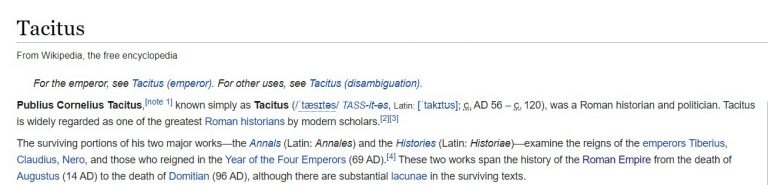
Until further down on the page, I read this:

The title presents his first name, but the small print says “his first name is not known”. Always when researching fabricated-history it pays off to have attention that spans beyond the first paragraph.
Geise also notes that nobody knows when or even where Tacitus was born, nor when or where he died. That’s not very reassuring for a figure we base a large chunk of History on. His first name isn’t known for certain, nor anyone he is related to. Even so, he is claimed to be an “eyewitness” of events spanning much more than only one lifespan. He not only describes wars, battles and Roman victories over those barbarians in great detail but also goes into local fist fights as if he were personally present (one sign that at least some of his writing may have been made up). He describes every tool and weapon in detail, countless conversations and interpersonal issues, etc. His writing titled “Germania” suddenly appears in the 15th Century. Before that, it was unknown. It purports to describe what happened in the year 190 B.C. The manuscript appeared in the Monastery of Corvey in Western Germany. It’s strange that these accounts of Roman History were unknown for 1500 years only to suddenly appear and form our understanding of History. This could point to a forgery. To use a funny comparison, we have thousands of pieces of more evidence of ancient aliens than of the existence of Tacitus.
There are many more rabbit-holes in Geise’s book that I haven’t had the leisure to go down. For example:
Atlantis and the Celts
One of the first clues that the Germans were perhaps not the enemies of “Rome” was in what Germans were called in Latin: Alemann, which is simply ancient German for “All Men”. Is this really a name you’d give to your enemies?
If we go by DNA Research, the Gauls (the Gallic people) and the Gaelic people of Ireland were the same. Looking at the words Gallic and Gaelic it makes sense, right? Both the Gauls and the Gaelic people were what is known as the “Celtic” people.
It is said that the Gallic people were so-called because of their red hair (Gallo meaning Rooster). I’m not sure about this, but it would distract from the article to go into the linguistic roots of the word. In my view, the Galatians inhabiting Turkey were also Celts, hence the word Gal. The German people were a mix of Celts/Gauls and other tribes. The Galatians (Gallic Celts) and Chaldeans (Celts) are also featured in the Bible.

The genetic map above is revealing. It shows that the red-haired and blonde Celtic and Gallic people likely came from the West, the Atlantic Ocean, first landing in western France (Gallia) and Ireland, then in Wales, England, Belgium and the Netherlands. The more they moved east, the more diluted their genes became through mixing with already existing tribes.
Hence in Greek Keltoi refers to “the one’s that arrived”.
I first pointed to these genetic facts in my work on Atlantis, ten years ago. If Atlantis existed as an advanced country in the Atlantic Ocean, then it’s sinking through a cataclysm would have driven survivors to Europe.
The genetic map of Europe doesn’t really support the idea of a “Roman Empire” invading and conquering Europe. It supports the idea of an Atlantean Empire invading and conquering Europe.
The Excavation of Rome

Excavations in Rome, Italy, were ongoing between the 1800s (image above 1885) to the 1940s. The structures excavated were labeled “Rome” but we find the same structures in the Expositions in America, in the Middle East, in Russia and other places where the Roman Empire was not. If the Roman Empire was “destroyed before the year 500”, why did they only start excavating the city in the 1800s? This doesn’t make any sense at all. Why was Mussolini excavating Roman buildings in the 1940s? Shouldn’t that have already started 1000 years prior?
Many of the buildings were 20 to 30 feet underground. How did that happen? Was the so called “Roman Empire” in fact the global Empire called “Atlantis” by some and “Tartaria” by others? And was it destroyed and flooded in a cataclysmic event or a series of events?
As I’ve shown elsewhere on this website, it is possible that the “Expositions” of America in the 1800s were not newly built but excavated from the old sunken empire. This then, was not the “Roman” Empire, not even the “Celtic” Empire, but a worldwide Empire that spoke a common language and shared a similar architecture.
If you input any random country in the world along with “Roman coins” to a search engine, you are likely to find something. The first examples I got when doing this:
1000 year old Roman coins found in Australia may rewrite History
Treasure Hunter finds ancient Roman coin in Australia
How did these Roman coins end up in Japan?
Roman coins uncovered in Hawaii
Roman coins discovered underwater in New Mexico
“Roman coins” can be found worldwide. Roman architecture can also be found worldwide, but it’s only called “Roman” when it’s dug up in Europe, because the narrative insists it was only there. If you dig up pillared structures anywhere else, they aren’t called Roman because “as everyone knows” the Romans only existed in Europe. Can you see the circular logic?
If this article provided food for thought, please share it.
The Roman Empire is the most well-known period of our Ancient History. We are told that, once upon a time there were stone age cavemen. Then came the Sumerians in what is today known as Iraq, then the Egyptians with their Pyramids, then the Greeks, then the Romans, then the middle ages, finally the Industrial Revolution 150 years ago and here we are today. Civilization, they tell us, happened in the last couple thousands of years.
You’ve learned about it in school, saw it in movies and documentaries. Ancient Rome defines us inasmuch the conveniences of modern civilization (roads, hospitals, plumbing, sofas, postal services, defense, etc.) can be traced back to that great World Empire.
Put “Roman Empire” into Google and you get 288 Million results. Surely with that much information on it, it must have existed. On the page of movies about Ancient Rome I counted 182 productions, mostly Hollywood films. Surely they wouldn’t make that many movies about something that never was?
During a recent vacation I read a German-language book titled “Die Irrealitaet des Roemischen Reiches” – “The Unreality of the Roman Empire“. Contrarian books are fun! This is me at the airport, reading it:
As the book has not been translated into English, I’ll provide a summary.
Did the Romans build roads while invading enemy territory?
The author, Gernot Geise, a fun guy I’ve personally had the pleasure to meet back in the 1990s, first looks into the “historical fact” of Roman Soldiers crossing the Alps (the mountains leading from Italy across Austria and Switzerland) to conquer France and Germany against enemy armies of “barbarian hordes”. At the same time, they are carrying supplies and also building roads and cities in conquered land within a fairly short time. He asks how, while advancing into enemy territory across roadless mountains, they had the manpower and ability to build all these roads, fortresses and walls and also ward off the native “barbarians” in Germany and France while additionally farming for food and carrying all their supplies. According to his calculations they didn’t have enough soldiers to accomplish such a feat.
If indeed the Romans “built the roads” in the countries they were conquering, then why didn’t they build them wide enough to have three soldiers march beside each other? The roads are so narrow that a procession of Romans must have gone for dozens of miles, making them vulnerable to attacks. This and many other questions remain un-answered according to Geise.
The idea that one city in Italy (Rome) and it’s approximately 30 000 able-bodied men (subtracting old men and boys) created an army that conquered the entirety of Europe seems questionable. According to Geise, passing the Alps was also extremely difficult if roads did not yet exist prior to the Romans. He believes the “Romans” did not built the roads, they were already there and possibly built by the Celts. It is known that the Celts, who were said to have lived in Europe long before Rome, had advanced Wagons and Chariots. Their wagons required good roads to already have existed. If you don’t have good roads, you don’t build chariots. So the idea that proper roads didn’t exist before Roman times is debunked by the fact that good wagons existed before Roman times, not only by the Celts but also the Greeks, Egyptians and Sumerians.
The Wagon above, dated to 600 B.C., Strettweg, Austria.
How would a chariot as above (photo added by me, not Geise) navigate through the rocky Alpine terrain of Austria without roads?
The author says that the Celts were not the Barbarians as shown in History Class. He asks “Who would start building streets during an all-out war?” No war of recent memory had the warring parties build continent-spanning roads during combat, even with modern technology. The streets must have been built in peaceful times for peaceful purposes, before the Romans arrived.
The author claims there is no evidence or documentation on who built the roads. Certain roads that are dug up out of the mud, are labeled “Roman roads” without documentation. Because all we know is “Roman Empire” we label anything we dig up as “Roman”. There is only one document, called Tabula Peutingeriana that is taken as evidence of Roman road building. But the document is from the 12th Century, long after the “Roman Empire” had passed away, if it ever existed. The document refers to a time a thousand years prior but any documents it is based on are “missing”.
That’s a common problem when trying to prove the Roman Empire existed – the documents proving it are from a time long after the supposed Empire had disappeared.
Why were the “Romans” mostly French, German and Celtic?
As other authors before him (such as Russian scholar Anatoly Fomenko), Geise asks why the majority of “Roman soldiers” ethnically consisted of Celts, Germans and Frenchmen (Gauls) – the countries they were supposedly invading?
And why do many of the “Caesars” (Rulers, Emperors) come from places in France, Britain and Germany? Aren’t these the countries the “Romans” were invading? Shouldn’t the Roman army and ruling class have consisted mostly of ethnic Italians, Spaniards or Southern Europeans? And if the Romans recruited their soldiers locally, surely the Commanders must have at least originated from Italy or Rome? In his book, Geise provides long lists of “Roman” rulers that are Celts, Gauls and Germans.
He posits that there is no discernable difference in the knighthood of the ancient celts to the knights outfits and tools of the middle ages to the behavior and outfit of Roman Soldiers. They might as well be the same. In digging up helmets and swords, an archaeologist would be hard pressed to identify his discovery as belonging to a medieval Knight, a Celtic warrior or a Roman soldier. It used to be assumed that any Celtic artifact dug up was part of loot, stolen by the “barbarians”. Meanwhile it’s accepted that the Celts themselves were capable of making pottery, weapons, sophisticated wagons and much more. The difference between a Roman and a Celtic helmet perhaps does not denote a difference of culture but simply a different fashion from a different time.
The rulers of the Roman Empire were called Caesar, which is in fact a German word. C was pronounced K. It’s the exact same sound as the German word Kaiser, which means Ruler. Gernot Geise says that the Roman Empire is really an Iberian-Celtic-Germanic Empire.
Similar to Anatoly Fomenko, he says that there were actually two “Romes”. Around the year 1000 there was a cataclysm or flood that destroyed the civilization of Europe or the Mediterranean. Some of it was rebuilt from the ruins and memory of what it used to be. The Romans post-flood were the Celtic-Germanic-French-Iberian people. The Romans pre-flood were Greek. This is why so many of the dug-out structures labeled “Roman” could just as well have been labeled “Greek”, while the more medieval looking structures, such as castles and fortresses, were not submerged.
The word “Celts” comes from the Greek word Keltoi. It means “the Brave” and “the Exalted”. An alternative Greek meaning is “the ones who arrived”, which would make them the immigrants.
In 600 B.C. the area of Italy was apparently populated by Greeks and Etruscans. “Roman Architecture” is simply a mere continuation of Greek architecture with Etruscan influences. It is even possible that the pre-flood Greeks are the same as the post-flood Celts. In fact, 400 B.C. Italy was called “Gallia. The Gallia people were the Gauls (Celts) that populated England, Belgium, Netherlands and France at the time.
Interestingly the ancient Greeks called their army Italia. At one point the entire Greek Empire (not just the region known as Italy today) was called Italia. The Greek letters developed from Runes. Runes were the magical symbols of Northern Europe.
The author has collected evidence from several sources and languages that the word Rome refers to “troops”, “soldiers” and “army”, not to a people or nation. He says that “Roman” is a profession within Celtic society, not an Empire. Thus, a “Roman” could work as border patrol, a customs official, police or military. Later on, “Roman” was the word for military fortresses and bases across Europe.
Etruscan Architecture
Even mainstream Academia now agrees that some things previously assigned to the “Roman Empire” really belong to a more ancient people called the Etruscans. Paintings, Architecture and Sculptures of which I learned in school were “Roman” have meanwhile quietly been relabeled Etruscan. You’d think that this fact would be published worldwide, but most people don’t know this and mainstream media has given up any real journalism long ago. False knowledge, taught for centuries, takes a while to be updated. Thus, in the last 40 years, we’ve slowly shifted from teaching that the “Romans” founded Italy, to “the Etruscans” founding it.
But didn’t the Romans build the famous waterways called Aqueducts? And weren’t these genius feats of engineering, helping people to use waterways instead of roads to transport goods and people? It amounts to transporting goods for free, no carrier needed.
That’s what was officially taught in school, but there is a growing body of evidence that aqueducts were also built by the Etruscans. Meanwhile, there is also evidence that they built waterways not only in Italy but all over Europe. Officialdom (Wikipedia) still says that aqueducts were built by the Romans but I expect the info to be updated in the coming years.
Meanwhile we even have evidence of the Assyrians and Mayans building aqueducts (see links provided).
Source
If “Roman architecture” was built by the Greeks and Etruscans, where does that leave the “Romans”? Perhaps it leaves them in the fictional universes dreamed up by Hollywood.
In my older books I have associated these Etruscans and Iberians with ancient Atlantis.
Many people may also be surprised to learn that most of the archaeological discoveries of “Roman” artifacts weren’t dug up in Italy, the supposed center of the Empire. But where then? In France and Germany. When archaeologists dig up an item they often lazily assign it to the same people and time-period as similar looking items dug up in the past. In this way, if there was an error, all the subsequent similar items are erroneously assigned to wrong places and times.
All Roads lead to Rome
The city we know today as Rome wasn’t even called Rome in ancient times. It was called Palatium. The word Palat means “sky” in Etruscan and “palace” in Greek.
According to Greek History, the founder of Palatium was King Euandros, who also invented the Latin language, to be used by Elites, not understood by commoners. He and the Pelsagians (Greeks) travelled to Italy and founded the town. Greek History says that Euandros expanded his Kingdom throughout all of Italy. Originally he had to pay the Etruscans who lived there for using the land. But later, after controlling the country, he no longer had to pay them.
Rome was not called Rome, but many cities across Europe were called Rome.
The German cities Trier, Landsberg, Mainz, Bamberg and Aachen for example, were all once called “Rome” because they were military Forts. There’s even a town in Sweden on the Island of Gotland that is still called Rome today.
There is a small city in Germany called Landsberg. On it’s old seal or flag it is called Roma. Aachen is a city in Germany, formerly Netherlands and Belgium. It was called Roma Renovata, which, probably means “Rome Renewed”. Its old city seal says “Romanorum”. The German city of Mainz has on its city flag “Romane”. How is it that all these places were called Rome? One could argue that these titles denoted their belonging to the Roman Empire, but Geise says it is because Rome simply denotes military bases. Otherwise thousands of other towns would also have to be denoted as being part of the Empire.
The name of Constantinople (formerly Byzantium, today Istanbul) was Nova-Roma. Carthage was called the African Rome. There’s an entire country called Rome, it’s Romania. All kinds of places were called Rome, but just not the place today known as Rome! Today’s city of “Rome” wasn’t even called so 1000 years after Christ. It was a small Greek village of 10 acres. It was only made the capital of Italy in 1870, before that, Milano was the capital. In 1337 the writer Francesco Petrarca called the area around Rome a place full of ruins. Perhaps it’s no coincidence that roman History was mostly written down not in Latin but in Greek.
The city of Trier, Germany, still exists today. It was once called Belgica Roma (Belgian Rome). According to Geise, this and not today’s “Rome” is the oldest known “Roman” city. It is mentioned in writings dating back to the year 250, but the city is even older than that. There are Caeasers that lived in a Palace in the town of Konz (a suburb of Trier), from which Britannia, Gallia and Germania were ruled.
The old townhall of trier has an inscription from 1684, in golden letters: “Rome-Trier has stood for 3000 years, may its peace last forever”.
If Rome-Trier stood for “3000 years” before 1684 it would mean it existed in 1316 B.C. But the Roman Empire was supposed to have been founded in 27 B.C. more than a thousand years later.
The Porta Nigra, the oldest building in Trier:
The Limes
The “Limes” is the name given to a defense, border, wall and tower system denoting the supposed Germanic borders of the Roman Empire. As learned in history class, the southern side of the Limes was “Roman” and the other side was enemy territory or non-Roman (the “barbaric hordes”).
Geise spends a lot of time debunking the notion of the Limes being the border of the Empire. I won’t recount all of his points here, but one of them is that “Roman artifacts” and architecture were dug out on both sides of the wall. Moreover, cities of the Roman empire were stationed on both sides.
I too have wondered why an ever-expanding empire would suddenly build a fixed border like this.
Geise sees the wall and its accompanying towers as either a toll-system to collect money from travelers or a Celtic long-distance communication system.
There is no evidence for a Historian named Tacitus
One of our primary sources of information on Ancient Rome is the writer Tacitus. Without Tacitus, we know almost nothing about Ancient Rome. Geise claims that Tacitus writings are a hoax created by the Catholic Church to justify their History. By creating a fake History after a cataclysmic event, the Catholics cemented their power.
I looked up the name on Wikipedia and found that they seem to have no problem with his name:
Until further down on the page, I read this:
The title presents his first name, but the small print says “his first name is not known”. Always when researching fabricated-history it pays off to have attention that spans beyond the first paragraph.
Geise also notes that nobody knows when or even where Tacitus was born, nor when or where he died. That’s not very reassuring for a figure we base a large chunk of History on. His first name isn’t known for certain, nor anyone he is related to. Even so, he is claimed to be an “eyewitness” of events spanning much more than only one lifespan. He not only describes wars, battles and Roman victories over those barbarians in great detail but also goes into local fist fights as if he were personally present (one sign that at least some of his writing may have been made up). He describes every tool and weapon in detail, countless conversations and interpersonal issues, etc. His writing titled “Germania” suddenly appears in the 15th Century. Before that, it was unknown. It purports to describe what happened in the year 190 B.C. The manuscript appeared in the Monastery of Corvey in Western Germany. It’s strange that these accounts of Roman History were unknown for 1500 years only to suddenly appear and form our understanding of History. This could point to a forgery. To use a funny comparison, we have thousands of pieces of more evidence of ancient aliens than of the existence of Tacitus.
There are many more rabbit-holes in Geise’s book that I haven’t had the leisure to go down. For example:
- The dark ages of the medieval times did not exist. They were invented as phantom time. At least 300 years were added. Others say 1300 years are fabricated.
- A 1633 book by Schottelius says that the Celtic language was brought to Europe after the Babylonian language confusion from Iraq by the Ascenas tribe. The book sees the Ascenas as the Father of the Germanic people (today known as Ashekenazi Jews).
- In 1691 an author by the name of Spaten said that Rome was built (or rebuilt?) in 3212 of the Jewish Calendar, which would be our year 1212.
Atlantis and the Celts
One of the first clues that the Germans were perhaps not the enemies of “Rome” was in what Germans were called in Latin: Alemann, which is simply ancient German for “All Men”. Is this really a name you’d give to your enemies?
If we go by DNA Research, the Gauls (the Gallic people) and the Gaelic people of Ireland were the same. Looking at the words Gallic and Gaelic it makes sense, right? Both the Gauls and the Gaelic people were what is known as the “Celtic” people.
It is said that the Gallic people were so-called because of their red hair (Gallo meaning Rooster). I’m not sure about this, but it would distract from the article to go into the linguistic roots of the word. In my view, the Galatians inhabiting Turkey were also Celts, hence the word Gal. The German people were a mix of Celts/Gauls and other tribes. The Galatians (Gallic Celts) and Chaldeans (Celts) are also featured in the Bible.
The genetic map above is revealing. It shows that the red-haired and blonde Celtic and Gallic people likely came from the West, the Atlantic Ocean, first landing in western France (Gallia) and Ireland, then in Wales, England, Belgium and the Netherlands. The more they moved east, the more diluted their genes became through mixing with already existing tribes.
Hence in Greek Keltoi refers to “the one’s that arrived”.
I first pointed to these genetic facts in my work on Atlantis, ten years ago. If Atlantis existed as an advanced country in the Atlantic Ocean, then it’s sinking through a cataclysm would have driven survivors to Europe.
The genetic map of Europe doesn’t really support the idea of a “Roman Empire” invading and conquering Europe. It supports the idea of an Atlantean Empire invading and conquering Europe.
The Excavation of Rome
Excavations in Rome, Italy, were ongoing between the 1800s (image above 1885) to the 1940s. The structures excavated were labeled “Rome” but we find the same structures in the Expositions in America, in the Middle East, in Russia and other places where the Roman Empire was not. If the Roman Empire was “destroyed before the year 500”, why did they only start excavating the city in the 1800s? This doesn’t make any sense at all. Why was Mussolini excavating Roman buildings in the 1940s? Shouldn’t that have already started 1000 years prior?
Many of the buildings were 20 to 30 feet underground. How did that happen? Was the so called “Roman Empire” in fact the global Empire called “Atlantis” by some and “Tartaria” by others? And was it destroyed and flooded in a cataclysmic event or a series of events?
As I’ve shown elsewhere on this website, it is possible that the “Expositions” of America in the 1800s were not newly built but excavated from the old sunken empire. This then, was not the “Roman” Empire, not even the “Celtic” Empire, but a worldwide Empire that spoke a common language and shared a similar architecture.
If you input any random country in the world along with “Roman coins” to a search engine, you are likely to find something. The first examples I got when doing this:
1000 year old Roman coins found in Australia may rewrite History
Treasure Hunter finds ancient Roman coin in Australia
How did these Roman coins end up in Japan?
Roman coins uncovered in Hawaii
Roman coins discovered underwater in New Mexico
“Roman coins” can be found worldwide. Roman architecture can also be found worldwide, but it’s only called “Roman” when it’s dug up in Europe, because the narrative insists it was only there. If you dig up pillared structures anywhere else, they aren’t called Roman because “as everyone knows” the Romans only existed in Europe. Can you see the circular logic?
If this article provided food for thought, please share it.


