WARNING LETTER
Patcos Cosmetics Pvt. Ltd.
MARCS-CMS 718220 — March 12, 2026
Delivery Method:VIA UPS
Reference #:320-26-52
Product: Drugs
Over-the-Counter Drugs
Recipient:
Mr. Vimal Patel Director
Director
Patcos Cosmetics Pvt. Ltd.
Survey No. 659 A Kevdi Falia Road
Daman 396210 Dadra and Nagar Haveli and Daman and Diu
India
Issuing Office:
Center for Drug Evaluation and Research (CDER)
United States
Warning Letter 320-26-52
March 12, 2026
Dear Mr. Patel:
The United States Food and Drug Administration (FDA) conducted an unannounced inspection of your drug manufacturing facility, Patcos Cosmetics Pvt. Ltd., FEI 3009250196, at Survey No. 659, A Kevdi Falia Road, Daman, Dadra and Nagar Haveli and Daman, India, from July 14 to 18, 2025.
Your drug products are adulterated under section 501(a)(2)(A) of the Federal Food, Drug, and Cosmetic Act (FD&C Act), 21 U.S.C. 351(a)(2)(A), in that they have been prepared, packed, or held under insanitary conditions, whereby they may have become contaminated with filth or rendered injurious to health.
This warning letter also summarizes significant violations of Current Good Manufacturing Practice (CGMP) regulations for finished pharmaceuticals. See Title 21 Code of Federal Regulations (CFR), parts 210 and 211 (21 CFR parts 210 and 211).
Because your methods, facilities, or controls for manufacturing, processing, packing, or holding do not conform to CGMP, your drug products are adulterated within the meaning of section 501(a)(2)(B) of the Federal Food, Drug, and Cosmetic Act (FD&C Act), 21 U.S.C. 351(a)(2)(B).
We reviewed your August 11, 2025, response to our Form FDA 483 in detail. Your response is inadequate because you failed to provide supportive documentation for evaluation or adequate evidence of corrective actions taken to bring your operations into compliance with CGMP.
During our inspection, our investigators observed specific violations including, but not limited to, the following:
Insanitary Conditions
Your firm manufactures over-the-counter (OTC)
(b)(4) drug products that are marketed to
(b)(4). Your drug products are adulterated under section 501(a)(2)(A) of the FD&C Act because they were prepared, packed, and held under insanitary conditions
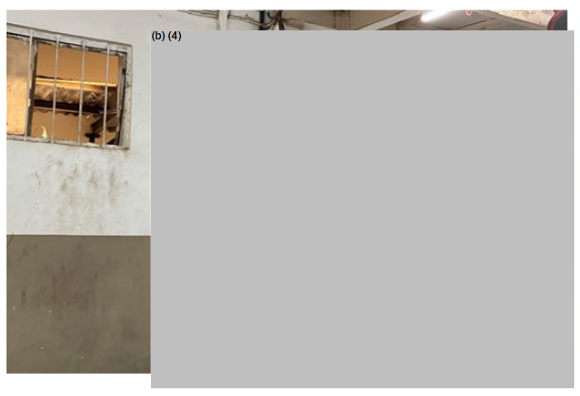
1. Your production operations, including filling lines, are conducted in a facility that lacks adequate separation barriers from the external environment. Specifically, our investigators observed evidence of harborage areas, broken windows, insanitary production-area sinks, and significant water damage in areas where open processing lines are located and where finished drug products are stored. Further, the investigators observed the following:
- Harborage areas immediately outside the first floor of the facility where filling, packaging, and (b)(4) production operations are performed. This area consisted of discarded piping with window-grate openings to the exterior of the facility.

- A broken window precluding the protection of open processing (b)(4) lines (lower right of photo) from the outside environment surrounding the facility.
- Sinks in the production area used as a source of water for cleaning production equipment.
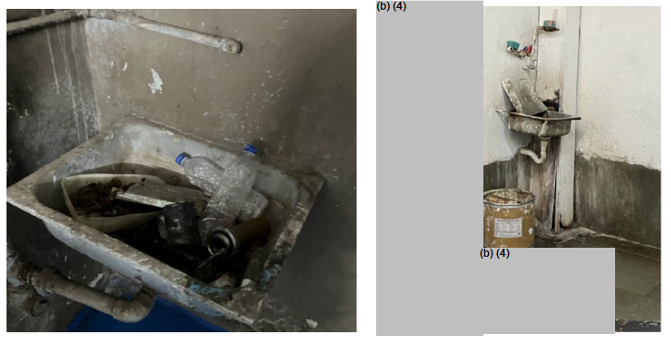
The insanitary conditions of your facility did not provide adequate protections of your
(b)(4) manufacturing operations from potential contamination with filth.
In your response, you state that facility cleaning and repairs will be carried out before restarting production. Your response is inadequate because no other details were provided including but not limited to the scope of repairs, timeframes for completion, or photographs documenting completed remediation. Nor did you include a comprehensive evaluation of your failure to maintain your facility and equipment in a clean and sanitary condition or the potential impact to your OTC drug products.
In response to this letter, provide:
- A comprehensive plan to remediate the facility, given the pervasive nature of the insanitary conditions.
- Detailed procedures that demonstrate your firm can maintain buildings free from pests and that they remain in a clean and sanitary state.
CGMP Violations
1. Your firm failed to maintain buildings used in the manufacture, processing, packing, or holding of drug products in a good state of repair (21 CFR 211.5 .
.
Your firm failed to maintain your facility in a good state of repair. During a 2017 FDA inspection, our investigators noted that your facility was in disrepair and had experienced flood damage to your facility and
(b)(4) system. Our current inspectional findings were commensurate with findings from 2017, indicating that you have not properly remediated and maintained your facility. For example, in addition to the previously mentioned insanitary conditions:
- The first floor of your facility contained dirt residue-covered flooring as well as water damage, which resulted in inadequate maintenance of the (b)(4)-production system.
- The (b)(4) floor of your facility showed evidence of significant water damage with brown discoloration of the ceiling and walls and green mold-like residue on the ceiling in retained product storage areas.
Although you are not currently producing
(b)(4) drug products for the United States (U.S.), the processing lines were previously used to produce
(b)(4) for the U.S. and continue to supply other markets.
To protect drug products from potential routes of contamination, your facility must be kept in a good state of repair and sanitary conditions must be maintained.
In response to this letter, provide:
- Your corrective action and preventive action (CAPA) plan to implement routine, vigilant operations management oversight of facilities and equipment. This plan should ensure, among other things, prompt detection of equipment/facilities performance issues, effective execution of repairs, adherence to appropriate preventive maintenance schedules, timely technological upgrades to the equipment/facility infrastructure, and improved systems for ongoing management review.
2. Your firm failed to conduct at least one test to verify the identity of each component of a drug product (21 CFR 211.84(d)(1)).
Your firm repeatedly failed to adequately perform identity testing of incoming high-risk components for
(b)(4) contamination. In response to our December 15, 2023, FDA Warning Letter 320-24-13 pertaining to the 704(a)(4) records request, you committed to updating your specifications and ensuring robust and documented testing procedures for each high-risk component, including but not limited to
(b)(4) solution, used in the manufacture of your OTC
(b)(4) drug products. During our recent inspection, we found your practices continued to be inadequate, in that:
- You continued to use the Indian Pharmacopoeia (IP-(b)(4)) specification for (b)(4) solution which did not require impurities or identity testing for (b)(4).
- You have not updated sampling procedures to ensure that sampling was properly documented and adequately represented each shipment of each lot of high-risk components.
- You affirmed that the methods used by your third-party lab to perform identity testing are neither validated nor verified.
Your responses are inadequate and demonstrate a failure to meet commitments. In your response to Warning Letter 320-24-13, you claimed that testing would be implemented. In your August 2025 response you reiterate previous commitments, stating that you will initiate validation/verification of all analytical methods using ICH guidelines and that USP-compliant
(b)(4) testing protocols will be adopted. Your current response is inadequate because you did not provide timeframes for completion, documented method validation, and an updated specification with sampling plan to ensure the quality of your high-risk components.
The use of ingredients contaminated with
(b)(4) has resulted in various lethal poisoning incidents in humans worldwide. See FDA’s guidance document
(b)(4) to help you meet the CGMP requirements when manufacturing drugs containing ingredients at high-risk for
(b)(4) contamination at
(b)(4).
In response to this letter, provide:
- A commitment to provide (b)(4) test results, no later than 30 calendar days from the date of this letter, from testing retains for all lots of high-risk drug components used in the manufacture of drug products. Alternatively, if a retain of a component lot is unavailable, perform retain sample testing of all implicated finished drug product batches for the presence of (b)(4).
- A full risk assessment for drug products that are within expiry which contain any ingredient at risk for (b)(4) contamination (including, but not limited to, (b)(4)). Take prompt and appropriate actions to determine the safety of all lots of the component(s) and any related drug product that could contain (b)(4), including customer notifications and product recalls for any contaminated lots. Identify additional appropriate CAPA that secure supply chains in the future, including, but not limited to, ensuring that all incoming raw material lots are from fully qualified manufacturers and free from unsafe impurities. Detail these actions in your response to this letter.
- A description of how you will test each component lot for conformity with all appropriate specifications for identity, strength, quality, and purity. If you intend to accept any results from your supplier’s certificate of analysis (COA) instead of testing each component lot for strength, quality, and purity, specify how you will robustly establish the reliability of your supplier’s results through initial validation as well as periodic revalidation. In addition, include a commitment to always conduct at least one specific identity test for each incoming component lot. In the case of (b)(4) and certain additional high-risk components we note that this includes the performance of parts A, B. and C of the United States Pharmacopeia (USP) monograph.
- The chemical quality control specifications you use to test each incoming lot of high-risk drug components to determine acceptability for use in manufacturing.
- A comprehensive, independent review of your material system to determine whether all suppliers of components, containers, and closures, are each qualified and the materials are assigned appropriate expiration or retest dates. The review should also determine whether incoming material controls are adequate to prevent use of unsuitable components, containers, and closures.
3. Your firm failed to establish adequate written procedures for production and process control designed to assure that the drug products you manufacture have the identity, strength, quality, and purity they purport or are represented to possess (21 CFR 211.100(a)).
Inadequate (b)(4) System
Your firm uses
(b)(4) as a component to manufacture OTC
(b)(4) drug products. You failed to adequately validate your
(b)(4)-production process to ensure that the system was producing
(b)(4) of appropriate quality for its intended use. Additionally, our investigators observed that your
(b)(4) system contained several design flaws (e.g., ball valves,
(b)(4) tubing with numerous joints, inadequate pipe sloping, threaded fittings and
(b)(4) tape), and it was not adequately maintained and periodically sanitized. Furthermore, your
(b)(4) system was inadequately monitored to ensure that it consistently produced
(b)(4) that met appropriate chemical and microbial quality standards.
In your response, you state that your
(b)(4)-system remediation will take effect when you resume routine production. Your response is inadequate because you do not include timeframes for remediating your
(b)(4) system’s poor design, completing microbiological and
(b)(4) testing, nor validation or sanitization of your
(b)(4) system. Further, you do not address the potential impact of a poorly designed
(b)(4) system on drug products distributed within the United States that are within expiry.
(b)(4) is
(b)(4) which must be suitable for its intended use and routinely tested. To achieve an ongoing state of control in your
(b)(4) system, you must conduct routine monitoring of
(b)(4), and microbial levels and identify any contamination in the system.
Inadequate Process Validation
You failed to validate the processes you use to manufacture your OTC drug products. During our inspection, you affirmed that process validation was not performed. Furthermore, you provided records for eight batches of
(b)(4) drug products tested in December 2023 and January 2024 that were super potent (
(b)(4)% to
(b)(4)%) for your active ingredient,
(b)(4). Your failure to properly validate your manufacturing processes provides a lack of assurance that your finished products have met all quality attributes including specifications.
In your response, you state that you will validate manufacturing processes once routine manufacturing resumes. Your response is inadequate because you do not provide documentation or timeframes for completing your process validation, nor do you consider a retrospective assessment of the potential impact to your products distributed within the U.S. that are within expiry.
Process validation evaluates the soundness of design and state of control of a process throughout its lifecycle. Each significant stage of a manufacturing process must be designed appropriately and assure the quality of raw material inputs, in-process materials, and finished drugs. Process qualification studies include intensive monitoring and testing throughout each significant process stage to characterize intra-batch variation and evaluates batches to determine whether an initial state of control has been established.
Successful process qualification studies are necessary before commercial distribution. Thereafter, ongoing vigilant oversight of process performance and product quality is necessary to ensure you maintain a stable manufacturing operation throughout the product lifecycle. See FDA’s guidance for industry,
Process Validation: General Principles and Practices, for general principles and approaches that the FDA considers appropriate elements of process validation at
In response to this letter, provide:
- A comprehensive, independent, assessment of your (b)(4) system design, control, and maintenance.
- A thorough remediation plan to install and operate a suitable (b)(4) system. Include a robust ongoing control, maintenance, and monitoring program to ensure the remediated system design consistently produces (b)(4) adhering to (b)(4), United States Pharmacopoeia (USP) monograph, specifications and appropriate microbial limits.
- Regarding the latter, ensure that your total microbial count limit for (b)(4) is appropriate in view of the intended use of the products produced by your firm.
- A detailed risk assessment addressing the potential effects of the observed (b)(4) system failures on the quality of all drug product lots currently in U.S. distribution or within expiry. Specify actions that you will take in response to the risk assessment, such as customer notifications and product recalls.
- A detailed summary of your validation program for ensuring a state of control throughout the product lifecycle, along with associated procedures. Describe your program for process performance qualification, and ongoing monitoring of both intra-batch and inter-batch variation to ensure a continuing state of control.
- A timeline for performing process performance qualification for each of your marketed drug products.
- Process performance protocol(s), and written procedures for qualification of equipment and facilities.
- A detailed program for designing, validating, maintaining, controlling, and monitoring each of your manufacturing processes that includes vigilant monitoring of intra-batch and inter-batch variation to ensure an ongoing state of control. Also, include your program for qualification of your equipment and facility.
4. Your firm failed to establish an adequate quality unit and the responsibilities and procedures applicable to the quality control unit are not in writing and fully followed (21 CFR 211.22(a) and (d).
The records and information you provided demonstrate that your quality unit (QU) did not effectively exercise its responsibilities to oversee the quality of your drug manufacturing operations. Specifically, your QU failed to:
- Ensure adequate control over laboratory data including deliberate alteration of original data to conceal out-of-specification results (21 CFR 211.194).
- Ensure that batch production and control records are complete (21 CFR 211.18
- Ensure adequate specifications, sampling plans, and test methods for components and drug products to assure they conform to appropriate standards of identity, strength, quality and purity (21 CFR 211.160(b)).
- Ensure the establishment of a written testing program designed to assess the stability characteristics of drug products and to use the results of stability testing to determine appropriate storage conditions and expiration dates (21 CFR 211.166(a)).
In your response, you state that you will perform certain corrective actions upon resumption of production but acknowledge that you have limited ability to fully implement the proposed systemic changes across the facility. Your response is inadequate because you did not provide documentation in support of any proposed changes or commit to compliance with CGMP before resuming operations. Furthermore, your response does not address the significant failures in data governance observed during our inspection.
Significant findings in this letter demonstrate that your firm does not operate an effective quality system in accordance with CGMP. In addition to the lack of effective management oversight of your production and laboratory operations, we found that your QU was not enabled to exercise proper authority and insufficiently implemented its responsibilities. Executive management should immediately and comprehensively assess your company’s manufacturing operations to ensure that your systems, processes, and products meet CGMP.
Your firm’s quality systems are inadequate. See FDA’s guidance document
Quality Systems Approach to Pharmaceutical CGMP Regulations for help in implementing quality systems and risk management approaches to meet the requirements of CGMP regulations 21 CFR parts 210 and 211, at
https://www.fda.gov/media/71023/download.
In response to this letter provide:
- A comprehensive assessment and remediation plan to ensure your QU is given the authority and resources to effectively function. The assessment should also include, but not be limited to:
o A determination of whether procedures used by your firm are robust and appropriate
o Provisions for QU oversight throughout your operations to evaluate adherence to appropriate practices
o A complete and final review of each batch and its related information before the QU disposition decision
o Oversight and approval of investigations and discharging of all other QU duties to ensure identity, strength, quality, and purity of all products
- A comprehensive, independent assessment and CAPA plan to ensure the adequacy of your stability program. Your remediated program should include, but not be limited to:
o Stability indicating methods
o Stability studies for each drug product in its marketed container-closure system before distribution is permitted
o An ongoing program in which representative batches of each product are added each year to the program to determine if the shelf-life claim remains valid
o Detailed definition of the specific attributes to be tested at each station (timepoint)
Responsibilities as a Contractor
Drugs must be manufactured in conformance with CGMP. FDA is aware that many drug manufacturers use independent contractors such as production facilities, testing laboratories, packagers, and labelers. FDA regards contractors as extensions of the manufacturer. You are responsible for the quality of drugs you produce as a contract facility regardless of agreements in place with product owners. You are required to ensure that drugs are made in accordance with section 501(a)(2)(B) of the FD&C Act for safety, identity, strength, quality, and purity. See FDA’s guidance document Contract Manufacturing Arrangements for Drugs: Quality Agreements at
https://www.fda.gov/media/86193/download.
Data Integrity Remediation
Your quality system does not adequately ensure the accuracy and integrity of data to support the safety, effectiveness, and quality of the drugs you manufacture. See FDA’s guidance document Data Integrity and Compliance With Drug CGMP for guidance on establishing and following CGMP compliant data integrity practices at
https://www.fda.gov/files/drugs/pub...ufacturing-Practice-Guidance-for-Industry.pdf.
We strongly recommend that you retain an independent third-party qualified consultant to assist in your remediation. In response to this letter, provide:
- A comprehensive investigation into the extent of the inaccuracies in data records and reporting. Your investigation should include:
o A detailed investigation protocol and methodology; a summary of all laboratories, manufacturing operations, and systems to be covered by the assessment; and a justification for any part of your operation that you propose to exclude.
o Interviews of current and former employees to identify the nature, scope, and root cause of data inaccuracies. We recommend that these interviews be conducted by a qualified third party.
o An assessment of the extent of data integrity deficiencies at your facility. Identify omissions, alterations, deletions, record destruction, non-contemporaneous record completion, and other deficiencies. Describe all parts of your facility’s operations in which you discovered data integrity lapses.
o A comprehensive retrospective evaluation of the nature of the testing and manufacturing data integrity deficiencies. We recommend that a qualified third party with specific expertise in the area where potential breaches were identified should evaluate all data integrity lapses.
- A current risk assessment of the potential effects of the observed failures on the quality of your drugs. Your assessment should include analyses of the risks to patients caused by the release of drugs affected by a lapse of data integrity and analyses of the risks posed by ongoing operations.
- A management strategy for your firm that includes the details of your global corrective action and preventive action plan. Your strategy should include:
o A detailed corrective action plan that describes how you intend to ensure the reliability and completeness of all the data you generate including analytical data, manufacturing records, and all data submitted to FDA.
o A comprehensive description of the root causes of your data integrity lapses including evidence that the scope and depth of the current action plan is commensurate with the findings of the investigation and risk assessment. Indicate whether individuals responsible for data integrity lapses remain able to influence CGMP-related or drug application data at your firm.
o Interim measures describing the actions you have taken or will take to protect patients and to ensure the quality of your drugs, such as notifying your customers, recalling product, conducting additional testing, adding lots to your stability programs to assure stability, drug application actions, and enhanced complaint monitoring.
o Long-term measures describing any remediation efforts and enhancements to procedures, processes, methods, controls, systems, management oversight, and human resources (e.g., training, staffing improvements) designed to ensure the integrity of your company’s data.
o A commitment to have a qualified consultant conduct extensive annual audits, for at least two years, to assist in evaluating CAPA effectiveness after you have executed your data integrity remediation protocol.
o Inform FDA if you will be hiring a Chief Integrity Officer who is fully empowered to receive anonymous complaints from employees reporting data integrity concerns and with the authority to ensure any potential breach is promptly investigated (by independent quality assurance function, along with expertise from outside entities whenever needed).
o A status report for any of the above activities already underway or completed.
CGMP Consultant Recommended
Based upon the nature of the violations we identified at your firm, you should engage a consultant qualified as set forth in 21 CFR 211.34 to evaluate your operations and to assist your firm in meeting CGMP requirements if your firm intends to resume manufacturing drugs for the U.S. market. The qualified consultant should also perform a comprehensive six-system audit of your entire operation for CGMP compliance and evaluate the completion and efficacy of your corrective actions and preventive actions before you pursue resolution of your firm’s compliance status with FDA. Your use of a consultant does not relieve your firm’s obligation to comply with CGMP. Your firm’s executive management remains responsible for resolving all deficiencies and systemic flaws to ensure ongoing CGMP compliance.
Conclusion
The violations cited in this letter are not intended to be an all-inclusive list of violations that exist at your facility. You are responsible for investigating and determining the causes of any violations and for preventing their recurrence or the occurrence of other violations.
FDA placed all drugs and drug products offered for import into the United States from your firm on Import Alert 66-40 on November 17, 2023, and issued an FDA Warning Letter on December 15, 2023, after review of your response to our 704(a)(4) Request for Records sent to you on July 12, 2023. Your response demonstrated CGMP violations related to controls for
(b)(4) in high-risk components used in your drugs. In response to this previous Warning Letter, your firm elected to re-register your facility stating your readiness for inspection and emphasizing your “ongoing compliance with current Good Manufacturing Practices” and “adhering to the highest quality standards”.
The inspectional findings detailed above further demonstrate your firm’s noncompliance, regardless of your affirmed compliance to CGMP and inspectional readiness status.
Your firm remains on Import Alert 66-40.
Correct any violations promptly. FDA may withhold approval of new applications or supplements listing your firm as a drug manufacturer until any violations are completely addressed and we confirm your compliance with CGMP. We may re-inspect to verify that you have completed corrective actions to any violations.
Failure to address any violations may also result in the FDA continuing to refuse admission of articles manufactured at Patcos Cosmetics Pvt. Ltd, 659 Kevdi Falia Road, Daman, India into the United States under section 801(a)(3) of the FD&C Act, 21 U.S.C. 381(a)(3). Articles under this authority that appear to be adulterated may be detained or refused admission, in that the methods and controls used in their manufacture do not appear to conform to CGMP within the meaning of section 501(a)(2)(B) of the FD&C Act, 21 U.S.C. 351(a)(2)(B).
This letter notifies you of our findings and provides you an opportunity to address the above deficiencies. After you receive this letter, respond to this office in writing within 15 working days. Specify what you have done to address any violations and to prevent their recurrence. In response to this letter, you may provide additional information for our consideration as we continue to assess your activities and practices. If you cannot complete corrective actions within 15 working days, state your reasons for delay and your schedule for completion.
Send your electronic reply to
CDER-OC-OMQ-Communications@fda.hhs.gov. Identify your response with FEI 3009250196 and ATTN: Matthew R. Dionne.
Sincerely,
/sneed/
Francis Godwin
Director
Office of Manufacturing Quality
Office of Compliance
Center for Drug Evaluation and Research
CC:
Mr. Kantibhai Patel
Chairman
Patcos Cosmetics Pvt. Ltd.
120 Mahal Industrial Estate
Mahakali Caves Road
Mumbai, Maharashtra
400093 India
__________
1 CDER is including photographs of your facility in this warning letter to document the gross insanitary conditions violations.


