From the Catalina Aircraft Trust:
(Archive)
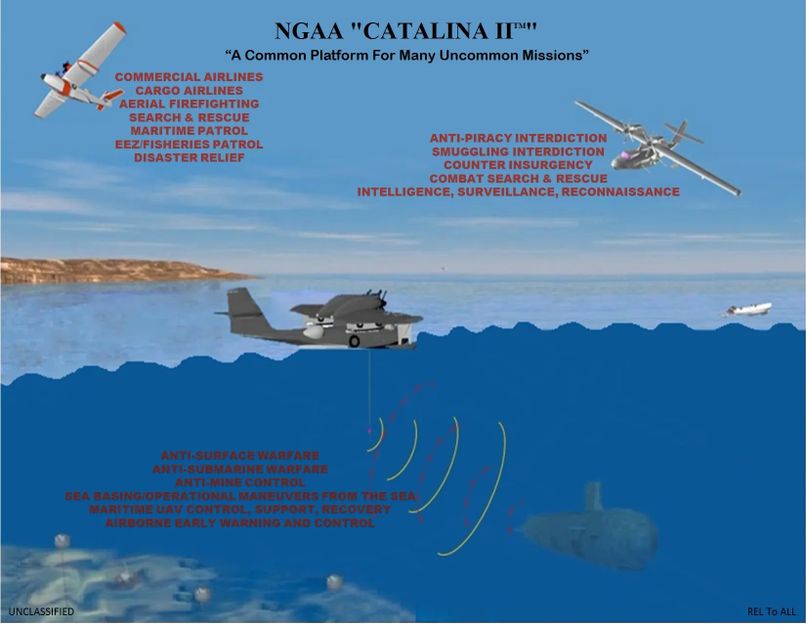
NGAA Catalina II Special Use Variant
(Archive)
Besides their ancient, boomer-tier webdesign, I love that they chose an image for the "Special Use Variant" depicting it as a fucking AC-130-style gunship in a pylon turn around a speedboat.

Still though, I'm cautiously optimistic to see them succeed on the civilian market. Except for their website & presentation, the company itself seems to at least have the technical ability, enough to build a couple of functioning & safe airframes to start & maybe small/limited initial production run; but I wonder if they could handle a larger number of orders.
But then again, seaplanes are quite a different animal than land-based aircraft. Maintaining & rebuilding existing airframes that've been around for near a century is one thing, but building a new one from ground up & putting it into production is an entirely different thing.
In any case, I know if I had the bank for one I'd definitely be in line, then fit it out like that vintage "flying houseboat of the future" Catalina & live in the thing.
Because fuck HOAs & neighbors.
(Archive)
Catalina Aircraft has been supporting the continued Airworthiness of legacy Catalinas around the world for the last 14 years. After discussing a production re-start option with several Governments, Militaries, Agencies, and Commercial Operators, and receiving positive interest from those parties, our senior management team (which has over 350 years of combined experience in civilian & defense aviation acquisition, development, production, test, evaluation, operations, and support) made the decision to formalize a production re-start program to bring our beloved Catalina back into mainstream service as a new production twin turboprop amphibious flying boat offering operators the quintessential standard in airborne amphibious operations.
No one can argue the legendary capabilities nor achievements of the Catalina amphibious flying boat. From the sighting of the Bismarck in the Eastern Atlantic before the United States officially entered the War, to the perceived last mission of the War, delivering the "Instrument of Surrender" to the Missouri anchored in Toyko Bay, the mighty Catalina has served and defended many nations during their time of need. After the War, Air France commissioned Consolidated-Vultee to convert some surplus military Catalinas into Transport Category, Standard Airworthiness, 28-5ACF commercial airliners. The 28-5ACF Catalina continued to serve, now including the public's needs, delivering passengers and cargo to locations typically out of reach of the land based commercial transports which required traditional airport infrastructure, fighting wildfires, performing humanitarian missions, as well as many other essential activities, all with a well proven track record. And for those reasons, the Catalina is the most recognizable, highly respected, and legendary amphibious aircraft in the world. The Catalina has an incredible history, proudly serving 41 nations during their time of need and has competently operated in 83 airlines worldwide. The Catalina has earned the respect of all who have operated it and all that have had a chance to experience it.
Catalina Aircraft is seizing the moment and is recreating history for this legendary and respected amphibious aircraft to once again be the epitome of amphibious aviation operations, offering a new production, modernized, twin turboprop, Transport Category amphibious flying boat for the private, commercial, government and military sectors.
The NGAA Catalina II targets two major aircraft client groups, the civilian / commercial operator and the Government / Military customer. The NGAA Catalina II is set to be the largest, fastest, longest range / endurance, highest payload, and most capable amphibious aircraft available worldwide with Western Certifications.
The NGAA Catalina II carries forward the history and legendary performance of the currently Transport Category, Standard Airworthiness certificated 28-5ACF Catalina by exploiting today’s advances in digitization, systems, materials, corrosion control, avionics, and engine / propulsion technologies.
Why Seaplanes Now?
As tourism (and threats) grow around the world, so does the desire to travel to / operate in regions of the world not supported by traditional airport infrastructure. Realizing that seventy-one percent (71%) of the Earth’s surface is covered by water, why are seaplanes not more commonly employed in today’s amphibious operations? Quite simply said; While there is an abundance of (limited capability) Small Category "float converted" land planes, there is a capabilities gap that exists as there are currently no Western Certificated, Large, Transport Category amphibious aircraft being produced to fill those larger capability needs desired by many customers and end users worldwide.
The production continuation / production re-start of the NGAA Catalina II provides civilian, commercial, government and military operators a significant capabilities expansion over many current platforms employed in amphibious operations today. As an air-bridge, the NGAA Catalina II can offer precision, speed and flexibility from land to air to sea.
With an almost limitless multi - CONOPs potential from a single platform, the NGAA Catalina II offers a single asset solution capable of replacing several existing platform types, thus reducing overall Acquisition, Operational and Sustainment costs.
The NGAA Catalina II, like its predecessor, is a strategic force multiplier that can be employed across an entire spectrum of operations by way of Land, Air, and Sea.
Catalina Aircraft is seizing the moment and is recreating history for this legendary and respected amphibious aircraft to once again be the epitome of amphibious aviation operations, offering a new production, modernized, twin turboprop, Transport Category amphibious flying boat for the private, commercial, government and military sectors.
The NGAA Catalina II targets two major aircraft client groups, the civilian / commercial operator and the Government / Military customer. The NGAA Catalina II is set to be the largest, fastest, longest range / endurance, highest payload, and most capable amphibious aircraft available worldwide with Western Certifications.
The NGAA Catalina II carries forward the history and legendary performance of the currently Transport Category, Standard Airworthiness certificated 28-5ACF Catalina by exploiting today’s advances in digitization, systems, materials, corrosion control, avionics, and engine / propulsion technologies.
Why Seaplanes Now?
As tourism (and threats) grow around the world, so does the desire to travel to / operate in regions of the world not supported by traditional airport infrastructure. Realizing that seventy-one percent (71%) of the Earth’s surface is covered by water, why are seaplanes not more commonly employed in today’s amphibious operations? Quite simply said; While there is an abundance of (limited capability) Small Category "float converted" land planes, there is a capabilities gap that exists as there are currently no Western Certificated, Large, Transport Category amphibious aircraft being produced to fill those larger capability needs desired by many customers and end users worldwide.
The production continuation / production re-start of the NGAA Catalina II provides civilian, commercial, government and military operators a significant capabilities expansion over many current platforms employed in amphibious operations today. As an air-bridge, the NGAA Catalina II can offer precision, speed and flexibility from land to air to sea.
With an almost limitless multi - CONOPs potential from a single platform, the NGAA Catalina II offers a single asset solution capable of replacing several existing platform types, thus reducing overall Acquisition, Operational and Sustainment costs.
The NGAA Catalina II, like its predecessor, is a strategic force multiplier that can be employed across an entire spectrum of operations by way of Land, Air, and Sea.
Civilian / Commercial Variant
The operational capabilities a Large, Transport Category amphibious flying boat can offer over those of a Small Category (under 12,500 pounds) float converted land plane are significant. Listed below are several of the Civilian / Commercial market segments the NGAA Catalina II can perform in:
Civilian / Commercial Applications:
● Passenger Airline Transport
● Air Cargo Transport
● Offshore Oil Rig Support
● Corporate / Personal / High Net Worth Air Yacht
● Air Ambulance
● Environmental Disaster Response
● Dive Emergency Response
● Fisheries Bulk Stocking
● Humanitarian Aid
● Postal / Supply Delivery
● Adventure Sports Transport
NGAA Catalina II Special Use Variant
(Archive)

The NGAA Catalina II Special Use Variant is an unpressurized, hulled, amphibious flying boat capable of maritime operations in up to Sea State 3. This Special Use Variant targets the government / military customer who desires a single asset solution that can operate to / from austere locations terra firma and within the maritime environment.
Capability
The Special Use Variant is a Large, Transport Category amphibious flying boat capable of operation from runways, grass, dirt, sand, lakes, rivers, bays, and blue water.
Range
With a maximum fuel capacity of up to 2710 gallons, the Special Use Variant has over 19 hours of operational capability available for missions. Other green energy power options can also be considered at the customer's request.
Performance
Equipped with more powerful engines and a Very Low Stall (VLS) wing design, the Special Use Variant can offer a high speed cruise of up to 200 Knots, as well as low speed entries as slow as 62 Knots providing the end user with an unmatched mission Capability, Capacity and Readiness (CCR) versus existing fixed wing and rotorcraft platforms currently employed for austere location and maritime operations.
Capacity
The Special Use Version has a Maximum Take Off Weight (MTOW) of 40,000 pounds. The forward and aft cabins have been enlarged and can support several configurations to include:
- Up to 30 fully geared Troops
- Up to 16,000 pounds of internal cargo and equipment
- Intelligence, Surveillance, Target Acquisition, Reconnaissance suites and/or Weaponization
- Aerial firefighting suite
- Two 2,500 pound external wing stores
A "straight" flying boat version of the Special Use Version is available for those customers who wish to further improve useful load through the weight elimination of the retractable landing gear.
Supportability
The Special Use Version is constructed using modern corrosion resistant materials, assembly practices and supportability initiatives to ensure the Material Availability and Operational Availability (Ao) remains at the highest rates possible. Many existing and proven in-service systems are employed to minimize logistics footprint growth and provide for commonality of components between the NGAA Catalina II and existing / emerging in-service aerial platforms. The Special Use Variant also offers an unmatched Battle Damage Assessment & Repair (BDAR) capability at the Organizational Level (O-Level) over any other in-service platform.
Safety
The Special Use Variant is a new production amphibious flying boat based on the design fundamentals of the legendary Transport Category, Standard Airworthiness, 28-5ACF Catalina, which to date has ZERO airframe Airworthiness Directives (ADs). Truly a testament to the Catalinas robust design! Unlike "float converted" land planes, the "hulled" fuselage of the NGAA Catalina II is designed specifically for operations in ever changing maritime conditions. Some of our safety features include:
- Hulled fuselage amphibious flying boat with no "float conversion" struts to break
- Retractable wing tip floats
- Dual ultra wide, 4 segment, Night Vision Goggle (NVG) compatible touchscreens
- "Dark Cockpit" Pilot Vehicle Interface (PVI) to reduce Pilot workload
- Landing gear / float selector interlocks to prevent inadvertent dual deployment
- Single lever engine / propeller controls
Production Order Book
We are pleased to announce a decision to formalize a production re-start program and we are now accepting pre-orders as well formal orders for the NGAA Catalina II Special Use Variant. Please email businessdevelopment@catalinaaircrafttrust.com to discuss your CONOPs needs and integration requests.
Besides their ancient, boomer-tier webdesign, I love that they chose an image for the "Special Use Variant" depicting it as a fucking AC-130-style gunship in a pylon turn around a speedboat.
Still though, I'm cautiously optimistic to see them succeed on the civilian market. Except for their website & presentation, the company itself seems to at least have the technical ability, enough to build a couple of functioning & safe airframes to start & maybe small/limited initial production run; but I wonder if they could handle a larger number of orders.
But then again, seaplanes are quite a different animal than land-based aircraft. Maintaining & rebuilding existing airframes that've been around for near a century is one thing, but building a new one from ground up & putting it into production is an entirely different thing.
In any case, I know if I had the bank for one I'd definitely be in line, then fit it out like that vintage "flying houseboat of the future" Catalina & live in the thing.
Last edited:


