EU Pope Francis is dead - GOOD. FUCKING. RIDDANCE.

  • 🏰 The Fediverse is up. If you know, you know.
  • Want to keep track of this thread?
    Accounts can bookmark posts, watch threads for updates, and jump back to where you stopped reading.
    Create account
Article || Archive

Francis became pope in 2013. In recent years, the 88-year-old was forced to cancel some events, sometimes at the last minute, because of his health.

Pope Francis has died at the age of 88, the Vatican has announced.
The pontiff, who was Bishop of Rome and head of the Catholic Church, became pope in 2013 after his predecessor Benedict XVI resigned.
In recent years, his papacy had been marked by several hospital visits and concerns about his health.
On 14 February, the Pope was admitted to hospital for bronchitis treatment.
In the days that followed, the Vatican said he had been diagnosed with bilateral pneumonia and that he had blood transfusions after tests revealed he had low levels of platelets in his blood, which is associated with anaemia.
On 22 February, it said the Pope was in a critical condition after a "prolonged respiratory crisis" that required a high flow of oxygen, and the next day the Vatican said Francis was showing an "initial, mild" kidney failure.
In the following days, thousands of faithful gathered in St Peter's Square to pray for his recovery, as others went to the Rome hospital where he was staying to leave flowers and cards.
He remained in hospital for the rest of the month, with doctors saying that his condition remained "complex".
On 6 March, his voice was heard for the first time since being admitted to hospital in an audio message, in which he thanked well-wishers, before adding: "I am with you from here."
On Sunday, he greeted crowds at the Easter Sunday Service.
His 38-day hospital stay ended on 23 March when he made his first public appearance in five weeks on a balcony at Gemelli where he smiled and gave a thumbs up to the crowds gathered outside.
He returned to the Vatican, making a surprise stop at his favourite basilica on the way home, before beginning two months of prescribed rest and recovery.
Doctors said Francis would have access to supplemental oxygen and 24-hour medical care as needed - adding that while the pneumonia infection had been successfully treated, the pontiff would continue to take oral medication for quite some time to treat the fungal infection in his lungs and continue his respiratory and physical physiotherapy.

'People's Pope'
Born in 1936, Francis was the first pope from South America. His papacy was marked by his championing of those escaping war and hunger, as well as those in poverty, earning him the moniker the "People's Pope".
In 2016, he washed the feet of refugees from different religions at an asylum centre outside Rome in a "gesture of humility and service".
He also made his views known on a wide range of issues, from climate change to wealth inequality and the role of women in the Catholic Church.
His acceptance of the LGBTQ community was unprecedented - beginning with an unexpected remark to reporters on a flight back from Brazil about gay clergy.
He said: "If a person is gay and seeks God and has good will, who am I to judge them?"
However, in April 2024 he appeared to reiterate the Vatican's staunch opposition to gender reassignment, surrogacy, abortion and euthanasia, by signing the text "Dignitas Infinita" (Infinite Dignity).
In the same year, his own liberal credentials were questioned after reports he used a homophobic slur behind closed doors.
Pope's health in recent years
As a young man in his native Argentina, Francis had part of one lung removed.
In the last few years of his life, Francis needed a wheelchair or a cane to get around and limited his public speaking while struggling with bronchitis and flu.
Francis first spent time in hospital as pope in 2021 for an operation to remove part of his colon.
In June 2023 he was admitted to hospital for an operation on his intestine. At the time, the Vatican said he had been suffering "recurrent, painful and worsening" symptoms caused by an abdominal hernia.
His recent health issues meant he was forced to miss significant events in the Roman Catholic calendar, including the traditional Good Friday procession at Rome's Colosseum last year.
In 2022, he hinted he might step down if his health deteriorated after he was pictured using a wheelchair due to mobility issues caused by a flare-up of sciatica - a nerve condition that causes leg pain.
His predecessor, the late Benedict XVI, became the first pope to resign in more than 600 years in 2013 instead of serving for life, and died in 2022.
The Pope's original name was Jorge Mario Bergoglio and he previously served as a bishop in Buenos Aires.
An estimated 1.4 billion Catholics across the world will mourn Francis' passing.
 
Are they though?
Liberation theology backfired for them very hard in South America, because Evangelicals came and stole their lunch by straight up giving the poors money.

Liberation theologists didn't give the poor any monies. They acted as a front for the Left fascists, assisting with recruitment and fundraising and by using their churches as weapons depots. Some of these "pacifists" participated in the killings directly, Antifa-style. D'Aubuisson's confederates in El Salvador finally got tired of playing footsie with these characters and started to dispose of Jesuits and the like in very ugly ways, Tokugawa-style.

1745252793468.webp
1745253007059.webp

Am I the only normie who remembers who Jennifer Casolo, Lori Berenson and the Maryknoll Sisters were? Remember Bishop and "saint" Oscar Romero? College kids soliciting funds so they could travel to Nicaragua and help "harvest the coffee crop?" Haz patria, mata un cura?

Left fascists are Marxist socialists, not Christians. They infiltrate Christian churches and wear their pelts as a second skin. You should have seen what they did to the Episcopalians in the 1990s.

I think that calling Pope Francis of all people a "communist" reeks of black-and-white extremist thinking.

Pope Pius XII wasn't a fascist either. They're popes trying to navigate an age dominated by murderous secular socialist religions and death cults. They have to deal with threats from without and within their Church. It's often a matter of life and death, and Left fascists never fight fair.
 
Last edited:
I'm not a Jesus guy, but he's values explicitly line up with Marx. The execution of communism, much like capitalism, democracy, and even the church aren't wholly representative of the conceptual values.
Thats why lefties love him. He falls in with the crowd that "hippiefied" christ. Treating him like a progressive activist rather than loving but stern father. They remind you not to throw stones but forget he also called to flip over tables. Its disgusting and it leads to people both calling to burn churches for progressive ideologies while at the same time demanding Christians worship butt sex and minorities as they do. -wd1215.webp -l5m3ig.webp
 
What commie faggot are they going to anoint next?
Well the Prophecy of the Popes has run out, so I guess if they want a new pope the cardinals all have to defeat each other in mortal combat, with the last survivor becoming the next pope. You'll know when the new pope is chosen when the victor starts a fire to burn the bodies.
 
Sede vacante: What happens now, and who is in charge? The Pillar
www.pillarcatholic.com


Sede vacante: What happens now, and who is in charge?​


The Pillar

11 - 14 minutes


Following the death of Pope Francis on Monday, the See of Rome is vacant. The College of Cardinals are now making their way to Rome from around the world, where they will, in due course, meet in conclave to elect the next successor of St. Peter.


Credit: essau via Shutterstock.
When that happens, they will meet, deliberate, and vote according to a detailed set of laws governing the process. But in the meantime, there are a lot of things that will happen first — and even without a pope the life of the Church continues.

So what happens now, and who is in charge?

The Pillar explains.


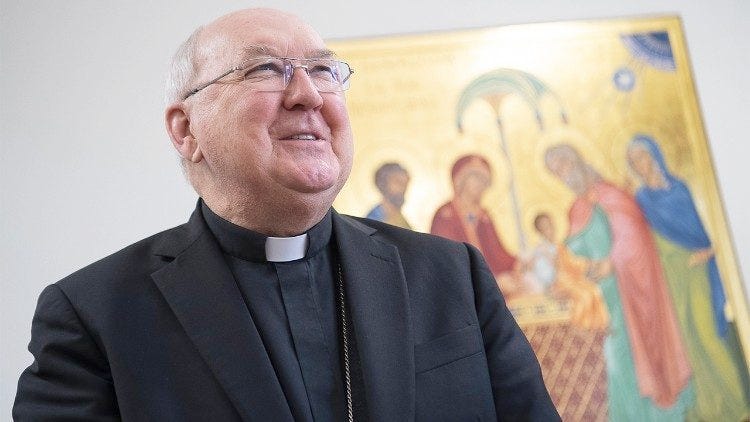
While Pope Francis died on Monday, and was pronounced dead by his doctors, the formal pronouncement of his death will be made after the body had been moved to the papal chapel in the Vatican, by Cardinal Kevin Farrell, the Camerlengo of the Holy Roman Church.


Cardinal Kevin Farrell. Credit:Vatican Media.
Cardinal Farrell is in turn responsible for informing the Cardinal Vicar of the Diocese of Rome, who in turn has the responsibility to “inform the People of Rome by a special announcement” of the death of their bishop.

In line with the norms of the apostolic constitution Universi Dominici Gregis, the announcement of the pope’s death is made separately to the diplomatic corps accredited to the Holy See and to the heads of their respective nations by the Dean of the College of Cardinals, Cardinal Giovanni Battista Re.

The camerlengo has the job of sealing the papal apartment in the Domus Sanctae Marta Guest house, where Francis chose to live after his election, along with the pope’s private study, and securing his personal papers.

Farrell also has the job of formally taking possession of the Apostolic Palace, the Lateran Basilica, and Castel Gandolfo.

And it is the camerlengo who will — within carefully defined limits — become the effective chief executor of the Church until the next pope is elected.

Most immediately, it is the camerlengo’s job, in consultation with the most senior cardinals of the college’s three ranks, to make all the decisions and arrangements regarding the pope’s funeral — in line with the existing liturgical norms for the event and any directions left by Francis himself for his own burial.

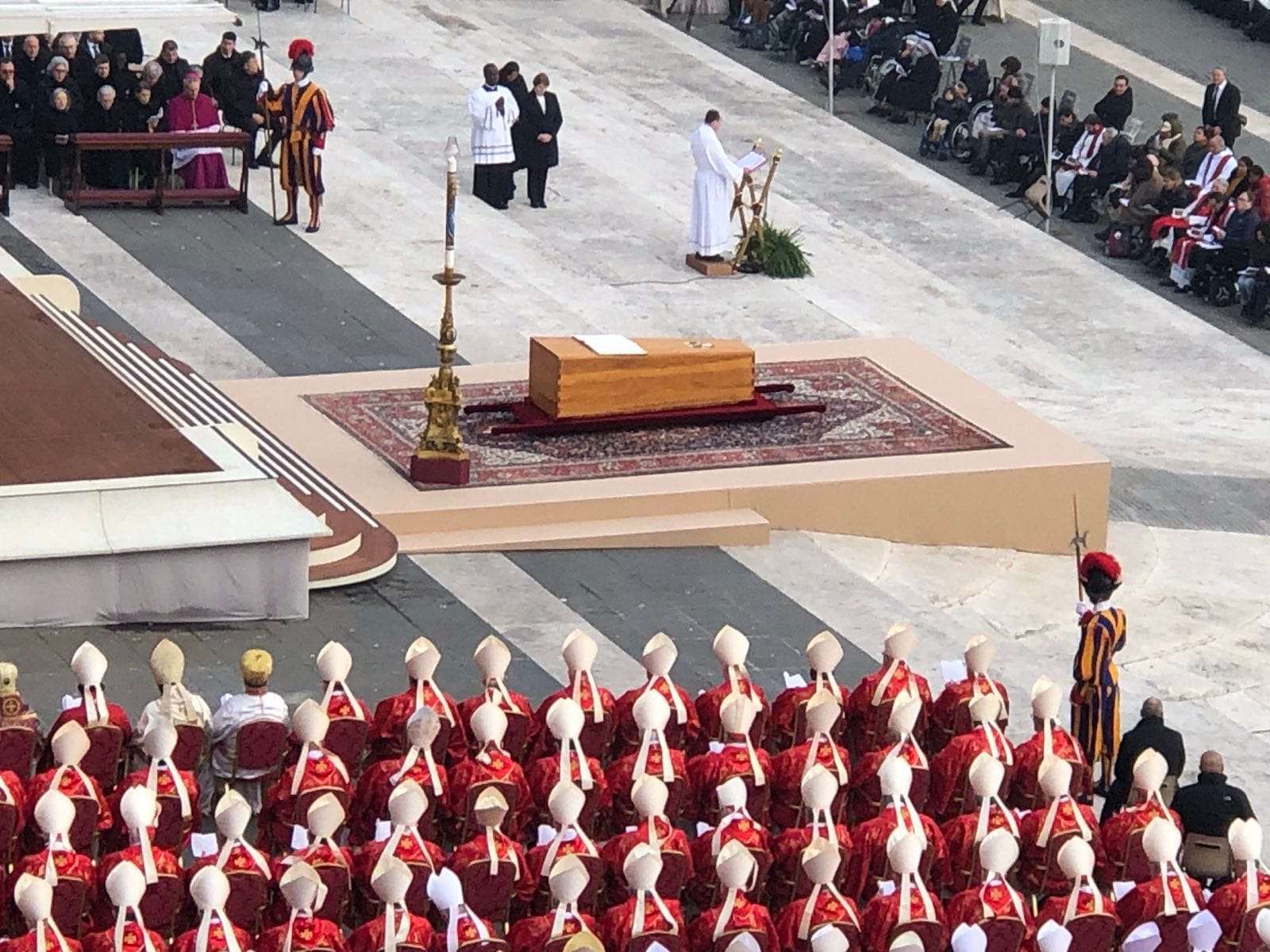
The Church will have to wait to see if there are any special provisions Francis may have made for his own funeral, but late last year he approved a number of changes to the papal funeral rites, including that his body be placed immediately inside a coffin for the faithful to venerate, instead of the customary litter on which previous popes have laid in St. Peters.

Francis did away with the customary triple coffins of cypress, lead, and oak in which popes have previously been buried, opting for a simpler single coffin, and he also made it known he wished to be buried in the papal basilica of St. Mary Major in Rome, not in St. Peter’s basilica in the Vatican.

The camerlengo is responsible for deciding by whom, and under what circumstances, the pope’s body can be photographed following his death.

Strictly speaking, the law says that “no one is permitted to use any means whatsoever in order to photograph or film the Supreme Pontiff either on his sickbed or after death, or to record his words for subsequent reproduction.”

Policy does give the camerlengo the final say over photos taken after death “for documentary purposes,” but he cannot “permit the taking of photographs of the Supreme Pontiff except attired in pontifical vestments.”

The period for the official funeral rites for the repose of the pope’s soul — the Church’s formal period of official mourning — lasts for nine days, with the pope to be buried within six days of his death.


The basic rule of law in the Church after the pope has died is that, until the new pope is elected, the College of Cardinals together exercise authority in the Church and provide for its necessary governance, but “solely for the dispatch of ordinary business and of matters which cannot be postponed.”

But, and it is a big but, “the College of Cardinals has no power or jurisdiction in matters which pertain to the Supreme Pontiff during his lifetime or in the exercise of his office; such matters are to be reserved completely and exclusively to the future Pope.”

While the see is vacant, no big decisions can be made and nothing the previous popes have decreed can be changed.

Of course, while nothing big can be changed without a pope, the life of the Church doesn’t stop entirely. For this reason, a small number of senior Church officials continue in office, even if there is no pope, including the camerlengo and the Vatican’s major penitentiary — responsible for dealing with the forgiveness of reserved sins.

Most others — including the cardinal secretary of state and the prefects of the curial departments together with the members of those Dicasteries — cease to exercise their office, though the sostituto of the Secretariat of State, the Secretary for Relations with States and the secretaries of the Dicasteries of the Roman Curia all remain in charge of their respective offices, and are responsible to the College of Cardinals.

However, they can only use their faculties “for the granting of favours of lesser importance, while more serious or controversial matters, if they can be postponed, shall be exclusively reserved to the future pope.”

The camerlengo, meanwhile, “in the name of and with the consent of the College of Cardinals,” deals with “all matters that circumstances suggest for safeguarding the rights of the Apostolic See and for its proper administration.”

Similarly, “all the civil power of the Supreme Pontiff concerning the government of Vatican City State belongs to the College of Cardinals,” though “unable to issue decrees except in cases of urgent necessity.”

From the moment when the pope is officially pronounced dead, the cardinal electors — those under 80 who are eligible to vote in a conclave — have fifteen full days to get to Rome, though the College of Cardinals can defer “for serious reasons” the beginning of the election for a few days more if they need to.

Either way, within a maximum of 20 days the conclave has to begin.

Prior to that, however, the whole College of Cardinals, including those members over 80 years of age, meet in what are called “general congregations.”

The congregations are meetings of the full college, presided over by the dean of the college, and are held daily, beginning on the day chosen by the camerlengo, together with the senior cardinal of voting age from each of the three ranks of the college.

These preparatory congregations are held daily, and among the things they have to decide are when and how the pope’s body will be displayed for “the homage of the faithful” and to make the necessary funeral arrangements — with the pope to be buried between the fourth to sixth day after his death.


Funeral of Pope Benedict XVI. Credit: Pillar Media.
These general congregations are also responsible for reading and dealing with any documents left for the College of Cardinals by the pope, approve expenses for running the Vatican until the next pope is elected, and arrange for the destruction of the Fisherman’s Ring and seal with which Francis authorized legal acts.

The cardinals will also select two people known for “sound doctrine, wisdom and moral authority” to present meditations to the cardinals on the problems facing the Church and on the need for careful discernment in choosing the next pope.

While these general congregations are meeting, and the cardinals are “meditating” among themselves on who the next pope might be, there are also regular meetings of what canon law calls “particular congregations,” which are basically executive subcommittees charged with approving the ordinary business of the global Church or Vatican affairs as needed.

The particular congregations are led by the camerlengo, who together with three cardinals chosen by lottery from among each of the three ranks of the college, decide on “questions of lesser importance which arise on a daily basis” — anything major goes to the full general congregation for a majority vote.

Three new cardinals are picked at random every three days until the conclave starts, at which point the governance of the Church shifts from the whole college to the assembly of cardinal electors — the cardinals under 80 — in the conclave, who continue to select three of their number by random to serve on the particular congregations.

While ordinarily the assembly of cardinal electors would be presided over by the dean, because the current dean and subdean are both too old to participate in a conclave, the assembly is led by the senior cardinal-bishop eligible to vote — Cardinal Pietro Parolin.

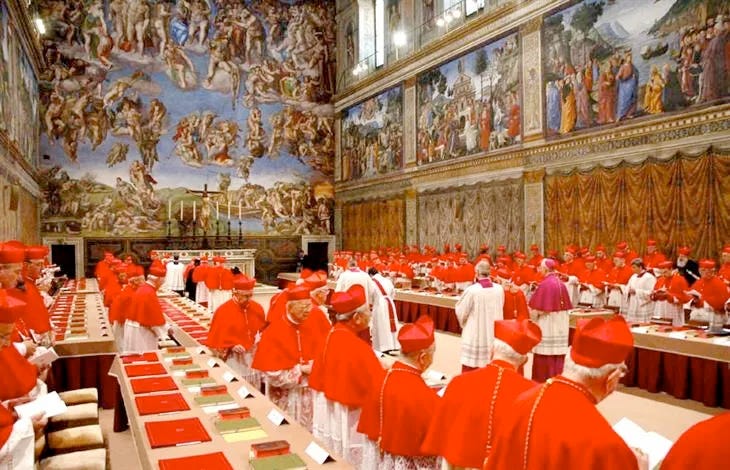
After fifteen days have passed since the death of the pope — unless the College of Cardinals votes to extend it by an extra five — the conclave begins, with the cardinal electors moving into the Domus Sanctae Marta guest house and celebrating a Mass Pro Eligendo Papa and then entering a communications blackout (hopefully) as they repair to the Sistine Chapel to vote.


Since the dean is older than 80, the votes will be chaired by Cardinal Parolin, who will also administer oaths of secrecy and sincerity from the cardinal electors.

Also allowed into the conclave, although they are not eligible to vote, are an assistant chosen by Parolin, the secretary of the College of Cardinals, who acts to secretary of the electoral assembly; the master of papal liturgical celebrations along with two masters of ceremonies and two religious attached to the papal sacristy.

Otherwise, only the cardinals under 80 are allowed in — and those who have lost or resigned their right to participate under Pope Francis (like Cardinal Angelo Becciu) cannot be rehabilitated by the college after his death.

If a cardinal elector doesn’t, for whatever reason, make it to Rome in time for the start of the conclave, it begins without him and he is to be admitted when he does get there.

But, the plots of recent Oscar-bait movies notwithstanding, cardinals named secretly by the pope, in pectore, are not eligible to participate, unless the pope made their appointments known publicly before his death.

After Mass on the morning it begins, the conclave formally gets underway after a final mediation is given to the electors and the doors to the Sistine Chapel are shut.

The electors vote once on the first afternoon, and four times a day — twice in the morning and twice in the afternoon — on the succeeding days, with a two-thirds majority needed to elect a pope.

If no one is elected after the first three days of voting, the cardinals break for a day of prayer and reflection. They are encouraged to have “informal discussion” among themselves and “a brief spiritual exhortation” is to be given by the senior cardinal in the Order of Deacons — Cardinal Dominique Mamberti, the chief judge of the Church’s supreme canonical court.

The cardinals then vote for another seven ballots, with another break if there is no result.

In the event of a deadlock after 33 rounds of voting, there’s a run off.

While Pope St. John Paul II created the option for the cardinals to elect a pope by simple majority, Benedict XVI did away with that. He instead decided that if there was no pope after 33 rounds, the top two vote-getters would go into a run off.

Once there is a two-thirds result — and a pope is elected, things move fast.

The senior cardinal — Cardinal Parolin — asks the one elected if he accepts his election.

From the moment he says “yes,” the man has the office.

From his yes, he “is immediately Bishop of the Church of Rome, true Pope and Head of the College of Bishops,” according to canon law.

He “acquires and can exercise full and supreme power over the universal Church,” and the conclave ends immediately — unless the new pope says otherwise. After all — at that point, he’s in charge.
 
I know a lot of you will grab pitchforks and torches, but...

I think that calling Pope Francis of all people a "communist" reeks of black-and-white extremist thinking.
 
I know a lot of you will grab pitchforks and torches, but...

I think that calling Pope Francis of all people a "communist" reeks of black-and-white extremist thinking.
Welcome to Kiwi Farms. It’s like this even when /pol/ isn’t down.

I thought there would be more Jew sperging here though.
 
Again, not what's going on. What he said stressed that it was always up to the discretion of the Priest, it was not an order, and giving someone a blessing in this context doesn't mean encouragement or approval. It's more like when you go to confession and say "Bless me Father for I have sinned."

In other words, if a Priest is aware of someone in this specific kind of situation and that person comes to the Priest seeking guidance the Priest has permission to offer a blessing such that the troubled individual might be aided by the grace of the Holy Spirit to help them, should the Priest, at his discretion, deem it the right thing to do.
Except it was "Bless COUPLES" not bless individuals. For what purpose would you explicitly talk about blessing them as a couple instead of the person if the whole point is to help the person overcome the sin that comes as a result of them being a couple?

You have to twist his words into 50 seperate pretzels to even come out with something partway acceptable.
 
I'm probably late on this but I'm just waiting for the inevitable pedophile allegations of this guy
 
I did not jump to conclusions, I'm perfectly aware was talking about blessings specifically and is still against marriage.

Hot take, but maybe the pope should not be ordering his priests to actively bless sodomy, wouldn't you say?
I recall hearing Italian radio citing Francis saying that faggots are sinners, but not criminals. And when FM DX-ing I heard enough Radio Maria to remember the "Prega per noi peccatori" part of the rosary, which I guess implies every mortal is a sinner. And I guess that if actual criminals on death row can get blessings, then I guess fags who don't do crime and pay their taxes can get the blessings too.

But I dunno, I'm not religious, and being Venetian very proud bestemmiator, so I probably shouldn't even scratch my right ass cheek as reaction to whatever the church or bible might think (it seems like every different person will give you a different answer too)
 
Back
Top Bottom