One of Leonardo DiCaprio’s biggest career regrets, and one of the biggest casting “what ifs” of all time, was the actor’s near-miss playing Dirk Diggler in Paul Thomas Anderson’s Boogie Nights. One Battle After Another, the latest film from PTA, and one which finally teams the writer-director and actor, may not be a time machine. But like Boogie Nights, it goes hard.
Boogie Nights is one of my favorite movies of all time. My dad recorded it off of HBO in the late ’90s, and when he and my mom went to sleep, I would sneak downstairs, snag the tape, and quietly watch in my room over and over. I’m not sure what came first – my love of movies, or my love of Boogie Nights.
Now, PT Anderson is back with One Battle After Another—a film I’m so excited for, I rewatched most of his back catalog and read the book it’s loosely based on. (Time well spent.) Despite the absurdly high expectations I set for this movie, Paul Thomas Anderson’s first $100M+ budget delivers an S-tier PTA flick about a stoner ex-extremist trying to reunite with his daughter before a Colonel with a penchant for martial law and secrets to hide can get to her first.
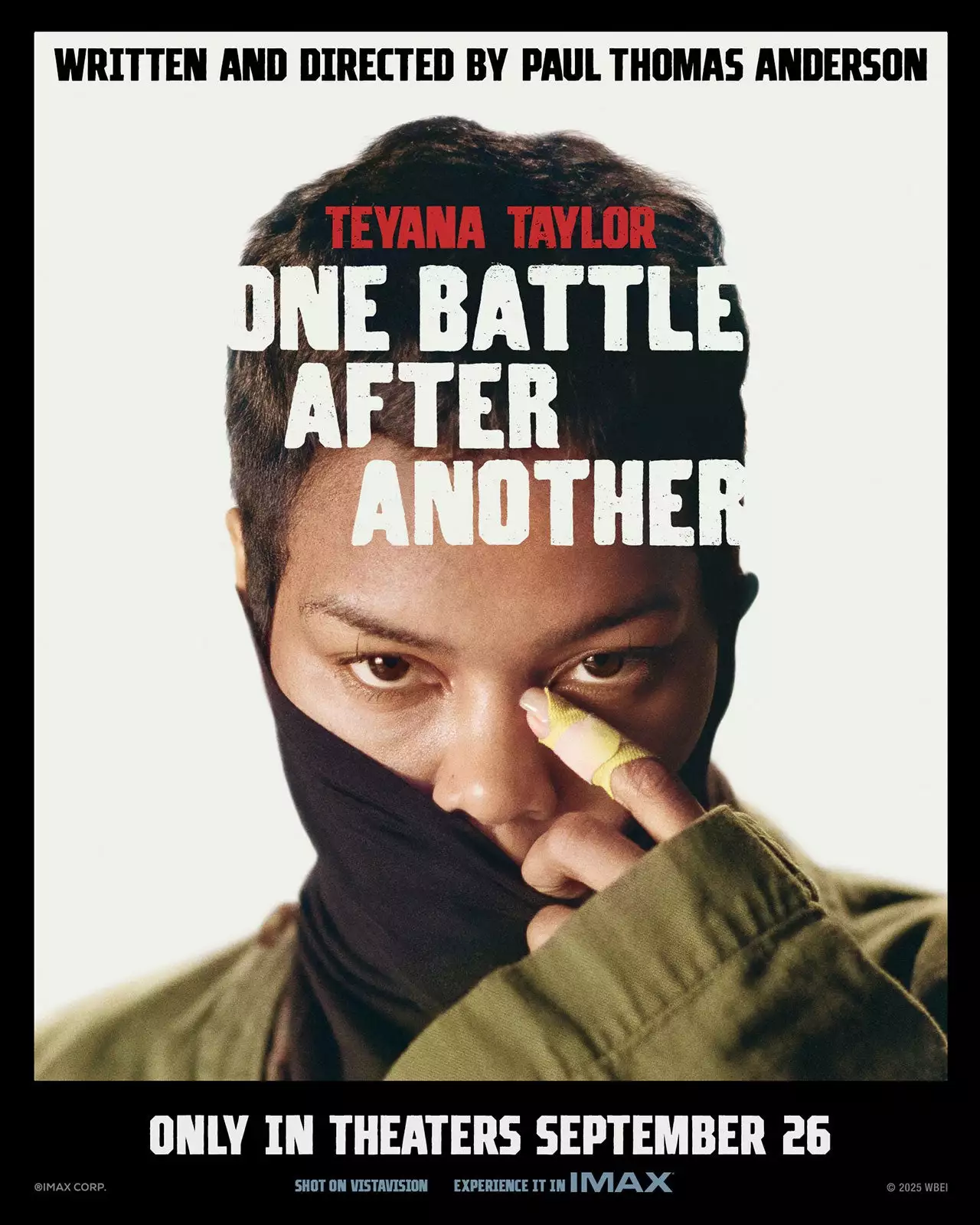
One Battle opens with the group’s back story, with one of its leaders, Perfidia Beverly Hills (Teyana Taylor), exclaiming, “Free borders. Free choices. Free from fear,” before they forcibly release all the detainees in a detention facility near the Mexican border. That line pretty much sums up the French 75’s politics, who spend the rest of the first act robbing banks and blowing up buildings as a means to that end.
Things move pretty quickly here. Think Bonnie & Clyde, Wild at Heart, Queen & Slim: the old romantic outlaws plot on fast forward. There’s a lot of sex and violence, but with a twist.
Perfidia may be hot and heavy with Leo’s Bob, but there’s also a simmering Dom/Sub sexual tension building between her and Col. Steven J. Lockjaw (Sean Penn), who has had the hots for her ever since he got a massive erection while she held him up during the detention liberation scene.
Paul Thomas Anderson has hit another high point of his career.
“
That sexual tension ultimately pays off in one of the strangest sex scenes I’ve seen in a while. (It’s kind of like that sex scene in The Sopranos between Richie Aprile and Janice, but the roles are reversed. You know the one. I’ve actually got a lot to say about this scene, but we’ll get to that later.)
Anyway, the freewheeling rebellion of the French 75 ultimately comes to an end after a botched bank robbery and Perfidia’s arrest, which sends everyone into hiding. Sixteen years later, Lockjaw is back on the hunt for Bob and his daughter. But when Willa goes missing, Bob has to battle with his past and years of substance abuse in his quest to reunite with his daughter.
Taylor’s performance goes far deeper than just being a smokeshow who brings out the worst in Bob and Lockjaw. This especially true after she has Willa, as the actress does an incredible job of externalizing Perfidia’s struggles with depression, guilt, and the loss of the individual autonomy that comes with starting a family. When she tells Bob, “I put myself first,” and storms out, you understand why. And when she regrets her decisions later in the film, you feel for her then, too.
The end of One Battle – and how it tugs on your heartstrings – wouldn’t be nearly as effective if it weren’t for Taylor’s performance.
You know the scene – the responsible child scolding the irresponsible parent – but this one is written by PTA. One of the biggest laughs in my theater came when Bob responds to Willa’s grilling with, “I know how to drink and drive. I know what I’m doing.”
They bicker, for sure, but it’s clear they care for each other, which Bob shows by threatening her friends in that fatherly way, while also casually insulting them, as they pick her up for the high school dance. It’s moments like these that give One Battle After Another its soul. This is a very politically-charged film, but it can also transcend the politics and remind the audience that this story, at its core, is about a father trying to connect with his daughter.
There’s a great ongoing bit throughout the film that’s heavily featured in the trailer, with Bob on a payphone talking to someone from the resistance. But he can’t remember the super secret password. After multiple interactions with the mysterious voice, Bob goes full Karen, essentially demanding to speak to a manager. This all ends up being a very funny button to his plotline.
But Leo’s performance as a degenerate fuck-up revolutionary isn’t all about laughs. It’s got heart too, especially when he connects with Benicio del Toro’s Sensei Sergio.
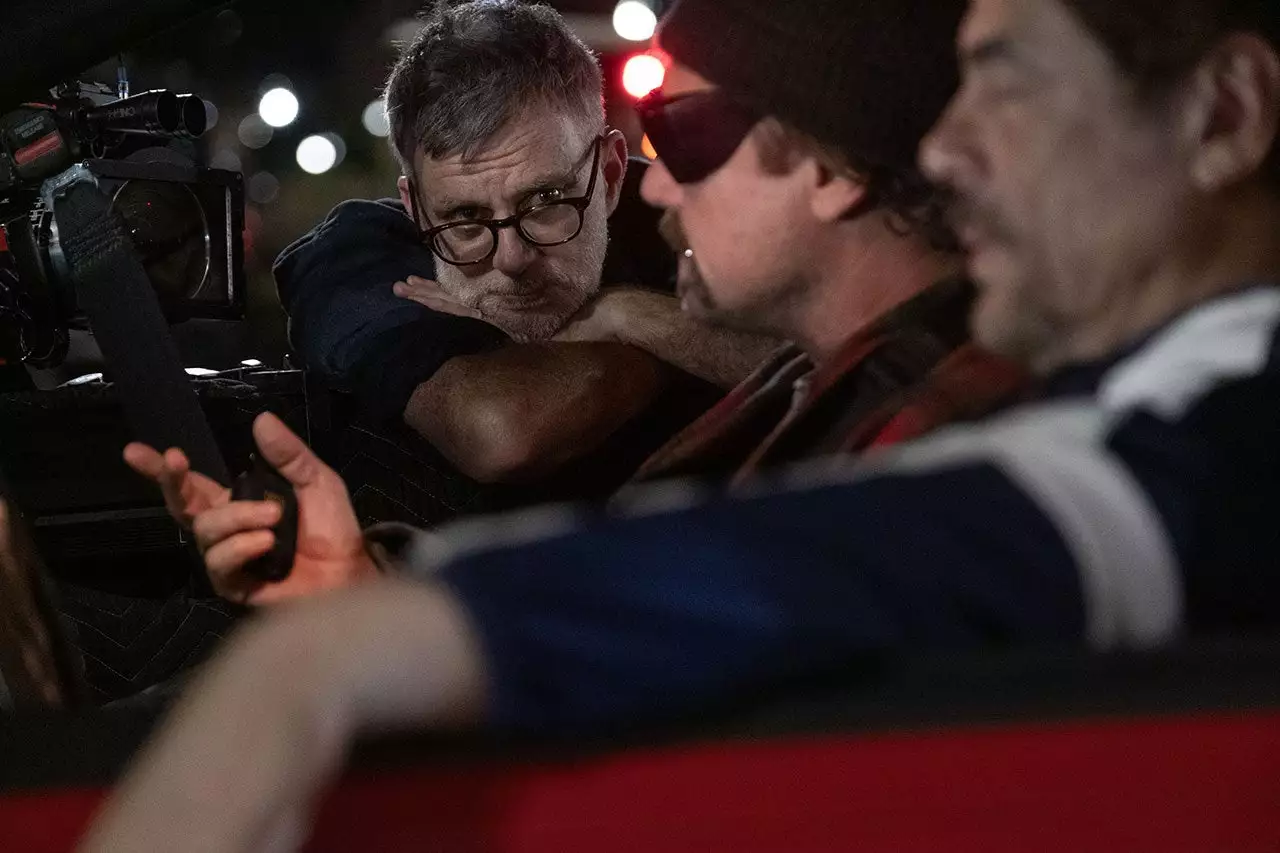
PTA DIRECTS LEONARDO DICAPRIO AND BENICIO DEL TORO.
Part pervert, part right-wing military psychopath, Penn plays Lockjaw kind of like a mix of A Few Good Men’s Col. Nathan R. Jessep and General Jack D. Ripper from Dr. Strangelove. But instead of being obsessed with “our precious bodily fluids!”, he’s more concerned with the semen demon.
There’s a scene where he’s being recruited to join a cabal of ultra-rich white nationalists. He’s clearly nervous, so the colonel decides to comb his hair by awkwardly licking his comb. It’s a moment that shows some of the insecurities bubbling under the surface of Col. Stephen J. Lockjaw.
It’s no secret that this movie is a loose adaptation of Pynchon’s 1990 novel Vineland. This would be PTA’s second Pynchon movie after 2011’s Inherent Vice, but One Battle feels more along the lines of how There Will Be Blood is an adaptation of Oil! by Upton Sinclair (even while being a looser adaptation than that work was).
PTA’s adaptation preserves most of the ways that the characters connected, but strips away all the novel’s sociopolitical context. Vineland’s Brock Vond and his war on drugs at the behest of the Reagan administration is replaced with Col. Lockjaw’s war on immigration and his willingness to enact martial law at the behest of a secret society of rich, white Americans who are pulling the strings of the government in an attempt to keep the U.S. “safe and pure.” And Vineland’s 24fps collective has been replaced with the French 75 revolutionaries, who believe in “Free borders. Free Choices. Free from fear.”
One Battle After Another draws a clear line in the sand, politically – there’s no such thing as a neutral bystander, and every character in this film has picked a side. They’re either part of the revolutionaries, trying to help the downtrodden, or they help the secret elite cabal trying to bring about a racially pure America. But having heavy stakes like that doesn’t mean PTA doesn’t try to adapt some of Pynchon’s absurdist humor. (There’s an order of nuns called Sisters of the Brave Beaver who train revolutionaries and grow weed.)
As for the Christmas Adventurers club, that’s the guild of calamitous intent that Lockjaw is trying to join. How fun! And they greet each other by saying “Hail St. Nick” – an almost childish auditory take on “Hail Satan.” But you know what? It works.
PTA’s instinct to take only the parts he liked from Vineland and fill in the rest is definitely the right move – especially for a $100M-plus movie. A straightforward adaptation of Vineland probably wouldn’t have netted a better film, and certainly wouldn’t have made for a more accessible one.
One Battle After Another draws a clear line in the sand, politically – there’s no such thing as a neutral bystander.
“
And for those of you who, like me, read Vineland to prep? Good news! Your time wasn’t wasted. This movie will make much more sense right from the jump. For those that haven’t, you might get a little lost with everything going on in the first act – it sets up a lot – but it’ll all make sense, especially on repeat viewings.
To be blunt, I’m still in awe that this film actually exists. It’s so much fun to watch, while also telling a timeless story about what a father would go through to protect his daughter. And PTA does all this while making an incisive commentary on America’s current political climate. Let us not forget that he does all of this while managing to make his most expensive movie to date, of original-ish IP, no less. One Battle After Another is estimated to have cost between $130M and $175M. PTAs biggest earner, There Will Be Blood, which only brought in $70M+ at the box office, cost $25M.
And you can see that budget on the screen. There’s not one, but two car chases! And each is distinct, with the climactic one proving particularly memorable. I can’t recall hills used in a car chase to such dramatic effect, and the filmmaker creates a whole chase out of oscillating roads, building tension in a way that would make Alfred Hitchcock proud. The oscillating rhythm as the car goes in and out of sight is an incredible visual foreshadowing of how Willa will ultimately fight back. I won’t say more.
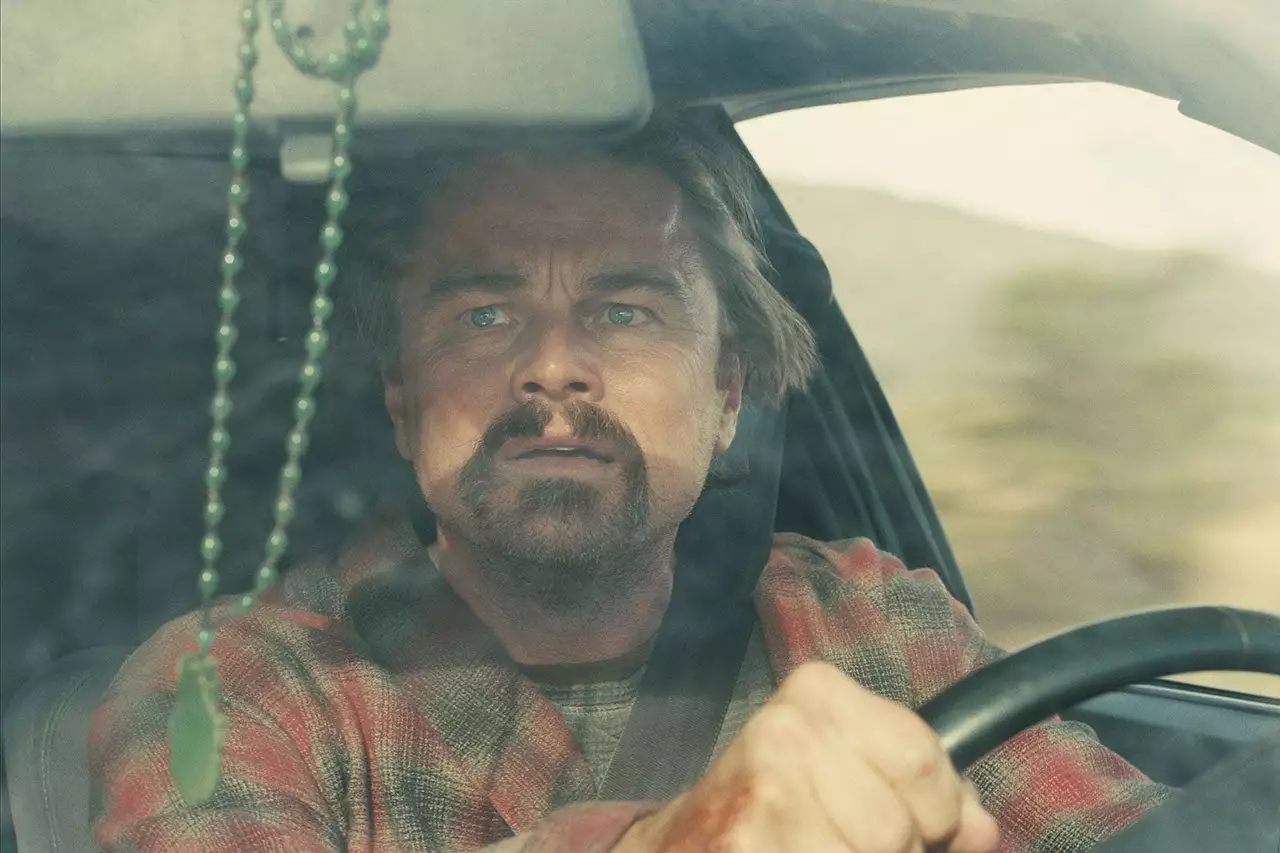
LEONARDO DICAPRIO’S BOB IS A WASHED-UP FREEDOM FIGHTER WHO’S DRAWN BACK INTO HIS PAST LIFE.
But it takes more than a car chase and some fat stacks to hold my attention for not quite, but almost, three hours. We’re so lucky that PTA decided to make his blank-check movie 30 years into his career. This movie’s pacing relies on narrative tricks he developed on his older, cheaper movies like Magnolia and Boogie Nights. As with those movies, One Battle After Another also starts in a frantic burst of exposition. Scenes are short and the camera basically never stops moving, allowing PTA to cover a lot of narrative ground quickly. However, as the plot thickens, with Anderson spending time letting layers of character drama peel away, scenes take longer. He thus has to rely on editing to convey a juxtaposition of thematic elements to keep audiences enticed.
Look at Magnolia. The film starts with a rapid telling of three unrelated deaths to convey its focus on coincidence, before setting up the plotlines of all the characters and how all their seemingly unrelated stories will eventually affect each other. PTA employs these speedy narrative hacks in One Battle After Another – albeit this time with more expensive stunts and action – to set up the French 75’s history. But once the group disbands, he uses the Magnolia editing technique to create interesting juxtapositions. For example, take the contrast of Bob’s parent-teacher conference with Lockjaw’s conditional acceptance into the Christmas Adventurers – both are moments of pride for the men.
To be clear, this is what a director working at his peak looks like. One Battle After another is, without a doubt, amazing. But is it a masterpiece?
Then it hit me: Who says our review scale is linear, with each number being equally spaced from the other? We’re “measuring” art with numbers, for Christ’s sake; it’s all a construction we’ve collectively made up. So let me ask: What if the gaps between the numbers in the middle of the spectrum – 5 to 6, 6 to 7, etc. – are larger than the quality gap between the numbers at the end of the spectrum? We may not care much about the nuanced improvements between an “Unbearable” 1 and a “Painful” 2, but we can probably agree they are slight. And if the differences are slight at one end of the spectrum, then logic reasons that the differences are also slight on the other.
The point I’m trying to make here is that the elements that separate an “amazing” film from a “masterpiece” are minor. Know that this 10 I’m about to drop does not come lightly. There are so many subtle things that make this film just that much better.
Take that sex scene that I hinted at earlier. PTA uses a Scorsese-esque needle-drop of “Soldier Boy” by The Shirelles as Perfidia holds Lockjaw’s own gun to his back as she pleasures him. The director then smash-cuts to an extremely pregnant Perfidia shooting a machine gun. At first glance, you could argue that the sequence is vulgar, but it’s not. It’s PTA in perfect control of his characters and the tone.
The same could be said for the Steely Dan “Dirty Work” needle-drop as we’re introduced to a teenage Willa and her dad’s parent-teacher conference prep of smoking dope in the car. Steely’s easy listening, yacht rock-tone perfectly embodies the vibe of their exile, but the lyrics hint at something else.
Even the things PTA whole-cloth invented for the film, like the harmony transponders, Bob forgetting the code words, the Christopher Reeve Superman poster in Sensei Sergio’s dojo, semen demon, the car chases, the stunt fall off a building down a tree… There are so many little details, seemingly inconsequential touches – the filmmaker’s style, if you will – that all add up bit by bit to turn this amazing movie into a masterpiece.

L/A
Boogie Nights is one of my favorite movies of all time. My dad recorded it off of HBO in the late ’90s, and when he and my mom went to sleep, I would sneak downstairs, snag the tape, and quietly watch in my room over and over. I’m not sure what came first – my love of movies, or my love of Boogie Nights.
Now, PT Anderson is back with One Battle After Another—a film I’m so excited for, I rewatched most of his back catalog and read the book it’s loosely based on. (Time well spent.) Despite the absurdly high expectations I set for this movie, Paul Thomas Anderson’s first $100M+ budget delivers an S-tier PTA flick about a stoner ex-extremist trying to reunite with his daughter before a Colonel with a penchant for martial law and secrets to hide can get to her first.
One Battle After Another: The Plot
The film follows DiCaprio’s Bob Ferguson, a former lefty revolutionary, who is raising his daughter Willa (Chase Infiniti). He’s been living in hiding ever since things went bad with his revolutionary group, the French 75, years earlier.One Battle opens with the group’s back story, with one of its leaders, Perfidia Beverly Hills (Teyana Taylor), exclaiming, “Free borders. Free choices. Free from fear,” before they forcibly release all the detainees in a detention facility near the Mexican border. That line pretty much sums up the French 75’s politics, who spend the rest of the first act robbing banks and blowing up buildings as a means to that end.
Things move pretty quickly here. Think Bonnie & Clyde, Wild at Heart, Queen & Slim: the old romantic outlaws plot on fast forward. There’s a lot of sex and violence, but with a twist.
Perfidia may be hot and heavy with Leo’s Bob, but there’s also a simmering Dom/Sub sexual tension building between her and Col. Steven J. Lockjaw (Sean Penn), who has had the hots for her ever since he got a massive erection while she held him up during the detention liberation scene.
Paul Thomas Anderson has hit another high point of his career.
“
That sexual tension ultimately pays off in one of the strangest sex scenes I’ve seen in a while. (It’s kind of like that sex scene in The Sopranos between Richie Aprile and Janice, but the roles are reversed. You know the one. I’ve actually got a lot to say about this scene, but we’ll get to that later.)
Anyway, the freewheeling rebellion of the French 75 ultimately comes to an end after a botched bank robbery and Perfidia’s arrest, which sends everyone into hiding. Sixteen years later, Lockjaw is back on the hunt for Bob and his daughter. But when Willa goes missing, Bob has to battle with his past and years of substance abuse in his quest to reunite with his daughter.
The Performances
Perfidia
I’m trying not to give away the whole movie here, just enough for context and to highlight what really makes this plot sing: the performances. We need to start with Teyana Taylor’s Perfidia Beverly Hills, who owns the first act and is the kind of femme fatale that would make Faye Dunaway and Sharon Stone blush.Taylor’s performance goes far deeper than just being a smokeshow who brings out the worst in Bob and Lockjaw. This especially true after she has Willa, as the actress does an incredible job of externalizing Perfidia’s struggles with depression, guilt, and the loss of the individual autonomy that comes with starting a family. When she tells Bob, “I put myself first,” and storms out, you understand why. And when she regrets her decisions later in the film, you feel for her then, too.
The end of One Battle – and how it tugs on your heartstrings – wouldn’t be nearly as effective if it weren’t for Taylor’s performance.
Willa
You know what they say: Like mother, like daughter. Chase Infiniti’s Willa is the heart and soul of the film. Unfortunately, for the purposes of this review, some of Infiniti’s best scenes are really spoiler-laden. But one that isn’t is Infiniti’s first moment onscreen with Leo.You know the scene – the responsible child scolding the irresponsible parent – but this one is written by PTA. One of the biggest laughs in my theater came when Bob responds to Willa’s grilling with, “I know how to drink and drive. I know what I’m doing.”
They bicker, for sure, but it’s clear they care for each other, which Bob shows by threatening her friends in that fatherly way, while also casually insulting them, as they pick her up for the high school dance. It’s moments like these that give One Battle After Another its soul. This is a very politically-charged film, but it can also transcend the politics and remind the audience that this story, at its core, is about a father trying to connect with his daughter.
Bob
Bob Ferguson is an odd mix of Leo’s previous characters. Think of Bob as a cross between The Wolf of Wall Street’s Jordan Belfort and his love of drugs, and Killers of the Flower Moon’s Ernest Burkhart and his stupidity. Bob genuinely loves his daughter, but he’s not the brightest bulb, dimmer now thanks to decades of drugs and alcohol, which is unfortunate because he’s being hunted.There’s a great ongoing bit throughout the film that’s heavily featured in the trailer, with Bob on a payphone talking to someone from the resistance. But he can’t remember the super secret password. After multiple interactions with the mysterious voice, Bob goes full Karen, essentially demanding to speak to a manager. This all ends up being a very funny button to his plotline.
But Leo’s performance as a degenerate fuck-up revolutionary isn’t all about laughs. It’s got heart too, especially when he connects with Benicio del Toro’s Sensei Sergio.
Sensei Sergio St. Carlos
In the production notes for the film, Leo refers to Sensei Sergio St. Carlos as Bob’s Obi-Wan, and it’s kind of true in a PTA way. And while he does help Bob out, and is a rebellious do-gooder himself, del Toro’s character isn’t in the film as much as the trailers would lead you to believe. There’s one scene where he and Bob are sharing some road sodas, while Bob is being really vulnerable about Willa, that continues to elevate the story above today’s contemporary political environment. But just because it’s heartfelt doesn’t mean it’s not funny. It's the scene that culminates with del Toro’s “Means no fear, like Tom Cruise!” moment. Great line.PTA DIRECTS LEONARDO DICAPRIO AND BENICIO DEL TORO.
Col. Stephen J. Lockjaw
If this film has an Obi-wan, it must also have a Darth Vader, so enter Sean Penn. Like the Sith Lord, Penn as Lockjaw is also despicably evil and absolutely captivating.Part pervert, part right-wing military psychopath, Penn plays Lockjaw kind of like a mix of A Few Good Men’s Col. Nathan R. Jessep and General Jack D. Ripper from Dr. Strangelove. But instead of being obsessed with “our precious bodily fluids!”, he’s more concerned with the semen demon.
There’s a scene where he’s being recruited to join a cabal of ultra-rich white nationalists. He’s clearly nervous, so the colonel decides to comb his hair by awkwardly licking his comb. It’s a moment that shows some of the insecurities bubbling under the surface of Col. Stephen J. Lockjaw.
The Pynchon and Politics of It All
The Christmas Adventurers club – what kind of goofy club is that? It sounds like something out of a Thomas Pynchon novel. Well, it’s not – but it sounds like it could be.It’s no secret that this movie is a loose adaptation of Pynchon’s 1990 novel Vineland. This would be PTA’s second Pynchon movie after 2011’s Inherent Vice, but One Battle feels more along the lines of how There Will Be Blood is an adaptation of Oil! by Upton Sinclair (even while being a looser adaptation than that work was).
PTA’s adaptation preserves most of the ways that the characters connected, but strips away all the novel’s sociopolitical context. Vineland’s Brock Vond and his war on drugs at the behest of the Reagan administration is replaced with Col. Lockjaw’s war on immigration and his willingness to enact martial law at the behest of a secret society of rich, white Americans who are pulling the strings of the government in an attempt to keep the U.S. “safe and pure.” And Vineland’s 24fps collective has been replaced with the French 75 revolutionaries, who believe in “Free borders. Free Choices. Free from fear.”
One Battle After Another draws a clear line in the sand, politically – there’s no such thing as a neutral bystander, and every character in this film has picked a side. They’re either part of the revolutionaries, trying to help the downtrodden, or they help the secret elite cabal trying to bring about a racially pure America. But having heavy stakes like that doesn’t mean PTA doesn’t try to adapt some of Pynchon’s absurdist humor. (There’s an order of nuns called Sisters of the Brave Beaver who train revolutionaries and grow weed.)
As for the Christmas Adventurers club, that’s the guild of calamitous intent that Lockjaw is trying to join. How fun! And they greet each other by saying “Hail St. Nick” – an almost childish auditory take on “Hail Satan.” But you know what? It works.
PTA’s instinct to take only the parts he liked from Vineland and fill in the rest is definitely the right move – especially for a $100M-plus movie. A straightforward adaptation of Vineland probably wouldn’t have netted a better film, and certainly wouldn’t have made for a more accessible one.
One Battle After Another draws a clear line in the sand, politically – there’s no such thing as a neutral bystander.
“
And for those of you who, like me, read Vineland to prep? Good news! Your time wasn’t wasted. This movie will make much more sense right from the jump. For those that haven’t, you might get a little lost with everything going on in the first act – it sets up a lot – but it’ll all make sense, especially on repeat viewings.
The Man of the Hour
And now, for the man of the hour – the writer, the director, Paul Thomas Anderson.To be blunt, I’m still in awe that this film actually exists. It’s so much fun to watch, while also telling a timeless story about what a father would go through to protect his daughter. And PTA does all this while making an incisive commentary on America’s current political climate. Let us not forget that he does all of this while managing to make his most expensive movie to date, of original-ish IP, no less. One Battle After Another is estimated to have cost between $130M and $175M. PTAs biggest earner, There Will Be Blood, which only brought in $70M+ at the box office, cost $25M.
And you can see that budget on the screen. There’s not one, but two car chases! And each is distinct, with the climactic one proving particularly memorable. I can’t recall hills used in a car chase to such dramatic effect, and the filmmaker creates a whole chase out of oscillating roads, building tension in a way that would make Alfred Hitchcock proud. The oscillating rhythm as the car goes in and out of sight is an incredible visual foreshadowing of how Willa will ultimately fight back. I won’t say more.
LEONARDO DICAPRIO’S BOB IS A WASHED-UP FREEDOM FIGHTER WHO’S DRAWN BACK INTO HIS PAST LIFE.
But it takes more than a car chase and some fat stacks to hold my attention for not quite, but almost, three hours. We’re so lucky that PTA decided to make his blank-check movie 30 years into his career. This movie’s pacing relies on narrative tricks he developed on his older, cheaper movies like Magnolia and Boogie Nights. As with those movies, One Battle After Another also starts in a frantic burst of exposition. Scenes are short and the camera basically never stops moving, allowing PTA to cover a lot of narrative ground quickly. However, as the plot thickens, with Anderson spending time letting layers of character drama peel away, scenes take longer. He thus has to rely on editing to convey a juxtaposition of thematic elements to keep audiences enticed.
Look at Magnolia. The film starts with a rapid telling of three unrelated deaths to convey its focus on coincidence, before setting up the plotlines of all the characters and how all their seemingly unrelated stories will eventually affect each other. PTA employs these speedy narrative hacks in One Battle After Another – albeit this time with more expensive stunts and action – to set up the French 75’s history. But once the group disbands, he uses the Magnolia editing technique to create interesting juxtapositions. For example, take the contrast of Bob’s parent-teacher conference with Lockjaw’s conditional acceptance into the Christmas Adventurers – both are moments of pride for the men.
To be clear, this is what a director working at his peak looks like. One Battle After another is, without a doubt, amazing. But is it a masterpiece?
Verdict
Frankly, when trying to come up with my final score for this movie, I’ve spent an absurd amount of time trying to figure out the difference between a 9 out of 10 and a 10 out of 10. What does an abstract “one better” mean?Then it hit me: Who says our review scale is linear, with each number being equally spaced from the other? We’re “measuring” art with numbers, for Christ’s sake; it’s all a construction we’ve collectively made up. So let me ask: What if the gaps between the numbers in the middle of the spectrum – 5 to 6, 6 to 7, etc. – are larger than the quality gap between the numbers at the end of the spectrum? We may not care much about the nuanced improvements between an “Unbearable” 1 and a “Painful” 2, but we can probably agree they are slight. And if the differences are slight at one end of the spectrum, then logic reasons that the differences are also slight on the other.
The point I’m trying to make here is that the elements that separate an “amazing” film from a “masterpiece” are minor. Know that this 10 I’m about to drop does not come lightly. There are so many subtle things that make this film just that much better.
Take that sex scene that I hinted at earlier. PTA uses a Scorsese-esque needle-drop of “Soldier Boy” by The Shirelles as Perfidia holds Lockjaw’s own gun to his back as she pleasures him. The director then smash-cuts to an extremely pregnant Perfidia shooting a machine gun. At first glance, you could argue that the sequence is vulgar, but it’s not. It’s PTA in perfect control of his characters and the tone.
The same could be said for the Steely Dan “Dirty Work” needle-drop as we’re introduced to a teenage Willa and her dad’s parent-teacher conference prep of smoking dope in the car. Steely’s easy listening, yacht rock-tone perfectly embodies the vibe of their exile, but the lyrics hint at something else.
Even the things PTA whole-cloth invented for the film, like the harmony transponders, Bob forgetting the code words, the Christopher Reeve Superman poster in Sensei Sergio’s dojo, semen demon, the car chases, the stunt fall off a building down a tree… There are so many little details, seemingly inconsequential touches – the filmmaker’s style, if you will – that all add up bit by bit to turn this amazing movie into a masterpiece.
L/A


