Newly discovered 'einstein' tile is a 13-sided shape that solves a decades-old math problem

  • 🏰 The Fediverse is up. If you know, you know.
  • Want to keep track of this thread?
    Accounts can bookmark posts, watch threads for updates, and jump back to where you stopped reading.
    Create account
Article
Archive

Newly discovered 'einstein' tile is a 13-sided shape that solves a decades-old math problem​


A new 13-sided shape is the first example of an elusive "einstein" — a single shape that can be tiled infinitely without repeating a pattern.

1680378550551.png
This computer-generated image shows a newfound shape arranged in concentric rings around a central, shaded "hat" (dark blue).

Look carefully! Mathematicians have invented a new 13-sided shape that can be tiled infinitely without ever repeating a pattern. They call it "the einstein."

For decades, mathematicians wondered if it was possible to find a single special shape that could perfectly tile a surface, without leaving any gaps or causing any overlaps, with the pattern never repeating. Of course, this is trivial to do with a pattern that repeats — just look at a bathroom or kitchen floor, which is probably made up of simple rectangular tiles. If you were to pick up your floor and move it (called a "translation" in mathematics), you could find a position where the floor looks exactly the same as before, proving that it's a repeating pattern.

In 1961, mathematician Hao Wang conjectured that aperiodic tilings, or tilings that never become a repeating pattern, were impossible. But his own student, Robert Berger, outwitted him, finding a set of 20,426 shapes that, when carefully arranged, never repeated. He then slimmed that down to a set of 104 tiles. That means that if you were to buy a set of those tiles, you could arrange them on your kitchen floor and never find a repeating pattern.


In the 1970s, Nobel prize-winning physicist Roger Penrose found a set of only two tiles that could be arranged together in a nonrepeating pattern, now known as a Penrose tiling.
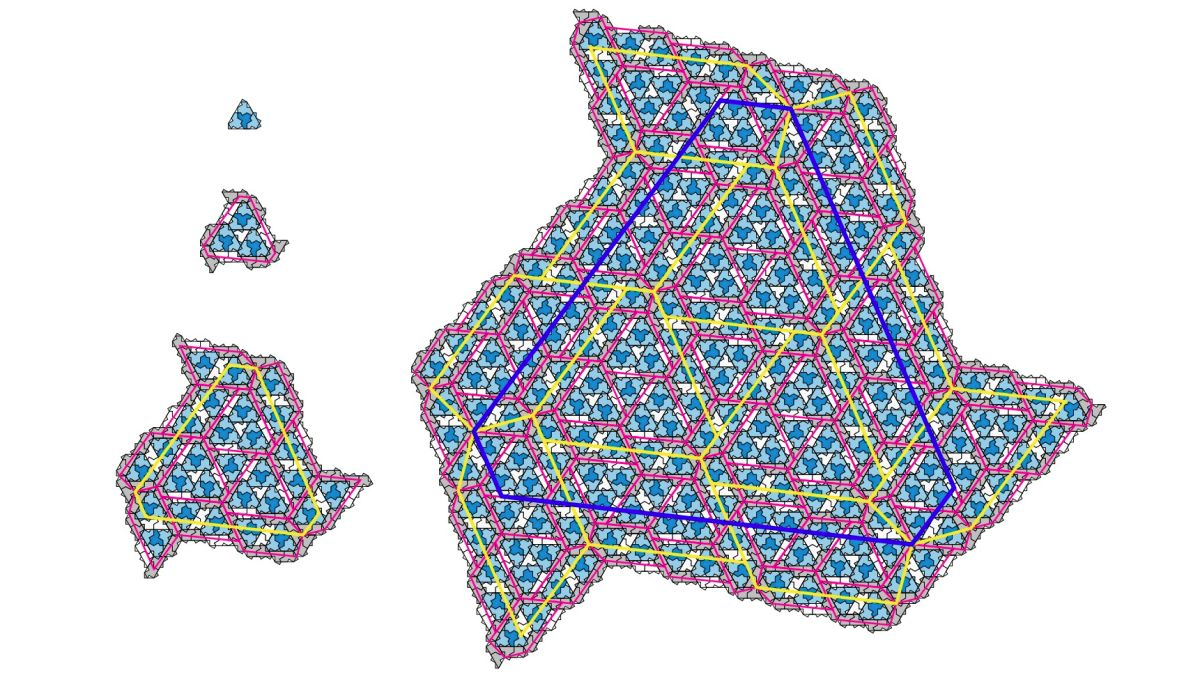
1680378673896.png
Here we see the first four iterations of the H metatile and its supertiles.

Since then, mathematicians around the world have searched for the aperiodic tiling holy grail, called "the einstein." The word doesn't come from the famous Albert but from the German translation of his last name: one stone. Could a single tile — one "stone" — fill a two-dimensional space without ever repeating the pattern it creates?

The answer was just discovered by David Smith, a retired printing technician from East Yorkshire, England. How did he come across this remarkable solution? "I'm always messing about and experimenting with shapes," Smith told The New York Times. “It's always nice to get hands-on. It can be quite meditative."

Smith and his co-authors dubbed the new shape "the hat," mostly because it vaguely resembles a fedora. Although mathematicians have known about the shape, which has 13 sides, they had never considered it a candidate for aperiodic tiling.

"In a certain sense, it has been sitting there all this time, waiting for somebody to find it," Marjorie Senechal, a mathematician at Smith College who was not part of the study, told The Times.

Smith worked closely with two computer scientists and another mathematician to develop two proofs showing that "the hat" is an aperiodic monotile — an einstein. One proof relied on building larger and larger hierarchical sets of the tiles, showing how the pattern never repeats as the surface area grows. The other proof relied on the team's discovery that there wasn't just one of these tiles, but an infinite set of related shapes that could all do the trick. The team's paper is available on the preprint server arXiv but has not yet been peer-reviewed, and the proofs have not yet been scrutinized.

These kinds of aperiodic tilings are more than mathematical curiosities. For one, they serve as a springboard for works of art, like the Penrose tiling found at the Salesforce Transit Center in San Francisco, and reveal that some medieval Islamic mosaics employed similar nonrepeating patterns.

Aperiodic tilings also help physicists and chemists understand the structure and behavior of quasicrystals, structures in which the atoms are ordered but do not have a repeating pattern.
 
Although I'm somewhat confused by the technical definition of "without repeating a pattern", because it looks like there's a pretty clear pattern in that first image.
You can blame the journoswine who picked the image for that one. These swine get blatant facts wrong about pretty much every subject they write about. And as it turns out, pure mathematics is no exception.

>13-sided shape discovered that can be tiled in such a way that it never repeats infinitely
>journalist deliberately chooses image showing a tiling with an immediately noticeable repeated pattern

The night of the rope will come for these people.
 
Imagine still believing in M-theory/string theory in the Year of our Lord 2023.
Ah whats the in-vogue subatomic theories of today? Been a while since ive bothered to keep up with that autism.
 
Nigger there are entire universities out there churning out commie nonsense and destroying civilization itself. This, meanwhile, is a bunch of autists literally trying to reverse engineer God's programming back.
Pretty shit job if people like you and @Safir want to cast doubt and call people niggers. So the repeating pattern caught out isn't wrong but you cannot explain why it doesn't fundamentally debunk what's asserted?
You can blame the journoswine who picked the image for that one. These swine get blatant facts wrong about pretty much every subject they write about. And as it turns out, pure mathematics is no exception.

>13-sided shape discovered that can be tiled in such a way that it never repeats infinitely
>journalist deliberately chooses image showing a tiling with an immediately noticeable repeated pattern

The night of the rope will come for these people.
And the Journoswine that picked this one?
1680395129350.png
What about this animation?

They've managed to penrose a chevron instead of a triangle. wow I can spin up autocad and blow some fucking minds if that's really where we set the bar for acheivement. Is this a theoretical "can" where they haven't actually found the solution yet? I mean yeah one journalist might be shitty but thrice over now? Maybe instead of talking about how we should respect le heckin' science someone can use their big boy words to explain what I'm getting wrong here.
 
Ah whats the in-vogue subatomic theories of today? Been a while since ive bothered to keep up with that autism.
At the moment, there's nothing comparable to how in vogue string theory was in its heyday. Not discovering supersymmetric particles or new physics at the Large Hard-On Collider really took the wind out the entire physics community's sails.
 
The most IFLS thing about this discovery is the name. I'm so sick of this fetishization of Albert Einstein, as if he was the first and only smart person in human history. Like, if you're going to be uncreative, at least name it The Pythagoras. The man's famous for triangles. His name is synonymous with both math and a shape. It's right there.

This is the most unbelievable part of the story. Ho Wang and Bob Burger sounded too good to be true but Dave Smith from East Yorkshire sounds like a white van man.

This post will mean little to those outside of the Uk.

"By eck, thas farnd a reyt shape" - Dave Smith, probably.
All "unsolvable math problem solved after 175,000 years!!!!" clickbait articles are either about 90 year old pensioners or 8 year old black kids. It's always very difficult to believe, but it generates tons of clicks from old people who grew up before the age of all news always lying all the time.
 
Is this a theoretical "can" where they haven't actually found the solution yet?
Yes, actually. It's literally a proof by contradiction in their preprint. Since we can't actually create an infinite tiling as an object in reality, to prove that they've found an infinitely aperiodic tiling with these hat tiles they use a proof by contradiction: they suppose instead that no such aperiodic tiling of these hat tiles exists (i.e. that no matter how you tile these, you end up with a periodic repeating tiling), and then show that this supposition violates the laws of geometry.

As to why the journalists those images, I have no fucking idea. They were probably just being lazy and pulled the images used in the paper, but divorced from context. For example, that 'triforce' picture in the OP is straight from the preprint, and doesn't have anything to do with the aperiodicity at all: what it shows is that the hat tiles actually form a tessellation of 2D space, which isn't obvious given the funky asymmetrical shape of the tiles so it's the first thing they needed to demonstrate in their proof.
Screenshot 2023-04-01 at 21-34-22 2303.10798.pdf.png

Since the paper posits that an infinitely aperiodic tiling exists, you'd think it should be straightforward to come up with a picture of a tiling that's at least aperiodic in a given region, which would have made for a better picture. Arguably the paper writers should have created such a picture if they wanted to run with this media hype faggotry, but in the math-nerds' defense I don't think any of them expected their quaint little mathematics paper to be receiving the hilariously broad coverage that it is. Your "who gives a fuck?" attitude is exactly the right attitude to have, because the truth is that this paper really isn't a big deal at all. The amount of media attention it's getting is ridiculous.

I mean yeah one journalist might be shitty but thrice over now?
All journalists.
 
Why do I suddenly smell matzo and hear Hava Nagila? Wiki:
In logic, proof by contradiction is a form of proof that establishes the truth or the validity of a proposition, by showing that assuming the proposition to be false leads to a contradiction. Although it is quite freely used in mathematical proofs, not every school of mathematical thought accepts this kind of nonconstructive proof as universally valid.
Well at least they are upfront that we're squarely in 🧩 territory here. So if I'm reading this right it's essentially proof without actually proving it, just making people doubt their assertions that it is false? "Constructive proof" might be a good comparison:
Constructive Proof [Aside: :story: at the irony]
(Redirected from Nonconstructive proof)
In mathematics, a constructive proof is a method of proof that demonstrates the existence of a mathematical object by creating or providing a method for creating the object. This is in contrast to a non-constructive proof (also known as an existence proof or pure existence theorem), which proves the existence of a particular kind of object without providing an example. For avoiding confusion with the stronger concept that follows, such a constructive proof is sometimes called an effective proof.
Okay so it's shaping up to be precisely what I expected. Knowing how fruitless the pilpul is from here, I'll carry on anyway. Let's see if I can decipher these Nuerodivergent-Talmudic ramblings.
A longstanding open problem asks for an aperiodic monotile, also known as an "einstein": a shape that admits tilings of the plane, but never periodic tilings. We answer this problem for topological disk tiles by exhibiting a continuum of combinatorially equivalent aperiodic polygons. We first show that a representative example, the "hat" polykite, can form clusters called "metatiles", for which substitution rules can be defined. Because the metatiles admit tilings of the plane, so too does the hat. We then prove that generic members of our continuum of polygons are aperiodic, through a new kind of geometric incommensurability argument. Separately, we give a combinatorial, computer-assisted proof that the hat must form hierarchical -- and hence aperiodic -- tilings.
Okay so I see why you hid this behind a hyperlink. Any math nerds, please chime in and correct me if I am wrong:
- "a shape that admits tilings of the plane, but never periodic tilings."= does- tessellate doesn't- repeat
- "by exhibiting a continuum of combinatorially equivalent aperiodic polygons." So either this shape, or groups of n shapes in arbitrary number, meet the above specification.
- Our Yarmulke Polykike and clusters thereof are the shape described above.
- "through a new kind of geometric incommensurability argument." So we're allowed to see myriad demonstrations of how this is plainly wrong but they aren't going to show us this novel argument?
"hierarchical -- and hence aperiodic -- tilings" <-pls explain this given fractals 'n' shit.

TL;DR- Believe our fraud goy. No you cannot see the proof because it's the oxymoronic kind.
I guess again I ask, if there isn't a frame in that animation where what they assert holds true, why not show the model where it does?
 
Look you lazy niggers I'll translate it for you. It means that if you grab the current pattern you're seeing, and move it in any way or rotate it in any way, it'll never match up perfectly. It doesn't mean that there aren't similar elements between parts of the pattern because that'd be trivial, each unit obviously repeats itself.
So anything drawn by a jogger also meets this pruff and pruves is gibs?
 
Okay so it's shaping up to be precisely what I expected. Knowing how fruitless the pilpul is from here, I'll carry on anyway. Let's see if I can decipher these Nuerodivergent-Talmudic ramblings.
And I suppose you're deceived by Survivor's Bias, as well. Better armor all the places on the planes that are full of holes since that's where they all get shot. The reasoning to it is sound, if necessarily roundabout.
 
And I suppose you're deceived by Survivor's Bias, as well. Better armor all the places on the planes that are full of holes since that's where they all get shot. The reasoning to it is sound, if necessarily roundabout.
Well that would presuppose the planes actually took off or even existed in the first place.
A new 13-sided shape is the first example of an elusive "einstein" — a single shape that can be tiled infinitely without repeating a pattern.
This is what was billed on the tin. As best as I can tell this is how they make the jump to get there.
The symmetry group of a tiling is the group of those isometries that act as a permutation on
the tiles of the tiling. A tiling is weakly periodic if its symmetry group has an element of infinite
order; in the plane, this means it includes a nonzero translation. A tiling is strongly periodic
if the symmetry group has a discrete subgroup with cocompact action on the space tiled. In
Euclidean space, all strongly periodic tilings are also weakly periodic. A set of tiles (or a single
tile) is weakly aperiodic if it admits a tiling but does not admit a strongly periodic tiling, and
strongly aperiodic if it admits a tiling but does not admit a weakly periodic tiling.
So note that it points out strongly periodic must also be weakly periodic. There is no such reciprocity with weakly periodic and requiring strong periodicity. In-fact, if this wasn't the case this entire distinction would be unnecessary.
Any finite set of polygons in the plane that admits a weakly periodic edge-to-edge tiling also

admits a strongly periodic tiling [GS16, Theorem 3.7.1],
Now if weak periodicity requires an infinite tesselating set to prove/disprove, why should this matter to me at all now if we're artificially excluding it by artificially limiting our set. Perhaps if the sets were any larger than demonstrated we would clearly see this weak periodicity.
and a similar but simpler argument
shows the same to be the case for a finite set of poly-T -tiles where T is itself a strongly periodic
tiling and the weakly periodic tiling consists of copies of the tiles all aligned to the same un-
derlying copy of T , instead of being edge-to-edge. Thus in such contexts it is not necessary to
distinguish weak and strong aperiodicity and we refer to tiles and sets of tiles simply as aperiodic.
Again it really seems like they are muddying the waters between strong and weak to hide that their hypothesis fails.
As noted in Section 1.3, a tile that does not admit strongly periodic tilings also cannot admit
weakly periodic tilings.
Therefore, together with the substitution system outlined in Section 2,
and described in detail in Sections 4 and 5, this theorem establishes that the hat is an aperiodic
monotile, thus proving Theorem 1.1.
Bolding is mine where they ask you to assume this goes both ways. Nowhere in 1.3 does it say it must be this way. If it demonstrates strongly, it must demonstrate weakly. Not the other way around according to their own definitions.

If the fundamental question is about something's nature to infinity what purpose does artificially limiting it to a finite set serve other than to conceal this weakly periodicity? They've arbitrarily precluded the one method of positively proving their theory doesn't hold. Otherwise refuting it requires proving a negative. Since neither is possible for contrived or logical reasons, we must accept their conclusion as we cannot prove it wrong. It's like asking me to use a 480p monitor to pick out 1080p detail. You've halved the resolution, of course it can't be done.
The reasoning to it is sound
Really? Because as near as I can tell I'm the only one making an effort to parse their "reasoning" here. Otherwise it's people leaning on these being math people that said they have proved it because you cannot disprove it under their contrived conditions. Also, not sure if strong/weak or strongly/weakly is correct. Both get lots of results.
 
You have to tile an infinite surface with pieces (of the same color) in a way that you can't
make an exactly the same second layer,
then move it some nonzero distance,
and have the lines match exactly.

A repeating pattern has a period. Because the surface is infinite, if you stand on it and look at the tiles (it's a flat surface, so you can see as far into infinity as you want), you can't tell where you are -- there's a (countably) infinite number of places on the surface from where it looks exactly the same. But if it's non-periodic, each place is unique.

It's kind of like the difference between rational and irrational numbers.
1/7 is 0.142857142857142857... -- the digits start repeating. Suppose there's a line of tiles marked with these digits, and you walk away from 0 without looking back and end up on the digit "8" somewhere. How far are you from zero? You can't tell by looking, it's all 57142857142857142857 into infinity. From every 8, the sequence looks exactly the same.
But sqrt(2) is 1.4142135623730950488016887242097... -- there's no pattern. There are only 10 digits, but if you look far enough toward infinity, you will always be able to tell where exactly you are.
This is a really really good explenation of how this works. It still seems odd to me that in infinity no pattern will ever emerge from this though.
 
I mean, at the very least, it could eliminate repeating tile textures in video games, making the graphics look more organic.
Off topic but lol:
Repeating tiles has already been solved for the most part:

This is usually too expensive though because you are sampling the same texture multiple times, which for a modern PBR material would be multiplied by however many channels the material has (Diffuse, Roughness, Normal, etc), so its only used for pre-rendered stuff. Most of the time (and this has been used for decades at this point), what they do is sample the texture twice, then scale the UVs of the second sample so that its larger, then fade between the normal scale and the large scale texture based on the distance from the camera.

With games on the Gamecube (Twilight Princess for example), instead of sampling the texture multiple times, the mipmap (LODs for textures, swapped based on viewing angle and distance to stop aliasing) is instead scaled. This makes sharp viewing angles blurrier since each mip chain is half the resolution of the previous one, but you get the tiling reduction for 'free' because the mips are loaded into the GPU with the texture. Because mips have multiple levels, you can have multiple fade levels to further reduce tiling noise in large scenes.

The reason games don't use the mip solution anymore is because mip mapping is usually generated at runtime now based on your texture settings, and also mip mapping is resolution dependent. The lower the resolution the harsher the mip mapping.
 
Back
Top Bottom