L | A
By M. David Huston
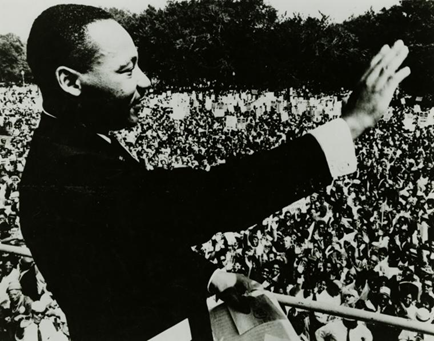
As we approach Martin Luther King, Jr. Day in the United States, I have been contemplating the reality that, if MLK, Jr. had been a member of the LDS church, he may not have been able to do what he did.
From my seat (and I am not a historian, so take this with a few grains of salt), in addition to his obvious talents, there are at least four structural elements that helped create the conditions for MLK Jr. to become the leader he was in the U.S. civil rights movement, but which would not have been present if had been a member of the LDS church.
First, MLK Jr. led a congregation. Though there were many pastors who did not become civil rights leaders, the fact that MLK Jr. led large congregations—first the Dexter Avenue Baptist Church in Montgomery, Alabama, and then the Ebenezer Baptist Church in Atlanta, Georgia—gave him a platform.
With access to the pulpit, his voice resonated weekly throughout his communities. In a real sense, the Jim Crow structures that served to silence the African American community did not hold sway within the walls of these churches. It is no surprise, then that African American church became the epicenter of the Civil Rights Movement.
However, were MLK Jr. a member of the LDS Church in the 1950s and 1960s, he would not have had this platform. Since he could not have led a congregation, he would not have had this kind of access to the pulpit, and thus, his voice may not have been heard in a way that was needed to build the kind of momentum required for this massive effort.
Second, MLK Jr. was seen as someone with spiritual and moral authority. MLK Jr. received a bachelor’s degree in sociology from Morehouse College, a Bachelor of Divinity from Crozer Theological Seminary, and PhD from Boston University all by the age of 25. He had done the work to establish his bona fides.
In his religious community, as well as within larger American society, these education accomplishments meant something. Though this education did not guarantee anything, his educational achievements likely helped establish his spiritual and moral credibility in the eyes of many outside observers.
However, in the LDS Church of the 1950s and 1960s, such accomplishments would have meant very little. They certainly would not have resulted in him being able to lead a congregation because he was of African descent, and in the LDS church of the 1950s and 1960s his race overrode any expertise he had.
Thus, in a church in which lay clergy (at the local and general level) is seen to be a primary source of authoritative spiritual and moral guidance, MLK Jr.’s inability to access those positions would have inherently limited the spiritual and moral authority he would have been afforded within the LDS community, notwithstanding all of his educational achievements.
Third, MLK Jr. understood his call as one that came directly from God. In 1956, in the midst of the Montgomery bus boycott, MLK Jr. received a threatening phone call late one night. He describes feeling as if “all of my fears had come down on me at once. I had reached the saturation point.” He prayed, expressing his anxieties and concerns to God.
Then, he says, “I experienced the presence of the divine…It seemed as though I could hear the quiet assurance of an inner voice, saying, ‘Stand up for righteousness, stand up for truth. God will be at your side forever.’” MLK Jr. knew for himself God was behind the Civil Rights Movement, and that his role in it was divinely blessed.
This experience was grounding for him as he made his way through numerous trials and tribulations. However, in the LDS Church, the Civil Rights Movement was viewed with some degree of suspicion by at least some senior LDS leadership.
Notably, in the October 1967 General Conference, then-Apostle Ezra Taft Benson described the Civil Rights Movement in America as a “Communist program for revolution in America.”
Though Benson used softer rhetoric in his General Conference address than the language he used in private settings, and softer language than that used by staunch segregationists like George Wallace, Benson and Wallace were making the same kinds of arguments.
In fact, Wallace and Benson were ideologically similar enough that Wallace asked Benson to be his vice-presidential running mate for the 1968 presidential election. Benson sought President David O. McKay’s permission to join Wallace’s ticket, but McKay declined to provide it.
During that time, institutionally, the Church tried to walk a careful line of affirming the principle of civil rights while still maintaining the priesthood/temple ban for member of African descent.
In this environment, if MLK Jr. had been a member of the LDS Church, any assertion he might have made that God was behind the Civil Rights Movement and that God had called him to take a leading role in it (both ideas that likely would have been anathema to Benson and his ilk) probably would have been poorly received and would have been unlikely to garner leadership or member support.
Fourth, theologically, MLK Jr. came out of a protestant tradition that espoused the ideas of justification by faith, the priesthood of all believers, and believed that Jesus’s gospel includes the notion that humankind can, and should, seek to make the world around them better.
This foundation of belief functioned as a theological mandate to engage in pro-civil rights activities and provided theological ‘permission’ to take steps to secure equal rights.
MLK Jr., and those who participated in the U.S. Civil Rights Movement believed God would justify their efforts, they believed they had the God-given authority to act, and they understood Jesus’s gospel as requiring such action. Theologically, they were motivated individually and collectively; and theologically, race was no impediment.
However, in the 1950’s and 1960’s LDS discourse about individuals of African descent included the promulgation of a variety of theories to explain and justify extant inequity between members of the church who were and who were not of African descent. Such theories ranged from the curse of Cain to a lack of fidelity the premortal life.
Not only did these “theologies of blackness” (for lack of a better phrase) suggest the existence of ontological inadequacies on the part of members of African descent, institutionally there was no mandate to act against this inequity (after all, such inequity was part of the official church structure through the priesthood/temple ban).
Put bluntly, the LDS church of the Civil Rights Era was simply theologically ill-equipped to support the Civil Rights Movement and those involved in it.
Many of these things are no longer true. In fact, in a class discussion during a recent church meeting, members of my ward were expressing praise for the U.S. Civil Rights Movement and affirming that God was, indeed, behind it. And for many years now President Nelson has been proactively engaging with the NAACP on areas of mutual interest.
But the reality remains that if MLK Jr. were a member of the LDS Church when the Civil Rights Movement was happening, the structural, organization, and theological impediments he would have faced from the LDS Church of the 1950s and 1960s may have limited his ability to accomplish what he accomplished.
Truly, I believe that MLK Jr. was one of those “holy men that ye know not of” (D&C 49: , and I think history bears that out. Thank the heavens MLK Jr. was born a protestant!
Finally, I think these observations require us to examine ourselves afresh.
In the LDS Church of 2025 are there structural, organization, and theological realities that inhibit members from achieving (what we may recognize in the future as) God-blessed missions? Will the ‘holy people that we know not of’ need to come from a different spiritual tradition because we are structurally, organizationally, or theologically ill-equipped to support what they have been called to do?
I honestly do not know, but it is something to consider.
By M. David Huston
As we approach Martin Luther King, Jr. Day in the United States, I have been contemplating the reality that, if MLK, Jr. had been a member of the LDS church, he may not have been able to do what he did.
From my seat (and I am not a historian, so take this with a few grains of salt), in addition to his obvious talents, there are at least four structural elements that helped create the conditions for MLK Jr. to become the leader he was in the U.S. civil rights movement, but which would not have been present if had been a member of the LDS church.
First, MLK Jr. led a congregation. Though there were many pastors who did not become civil rights leaders, the fact that MLK Jr. led large congregations—first the Dexter Avenue Baptist Church in Montgomery, Alabama, and then the Ebenezer Baptist Church in Atlanta, Georgia—gave him a platform.
With access to the pulpit, his voice resonated weekly throughout his communities. In a real sense, the Jim Crow structures that served to silence the African American community did not hold sway within the walls of these churches. It is no surprise, then that African American church became the epicenter of the Civil Rights Movement.
However, were MLK Jr. a member of the LDS Church in the 1950s and 1960s, he would not have had this platform. Since he could not have led a congregation, he would not have had this kind of access to the pulpit, and thus, his voice may not have been heard in a way that was needed to build the kind of momentum required for this massive effort.
Second, MLK Jr. was seen as someone with spiritual and moral authority. MLK Jr. received a bachelor’s degree in sociology from Morehouse College, a Bachelor of Divinity from Crozer Theological Seminary, and PhD from Boston University all by the age of 25. He had done the work to establish his bona fides.
In his religious community, as well as within larger American society, these education accomplishments meant something. Though this education did not guarantee anything, his educational achievements likely helped establish his spiritual and moral credibility in the eyes of many outside observers.
However, in the LDS Church of the 1950s and 1960s, such accomplishments would have meant very little. They certainly would not have resulted in him being able to lead a congregation because he was of African descent, and in the LDS church of the 1950s and 1960s his race overrode any expertise he had.
Thus, in a church in which lay clergy (at the local and general level) is seen to be a primary source of authoritative spiritual and moral guidance, MLK Jr.’s inability to access those positions would have inherently limited the spiritual and moral authority he would have been afforded within the LDS community, notwithstanding all of his educational achievements.
Third, MLK Jr. understood his call as one that came directly from God. In 1956, in the midst of the Montgomery bus boycott, MLK Jr. received a threatening phone call late one night. He describes feeling as if “all of my fears had come down on me at once. I had reached the saturation point.” He prayed, expressing his anxieties and concerns to God.
Then, he says, “I experienced the presence of the divine…It seemed as though I could hear the quiet assurance of an inner voice, saying, ‘Stand up for righteousness, stand up for truth. God will be at your side forever.’” MLK Jr. knew for himself God was behind the Civil Rights Movement, and that his role in it was divinely blessed.
This experience was grounding for him as he made his way through numerous trials and tribulations. However, in the LDS Church, the Civil Rights Movement was viewed with some degree of suspicion by at least some senior LDS leadership.
Notably, in the October 1967 General Conference, then-Apostle Ezra Taft Benson described the Civil Rights Movement in America as a “Communist program for revolution in America.”
Though Benson used softer rhetoric in his General Conference address than the language he used in private settings, and softer language than that used by staunch segregationists like George Wallace, Benson and Wallace were making the same kinds of arguments.
In fact, Wallace and Benson were ideologically similar enough that Wallace asked Benson to be his vice-presidential running mate for the 1968 presidential election. Benson sought President David O. McKay’s permission to join Wallace’s ticket, but McKay declined to provide it.
During that time, institutionally, the Church tried to walk a careful line of affirming the principle of civil rights while still maintaining the priesthood/temple ban for member of African descent.
In this environment, if MLK Jr. had been a member of the LDS Church, any assertion he might have made that God was behind the Civil Rights Movement and that God had called him to take a leading role in it (both ideas that likely would have been anathema to Benson and his ilk) probably would have been poorly received and would have been unlikely to garner leadership or member support.
Fourth, theologically, MLK Jr. came out of a protestant tradition that espoused the ideas of justification by faith, the priesthood of all believers, and believed that Jesus’s gospel includes the notion that humankind can, and should, seek to make the world around them better.
This foundation of belief functioned as a theological mandate to engage in pro-civil rights activities and provided theological ‘permission’ to take steps to secure equal rights.
MLK Jr., and those who participated in the U.S. Civil Rights Movement believed God would justify their efforts, they believed they had the God-given authority to act, and they understood Jesus’s gospel as requiring such action. Theologically, they were motivated individually and collectively; and theologically, race was no impediment.
However, in the 1950’s and 1960’s LDS discourse about individuals of African descent included the promulgation of a variety of theories to explain and justify extant inequity between members of the church who were and who were not of African descent. Such theories ranged from the curse of Cain to a lack of fidelity the premortal life.
Not only did these “theologies of blackness” (for lack of a better phrase) suggest the existence of ontological inadequacies on the part of members of African descent, institutionally there was no mandate to act against this inequity (after all, such inequity was part of the official church structure through the priesthood/temple ban).
Put bluntly, the LDS church of the Civil Rights Era was simply theologically ill-equipped to support the Civil Rights Movement and those involved in it.
Many of these things are no longer true. In fact, in a class discussion during a recent church meeting, members of my ward were expressing praise for the U.S. Civil Rights Movement and affirming that God was, indeed, behind it. And for many years now President Nelson has been proactively engaging with the NAACP on areas of mutual interest.
But the reality remains that if MLK Jr. were a member of the LDS Church when the Civil Rights Movement was happening, the structural, organization, and theological impediments he would have faced from the LDS Church of the 1950s and 1960s may have limited his ability to accomplish what he accomplished.
Truly, I believe that MLK Jr. was one of those “holy men that ye know not of” (D&C 49:
, and I think history bears that out. Thank the heavens MLK Jr. was born a protestant!Finally, I think these observations require us to examine ourselves afresh.
In the LDS Church of 2025 are there structural, organization, and theological realities that inhibit members from achieving (what we may recognize in the future as) God-blessed missions? Will the ‘holy people that we know not of’ need to come from a different spiritual tradition because we are structurally, organizationally, or theologically ill-equipped to support what they have been called to do?
I honestly do not know, but it is something to consider.


