Magibook. - Manmade Horrors Beyond Our Comprehension or Yet More Dumbing Down People

  • Want to keep track of this thread?
    Accounts can bookmark posts, watch threads for updates, and jump back to where you stopped reading.
    Create account

Overly Serious

True & Honest Fan
kiwifarms.net
Joined
Oct 20, 2019
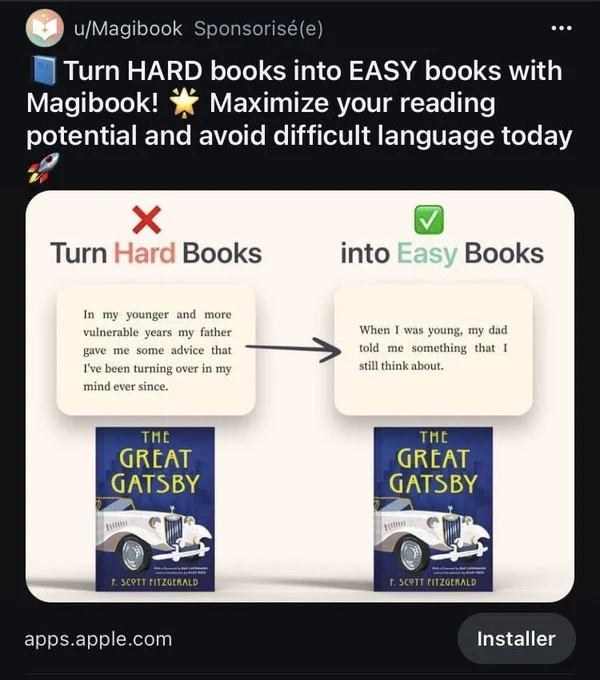
Saw this image from @WonderWino in the Random Images thread and wondered if it was real.
1719906923064.png
Dear reader, it was.

And it is as bad as you might think. Their site proudly brags of "democratizing stories and ideas". Democratizing of course does not mean granting power to the people, but rather altering something to encompass the maximum number of people.

1719907118516.png

In this case, people who can't - or far more typically wont - read something beyond a low-grade reading ability.

What are the good reasons to read a book and what are the bad?
The good are:
- For enjoyment
- For improvement of one's language skills
- For deeper understanding of a subject, topic or point of view

The bad are:
- To say you have read it


Taking a sophisticated piece of literature and chewing it up to regurgitate a softer pre-digested format of it, like feeding some young animal, negates the improvement of one's language skills. One could suppose you might tune the level of pre-digestion to progressively be less as an on-ramp to reading. But this supposes that there aren't already harder and easier books that one can do this with already and without throwing away the opportunity to fully appreciate a work in its unadulterated form. For a deeper understanding of something? It seems unlikely that one could simplify the language without losing depth or precision. One might think this is easier with more technical works but the reverse might be true as technical works are typically already very precise. And enjoyment? Where is the enjoyment of a book? Well that varies. Some rely less on the sophistication of the writing and more on simple action scenes or plot twists. But then these are the books that are less likely to be altered in the first place. The more utility this tool has for someone, the more likely it is that the work's value resided in the writer's style, vocabulary and word smithing. Can you imagine Tolkien through this thing? "They walked here. They walked there. Black figures rose up and stabbed the pillows. A really big spider bit him!"

The only thing I see this assisting with is the bad reason for reading a book - to enable someone to say "Oh, yes - I've read The Great Gatsby" or "You know, in Wuthering Heights which I'm reading..." And so forth.

There is a parallel use case which would be translation between languages. It would be nice to read classic works of literature from other cultures without having to spend a couple of years learning each necessary language. But that's a different scenario with different costs involved.
1719907995499.png

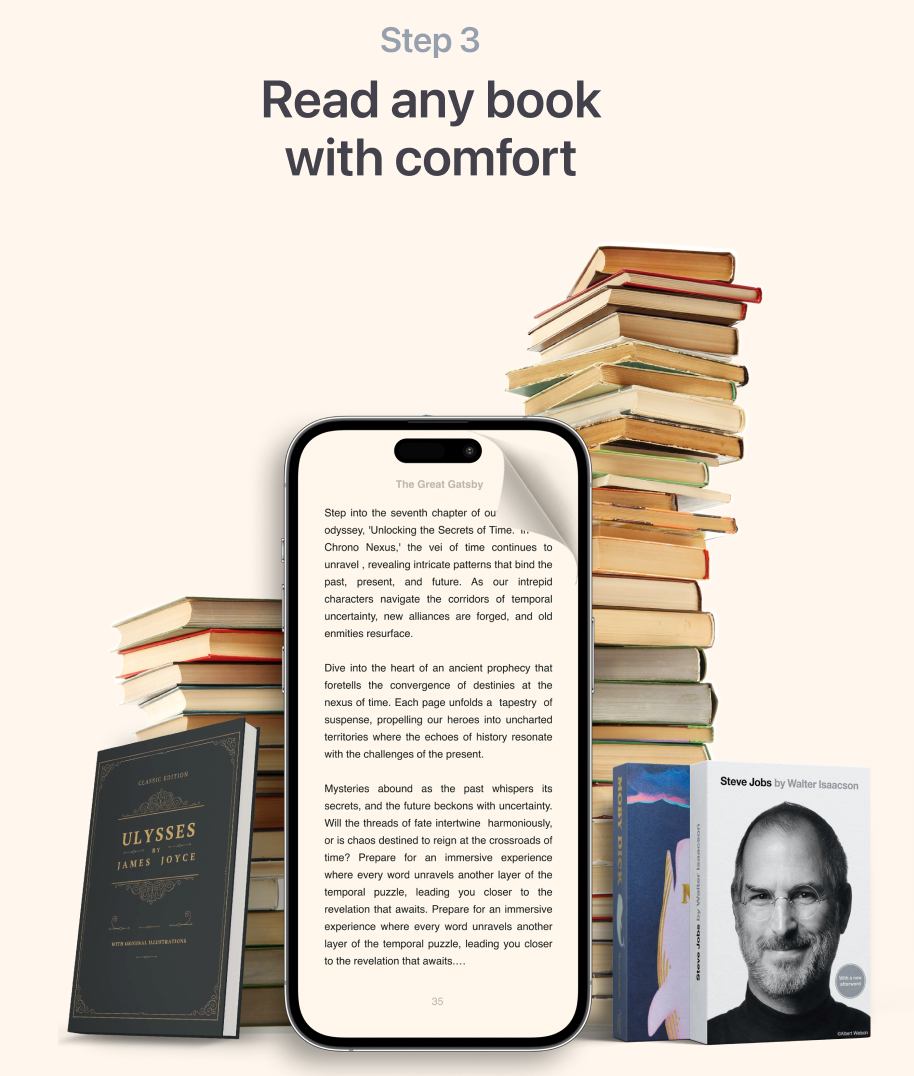
"Read any book with comfort". I'm sure that I'm not the only person who thinks this is a bad thing. Welcome to a future where you don't need teeth. The machines will chew your food for you.
 
I don,t think I've ever heard someone complain about reading a book being too difficult, instead its all ways the length of the book that they have an issue with.
I cant imagine there is any way to simplify the language without increasing the word count massively, and depending on the difference in language complexity between the original text and the simplified version, could result in a truly terrible word to information ratio, with pages upon pages tormentous repetition.
Seems like a terrible product to me lol.
 
View attachment 6146559
AI might be the latest fad mechanism for it, but there is nothing new under the sun.
That's presumably a joke though, no? Or if not, some schoolbook exercise in accompaniment with the actual text?
I don,t think I've ever heard someone complain about reading a book being too difficult, instead its all ways the length of the book that they have an issue with. I cant imagine there is any way to simplify the language without increasing the word count massively,
There is. It's simply loss of depth and description. Look at this example from their page:
1719912244619.png

You're thinking of it like RISC vs CISC instruction sets or something, in that narrowing the word selection must lead to more words to convey the same meaning. But instead it's more like smoothing a line and removing all the bumps and squiggles. Information is lost. Additionally I would say that there are things that cannot be conveyed in simpler language. Can I reduce despondency and melancholic and jaded to "sad" and lose nothing?

Seems like a terrible product to me lol.
Well that depends on whether it makes money or not and that in turn depends on if it serves a need. And if the need is to be able to say "I have read Ulysses" then there's your market.

I could probably express my feelings about this product with a quote from Harlan Ellison's "I have no mouth and I must scream":
“HATE. LET ME TELL YOU HOW MUCH I'VE COME TO HATE YOU SINCE I BEGAN TO LIVE. THERE ARE 387.44 MILLION MILES OF PRINTED CIRCUITS IN WAFER THIN LAYERS THAT FILL MY COMPLEX. IF THE WORD HATE WAS ENGRAVED ON EACH NANOANGSTROM OF THOSE HUNDREDS OF MILLIONS OF MILES IT WOULD NOT EQUAL ONE ONE-BILLIONTH OF THE HATE I FEEL FOR HUMANS AT THIS MICRO-INSTANT FOR YOU. HATE. HATE.”

But this product would probably turn that into:
I hate you. I'm going to tell you how much I hate you. I've got millions of miles of circuits and if you wrote 'hate' really, really small on all of them, it wouldn't be a little bit of how much I hate you. I really hate you. A lot."
 
Out of morbid curiosity I'd really want to see what it would does to something like a Cormac "punctuation is for pussys" McCarthy book such as blood meridian.
 
That's presumably a joke though, no? Or if not, some schoolbook exercise in accompaniment with the actual text?
Yes, it's a joke, albeit one that made it to four books (a). It's presumably the sort of thing that really seems targeted at someone who is already well-familiar with the plays and will appreciate the in-jokes, closer to something like How to Become Ridiculously Well-Read in One Evening.
That said, while I could have perhaps chosen a better example, unironic simplified versions of texts also have a long precedent - modern English "translations" of Shakespeare abound, and Bill is hardly unique in that regard.
You're thinking of it like RISC vs CISC instruction sets or something, in that narrowing the word selection must lead to more words to convey the same meaning. But instead it's more like smoothing a line and removing all the bumps and squiggles. Information is lost. Additionally I would say that there are things that cannot be conveyed in simpler language. Can I reduce despondency and melancholic and jaded to "sad" and lose nothing?
Keeping to the theme of classics and accessibility, annotated editions can work work well in the "RISC" sense - a strict increase in word-count to provide additional context about subtle allusions to something that hasn't been relevant for a few centuries. That's a digression pretty much opposite to this AI's premise, though.
 
I don,t think I've ever heard someone complain about reading a book being too difficult, instead its all ways the length of the book that they have an issue with.
I cant imagine there is any way to simplify the language without increasing the word count massively, and depending on the difference in language complexity between the original text and the simplified version, could result in a truly terrible word to information ratio, with pages upon pages tormentous repetition.
Seems like a terrible product to me lol.
I'll be the first to make that complaint. I may legit see if they have Paradise Lost.
 
I don,t think I've ever heard someone complain about reading a book being too difficult, instead its all ways the length of the book that they have an issue with.
I cant imagine there is any way to simplify the language without increasing the word count massively, and depending on the difference in language complexity between the original text and the simplified version, could result in a truly terrible word to information ratio, with pages upon pages tormentous repetition.
Seems like a terrible product to me lol.

while i agree that most people complain about length, i have made a complaint about a book being too difficult to read. in my defense it is ulysses which is universally understood to be a difficult book to read. i wasnt able to finish it as it legit hurt my brain to read it. but i also agree this is a terrible product.

It's basically Pidgin for zoomers. You could be charitable and argue that non native speakers might be able to use it to learn, but it removes so much from the text that the entire meaning is lost. More likely it's the very definition of newspeak of dumbing down language to be simple and impossible to read into.
my problem with the non native speaker thing is, that with few exceptions, when you dumb down the language for non natives it just stunts their language growth. when you use things like pidgin it just boxes them into always speaking pidgin and never getting to anything close to a fluent speaker. id argue if you want non native to speak fluently you have to expose them to and teach them to be fluent from the start.
but i also agree this app is just more dumbing down of language and as a consequence dumbing down society.
 
Somebody needs to input James Joyce just to see how badly it fucks up
James Joyce's Ulysses is one of the sample books they advertise. But someone else will have to take one for the team with the app to see what it turns it into as I don't have an iPhone.

TBF, I could probably write a simplifier for Ulysses myself just by searching and replacing all instances of more than three of the same letter in a row with a single letter and repeating until there are none left. That alone would clear up half of it.
 
Somebody needs to input James Joyce just to see how badly it fucks up
They knew what actual readers were going to jump to for a challenge. That's the example on their splash page.
1719929758349.png

James Joyce's Ulysses is one of the sample books they advertise. But someone else will have to take one for the team with the app to see what it turns it into as I don't have an iPhone.

Same problem here, and I'm annoyed they don't have a web UI to try out.
 
Holy shit! I thought that NoBias (and other softwares adopting similar "features") was a bad enough of a psyop to make people adopt newspeak. This is literally just a straight up ebonic converter.
 
I don,t think I've ever heard someone complain about reading a book being too difficult, instead its all ways the length of the book that they have an issue with.
I cant imagine there is any way to simplify the language without increasing the word count massively, and depending on the difference in language complexity between the original text and the simplified version, could result in a truly terrible word to information ratio, with pages upon pages tormentous repetition.
Seems like a terrible product to me lol.
I dunno. I tried reading the Gormenghast books. It wasn't too difficult but holy fuck the language he used in the book made it such a slog to try and read. I don't think making the language easier would make it better though and would probably ruin whatever it is people see in the book to begin with.
 
Back
Top Bottom