Navigation
Install the app
How to install the app on iOS
Follow along with the video below to see how to install our site as a web app on your home screen.
Note: This feature may not be available in some browsers.
More options
Style variation
You are using an out of date browser. It may not display this or other websites correctly.
You should upgrade or use an alternative browser.
You should upgrade or use an alternative browser.
💰 Grifter "Mad at the Internet" - a/k/a My Psychotherapy Sessions
- Thread starter Null
- Start date
-
🏰 The Fediverse is up. If you know, you know.
-
Want to keep track of this thread?
Accounts can bookmark posts, watch threads for updates, and jump back to where you stopped reading.
Create account


- Joined
- Dec 15, 2022
Machine Girl's music reminds me a lot of the Felix Colegrave's soundtrack for 'Donks'.
Of course that work was much after she got her start, so I wonder if Felix had inspiration from her.
I'd be surprised if a Nu-Age hippie would be into music like hers.
Actually on further review it looks like she has more sounds than Ween, and they are all schizophrenic. There is probably a track in her body of work that shares motifs with every song ever made. My comparison only holds up for half of one track.
Of course that work was much after she got her start, so I wonder if Felix had inspiration from her.
I'd be surprised if a Nu-Age hippie would be into music like hers.
Actually on further review it looks like she has more sounds than Ween, and they are all schizophrenic. There is probably a track in her body of work that shares motifs with every song ever made. My comparison only holds up for half of one track.
Last edited:

- Joined
- May 1, 2025
I thought Machine Girl was a guy? I'll admit I don't pay much attention to them outside the music but I kept seeing pictures of the same dude's face so I assumed it was them.Machine Girl's music reminds me a lot of the Felix Colegrave's soundtrack for 'Donks'.
Of course that work was much after she got her start, so I wonder if Felix had inspiration from her.
I'd be surprised if a Nu-Age hippie would be into music like hers.
Actually on further review it looks like she has more sounds than Ween, and they are all schizophrenic. There is probably a track in her body of work that shares motifs with every song ever made. My comparison only holds up for half of one track.

Kakkerum420
kiwifarms.net
- Joined
- Jan 16, 2025
Are the compilation videos on the channel published uncensored somewhere else?
I appreciate them but the censor sound is extremely annoying .
I appreciate them but the censor sound is extremely annoying .

- Joined
- Oct 4, 2021
When is MATI going to adopt this format?
- Joined
- Dec 15, 2022
You're probably right, I have no idea.I thought Machine Girl was a guy? I'll admit I don't pay much attention to them outside the music but I kept seeing pictures of the same dude's face so I assumed it was them.

- Joined
- Nov 12, 2019
TLDR: Spiralling because he knows it over want to fight out that yes we can still be toxic to society & accelerate decline iin wake of charlie kert.Dedicated Patriot Sólionath on twitter has done nothing but get libtards fired for claiming Charley Kirk deserved to be assassinated for the past week.
View attachment 7932503
His biggest target is for Twitch to drop Hasan Piker for him promoting and calling for left wing political violence. The original post on September 14'th has gained over 22 million views alone.
View attachment 7932510
Twitch and Amazon have yet again ignored their Turkish roach infestation but Sólionath has not simply giving up. He has gathered a list of 67 of Twitch's advertisers for what has grown into what I consider, the mass "chimping for Kirk" campaign. The list will remain an attachment and linked above due to it's length.
** Sam Hyde: the boats are burned there is no turning back**
Last edited:

- Joined
- Jan 5, 2021
That is mad funny by the story alone but the dog face, I swear to god, I've seen black girls who look just like that.SnapInsta.to_AQMseB_9Y6IiR7kiv-hNlH1XRuiT__knsdVc6hkryz7jJh2Ef1E-DbwevL_prpurkH5JyIqZ-pe_yZdW5...mp4
When is MATI going to adopt this format?
Also, I share Josh's opinion about the popping up text, I usually hover my thumb or move the window to cover that shit so I'm not distracted.

- Joined
- Apr 1, 2024
Chat what do you think. Are we going to get a full on politisperg stream tomorrow, or are we gonna get da lolcow OP rewrite content?
I can't guess which it will be. Maybe some heck wholesome xeets.
Edit: oh wait, I forgot, is mati going to be Saturday this week? Been an eventful week I can't remember if it was MATI or something else.
I can't guess which it will be. Maybe some heck wholesome xeets.
Edit: oh wait, I forgot, is mati going to be Saturday this week? Been an eventful week I can't remember if it was MATI or something else.
- Joined
- Dec 15, 2022
He's going to celebrate Ethan's birthday.Chat what do you think. Are we going to get a full on politisperg stream tomorrow, or are we gonna get da lolcow OP rewrite content?
I can't guess which it will be. Maybe some heck wholesome xeets.
Edit: oh wait, I forgot, is mati going to be Saturday this week? Been an eventful week I can't remember if it was MATI or something else.

- Joined
- Jan 29, 2021
The Maldavius Fagtree Vs. The Internet video that came out on Youtube was a great way to consume the entire drama as recorded in Null's streams.
But more importantly it shows in stark contrast how Jersh's audio changes WILDLY in quality EVERY SINGLE WEEK.
Also, I would have dropped the segment with Card in it since that segment was more about Card than Mald.
But more importantly it shows in stark contrast how Jersh's audio changes WILDLY in quality EVERY SINGLE WEEK.
Also, I would have dropped the segment with Card in it since that segment was more about Card than Mald.


- Joined
- Apr 1, 2024
I think a good super cut would be every time he yells at chat.Can we get the payment processor rant supercut next?


- Joined
- Jul 29, 2024
@Null "Race of Doom" by Devo is my suggestion for the MATI intro song. It perfectly summarizes the destructive LGBT mindset.
Included is an upload because our Glorious Sneeder will not sign in to YouTube.
Included is an upload because our Glorious Sneeder will not sign in to YouTube.
Race of doom
Is it on
Is it off
Reply
It’s a matter of time
It’s a matter of luck
It’s a factor of chance
’til I self-destruct
You fire at random
I’m under attack
Strapped in and freewheeling
Flying off the track
I want to be your time bomb
Let me be your time bomb baby
I want to be your time bomb
Please let me be your time bomb baby
Everywhere there is danger
Absolutely for real
Subliminal feelings
Too strong to conceal
Unscramble your program
My turn to unload
Unbelievably certain
Guaranteed to explode
Race of doom
Is it on
Is it off
Reply
It’s a matter of time
It’s a matter of luck
It’s a factor of chance
’til I self-destruct
You fire at random
I’m under attack
Strapped in and freewheeling
Flying off the track
I want to be your time bomb
Let me be your time bomb baby
I want to be your time bomb
Please let me be your time bomb baby
Everywhere there is danger
Absolutely for real
Subliminal feelings
Too strong to conceal
Unscramble your program
My turn to unload
Unbelievably certain
Guaranteed to explode
Race of doom
Last edited:
- Joined
- Jul 29, 2024
Here's one of my favorites.I think a good super cut would be every time he yells at chat.

- Joined
- Jan 31, 2020
Boss moving a little slow in this gif. Must be on the comedown or just woke up from his crackcoma.With my 1000th post I will shit up Josh's thread.
View attachment 7932501
Thank you for your attention. God willing, I will blight this website with another 1000 of my dogshit posts.
- Joined
- Nov 12, 2019
given credit to user but ,
NULL LAW IS IN EFFECT YAAAAAAAAA.
You get orwell but, 230 gets knee capped.
favorite 3 kids: KOSA, BEARD , AI- Act
NULL LAW IS IN EFFECT YAAAAAAAAA.
You get orwell but, 230 gets knee capped.
favorite 3 kids: KOSA, BEARD , AI- Act
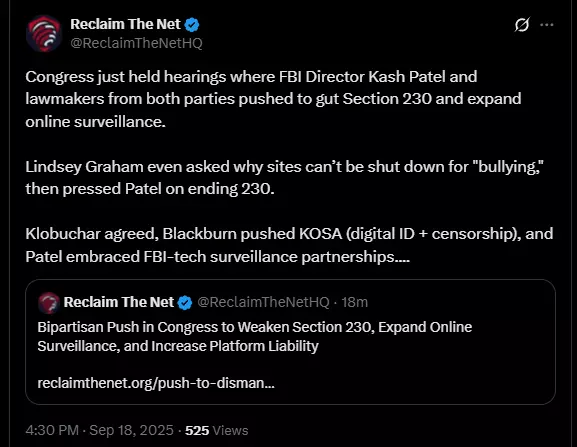
During this week’s testimony before both chambers of Congress, FBI Director Kash Patel and several lawmakers made a concerted push to weaken protections for online platforms, advance surveillance partnerships, and promote government intervention in digital speech spaces.
The hearings revealed a rare bipartisan consensus around dismantling Section 230 and tightening control over how people interact and communicate online.
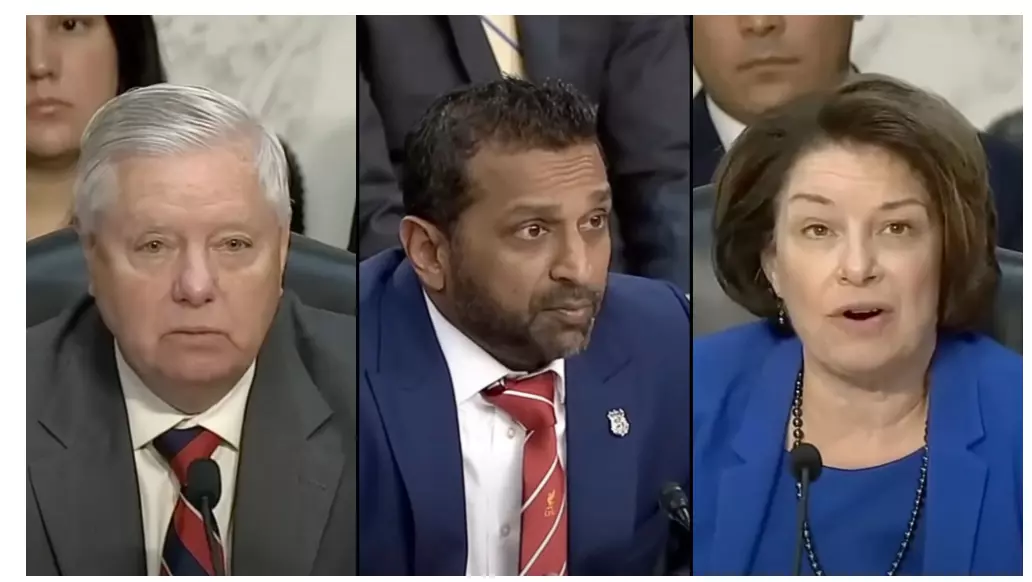
In the Senate, Republican Senator Lindsey Graham opened his questioning by linking online platforms to the assassination of Charlie Kirk, then repeatedly pressed Patel on whether the internet was a breeding ground for radicalization and crime.
Throughout their exchange, Graham blurred the lines between criminal behavior, such as grooming or inciting violence, and broad categories like bullying.
“Is there any law that can shut down one of these sites? For bullying children or allowing sexual predators on the site,” Graham asked.
He repeatedly implied that websites hosting objectionable content should be held legally responsible, asking, “Would you advocate a sunsetting of Section 230 to bring more liability to the companies who send this stuff out?”
Patel replied, “I’ve advocated for that for years.”
Section 230 of the Communications Decency Act is a legal provision that protects online platforms from being held liable for content posted by their users.
It allows websites, forums, and social media services to host a wide range of speech without being treated as the publisher of that content. If Section 230 were repealed or weakened, platforms would face significant legal risk for everything users say or share.
This could push companies to aggressively censor user content to avoid lawsuits, leading to broader suppression of speech, fewer places for open dialogue, and less room for dissenting or controversial viewpoints online.
When Graham demanded action against platforms that allow bullying or grooming, Patel suggested that platforms cannot be sued under current law, adding that the explosion of AI-generated abusive material had worsened the problem.
Note that Section 230 does not give platforms immunity from federal criminal law. If a website is knowingly hosting or involved in illegal content, such as child exploitation, terrorism, or sex trafficking, it can already be held criminally liable under existing statutes.
Patel called the situation a “public health hazard” and stated, “I think not only are some of these sites designed to be addictive, unfortunately, the reality is some of these sites are designed to generate income, and many people are generating income based on this illegal trade.”
The hearing offered no engagement with the consequences of gutting Section 230. Instead, there was a clear push to strip away those protections in the name of safety.
Senator Amy Klobuchar, a Democrat, echoed that sentiment. “For years I have supported repealing Section 230,” she said, arguing that the law is outdated and was crafted for a different era.
While she prefaced her comments by claiming to oppose censorship, her solution was the same as Graham’s: eliminate legal protections for platforms to create a “better environment online.”
Klobuchar veered into broader political territory, citing a wave of threats and violence targeting lawmakers.
She asked Patel to commit to conveying her concerns to the White House and emphasized a need to “move forward” on both speech laws and gun control measures.
Republican Senator Marsha Blackburn seized the opportunity to promote the Kids Online Safety Act (KOSA).
KOSA is a proposed law that presents itself as a measure to protect children but would fundamentally alter the structure of the internet by encouraging surveillance, forced identity verification, and government-influenced content moderation.
While the bill mandates that platforms shield minors from content deemed harmful, such as material linked to mental health concerns, it also gives the Federal Trade Commission the authority to penalize companies over subjective definitions of what constitutes harm.
KOSA directs federal agencies to develop age verification systems at the device or operating system level, setting the stage for a national digital ID regime that would eliminate online anonymity and expose users to deeper tracking and data collection.
Despite revisions and corporate endorsements, the bill continues to raise alarms among civil liberties advocates who warn it would pressure platforms to over-censor, chilling free speech under the pretense of child safety.
Blackburn described platforms like Discord as enablers of predation, referencing the Kirk assassination, and asked Patel what Congress could do to give the FBI more power.
Patel responded with a call for financial crackdowns and more legal obligations for tech companies, stating, “Nobody’s being held accountable. They’re making money and our youth is dying.”
During his exchange with Rep. Brandon Gill, Patel made one of the most interesting comments of the hearing.
Patel called for expanding surveillance partnerships between the government and private tech companies, including gaming and social media platforms.
“There is no way to triage the amount of information generated on these sites by the FBI alone,” Patel said.
He advocated renewing a law that allows companies to report users to the FBI without fear of liability, framing this corporate-government alliance as essential to national security.
This approach would effectively deputize tech companies as enforcers. No concern was raised about how such partnerships could be abused to monitor lawful political activity or dissent.
Despite the repeated invocation of safety and child protection, the hearings presented little evidence that any of the proposed changes would meaningfully prevent crime.
Instead, lawmakers from both parties appeared eager to empower both the FBI and online platforms to act as gatekeepers of acceptable discourse, with Patel affirming at every turn that the Bureau would welcome such powers.
The push to overhaul Section 230, pass KOSA, and institutionalize surveillance under the banner of public-private “partnership” may signal a dangerous change in how speech is treated online.
Rather than protect fundamental rights, lawmakers are pushing to dissolve long-standing legal safeguards in pursuit of control over what people are allowed to say, and where they’re allowed to say it.

- Joined
- Dec 17, 2019
Not gonna wait a year to post this so...
It's just too perfect. Louis de Funes is the GOAT.
It's just too perfect. Louis de Funes is the GOAT.