The German Ludwig von Mises institute has just published part 3 of its three-part series "Javier Milei, The First 6 Months".
I've decided to translate it to English just for the A&N audience. Keep in mind that some links are German and that some translator's notes are inserted.
What's good about this review is that the author points out some background information on things like Argentina's constitutional and election-related peculiarities which are probably not common knowledge among observers from abroad.
The source links in German are parts 1 [A], 2 [A], and 3 [A].
The author is Stephan Ring, PhD [A], lawyer and board member of the German Ludwig von Mises Institute.
Without further ado:
I've decided to translate it to English just for the A&N audience. Keep in mind that some links are German and that some translator's notes are inserted.
What's good about this review is that the author points out some background information on things like Argentina's constitutional and election-related peculiarities which are probably not common knowledge among observers from abroad.
The source links in German are parts 1 [A], 2 [A], and 3 [A].
The author is Stephan Ring, PhD [A], lawyer and board member of the German Ludwig von Mises Institute.
Without further ado:
Javier Milei is a president who publicly refers to the great economists and social philosophers of the Austrian School of economics, especially its great stalwart Ludwig von Mises (1881-1973) and the Nobel Prize laureate Friedrich August von Hayek (1899-1992), and lets its economic insights guide his policies. It has now been roughly 6 months since the libertarian economist Milei, as a career jumper, surprisingly became the president of Argentina. It's a good point in time for reviewing what has happened so far, i.e. examine how the governmental practice of Argentina's president is guided by the Austrian School, and draw a verdict.
1. Initial situation at the point of inauguration at the start of December 2023
During his inauguration in December, the socialist previous government left behind an overindebted central bank with net foreign currency liabilities valued roughly 12 billion USD and, depending on the calculation method, the expected inflation was between 30% and 50% per month, or up to 17,000% per year. The yearly government budget deficit amounted to 5% of GDP and even up to 17% if you take the central bank into account. The government pension system is basically not workable due to the massive intake of people who have never paid in.
50% of Argentinians live below the poverty line and receive government aid in some form. An estimated 10% are homeless, and even though Argentina produces food for over 400 million people, 5 million Argentinians are hungering. 50% of jobs are in the shamefacedly labeled "informal" area. Socialists just don't like speaking of black markets when they're responsible for the situation.
Energy is governmentally subsidized by up to 80%. Exports and imports are wrought with red tape and even export tariffs. The latter are an interesting social invention and development on departure taxation. The bureaucracy is corrupt.
Unions organize mass strikes, as it turns out, by threatening to deprive the recipients of government food coupons of food if they don't participate in the demonstrations. Political strikes with complete blockades of roads and factories are daily occurrences. A quasi-military strike culture has developed to ensure the rule of unelected union leaders above the state. NGOs, unchecked, receive immense funding from tax money to ensure the power and luxury of the "social oligarchs".
In a nutshell: After 100 years of socialism, the country that once was one of the wealthiest places on Earth has reached rock bottom. According to the World Bank, since 1950, Argentina has had the most recessions of all countries on Earth. In real terms, wages declined by 80% between 2001 and 2023.
2. The first measures
For the measures immediately following his inauguration in December 2023, [at this point the author points to another article of his, Javier Milei: 100 days of libertarian revolution.] What is also informative is his address to the nation.
3. "Ley Bases", the path to the first law
[The author wishes to convey an] understanding of the political and constitutional situation in Argentina. Some peculiarities, which make this project so exciting for a German observer and knowledge of which is absolutely mandatory to be able to judge legislative measures, are worth mentioning. At this point, it should be mentioned that the German media, if they do any reporting in the first place, either intentionally, for the sake of being short-lived, or, what I rather believe, because of insufficient researching, don't mention the local constitutional peculiarities and thus inform the reader with a German constitutional understanding badly or, mostly, completely wrongly.
Argentina originally copied its constitution from the USA, with multiple reworks after numerous government overthrows within the past 100 years, and kept its basic structure. The large country consists of 24 provinces which are structurally equivalent to the USA's states and are being led by governors. The central state is ruled by one directly elected president for 4 years with the one-time possibility of a second term.
The legislative of the central state consists of a parliament - the Congress - and a second chamber - the Senate. The congressmen are being voted by the populace according to "one man, one vote". The Senate consists of 3 senators each for every province, although 2 senators are being sent by the winning party and 1 senator by the party with the second-most votes. Thus, the dependence of the senators on the corresponding governor is bigger than in the USA, but not as big as in Germany's Federal Council.
The corresponding elections happen in the same rhythm as in the USA, that is, with bi-annual midterm elections for the Congress and Senate, in which a part of officials and senators are being elected.
The presidential powers are extraordinarily big. In many areas, he can rule by means of emergency decrees which have the status of a law and actively need to be rebuked by both chambers. Thus, as long as both chambers haven't voted against it, the decree stays in effect. It is this constitutional mechanic which allowed for Argentina's "quick turnaround" because, with just 7 of 72 senators and only 17% of congressmen, Milei practically has no legislative base for his power.
A few days after his inauguration, Milei introduced a comprehensive reform (the so-called "DNU") which affected nearly every area of life, which, with the exception of a few, especially labor-law-related matters which were fought in courts, is still in effect and has been retroactively legitimated by the recently passed law "Ley Bases" ("law of bases").
In Argentina, the unions have an enormous political importance because their comprehensive rights to participation are protected by the constitution in a way that's similar to basic human rights. The corresponding nonparliamentary and democratically nonlegitimated power is one of the big obstacles which Milei needs to overcome. What helps him is that a large part of the populace has grown tired of the power abuse of this group, and also that he is willing to shut off the money valve at all direct and especially indirect sources and fight on all fronts, including by means of criminal prosecution.
In December 2023, Milei tried to pass his emergency decree into law. However, this attempt already failed in Congress because of the prodecural obstacles and the procedural traps placed by the opposition. Instead of accepting a bill which was basically unrecognizable after many changes, the government withdrew this first draft and presented a new, slim bill, the so-called "Ley Bases", with still 10 sections, containing 279 articles in 41 chapters on 339 pages.
An important part of this bill is the time-limited, regularly for one year, transfer of legislative power to the president, which, observing from the outside, is comparable to a "dictator" according to ancient Roman structure. But, in Argentina, this procedure is completely normal. Factually, this is the first act after the election of a new president, who obtains this power for his government program which is democratically legitimated through his direct elections. In the case of Milei, however, it has been attempted to first completely reject this transfer of power, and then only grant it in a very restricted way within the legislative process.
The main reason why Milei could as much as hope to pass his decree against all resistance and without legislative power is the populace. Due to the successful fight against inflation, which is merely 4.2% per month in May, and a simultaneous social safety net and fighting against the socialist structures of power abuse, Milei has managed to reach an approval rate which is extremely unexpected for presidents who pull tough measures like these. Because it's time for the midterm elections in fall 2025, everyone who conducts in politically motivated fundamental opposition activities is going to face an existential problem if the approval rates of Milei and his core team of recently almost 60% remain high.
Milei does not hesitate to call out and directly attack every opponent. Through social media, he circumvented the socialist-controlled media and public opinion apparatus and can address the populace directly. In addition, the opposition has disbanded almost completely. Only the fully socialist core of roughly 30% can still be considered organized. Some oppositional leaders are currently engaged in criminal prosecution because of embezzlement and corruption, others are currently so unpopular among the people that a comeback is unlikely.
The legislative procedure in Argentina starts in one chamber, usually the Congress. In practice, because the president has a veto right, a governmental bill is the base for a congressional decision. After long and arduous negotiations with the political powers in Congress, who were fundamentally in favor of change, the government managed to get the Ley Bases through the first chamber, Congress, against all resistance from the socialist opposition. The fundamental opposition's tactic has been to stall for time by means of delays and procedural demands, always hoping that the popular approval numbers would finally decline in the face of tough government policies.
Also, the opposition has managed to mobilize the universities, especially large numbers of students, against Milei. By means of an intentionally nourished irrational fear that the government would abolish free education, other parts of the populace were confused as well, and his approval sank to slightly below 50%. It has to be admitted that the government's reaction was very unfortunate at first. However, it quickly adjusted and eliminated the danger at its core by means of aggressive public relations campaigns and quick payments.
Unlike what the opposition hoped for, since the end of the student protests in March, the government's approval figure has been increasing in every month in which the inflation declined faster than expected and with every reveal of a corruption and embezzlement scandal of previous governments. The result of the opposition's stall tactics is thus only that Milei now occupies the top spot in the ranking of all presidents in terms of whose first bill had to wait the longest for the parliament's approval.
In addition to the resistance in the legislative procedure, the nonparliamentary resistance has been mobilized. In the first months of his term, starting even in December, 3 national strikes were called for. However, the most recent one, on May 8 2024, has been a big defeat for the unions.
By conducting the payments to the needy no longer by means of the nongovernmental soup kitchens, but instead directly to the needy and without proof requirements, shortly after the inauguration, 3 things were achieved. First, the "social intermediaries" and NGOs who used these funds to force the needy into free labor, participating in demonstrations, up to prostitution, have been deprived.
Second, without any increase of the funding, it is estimated that the needy now receive double the money they used to receive.
And third, in the special newly created complaints hotline, more than 100,000 complaints were submitted, among which, so far, more than 10,000 resulted in criminal investigations against the alleged "social helpers".
Next to depriving those business dealings of funds and drastically increasing the risk of criminal prosecutions, Milei channeled the right to demonstrate and outlawed strikes blocking roads or violently closing factories. Thus, in this last attempt of a national strike, the Argentinians were so trusting in the functioning of the police measures that the non-strikers went on to work, which they were now able to reach without peril - in spite of demonstrations.
On top of that, unlike before, every government employee who doesn't show up to work without permission is now facing a pay cut, and the many bus companies who receive funding for operating certain lines were informed that these payments will only be made if they properly follow through, with controls.
As a result of all these measures, this last national strike has been mostly inconsequential. 48% of public transport was running. 76.6% of small and mid-sized industrial businesses were working, and 90.43% of stores, including the big supermarkets, were open. The approval figures for Milei crossed over the 60% mark. More than 70% of the populace were in favor of his measures.
The government continued being active. An audit of the poor feeding programs found out that 52.3% of them were not able to be properly audited. 32% of them simply didn't exist. For almost 25%, the claimed information didn't match reality. Thus, for instance, food has been demanded for 500 people, but only 50 showed up during the control, and no proof was able to be submitted for further needy people. One "poor feeding" institution was even registered in a remote, rural, locked down settlement that had no access to public transportation.
After this first hurdle in the legislative procedure was passed, the Senate now had to approve. This is where Milei had leverage against the governors, because he cut the central governmental, but fundamentally voluntary, funding allocations by 87% in real terms, by means of simple nonpayment, reconciliation with debt, or refusing to adjust for high inflation. In doing so, he fulfilled every legal obligation. Because the prior socialist system relied on these governmental payments to remain in power, the provinces which were constitutionally intended to be independent became dependent. In a "Pacto de Mayo" ("May pact"), Milei suggested to the governors to cooperate under new terms. The condition, however, was an agreement to the Ley Bases in the Senate. A new appointment for this pact is now planned for the beginning of July.
In addition to stalling tactics in the Senate, the people on the street mobilized again. What is interesting is that the union umbrella group CGT, comparable to the German DGB (German Trade Union Confederation), rejected an open call to demonstration for all unions. In addition to the "defeat" in the last national strike, there was a fear that the bill could pass and they would end up as losers again, which could destroy the last remaining pretense of their formal, but actually nonexistent, political neutrality.
The leaders of nonparliamentary opposition, increasingly suffering from real and prosecutorial pressure, and the most militant unions, however, have announced drastic measures for the day of the session in the Senate. Apparently, the goal was to use attacks against the Senate buildings to create a repeat of the situation in 2017, to give the allied senators in the Senate the opportunity to reschedule because of the threat of a storm of the building. The following loss of trust in the governability of Argentina was supposed to lead to an organized bank run and eventually to the overthrow of the government.
But the government was prepared. In the early morning hours of the session day, the area was put under a complete lockdown, partially with 3 meter tall metal walls [translator's note: 10 feet]. The police presence was overwhelming. When the first bricks and molotov cocktails flew at night, the heavily armed and armored police reacted with tear gas and water cannons. People were injured. One police unit has been basically completely pelted with rocks before it was able to retreat. The car of a media representative has been torched.
As they feared, the senators of the opposition wanted to "keep an eye" on the situation and interrupt the session, which they didn't manage to do.
According to Bullrich, minister of the interior, 29 people have been arrested in the violent riots and the prosecution is investigating a violent attempt to overthrow the government. The damages are roughly 10 million USD. They intend to demand a repayment for these damages from the culprits. Parts of the opposition felt so secure that they filmed themselves committing the crimes and uploaded these films to the net. This way, some of the culprits were able to be identified.
At first, it was especially exciting in the Senate because the fundamental opposition lacked only 5 of 72 senators to be in the majority. In a dramatic 13 hour long marathon session of the Senate, on Thursday, June 13 2024 at 11:16 PM, the bill was passed with many changes that were conceded by the government. The vote ended with a 36:36 stalemate which was ended in Milei's favor by the Vice President. This decisive moment can be seen here on X.
But it hasn't been a completely smooth ride. Thus, during negotiations on the bill, Milei replaced his chief of staff with a politically experienced and well-connected minister, although it remained unclear if the reason was an accusation of governmental internal wiretapping. Numerous leading officials have left the government. Depending on the point of view, this can be seen in a positive light because vacant seats can be filled with people who help put Milei's agenda into practice.
However, the government also managed to paralyze the opposition in the legislative process. After the final passing of the bill, mutual accusations of wrongdoing and insults as traitors was the situation among the Peronists (who can be considered a very left-wing people's party with numerous wings, mostly united by their hunger for power). The left-wing media speaks of a fracture of the left wing. Many officials and senators who are up for election in 2025 apparently no longer believe to be able to win a vote together with Cristina de Kirchner or her protégé Alberto Fernández.
After the Senate only agreed to pass the bill with changes, it had to go through Congress again. Thus, to avoid a legislation ping-pong, the constitution of Argentina provides for the following: There is no mediation committee like there is in Germany. Depending on whether the Senate passed the relevant change with a simple majority or a 2/3 majority, the Congress can repeal it with the same majority. If it doesn't repeal it, or not without the required majority, the change is considered settled. Afterwards, the bill is presented for the president to sign. Another run through the Senate is not intended, nor is the possibility of Congress to withdraw the bill completely.
This vote has passed at the end of June. With the basic agreement of the Senate and the final vote in Congress, the bill is thus dependent exclusively on the president. In Congress, it was only about the specific changes by the Senate anyway. In practice, with the agreement of the Senate, Milei has managed to get his first important big package of laws through the legislative procedure. The short official, somewhat dramatic announcement, can be seen here on X with a German translation.
In addition to the now legally valid emergency decree (DNU) of December 2023, with Ley Bases, a total of 800 structural changes (that is, measures to shrink the state) are effective or possible to put into effect, although over 100 of these measures are the abolition of entire laws, which Milei, with Ley Bases, now has the power to do.
According to Milei's statement, on the index for economic freedom, Argentina is thus going to climb by 90 places and reach the heights of Germany. Which, for Milei, is only a step on the way towards Switzerland and Ireland and the final goal, to make Argentina the freest country on Earth, because the most free countries are also the richest, with the highest absolute wealth for everybody. For the implementation of these measures in the 2nd phase of his rule, Milei created a new ministry with this being its only duty. There shall be no distraction with other tasks.
4. The balanced budget
Immediately in December 2023, the budget was put to zero. In spite of all forecasts, the budget of the federal government under Milei's rule has been positive in every month since January. In real terms, expenses were cut by over 30%. It is the first time since 2008 that there has been a budget surplus for 5 consecutive months. A loss is expected in June, especially because of the peculiarities of that month regarding wage payments, which, however, should be covered by the savings of the prior months.
This possibility of refusing to create new debts to finance the budget has put Milei into a strong position against Congress. Contrary to the scenario which has been governing politics for centuries, the government doesn't want to spend more money and thus doesn't need the parliament. This has been another miscalculation by the opposition. Milei makes use of a ruling that simply prescribes the budget of the previous year in case there is no passing of a new budget, this even gives the government the option to reallocate the funds differently. Thus, Milei didn't present a new budget. The opposition thus has no way to supply its cronies with government funds.
To sabotage the balanced budget, the Congress decided to pass a blanket increase of pensions - without a debt-free financing. Milei already announced his veto in case the Senate also agrees to this attack on the balanced budget. Thus, a veto would only be able to be overruled by a repeat vote of both chambers with a 2/3 majority each, which is currently unlikely.
The bill to increase pensions is a desperate attempt by the opposition to rally the populace against Milei, which it is failing to do according to current polls. Instead, the populace becomes increasingly radical in its desire for change. Especially since Milei wastes no opportunity to point out the previously concealed grievances. Thus, 2.6% of the population are receiving disability pensions without having paid in. Without any war conflict in the past 30 years, this is 10 times as many people as in 2001.
5. The economic development
Since March, wages in the "legal area" have been going up again in real terms. Several industries report growth, even if it is low, and in May 2024, the governmental pensions have first reached the level of Milei's inauguration in December 2023 in real terms.
The augurs, however, keep underestimating the inflation forecast, which, in May, has been at just 4.2% per month, and thus half as high as in April. The forecasts were 5.5%. Thus, Milei has achieved the fact that, since May 2024, the inflation no longer is the number one problem among the Argentinians in the polls.
The deregulation has shown quick results. Thus, the abolition of rent controls in December and the trimming of tenancy law led to a quick rise in the number of apartments for rent. At the same time, rent prices declined by up to 20% in real terms.
The so-called country risk, i.e. the interest premium of Argentinian dollar bonds compared to those of the USA, declined from over 20% to its lowest point below 12%.
The not-yet-unfrozen dollar exchange rate to the Argentinian peso was raised immediately from 300 to 800 peso after the inauguration in December 2023 and later 900 peso per USD, and it has been increasing monthly by 2% since. Considering a financial transaction tax of 17.5% when redeeming legal USD, this official exchange rate now almost matches the unofficial black market rate, the so-called "blue" dollar. The forecasters' expectation, prevented by Milei's policies, was for the USD to approach 3000 peso.
An unshackling of the fixed exchange rate of the peso is only expected when the central bank has sufficiently filled its foreign currency reserves in order to be able to defend against an expected attack against the peso. Milei is a libertarian, but he is not dumb enough to fall for the siren's call of the formerly left-wing and now suddenly allegedly libertarian commentators who keep demanding the flexible exchange rate which he promised in his campaign.
At the time of the inauguration, the overindebted central bank had a coverage deficit in foreign currency liabilities of around 12 billion USD. By May, this coverage deficit has been compensated in the calculation of the International Monetary Fund (IMF), partially through refinancing, but also by the purchase of USD without increasing the monetary base of the peso. If you take into account the foreign currency bonds with a later term, that is, all foreign currency debts of the central bank, there is still a coverage deficit of around 11 billion USD.
[This can be put in one sentence in German, but is really hard to translate succinctly. Basically, there is a time gap between the importation of goods and the payment of these imports that are being paid in USD. This gap is now increasingly getting smaller.] From the lowest point, at which only 17% of foreign currency imports were paid in time, the ratio is now up to 75% in May. This is another area in which more than 2/3 of the way towards normalcy has been achieved. However, there is still a backlog from the time of the previous governments and the months since December 2023 to work through.
In addition, in spite of high inflation and completely violating the opinion of mainstream academics, the central bank lowered the interest rates in multiple, partially rapidly iterating steps from 250% p.a. to 40% p.a. in May. The fact that this had no effect on inflation is due to the peculiar situation in Argentina. Decades of socialism have basically eradicated private money lending. Private credit makes up only roughly 4% of GDP. Even developing countries have a figure around 20%. Developed countries are around 80-100%. Accordingly, the private creation of credit money is negligible and also useless as a transmission chain for fighting inflation in Argentina. The high interest rates have only reduced the governmental funds at the cost of the banks who deposited all of their money in the central bank. With a reduction of the interest rate to 40% p.a., far below annual inflation, which is still around 100% in spite of the short-term positive developments, the central bank has cut its debt at the cost of the financial industry.
At the same time, the banks were encouraged to finally make business with private clients. Thus, since April 2024, what has been long impossible in Argentina has finally become possible, getting a long-term mortgage loan. On the other hand, by exploiting the big potential that exists in the currently practically nonexistent private loan business, the credit money printer could start up again, which is a threat for the inflation numbers.
A big driving force of inflation is the targeted abolition of government price controls, like rent control. The regulations of the prior governments have created an artificial price ceiling estimated around 59% by the time of the inauguration in December 2023. In April 2024, only an expected inflation of 22% remains of this number. In merely 6 months, two thirds of the way are done.
At the same time, governmental subsidies, such as the funding of private companies in public transport, but especially in the energy sector, are being abolished. Thus, this hidden inflation will become technically visible in the official inflation rate. The forecast is a monthly inflation of roughly 5% by December.
However, the augurs have kept underestimating the reduction of inflation in the past 5 months. Most recently in May 2024, with estimates being 5.5% per month and actual inflation reaching only 4.2%. That means that the forecasts were off by 30%. The financial derivative market, in any case, expects an inflation rate of 0% starting in January 2025. In the no-longer-subsidized food sector, inflation at the beginning of June has been at practically 0% for 3 subsequent weeks, for the first time in decades.
In addition, Milei caused a positive mood among the people by means of many smaller and larger deregulations. Just for example: The "blue card" for vehicle owners, which was personalized and mandatory for every driver, preventing you from just lending your car to a friend, has been abolished. Import red tape has been abolished. Until now, for instance, the importation of books with ink having more than 0.06% lead was outlawed. Export permissions which have been mandatory for practically all foodstuffs have been abolished. 10 of 18 ministries have been abolished and integrated as divisions in other ministries. The former Ministry for Women, Genders, and Diversity, which was at first degraded as a subsidiary of the Ministry of Justice, has been completely shut down and 800 jobs were cut after the internal audit found that the tasks are being done anyway by other ministries. Government officials who, due to governmental laws, are in the board of directors of social communities are now obligated to transfer their corresponding, apparently exceedingly high remuneration to the state. The government announced an audit of pension entitlements which were approved without the recipients paying in. A sample audit of 3000 recipients allegedly uncovered an error rate of 80%. An institution for the promotion of economic participation among indigenous Argentinians has been disbanded after 90% of the funds were wasted on 900 employees.
In total, more than 20,000 public sector jobs have been cut since the inauguration. Milei is determined to get rid of a total of 20,000 red tape obstacles and cut 70,000 public sector jobs. The Ley Bases is supposed to give him the power to achieve this. His slogan: Where the state doesn't intervene, corruption is shut out.
6. More aid for the victims of socialism
At the same time, Milei takes care of the weakest members of society who have been exploited by the prior socialist governments and their allied allegedly social NGOs as well as the brutal inflation. Milei distributes all profits of his budget first to them. Thus, in the time frame from the inauguration until June 2024, the child allowance for socially precarious parents has increased by 88% in real terms. The average pension increased by 2.8% in real terms. Maternity protection funds were greatly increased. An increase to the school allowance for private schools was established to prevent poverty-related school transfers. The school material allowances were increased. In total, welfare payments rose by more than 11% in real terms.
7. Homeland security
His minister who is responsible for homeland security is diligently fighting crime. In this context, it's important to understand the particular location of Argentina. The Rio Panará, through 3,000 km, roughly 1,000 of which are on Argentinian soil [translator's note: 1870 and 620 miles respectively], connects the western and central states of South America to the Atlantic. It is an important route for the drug trade towards Argentina and Europe.
The city of Rosario, situated at the lower end of the river, the third-largest city of Argentina, is the drug collecting point. The drug cartels have attempted to create a lawless zone in Rosario, similar to how the cartels in Mexico managed to do it. There has been a proper civil war between police and drug cartels. Innocent pedestrians have been randomly shot dead to spread terror and force the state into a partial retreat.
For historical and constitutional reasons, the government was prohibited from using the military. Still, by a massive increase of troops in addition to a fight against police corruption, they managed to get the situation under control in a really short time frame.
The prisons have received increased personnel and the communication of inmates, often drug lords, with the outside world, apparently also with technical assistance of the USA, was curtailed [translator's note: the phrasing of the original sentence makes it unclear to me whether the USA provided technical assistance when it came to curtailing the communication or whether it came to the inmates communicating with the outside world] and inmates were systematically transferred to different prisons to destroy the organizations and power structures in the prisons.
All of this has led to a decline in the murder rate in Rosario of almost 70% compared to the previous year and to the lowest murder rate in 10 years - with a tendency to drop further. The people are feeling more safe again. Criminals are getting deported, entire clan families were extradited to their home countries where they are usually facing criminal prosecution.
8. The culture war
Next to all these duties, Milei engages in the culture war. Within just a few years, he managed to almost completely refute the narrative of the "benevolent state" which has been running for 100 years in Argentina. He vigorously fights against the incoherent apologetics of the Keynesian powers that be and forces them to play defense when it comes to public opinion. It's worth watching journalists try to instrumentalize obviously poor pensioners against Milei during street interviews, only to have them retort how wrong, hypocritical, and unsuccessful the prior ideologies are.
Milei deliberately quotes books and writings of libertarian vanguards, such as Ludwig von Mises (1881-1973), Friedrich August von Hayek (1899-1992), or Murray N. Rothbard (1926-1995), wherever possible in every speech and every interview, and always points out the corresponding sections in order to encourage the Argentinians to go out and read for themselves.
The fact that inflation is a tax on the poor is now part of common knowledge in Argentina. The same is true for the fact that the sole culprit is the government deficit. Currently, Milei starts to explain why deflation doesn't need to be bad. What's bad about food becoming cheaper in the supermarket?
I believe that it's his function as "teacher of the nation" which will be his biggest impact in the long term. Even if his government will turn out to be short-lived and his successors turn back to the old ways, inflation and thus government debt will never again be an easy thing to pull off politically in Argentina. He has created a "populist debt limit". If he will be successful, this knowledge figuratively enters the Argentinian gene pool, just as the fear of inflation is in the genes of the Germans.
His extreme discipline and his ability to win over the people in public appearances are exceptional. The recent publication of his book on economics, in which he summarizes all thoughts and fundamentals of his actions, is an exemplary anecdote. After the extremely left-wing, state-subsidized annual book fair in Buenos Aires sabotaged his book presentation, Milei quickly booked a concert hall with 11,000 seats. The queues for the free tickets were very, very long. The hall was filled mostly with young people who completely lost it when Milei went on stage wearing a black leather jacket. After the live performance of a self-written rock song, they followed closely to his economics lecture, interrupting him again and again with cheers and applause. A professor as a rock star. What helps Milei is that he genuinely was front singer of a Rolling Stones cover band before he taught economics as a professor.
Whenever his convoi is spotted by groups of youths, it's not unusual for chaotic scenes to happen which are reminiscent of the kind of fanfare around the Beatles. You don't want to be part of his security staff when he orders the convoi to stop in order to take selfies with the cheering crowd. The fact that, almost every day, young students wait in front of his official residence in the hope that Milei waves at them, is almost part of folklore.
One bill, for the abolition of his pension and the pension claims of all future presidents, was rejected in Congress by the left-wing opposition. Afterwards, he has abstained from his own pension claims in a way that can't be legally undone. He aggressively publicizes all payments going to the politicians, which has led to an unusual and unprecedented pressure to justify themselves.
He wasn't able to prevent a salary hike of senators and officials by 80%, but those who voted in favor are facing massive ridicule by the populace that, since Milei, is less and less understanding whenever the "caste", as Milei calls the politicians, enriches itself at the cost of the taxpayer. One of the senators even claimed that he wasn't aware of what the vote was about, he merely accidentally voted in favor. Another became the butt of various jokes and memes because he turned away during the open vote and his approving hand gesture only barely reached over his desk.
He publicly rejected the efforts of the World Health Organization (WHO), as a supra-national, democratically unlegitimated entity, to be able to intervene in the rights and freedoms of Argentinians with the justification of a self-declared emergency. Thus he's not entirely blameless for the failure of the WHO's attempt.
In South America, especially in the Spanish-speaking areas, Milei and his messages are on the daily agenda. But he is bringing the culture war to Europe as well. And he won't just stop at his speech [at the World Economic Forum meeting] in Davos. He's in a fight with the Spanish president Sánchez because, as a guest speaker at a rally of his political opponent, the VOX, he mentioned the corruption investigations against Sánchez's wife, without naming names. You need to know the context that, previously, Sánchez massively intervened in the Argentinian elections and the members of his administrations insulted Milei, while naming him, as a drug-addicted Nazi, all of which remained without consequences. While all of this had no effect on Milei, with the mental state of a soccer goalkeeper who was a member of Argentina's 4th league [translator's note: it is indeed true that Milei was a rock music singer and also a soccer goalkeeper], the same can't be said about Sánchez. He utilized the "insult" against his wife, who is genuinely under investigation by the Spanish prosecution and who has no seat in the government or the state, to withdraw the Spanish ambassador in Argentina. However, this backfired, as Milei's fame, and thus also the publicity of his messages, increased in Spain while Sánchez's approval numbers hit another blow after this abuse of government power for personal use. When Sánchez tried to rally the EU against Milei, he failed.
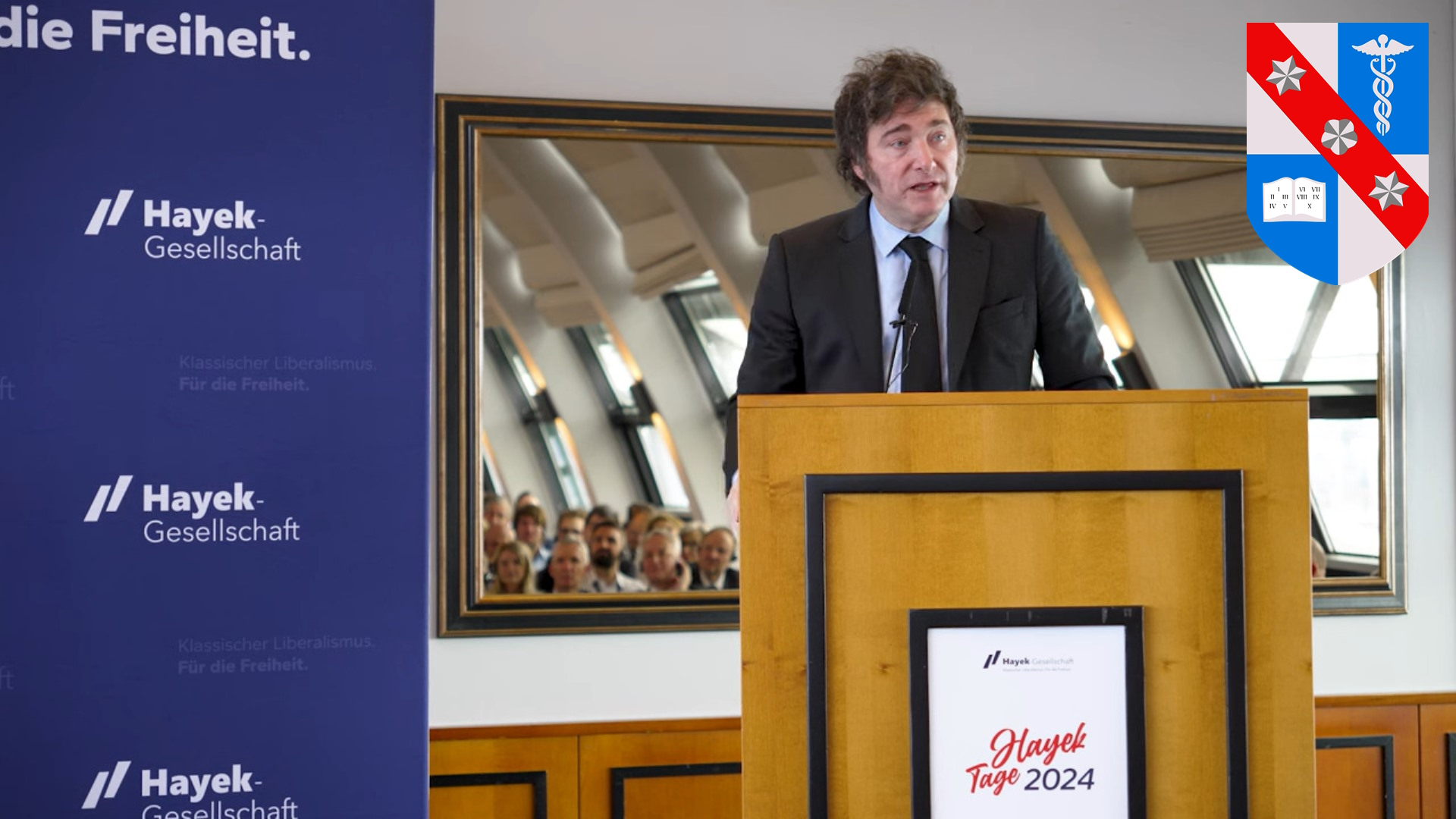
And Milei has been to Germany as well. However, the reason was the awarding of the Hayek medal for him in Hamburg. The state visit with the federal chancellor was merely squeezed in. If you want to see his excellent award speech on his intellectual journey with a German translation, you can do that here.
9. Conclusion
The conclusion is that Milei is enormously successful. He is a fighter on all fronts, and it remains to be hoped that he keeps his high energy and health. With the Ley Bases, he overcame the next big hurdle, and within 6 months, according to him, he has implemented or enabled 5 times as much structural change as every president before him. And he's hardly finished.
In Argentina, the second phase of his presidency is starting. The economy must recover, or else Milei is going to fail politically. He needs to manage to carry not just the poorest in society, but also the heavily battered and, by Western standards, hardly wealthy middle class. As long as that group believes in continued improvements, the Milei model could have an impact that far exceeds Milei's Argentina in time and space, comparable to "Germany's economic miracle" in the post-war.
The signs are good. The economy appears to have reached a floor in April 2024 and is in partial recovery. Especially the production of ores, oil, and natural gas are showing signs of an upswing. The inflation in the food sector reached 0% in June. In the energy sector, there are only a few subsidies remaining to be abolished in a way that affects inflation.
The mostly left-wing journalists and commentators, in their cluelessness with the Milei phenomenon, are currently riding the narrative that a law is hardly the same thing as its implementation. The latter is allegedly going to be difficult and will need a long time to cause politically useful change. Also, Milei is allegedly reliant on the bureaucracy, the bulk of which allegedly consists of his political opponents.
However, this could be a double error. On one hand, not every low level government employee is against Milei. This can be seen among security staff and the military. In addition, Milei obeys the law and accepts existing contracts. That means that the government employees are taking risks when they get perceived as stalling.
But to me, what's much more important is that they are underestimating how little bureaucracy is necessary for the simple abolition of it. An abolished regulation needs no new paperwork. And Milei doesn't want to reform or adjust, but radically cut. One needs to expect that, out of over 140 taxes, 130 will simply be abolished, at least when it comes to funds going to the central government. The "bureaucratic" problem thus isn't related to implementation, but simply internal staff cuts. The political commentators simply have no experience to turn back to when it comes to evaluating how quickly the Ley Bases can be put into effect, other than such obvious cases like the privatization of government enterprises.
The situation remains exciting and I'm sticking with my previous estimation. We're going to witness an "orgy of deregulation" and an abolition of bureaucracy and taxes in Argentina, the likes of which have probably never existed before in a democracy. When has a government ever been doing nothing but shrinking its own power? One also mustn't underestimate Milei when it comes to speed. For his first decree (DNU), he only took 3 days. It wouldn't surprise me if we get to witness a significantly bigger deregulation bill even in July.
And he doesn't have much time. The businessmen at home and abroad need to trust that it happens in order to invest. And, for Milei, there's nothing to gain by stalling. Either the improvement can be felt by the midterm elections in September 2025, in which case he'll gain political power, or he fails in the midterms, in which case the implementation in his coalition administration could become harder and every gain that has been achieved is a long-term victory.
If you are interested in the current developments in Argentina, check out the account @JavierMileiDE on X which has been informing on Milei government developments in the form of an almost-daily diary.
Last edited:


