Link (Archive)
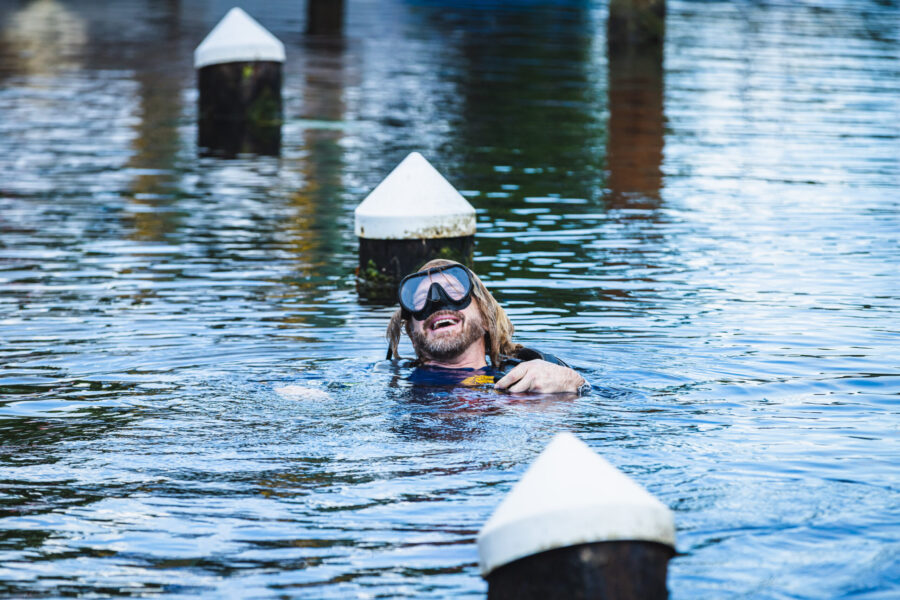
University of South Florida professor Joseph Dituri, or Dr. Deep Sea, has emerged from his underwater habitat over a half-inch shorter and with significantly reduced stress hormone and cholesterol levels.
Those are just a few of the biomedical engineer’s initial physiological changes after spending 100 days – a new world record – living underwater. He began his research mission March 1 to learn more about hyperbaric pressure’s effect on the body.
“It’s the longest dive in the world,” Dituri told the Catalyst. “I remained under pressure the entire time.”
Dituri, 55, resurfaced June 9 from his 100-square-foot home 22 feet below the surface of a Key Largo lagoon. He is currently leading presentations on the benefits of using elevated atmospheric pressure to treat traumatic brain injuries (TBI) and post-traumatic stress disorder (PTSD) at an International Hyperbaric Association conference.
Dituri served as a saturation diving officer in the U.S. Navy for 28 years. He previously noted a preponderance of PTSD and TBI in servicemembers, often due to concussive blasts.
He hopes his latest research mission, Project Neptune 100, will bolster treatments for those diagnoses and other illnesses. A University of Wisconsin study that suggested increased pressure could increase longevity and prevent age-related disease led Dituri to enter uncharted scientific territory.
He expressed excitement for the preliminary results.
“So far, every single inflammatory marker in my body was cut in half,” Dituri said. “The oxidative stress and cortisol – a measure of stress – is down significantly. I mean, it went down from the mid-70s to single digits. It’s crazy.
“My height decreased, whatever; my cholesterol is down by 72 points.”
He said brain coherence has also increased, although it is too soon to call the change statistically significant. Dituri also awaits test results to determine if the trip reversed his aging process.
He explained that hyperbaric pressure could increase telomere length by up to 33%. Those repetitive DNA sequences at the end of chromosomes become so short over time that cells can no longer divide, and subsequently die.
Dituri said increasing telomere length as people age could add 10 to 15 years to average life spans. However, he said, “That information is not back yet.”
There were also some slightly negative impacts.
Dituri measured 73 inches tall when he entered Jules’ Undersea Lodge, and doctors pegged him at just over 72 inches when he emerged. A medical team immediately performed his first round of testing on a Key Largo dock amid a sea of friends, family and strangers who followed his journey.
He also noted the adjustment to life above water, which came at “5,000 miles an hour.”
Dituri explained how he lived in the moment during his 100-day stay below the surface. A meticulously planned daily routine included teaching a USF bioengineering class, providing blood and urine samples, video conferencing with children, conducting research, exploring the surrounding environment and more medical testing.
He did the same things for over three months, obliterating the previous 73-day world record. Dituri then abruptly returned to crowds of people, phones ringing, a media circus and traffic jams.
“It’s just like wow, sensory and information overload,” he added. “Because I was in an isolated, confined, extreme environment, that was a little difficult.”
In addition, Dituri said his feet hurt after wearing shoes and walking around for the first time in 100 days. He also had to acclimate to a plethora of external influences and choices.
Unexpected benefits
Dituri realized that many positive impacts were measurable after his first month underwater. He believes people could receive those same effects through multiple treatments in a hyperbaric chamber – minus the water – in 28 days.
Another mission goal was increasing STEM (science, technology, engineering and math) participation among children. Dituri said he reached over 5,000 kids and, in many cases, their parents.
He noted that an elderly woman approached him on a walk around the neighborhood and told Dituri that his time underwater motivated her to begin a 30-day diet. He also relayed several messages from people who followed his journey and decided to take up diving.
“I had people from India, Africa, Pakistan – this is what happens,” Dituri said. “The world’s oceans connect us together. I made the world smaller through the ocean.”
(Bonus content: video tour of the underwater facilities)
Those are just a few of the biomedical engineer’s initial physiological changes after spending 100 days – a new world record – living underwater. He began his research mission March 1 to learn more about hyperbaric pressure’s effect on the body.
“It’s the longest dive in the world,” Dituri told the Catalyst. “I remained under pressure the entire time.”
Dituri, 55, resurfaced June 9 from his 100-square-foot home 22 feet below the surface of a Key Largo lagoon. He is currently leading presentations on the benefits of using elevated atmospheric pressure to treat traumatic brain injuries (TBI) and post-traumatic stress disorder (PTSD) at an International Hyperbaric Association conference.
Dituri served as a saturation diving officer in the U.S. Navy for 28 years. He previously noted a preponderance of PTSD and TBI in servicemembers, often due to concussive blasts.
He hopes his latest research mission, Project Neptune 100, will bolster treatments for those diagnoses and other illnesses. A University of Wisconsin study that suggested increased pressure could increase longevity and prevent age-related disease led Dituri to enter uncharted scientific territory.
He expressed excitement for the preliminary results.
“So far, every single inflammatory marker in my body was cut in half,” Dituri said. “The oxidative stress and cortisol – a measure of stress – is down significantly. I mean, it went down from the mid-70s to single digits. It’s crazy.
“My height decreased, whatever; my cholesterol is down by 72 points.”
He said brain coherence has also increased, although it is too soon to call the change statistically significant. Dituri also awaits test results to determine if the trip reversed his aging process.
He explained that hyperbaric pressure could increase telomere length by up to 33%. Those repetitive DNA sequences at the end of chromosomes become so short over time that cells can no longer divide, and subsequently die.
Dituri said increasing telomere length as people age could add 10 to 15 years to average life spans. However, he said, “That information is not back yet.”
There were also some slightly negative impacts.
Dituri measured 73 inches tall when he entered Jules’ Undersea Lodge, and doctors pegged him at just over 72 inches when he emerged. A medical team immediately performed his first round of testing on a Key Largo dock amid a sea of friends, family and strangers who followed his journey.
He also noted the adjustment to life above water, which came at “5,000 miles an hour.”
Dituri explained how he lived in the moment during his 100-day stay below the surface. A meticulously planned daily routine included teaching a USF bioengineering class, providing blood and urine samples, video conferencing with children, conducting research, exploring the surrounding environment and more medical testing.
He did the same things for over three months, obliterating the previous 73-day world record. Dituri then abruptly returned to crowds of people, phones ringing, a media circus and traffic jams.
“It’s just like wow, sensory and information overload,” he added. “Because I was in an isolated, confined, extreme environment, that was a little difficult.”
In addition, Dituri said his feet hurt after wearing shoes and walking around for the first time in 100 days. He also had to acclimate to a plethora of external influences and choices.
Unexpected benefits
Dituri realized that many positive impacts were measurable after his first month underwater. He believes people could receive those same effects through multiple treatments in a hyperbaric chamber – minus the water – in 28 days.
Another mission goal was increasing STEM (science, technology, engineering and math) participation among children. Dituri said he reached over 5,000 kids and, in many cases, their parents.
He noted that an elderly woman approached him on a walk around the neighborhood and told Dituri that his time underwater motivated her to begin a 30-day diet. He also relayed several messages from people who followed his journey and decided to take up diving.
“I had people from India, Africa, Pakistan – this is what happens,” Dituri said. “The world’s oceans connect us together. I made the world smaller through the ocean.”
(Bonus content: video tour of the underwater facilities)


