Link (Archive)
August 1, 2021 6:30 AM
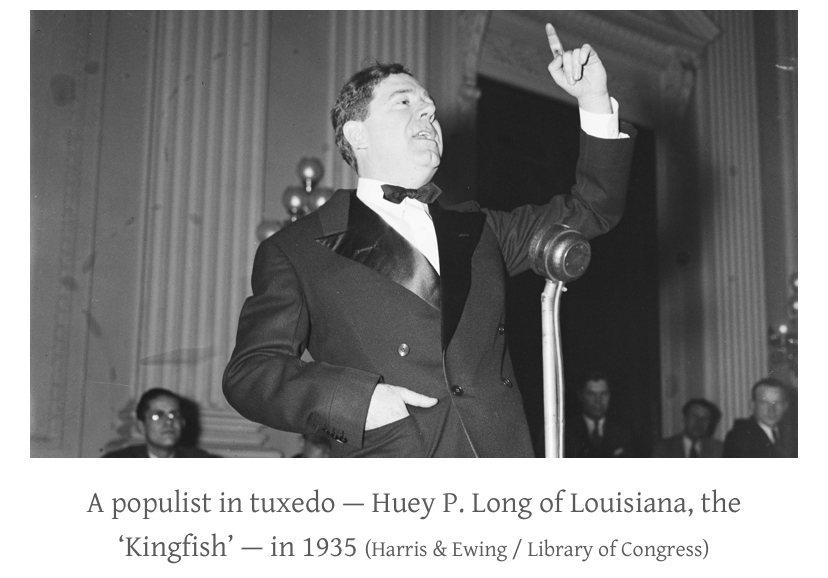
Nearly a century after his death, the Kingfish is making a comeback. Fans of the late Louisiana politician Huey P. Long can be found across the partisan divide, with populist conservatives and socialist Democrats embracing his message of economic equality under the banner of “Every man a king.” These days, he’s even a featured character in Hearts of Iron 4, a computer wargame, and he’s developed a cult following among gamers.
Evidence of Long’s peculiar cultural resurrection can be found on the left in universal-income advocates such as Andrew Yang and avowedly socialist lawmakers such as Bernie Sanders. Just swap out “Share the Wealth” for $1,000 checks and retaliating against Standard Oilfor targeting “millionaires and billionaires,” and the Kingfish lives again.
Among Democrats and the left-wing intelligentsia, that’s to be expected. They crave a return to the era of Long and FDR, a time of big social programs and greater economic parity. (Nearly everyone being poor makes things miserable but equal.) But conservatives tempted by the lure of populism’s nostalgia would do well to choose different heroes to emulate — and reconsider their policies altogether.
In a May column for American Greatness, writer Pedro Gonzales waxed poetic about Long, directing modern-day conservatives to seize his political “blueprint” as their own. The Kingfish, Gonzales claimed, “actually was what Donald Trump only pretended to be” — a successful fighter for the common man. Coming from one of the most Trump-centric outlets on the right, it was an eye-opening assertion.
In his hagiography of Long, Gonzales implies that the politician fought for the working class because his “poor white” upbringing gave him an understanding of human suffering. But, in the true spirit of a good grift, the backstory Long told about himself — and Long apologists still tell today — is a lie. Though on the campaign trail, he led voters to believe that he was raised poor in a log cabin, he was actually born to an affluent family who lived on a sprawling estate in north Louisiana. Throughout an adulthood spent in public life, Long would lament to crowds that he was as poor as they were, even as he lived lavishly on the taxpayer dime, indulging his penchants for extravagant clothes, luxury homes, booze, and fine dining.
Like so many populist politicians, Long rose by grabbing power through corrupt and violent means. Political opponents went missing, and some were nearly killed. Those brave enough to speak against him or his policies saw their families threatened and their livelihoods destroyed. Civil-service positions at every level of the state government were available only to those who vocally backed him, leaving would-be workers with scant political choices during the nation’s worst depression. Those lucky enough to have government jobs watched week after week as percentages of their paychecks were automatically sent to Long’s infamous “deduct box” to fund his political ambitions. When newspapers refused to print Long’s propaganda, he had the legislature establish a state printing board that could deny them “official printer” status, and started his own paper.
Throughout his time in politics, Long clearly saw himself as outside and above the law. He once declared, “I am the Constitution now,” signaling to anyone who dared question him that he was too powerful to be tamed by laws, ethics, or even basic manners. He named himself the state’s chief lawyer, drawing an additional salary for representing Louisiana in court. He appointed cronies to plush taxpayer-funded roles he created, all the while summarily removing anti-Long or Long-agnostic government officials from their posts. He bullied the state legislature, often with loyalty oaths backed by bribes and threats, to pass his desired legislation without even reading or debating it. And on the off chance the legislature wouldn’t approve his building projects, Long would simply order construction to begin, which it then did.
During his tenure as governor, Long practically eliminated local governance, as municipal and parish officials were forced to go to Baton Rouge to beg for financial support for their community projects. He stripped local leaders of most of their authority, with special punishments exacted upon the mayor of New Orleans, whom he deeply resented.
The Kingfish made no secret that he sought total control, often bragging openly about his success in centralizing all of Louisiana’s government under his command. Even after he left the governorship for the U.S. Senate, he still maintained total authority over the state legislature, as he or one of his henchmen would monitor and direct daily activities in the chambers. In his early years in Washington, Long’s national aspirations grew, and he was seen as a formidable opponent to President Roosevelt, eager to push the Democratic Party further left and the country in an even more populist direction. Still, he kept a keen eye on the tyrannical regime he had established back home.
Despite the overwhelming evidence of the evils of Long’s reign, present-day Longites on both the left and right seem all too eager to paint him as merely an eccentric politician from the “good ol’ days.” For them, the lesson of Long’s career is that a ruthless approach to politics can be effective at achieving big things for the little guy. They point to Long’s aggression toward the “ruling class,” even though he was the most pompous and vicious ruler of all, as proof that politicians who champion the cause of the common man will reap great political rewards.
In happier times, most conservatives would find such an instinct repulsive and antithetical to Americans’ belief in justice and fairness under the law. Now, a growing contingent of populists seems to find Long’s tactics worth celebrating and replicating. In American Greatness, Gonzales argued that the Right should “embrace [Long’s] method, his spiritedness, his willingness to fight dirty against corrupt elites who only yelp for civility and constitutionalism when they’re losing.”
Those convinced that Long’s depraved means justified his ends couldn’t be more wrong. Long’s abysmal legacy is that of a tyrant who spent his career bending government to achieve his corrupt aims and grooming generations of populist standard-bearers.
Louisiana is rich in natural resources. It maintains one of the world’s most important ports. It enjoys a vibrant agricultural sector. It has world-class entertainment, wildlife wonders, and a proud, unique history. Yet even today, it ranks at or near the bottom of all states by most quality-of-life metrics.
U.S. News and World Report ranks it last among the 50 states. It grades Louisiana as 46th in health care, 48th in education, 47th in economy, 47th in infrastructure, 48th in opportunity, 42nd in fiscal stability, and 50th in crime and corrections. Louisianans, especially young professionals, are fleeing the state, and a recent study placed it at 44th in the country for outmigration. Nineteen percent of Louisianans languish at or below the poverty line, including 27 percent of children. Violence is out of control. Jobs, even in the state’s traditionally strong chemical-manufacturing and energy sectors, are disappearing.
There are states with far fewer assets that perform far better than Louisiana does. The source of the state’s struggles is a political culture shaped by Huey Long. A 2015 analysis by FiveThirtyEight found that Louisiana remained the most corrupt state in America. Long-era systems that effectively tie the hands of the state legislature and make local-government officials useless are still in place. There are few efforts to diversify the state’s economy, with politicians instead largely focused on picking political winners and losers, and educated Louisianans are leaving the state for better opportunities in Houston, Atlanta, and elsewhere. The glimmering roads and bridges Long erected have long since decayed, and Louisianans are left instead with infrastructure more characteristic of the Third World than the United States.
For all his populist promises, the reality of living under Long was a painful one, and the damage he did to Louisiana has never fully been repaired. During his time in politics, he hurt a lot of people, eroded important civic institutions, and enacted policies that even today leave Louisianans far behind. He also normalized a particularly corrupt, dishonest political template that would be followed to great success by, among others, the recently deceased Edwin Edwards, who served time in federal prison after the last of his record four terms as governor. Long was not merely a caricature of a bygone political era, a tough-talking everyman willing to wield the hammer of justice against the greedy and the cruel. He was a self-serving crook, a career politician whose progressive ideals and policies have stunted his state for nearly a century. Neither he nor his methods are worthy of admiration or replication, especially by conservatives who should have enough ethics and sense to know better.
Huey Long Was Wrong
By ELLEN CARMICHAELAugust 1, 2021 6:30 AM
Nearly a century after his death, the Kingfish is making a comeback. Fans of the late Louisiana politician Huey P. Long can be found across the partisan divide, with populist conservatives and socialist Democrats embracing his message of economic equality under the banner of “Every man a king.” These days, he’s even a featured character in Hearts of Iron 4, a computer wargame, and he’s developed a cult following among gamers.
Evidence of Long’s peculiar cultural resurrection can be found on the left in universal-income advocates such as Andrew Yang and avowedly socialist lawmakers such as Bernie Sanders. Just swap out “Share the Wealth” for $1,000 checks and retaliating against Standard Oilfor targeting “millionaires and billionaires,” and the Kingfish lives again.
Among Democrats and the left-wing intelligentsia, that’s to be expected. They crave a return to the era of Long and FDR, a time of big social programs and greater economic parity. (Nearly everyone being poor makes things miserable but equal.) But conservatives tempted by the lure of populism’s nostalgia would do well to choose different heroes to emulate — and reconsider their policies altogether.
In a May column for American Greatness, writer Pedro Gonzales waxed poetic about Long, directing modern-day conservatives to seize his political “blueprint” as their own. The Kingfish, Gonzales claimed, “actually was what Donald Trump only pretended to be” — a successful fighter for the common man. Coming from one of the most Trump-centric outlets on the right, it was an eye-opening assertion.
In his hagiography of Long, Gonzales implies that the politician fought for the working class because his “poor white” upbringing gave him an understanding of human suffering. But, in the true spirit of a good grift, the backstory Long told about himself — and Long apologists still tell today — is a lie. Though on the campaign trail, he led voters to believe that he was raised poor in a log cabin, he was actually born to an affluent family who lived on a sprawling estate in north Louisiana. Throughout an adulthood spent in public life, Long would lament to crowds that he was as poor as they were, even as he lived lavishly on the taxpayer dime, indulging his penchants for extravagant clothes, luxury homes, booze, and fine dining.
Like so many populist politicians, Long rose by grabbing power through corrupt and violent means. Political opponents went missing, and some were nearly killed. Those brave enough to speak against him or his policies saw their families threatened and their livelihoods destroyed. Civil-service positions at every level of the state government were available only to those who vocally backed him, leaving would-be workers with scant political choices during the nation’s worst depression. Those lucky enough to have government jobs watched week after week as percentages of their paychecks were automatically sent to Long’s infamous “deduct box” to fund his political ambitions. When newspapers refused to print Long’s propaganda, he had the legislature establish a state printing board that could deny them “official printer” status, and started his own paper.
Throughout his time in politics, Long clearly saw himself as outside and above the law. He once declared, “I am the Constitution now,” signaling to anyone who dared question him that he was too powerful to be tamed by laws, ethics, or even basic manners. He named himself the state’s chief lawyer, drawing an additional salary for representing Louisiana in court. He appointed cronies to plush taxpayer-funded roles he created, all the while summarily removing anti-Long or Long-agnostic government officials from their posts. He bullied the state legislature, often with loyalty oaths backed by bribes and threats, to pass his desired legislation without even reading or debating it. And on the off chance the legislature wouldn’t approve his building projects, Long would simply order construction to begin, which it then did.
During his tenure as governor, Long practically eliminated local governance, as municipal and parish officials were forced to go to Baton Rouge to beg for financial support for their community projects. He stripped local leaders of most of their authority, with special punishments exacted upon the mayor of New Orleans, whom he deeply resented.
The Kingfish made no secret that he sought total control, often bragging openly about his success in centralizing all of Louisiana’s government under his command. Even after he left the governorship for the U.S. Senate, he still maintained total authority over the state legislature, as he or one of his henchmen would monitor and direct daily activities in the chambers. In his early years in Washington, Long’s national aspirations grew, and he was seen as a formidable opponent to President Roosevelt, eager to push the Democratic Party further left and the country in an even more populist direction. Still, he kept a keen eye on the tyrannical regime he had established back home.
Despite the overwhelming evidence of the evils of Long’s reign, present-day Longites on both the left and right seem all too eager to paint him as merely an eccentric politician from the “good ol’ days.” For them, the lesson of Long’s career is that a ruthless approach to politics can be effective at achieving big things for the little guy. They point to Long’s aggression toward the “ruling class,” even though he was the most pompous and vicious ruler of all, as proof that politicians who champion the cause of the common man will reap great political rewards.
In happier times, most conservatives would find such an instinct repulsive and antithetical to Americans’ belief in justice and fairness under the law. Now, a growing contingent of populists seems to find Long’s tactics worth celebrating and replicating. In American Greatness, Gonzales argued that the Right should “embrace [Long’s] method, his spiritedness, his willingness to fight dirty against corrupt elites who only yelp for civility and constitutionalism when they’re losing.”
Those convinced that Long’s depraved means justified his ends couldn’t be more wrong. Long’s abysmal legacy is that of a tyrant who spent his career bending government to achieve his corrupt aims and grooming generations of populist standard-bearers.
Louisiana is rich in natural resources. It maintains one of the world’s most important ports. It enjoys a vibrant agricultural sector. It has world-class entertainment, wildlife wonders, and a proud, unique history. Yet even today, it ranks at or near the bottom of all states by most quality-of-life metrics.
U.S. News and World Report ranks it last among the 50 states. It grades Louisiana as 46th in health care, 48th in education, 47th in economy, 47th in infrastructure, 48th in opportunity, 42nd in fiscal stability, and 50th in crime and corrections. Louisianans, especially young professionals, are fleeing the state, and a recent study placed it at 44th in the country for outmigration. Nineteen percent of Louisianans languish at or below the poverty line, including 27 percent of children. Violence is out of control. Jobs, even in the state’s traditionally strong chemical-manufacturing and energy sectors, are disappearing.
There are states with far fewer assets that perform far better than Louisiana does. The source of the state’s struggles is a political culture shaped by Huey Long. A 2015 analysis by FiveThirtyEight found that Louisiana remained the most corrupt state in America. Long-era systems that effectively tie the hands of the state legislature and make local-government officials useless are still in place. There are few efforts to diversify the state’s economy, with politicians instead largely focused on picking political winners and losers, and educated Louisianans are leaving the state for better opportunities in Houston, Atlanta, and elsewhere. The glimmering roads and bridges Long erected have long since decayed, and Louisianans are left instead with infrastructure more characteristic of the Third World than the United States.
For all his populist promises, the reality of living under Long was a painful one, and the damage he did to Louisiana has never fully been repaired. During his time in politics, he hurt a lot of people, eroded important civic institutions, and enacted policies that even today leave Louisianans far behind. He also normalized a particularly corrupt, dishonest political template that would be followed to great success by, among others, the recently deceased Edwin Edwards, who served time in federal prison after the last of his record four terms as governor. Long was not merely a caricature of a bygone political era, a tough-talking everyman willing to wield the hammer of justice against the greedy and the cruel. He was a self-serving crook, a career politician whose progressive ideals and policies have stunted his state for nearly a century. Neither he nor his methods are worthy of admiration or replication, especially by conservatives who should have enough ethics and sense to know better.


 , just another Hitler!
