By Craig Whitlock, Lisa Rein and Caitlin Gilbert
October 6, 2025 at 5:00 a.m. EDT

(Illustration by Deena So'Oteh/For The Washington Post)
Military veterans are swamping the U.S. government with dubious disability claims — including cases of brazen fraud totaling tens of millions of dollars — that are exploiting the country’s sacred commitment to compensate those harmed in the line of duty, according to a Washington Post investigation.
Taxpayers will spend roughly $193 billion this year for the Department of Veterans Affairs to compensate about 6.9 million disabled veterans on the presumption that their ability to work is impaired. VA officials say most veterans’ disability claims are legitimate.
Yet The Post found that millions of the claims are for minor or treatable afflictions that rarely hinder employment, such as hair loss, jock itch and toenail
fungus. (The federal budget for fiscal year 2025, which ended Sept. 30, projected that VA would spend $193 billion on disability compensation. The Trump administration has requested $220 billion from Congress for fiscal 2026.)
About 556,000 veterans receive disability benefits for eczema, 332,000 for hemorrhoids, 110,000 for benign skin growths, 81,000 for acne and 74,000 for varicose veins, the most recently available figures from VA show. Individual payouts for such mundane conditions vary, but collectively they cost billions of dollars a year. (The figures for eczema and hemorrhoids are from fiscal year 2024. The statistics for skin growths, acne and varicose veins are from fiscal 2023, the most recent year that VA has made data available for these conditions.)
In contrast, far fewer veterans receive compensation for certain combat-related injuries. About 10,900 service members who have suffered “severe” or “penetrating” brain injuries since 2000 are eligible for benefits. Fewer than 1,700 receive disability payments for losing limbs during the wars in Afghanistan and Iraq.
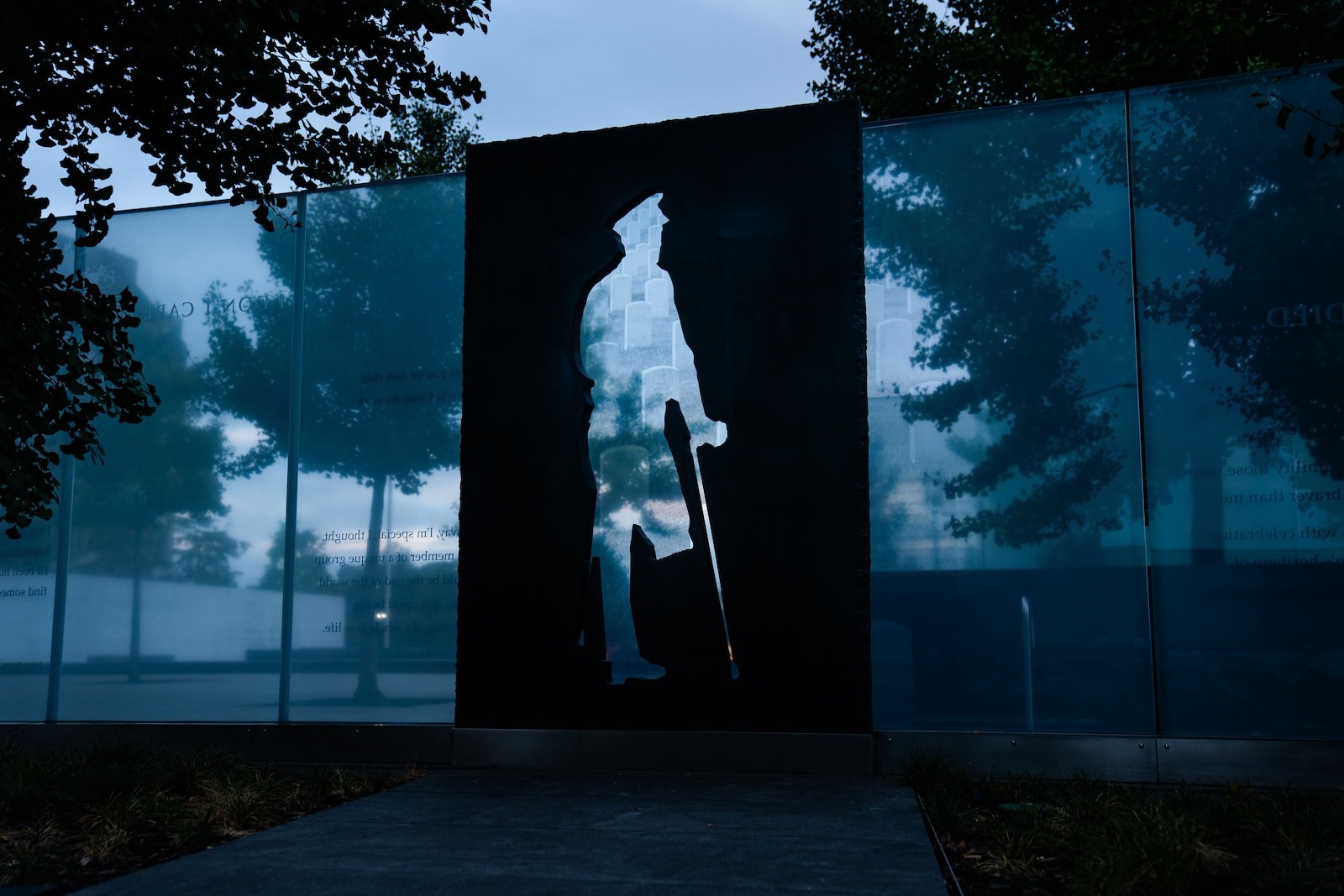
A silhouette sculpture at the American Veterans Disabled for Life Memorial, near the National Mall in D.C., pays tribute to the sacrifices made by service members. (Demetrius Freeman/The Washington Post)
The Post analyzed 25 years of government data on disability claims and sued VA and the Justice Department under the Freedom of Information Act, forcing the agencies to disclose thousands of pages of internal records and dozens of surveillance videos. The Post also interviewed scores of current and former U.S. officials and visited military bases around the country to speak with veterans. (The Post filed its FOIA lawsuit against the Department of Veterans Affairs in September 2024 and later added the Executive Office for U.S. Attorneys as a defendant. Read the amended legal complaint.)
The investigation exposed an increasingly costly disability program prone to rampant exaggeration and fraud, which make it harder for veterans with legitimate claims to get their benefits processed. Bipartisan political indifference and a weak array of checks and balances have compounded the dysfunction.
Veterans’ advocates, for-profit companies and VA itself encourage vets to file as many claims as possible to milk the system. The documents and data obtained by The Post spotlighted other obvious signs of waste and abuse, as well as an internal awareness and tolerance of such problems.
How The Post investigated VA’s disability benefits program
The Post analyzed 25 years of government data on disability claims and sued VA and the Justice Department under the Freedom of Information Act.
(Video by Joy Sung/The Washington Post; Cover art by CJ Riculan/For The Washington Post)
Critically, VA has failed to update antiquated rules that provide outsize benefits for some easily manageable ailments. For instance, VA typically pays veterans diagnosed with sleep apnea, a common breathing disorder, more than a combat vet with a leg amputated below the knee. (Disability ratings for sleep apnea vary, depending on the severity of the condition. But veterans who need to use a continuous positive airway pressure (CPAP) machine generally receive a 50 percent rating. Those with a leg amputated below the knee generally are rated as 40 percent disabled.)
The easy-to-manipulate regulations have turned the disability program into a rich target for con artists, who are typically prosecuted only in the most egregious and flagrant cases.
Last year, a grand jury indicted an Army veteran on charges of conspiring to defraud the government of $1.1 million by pretending to be paralyzed. According to prosecutors, she spent some of the money on Caribbean vacations and gambling jaunts to Las Vegas. She has pleaded not guilty. In June, a Vietnam War veteran pleaded guilty to ripping off VA by claiming to be blind for 29 years. In fact, he could see well enough to drive and repeatedly renewed his license. The Justice Department said he defrauded taxpayers of nearly $1.2
million. (The attorney for the Vietnam veteran who pretended to be blind, Paul Lesslie Thompson, has filed court papers arguing that the total loss to VA was only $281,000. He did not respond to emails seeking comment. Thompson is scheduled to be sentenced Oct. 23.)
In August, a peripatetic former soldier from Walla Walla, Washington, was arrested on charges of swindling VA of $244,000 by professing to be paraplegic even though he was agile enough to hunt elk and get into fistfights that drew the police. When VA officials began investigating, he vanished in a canoe and faked that he died by drowning in the North Woods of Maine, authorities said. After a year of searching, a fugitive task force finally nabbed him at an Amtrak station in Missouri. (The former soldier, Gregory P. Heimann Jr., has not yet entered a plea in the case, federal court records show. His attorney did not respond to a request for comment. Read the affidavit and criminal complaint filed by a special agent from VA’s Office of Inspector General.)
A Post review of 70 fraud prosecutions since 2017 shows VA regularly falls victim to half-baked schemes. In three cases, men who never served a day in uniform fooled the department into thinking they were disabled war heroes; two of them also lied that they were held captive by the enemy, records show.
Since retaking office in January, President Donald Trump has sought to slash spending and root out fraud across the government, dismantling entire agencies in the process. But the White House has promised not to curtail veterans’ benefits, and the U.S. DOGE Service has largely spared VA from the deep cuts it has imposed elsewhere.
Disability payments to veterans are tax-free and typically last for life. Last year, disabled vets received $25,046 on average, VA figures show. The money comes on top of free or subsidized medical care provided by VA.
Under the law, disabilities must be connected to military service to qualify for compensation but do not need to arise from combat. Military work can be hazardous outside a war zone, with many troops injured during training.
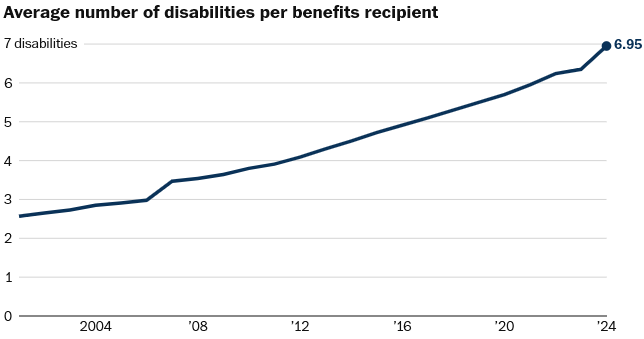
Veterans can — and increasingly do — file claims for multiple ailments. Last year, each disabled veteran received, on average, benefits for a combination of about seven injuries and illnesses, up from 2.5 per person in 2001. The Post found that it has become common for veterans to submit claims for 20 or more disabilities each.
Over the past quarter-century, veterans have flooded VA with an escalating number of claims. In 2001, veterans received benefits for a total of nearly 6 million disabilities. By last year, that figure had risen to 41.7 million, a sevenfold increase.
VA officials and independent analysts note that injuries and wounds from the grinding wars in Afghanistan and Iraq, as well as other overseas military operations, have contributed to the torrent of claims.

Army soldiers watch as trash burns in a pit near a base in Afghanistan in 2012. A 2022 law, the Pact Act, makes it easier for veterans to claim benefits based on exposure to airborne toxic substances in war zones. (Lorenzo Tugnoli/For The Washington Post)
Thanks to advances in triage care, more troops survive serious combat wounds that would have been fatal in the past. In addition, with high suicide rates among those who have served in uniform, VA and the Defense Department have placed greater emphasis on mental health, encouraging vets to seek care for depression and post-traumatic stress.
Against that backdrop, presidents and lawmakers from both parties have committed to spending whatever is necessary to compensate disabled veterans, acknowledging that they made extraordinary sacrifices that can never be adequately repaid.
The Post presented VA officials with a detailed summary of this story and a list of questions, which they declined to answer. (The Post also sought an interview with VA Secretary Douglas A. Collins. VA officials did not respond to the request.)
Instead, VA press secretary Pete Kasperowicz provided a statement. “The extraordinarily liberal Washington Post never met a government program it didn’t love — until now,” he wrote. “Unbelievably, the far-left Washington Post believes many Veterans don’t deserve the VA benefits they’ve earned.
“Our message to the out-of-touch liberal activists peddling this garbage story is simple: America’s Veterans earned their VA benefits, and it should be easier — not harder — to get them. Under President Trump, we are improving VA so it’s faster and more convenient for Veterans to get what our nation owes them.”

The current disability program was designed 80 years ago to provide a safety net for unemployable veterans wounded or injured during World War II. Today, the vast majority of disabled veterans under age 65 still work and collect paychecks from full-time jobs, records show.
According to the most recent available figures from the Bureau of Labor Statistics, the unemployment rate for disabled veterans last year was 4.1 percent, about the same as the population at large. In 2023, more than 100,000 disabled veterans — roughly 1 in 60 — reported an income of $250,000 or higher, according to a Post analysis of VA and census data. (According to this analysis of U.S. Census Bureau microdata from IPUMS USA, the number of veterans making more than $250,000 who received a 70 percent disability rating or higher increased by over 400 percent between 2012 and 2023. This was the highest increase across income brackets. Bureau of Labor Statistics data also shows that the overall unemployment rate for individuals with disabilities was 7.5 percent, nearly double that of veterans with disabilities.)
Other public disability programs help only people who certify that they are incapacitated or severely impaired in their ability to work. The Social Security Administration, which provides disability aid to more than 15 million people, limits benefits to those who cannot hold a job or are unable to earn more than $19,440 a year.
The Post’s investigation found that Congress and VA have made it easier to cheat and take advantage of the system.
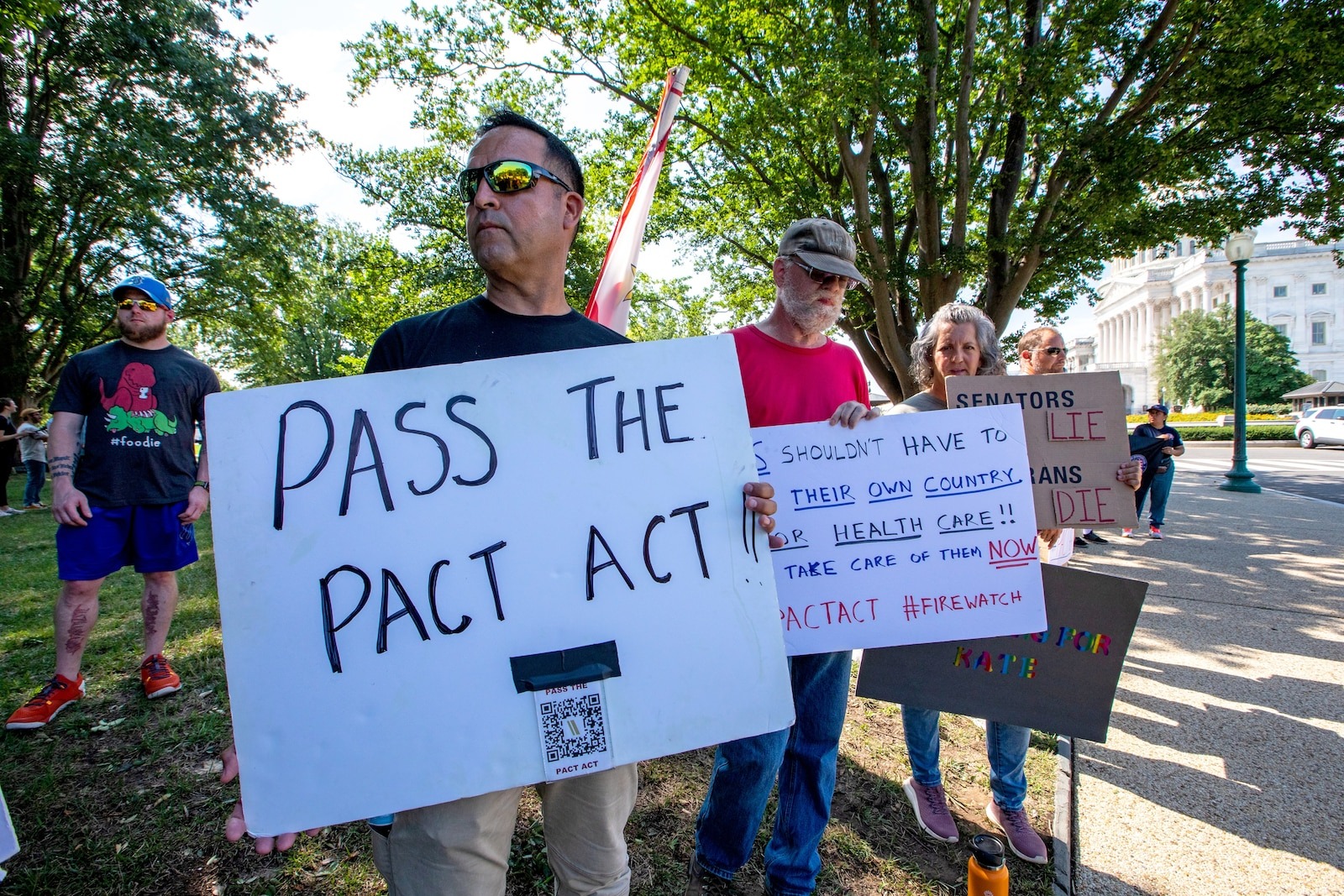
Supporters of the Pact Act demonstrate outside the Capitol in 2022, calling on lawmakers to pass the legislation to expand disability benefits for veterans. (Yasin Ozturk/Anadolu Agency/Getty Images)
Since 2001, under public pressure to improve care for veterans, lawmakers from both parties have approved a succession of bills lowering the standard of proof for disability claims. The biggest came in 2022, when Congress passed legislation known as the Pact Act, which made it simpler for generations of veterans to assert that their ailments were caused by exposure to airborne toxic substances and other environmental hazards while serving in war zones.
The Pact Act has helped many veterans receive compensation for cancer and other serious illnesses diagnosed years or even decades after they left the military, by presuming the conditions are connected to their service. But the law also has led to the approval of a skyrocketing number of claims for treatable respiratory and digestive conditions.

The number of veterans receiving benefits for disabilities such as tinnitus and post-traumatic stress disorder has grown exponentially since 2001.
Claims for ailments such as irritable bowel syndrome and hay fever have also jumped in recent years.
Last year, for instance, 680,834 veterans were categorized as disabled for allergic rhinitis, or hay fever, VA figures show. That’s up from 30,705 in 2006 — a 22-fold increase. Payouts for allergic rhinitis can range between $176 and $750 a month.
Claims for irritable bowel syndrome have also soared; since 2013, approved cases have risen 400 percent. Cases of hiatal hernia, a condition that causes heartburn and acid reflux, have increased tenfold since 2005.
For many of the most common disabilities, including migraines, depression and back pain, there is no conclusive way to determine whether a veteran is telling the truth about the severity of their symptoms. Under federal law, VA must give a veteran the benefit of the doubt and approve their claim when evidence is evenly split.
“My belief is that this is a flawed system. Many of these conditions are hard to measure,” said David Shulkin, a physician who served as VA secretary for 14 months during the first Trump administration and as undersecretary of health for nearly two years under President Barack Obama. “The vast majority of veterans are trying to follow the rules, but the process leads to ambiguity and concern.”
Authorities have known for years that some veterans who don’t genuinely need help are gaming the disability program, according to documents and interviews.
“One inherent problem [VA] must contend with, is that it operates on an honor system with its veterans,” Justice Department prosecutors wrote in a 2021 court filing for a case involving an Army veteran who defrauded VA of more than $200,000. “… The result is that some veterans can, and unfortunately some veterans do take advantage.” (The agency “will always err on the side of the veteran because it’s historical mission and purpose is to reintroduce the veteran into society after having served our country and make that veteran whole again,” prosecutors added. Read the court filing.)
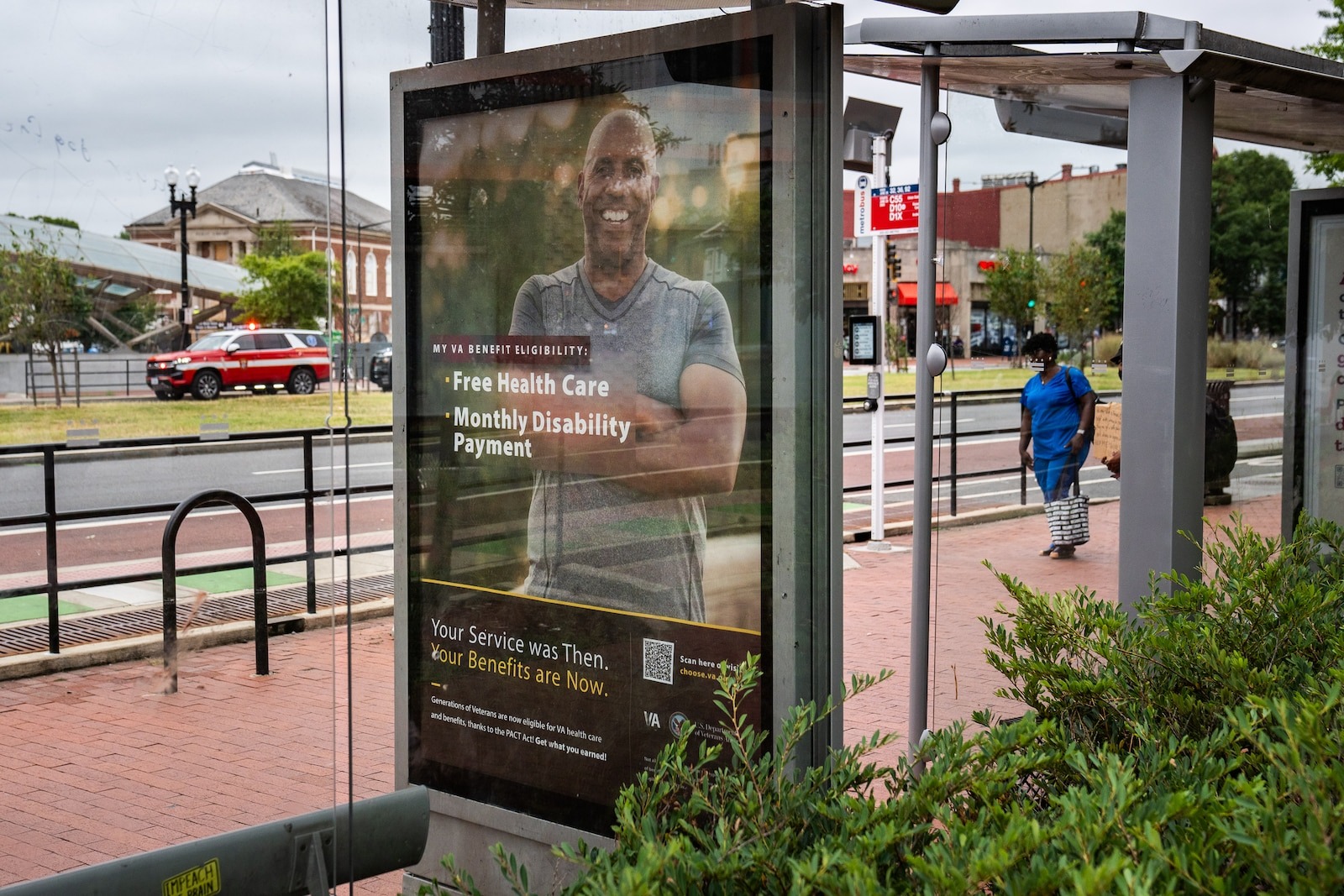
A sign at a bus stop in the Capitol Hill neighborhood of D.C. encourages veterans to apply for disability benefits. (Demetrius Freeman/The Washington Post)
Alex Morrow, an Army vet from Colorado Springs who hosts a popular physical fitness podcast, acknowledged that it is “extremely common” for veterans to stretch the truth when applying for disability. He blamed the system for creating incentives to exaggerate.
“Many veterans see those checks as validation of their service and the sacrifice they made,” he told The Post. “They are sitting at a table and at that table is a stash of cash. I’m not going to tell them not to claim it. It shouldn’t be a crime to claim something.”
Embellished and bogus claims are clogging the system and making it harder for veterans with bona fide injuries to get the help they deserve, according to judges and prosecutors who have handled fraud cases. For the past two decades, VA has been overwhelmed by a persistent backlog of applications. As of Sept. 27, VA reported it was processing nearly 635,000 claims, of which 134,000 had been pending for more than four months.
“There is already a backlog in the system, and … [it] can be notorious to get your legitimate claims through,” Coreen Mao, a federal prosecutor, said during the 2022 sentencing of an Army veteran in Maryland who cheated VA out of $370,000 by faking memory loss and paralysis.
“Committing fraud on the program makes it harder for all of the other veterans … to get the services that they need in a timely manner.” (“And, of course, it can work to undermine public confidence in … the important work that the VA does,” Mao added. Read the court transcript.)
Since 9/11 and the wars that followed, however, the pendulum has swung the other way.
During the Biden administration, VA went to new lengths to make it as easy as possible for veterans to obtain disability compensation and other benefits. Across the country, the department blanketed buses and billboards with ads encouraging vets to apply. It hosted temporary clinics at conventions and sporting events where vets could walk in, file claims and get same-day approval.
Agency leaders embraced an unofficial slogan to emphasize how keen they were to grant requests, saying they would do everything in their power to “get to yes.” Internal tracking reports charted record jumps in authorized claims.
Joshua Jacobs, who served as VA undersecretary for benefits for two years under President Joe Biden, told The Post it was important for the agency to bend over backward to help veterans given its past failings. He denied that VA had opened the door to a wave of fraudulent or specious claims, saying that, if anything, more disabled vets deserve compensation.
“We have a duty to assist. So unlike other federal programs, the goal here is not to be adversarial,” Jacobs said. “The thing that keeps me up at night is not that we’re being too generous. It’s that we’re not meeting enough veterans, we’re not delivering the benefits that they’ve earned.”
The $193 billion that VA will spend this year on disability compensation is about $8 billion more than what it costs to run the entire Army. Adjusted for inflation, that is more than six times what VA spent on the disability program in 2001.
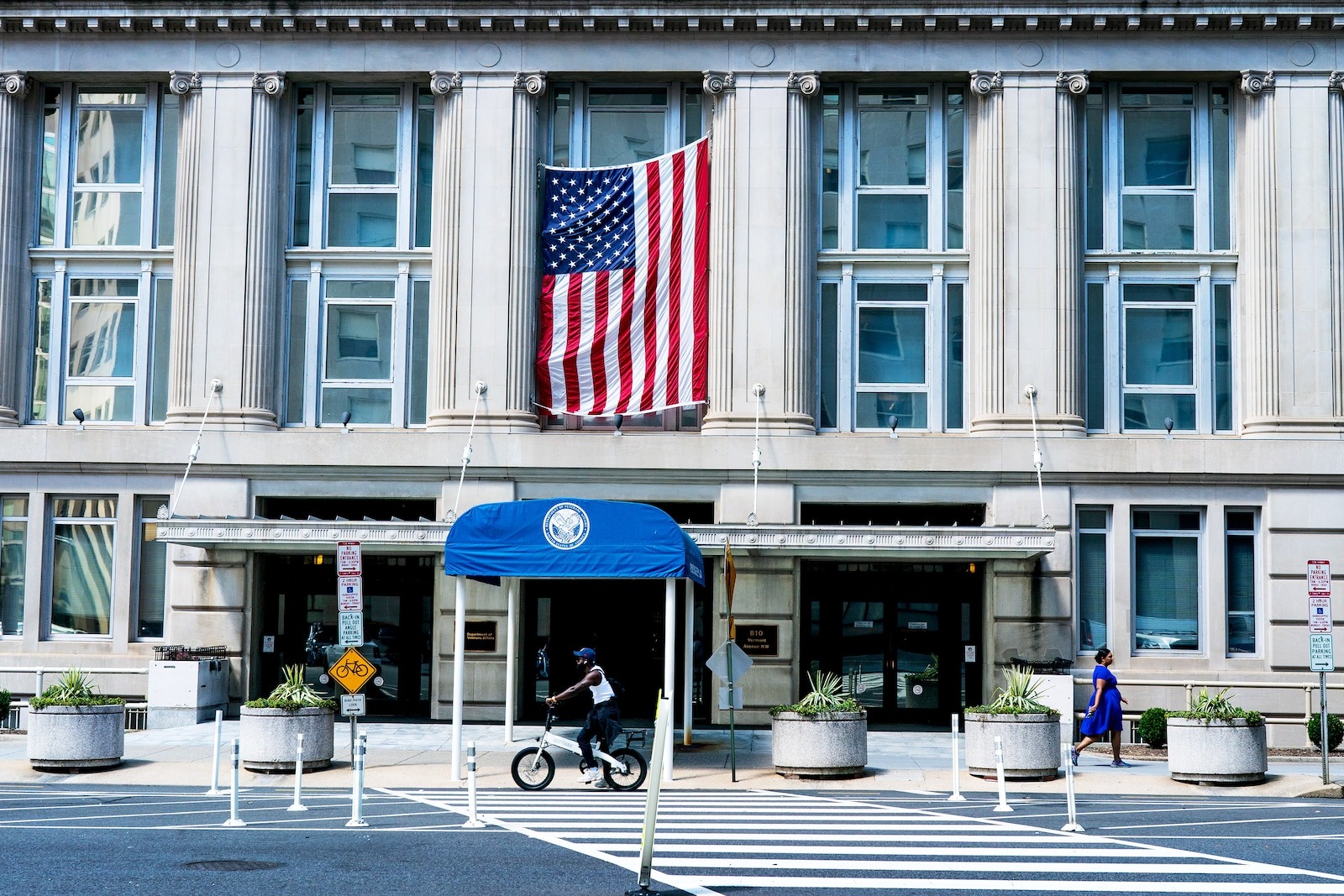
VA headquarters in D.C. (Demetrius Freeman/The Washington Post)
Proposals to curtail disability benefits rarely get far in Washington because veterans groups wield enormous political clout. In March, the Trump administration drew up plans to cut the Veterans Affairs workforce by 15 percent, or about 83,000 employees, describing the department’s overhead costs as bloated.
Though VA Secretary Douglas A. Collins promised to leave disability and health care benefits intact, the proposal generated a backlash among advocacy groups and bipartisan criticism in Congress. By July, Collins abandoned the proposal and said VA would try to eliminate 30,000 jobs instead, mostly through attrition and early retirement.
In interviews, several former claims processors and health care providers said that VA leaders have ignored systemic waste and fraud in the disability program since the George W. Bush administration because they fear the political consequences that would result if they scrutinized claims more closely.
“If you’re a politician and you go against veterans and say we shouldn’t be funding them as much, you’re pretty much committing political suicide,” said Shea Wilkes, an Army veteran who is a clinical social worker at the VA hospital in Shreveport, Louisiana.
Vince Hancock, who worked as a disability ratings specialist for VA for 12 years before retiring in 2022, said processors faced constant pressure to approve questionable claims.
“Our job was not to look for the truth, to figure out what’s true about the claim, but to grant what we could,” he said. “Honestly, I granted some that I personally didn’t believe.”
Paul Mitchell, a Navy veteran from Greenville, South Carolina, who worked for the agency as a claims processor for 13 years until he retired in 2019, said he was “really gung ho” about his job at first because he wanted to help others who had served their country. But he became disillusioned by those trying to bilk the system.
Some vets, he said, improbably claimed up to 75 disabilities. “At some point it seemed like it really was just a game,” he added. “The veterans would say, ‘The government is handing out money; get in line.’”
In some cases that led to criminal prosecution, veterans faked their injuries with a melodramatic flair.
Zachary Barton, a former Army medic from Florida, conned the government into giving him $245,000 to which he was not entitled between 2017 and 2021, court records show. When he went to VA appointments, he parked in a spot reserved for disabled people and hobbled inside with a cane. Smelly and unbathed, he wore a diaper and a T-shirt that read “Not All Heroes Wear Capes.” (Using FOIA, The Post obtained the VA inspector general’s investigation into Barton. Read some of the documents.)
A relatively young man in his 30s, Barton claimed to suffer from a long list of ailments: urinary incontinence, post-traumatic stress disorder (PTSD), depression, erectile dysfunction, spinal degenerative disease and a neurological disorder that caused one side of his face to droop. He said he could barely lift 10 pounds.
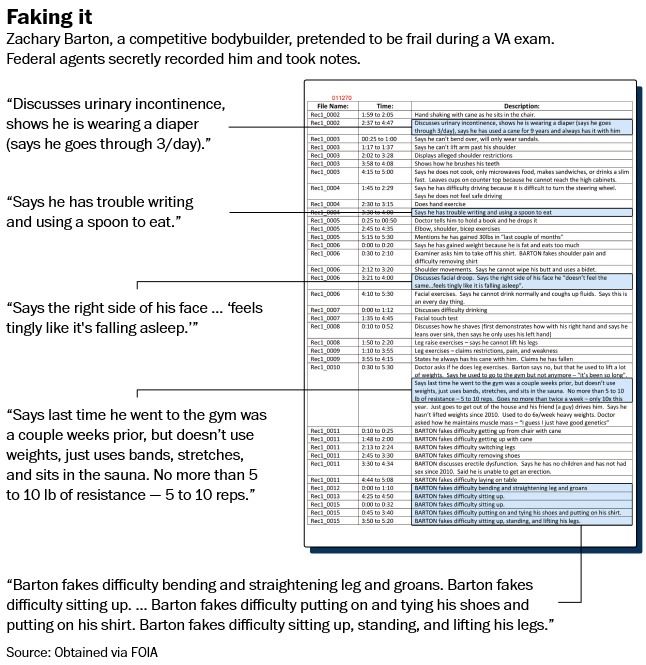
When a VA staffer remarked that Barton actually looked pretty strong — in reality, he was a competitive bodybuilder on steroids with a scant 4 percent body fat — the Iraq War veteran replied that he had “good genetics.”
The scam worked until an anonymous whistleblower tipped off VA in 2019. Federal investigators searched online and found Barton bragging on Facebook and Instagram under the name “Zach Ryan” about being a weightlifting champion. Undercover agents placed him under surveillance and followed him to two gyms.
They observed him doing 650-pound leg presses, a dozen reps at a time. (Federal agents conducted surveillance on Barton while he worked out at two gyms in Colorado Springs. Read their reports.)
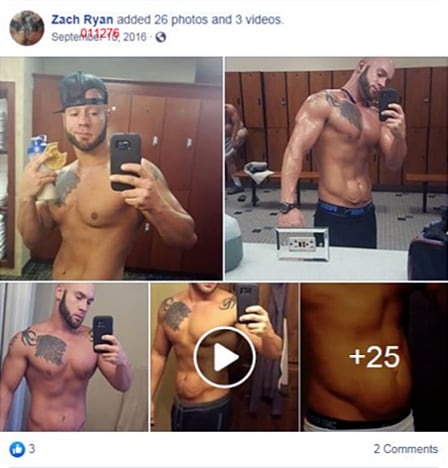
Social media photos contained in documents from the VA inspector general’s office show former Army medic Zachary Barton flexing for the camera. (Obtained by The Washington Post)
When investigators later knocked on Barton’s door to question him, he clung to his routine of feebleness at first, insisting that the most exercise he got was from playing video games on the couch.
Confronted with evidence to the contrary, the former medic eventually confessed to inventing his disabilities and fabricating stories about serving in combat. He admitted to investigators that he had “gamed the system” and that it “got out of control,” calling himself “selfish” and “a shitbag.” (Read investigators’ notes from their interview of Barton.)
Barton pleaded guilty to theft of government property and was sentenced to a year in prison and ordered to repay the government $245,000. His attorney, Daniel Forman, told The Post that Barton’s conviction “scared him straight” and that he has revamped his life. “This was probably the best thing that ever happened to him,” Forman said.
On paper, there are more severely disabled veterans than ever.
More than 1.5 million veterans held a 100 percent rating last year, double the figure from 2019 and nearly nine times as many as in 2001. Each received, on average, $49,645 in disability compensation. (According to data from the Veterans Benefits Administration, the 100 percent rating became the most common rating in 2021 and is now awarded nearly twice as often as the next most common rating (10 percent).)
Veterans categorized as 100 percent disabled often still hold normal, full-time jobs. Most have an assortment of ailments — such as arthritis, diabetes, scars or a deviated septum — that by themselves are not incapacitating but that add up to a 100 percent rating under VA rules.
Lawmakers have approved a host of extra benefits for veterans who are 100 percent disabled, tacitly encouraging former service members to claim multiple ailments and inflate their rating.
In addition to receiving free medical care and prescription drugs from VA, those permanently rated as 100 percent disabled pay nothing for dental treatment and don’t have to repay federal student loans. Their spouses and children also get free health care and up to $60,000 each for college or trade school.
In many states, 100 percent disabled vets are entitled to numerous other perks, including free license plates, complimentary hunting and fishing permits, and property tax deductions.
Disabled veterans of all ratings also benefit from hiring preferences, especially when applying for federal jobs. About 2 percent of U.S. adults are disabled vets, but they account for about 16 percent of the federal civilian workforce. (Overall, veterans (disabled and nondisabled) accounted for 28 percent of the federal workforce during fiscal year 2023, the most recent data available, according to a July 2025 report from the Office of Personnel Management.)

To qualify for disability compensation, veterans must show that their illness or injury is connected to their military service. In most cases, medical records documenting that they were treated for the condition while in uniform, or within a year of leaving the armed forces, are required.
In recent years, however, Congress and VA have relaxed requirements for some common conditions. For PTSD, veterans do not need to demonstrate that they received medical care while in the service; notes from a current therapist or “buddy letters” from military colleagues can be enough to support a claim. (Veterans receive “presumptive,” or streamlined, approval for PTSD claims if they can verify they served in combat.)
Significantly, veterans do not need to prove that military duty caused their sickness or injury, only that it occurred or worsened while they were in the service. Lingering health problems from off-duty accidents — a kitchen mishap, even a bar fight — can be eligible for disability compensation.
Daniel Gade, a retired Army lieutenant colonel and Iraq combat veteran who is the co-author of the 2021 book “Wounding Warriors: How Bad Policy Is Making Veterans Sicker and Poorer,” cited the case of a soldier who received disability benefits for a brain injury suffered while driving drunk. “It undermines the integrity of the system,” Gade, who also has served as commissioner of the Virginia Department of Veterans Services, said in an interview.
The average disability rating has climbed steadily over the years in part because VA rules allow veterans to appeal decisions they disagree with — again and again and again.
Veterans whose claims are initially denied can seek more favorable rulings from regional VA offices, the Board of Veterans’ Appeals and the U.S. Court of Appeals for Veterans Claims. Most veterans who appeal receive free representation from VA-certified attorneys.
In recent years, VA has made it easier for veterans to appeal claims rejected by regional offices and to submit additional evidence. Social media influencers and for-profit claims advisers have also become more visible online in encouraging vets to file appeals, repeatedly if necessary.
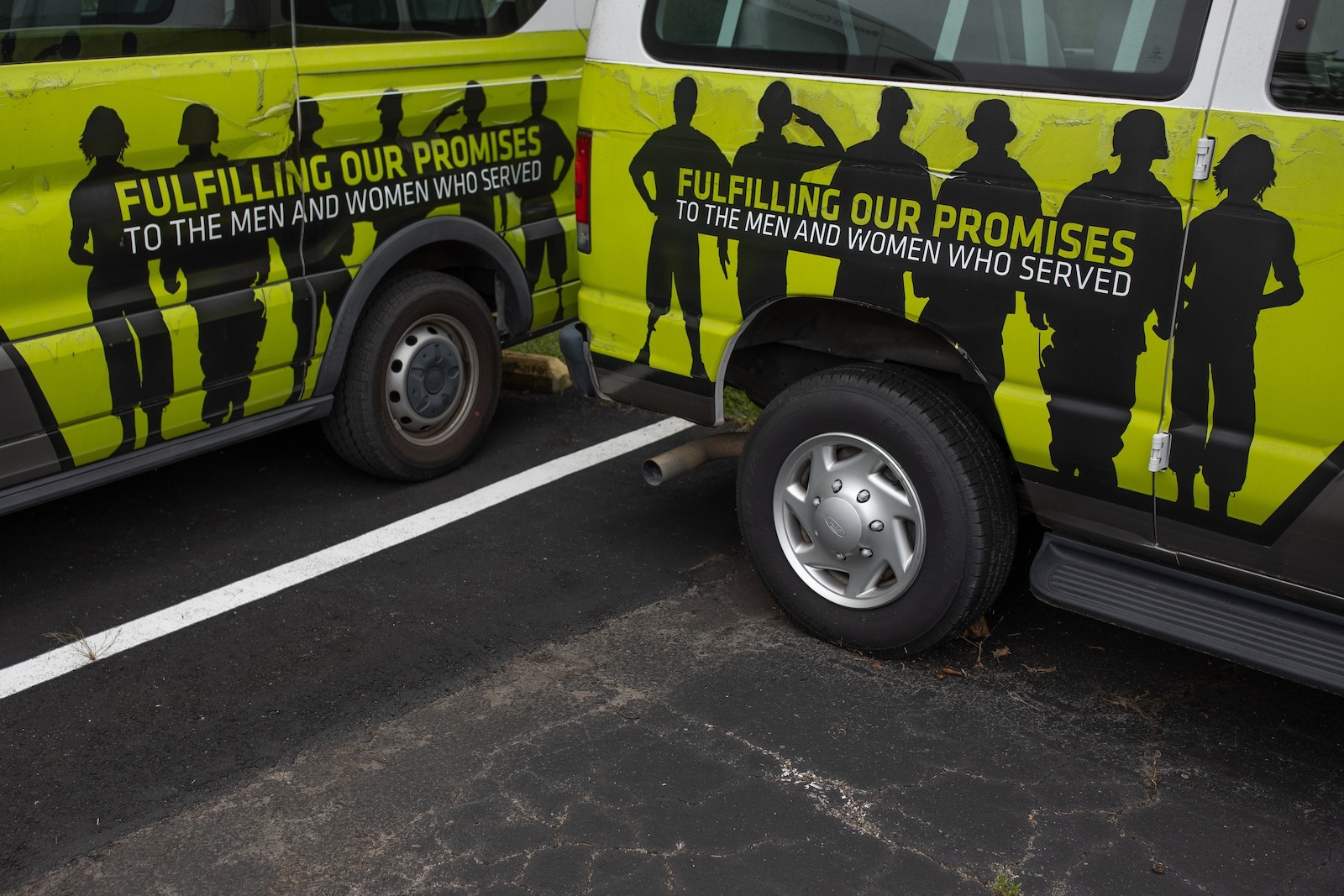
Vehicles parked outside the offices of Disabled American Veterans near Camp Lejeune in North Carolina. The nonprofit group transports veterans to VA facilities. (Madeline Gray/For The Washington Post)
A review of the docket for the Board of Veterans’ Appeals, which decides tens of thousands of cases annually, shows that all sorts of claims can pay off in the end.
One veteran appealed VA’s denial of his claim for depression, arguing that his mood disorder had been triggered by several other disabilities, including cases of hemorrhoids, genital herpes and genital warts that he had contracted two decades earlier while on active duty.
At a hearing, the veteran complained that he was in “constant pain” because of those conditions, as well as a gouty right foot, and that his depression was exacerbated by his previously granted claims for erectile dysfunction, sleep apnea and PTSD, documents show.
The board was sympathetic. In a 2023 ruling, it determined that his chronic pain and other issues were “likely the cause of his depressive disorder” and that he was entitled to more money, along with the undisclosed amount he already had been receiving for the rest of his problems. (Read the Board of Veterans’ Appeals ruling in the case.)
In another case, a Marine Corps veteran won a decision from the board last year that granted him a 30 percent disability rating for a case of genital and oral herpes he contracted when he was in the service more than a decade earlier.
The board ruled that he also deserved compensation for major depressive disorder, in part because he reported witnessing the “violent death” of another Marine while stationed in the United States. He also alleged that other service members had injured him during hazing incidents.
The veteran said he had been further traumatized by “fear of enemy action” while serving on a ship in the Middle East because his vessel had been fired upon but he was not allowed to return fire. (Read the Board of Veterans’ Appeals ruling in the case.)
Since then, VA and Congress have taken some steps to modernize the standards, but many regulations remain outdated and inconsistent.
Sleep apnea, a breathing disorder, wasn’t identified in medical literature until mid-century. Today, sleep apnea can be treated effectively by wearing a breathing mask at night. Most people with the condition have no trouble holding a job.
Yet VA, clinging to decades-old rules, considers most veterans who are prescribed a sleep apnea mask to be 50 percent disabled. That rate entitles them to $1,102 per month in tax-free payments, more if they have dependents.
Sleep apnea is now one of VA’s most frequently claimed disabilities. Last year, 659,335 vets received compensation for it. That’s about 11 times the number who did in 2009, VA figures show.
In comparison, VA generally considers combat veterans who had their legs amputated below the knee to be 40 percent disabled. At that rate, they receive $774 per month, more with dependents.
Some disabled veterans told The Post they are baffled by what VA pays them.
Carol Ramsey, a 78-year-old Air Force veteran and physician from Colorado, said she receives about $34,000 a year in compensation for her 90 percent disability rating, mostly because she had a hysterectomy while on active duty to address a medical condition.
She said that she never considered herself disabled and that her hysterectomy didn’t affect her ability to earn a living. “I wasn’t going to put in for it,” she added, explaining that a veterans service organization advised her to submit the claim. “But it would have been foolish of me to turn down the benefit.” Still, Ramsey said she thinks it’s unfair that combat-wounded veterans receive less than her: “Nobody ever shot at me.”
Michael Spinelli, an Air Force veteran from Pennsylvania who processed disability claims for VA for 26 years, said the department just “wants to give, give, give.” He criticized the VA rating schedule for “making a mockery of the ones who really do deserve it” by failing to distinguish between combat veterans “with body parts missing” and those “who never saw a bullet.”
“There’s some ridiculous stuff that’s got nothing to do with military service, where family [medical] history is more likely to be the issue,” added Spinelli, who left his VA job in 2019.
In 1989, the Government Accountability Office (GAO), a research arm of Congress, found that 19 percent of disabled veterans were being compensated for “ordinary diseases of life.” A study by GAO doctors “found no evidence that any aspect of military service caused or aggravated these diseases,” a category that included hemorrhoids, arteriosclerotic heart disease, multiple sclerosis, Crohn’s disease and uterine fibroids.
The study, however, led to no legislative changes, and the issues persisted. In 2018, the nonpartisan Congressional Budget Office calculated that VA could save $33 billion over a decade by ending disability payments for seven of the “ordinary” diseases the GAO had flagged almost 30 years earlier.
Instead of cutting back, lawmakers and VA have expanded eligibility for some everyday afflictions. For instance, the 2022 Pact Act made it far easier for veterans to claim compensation for hypertensive vascular disease, which can be a consequence of unmanaged high blood pressure.
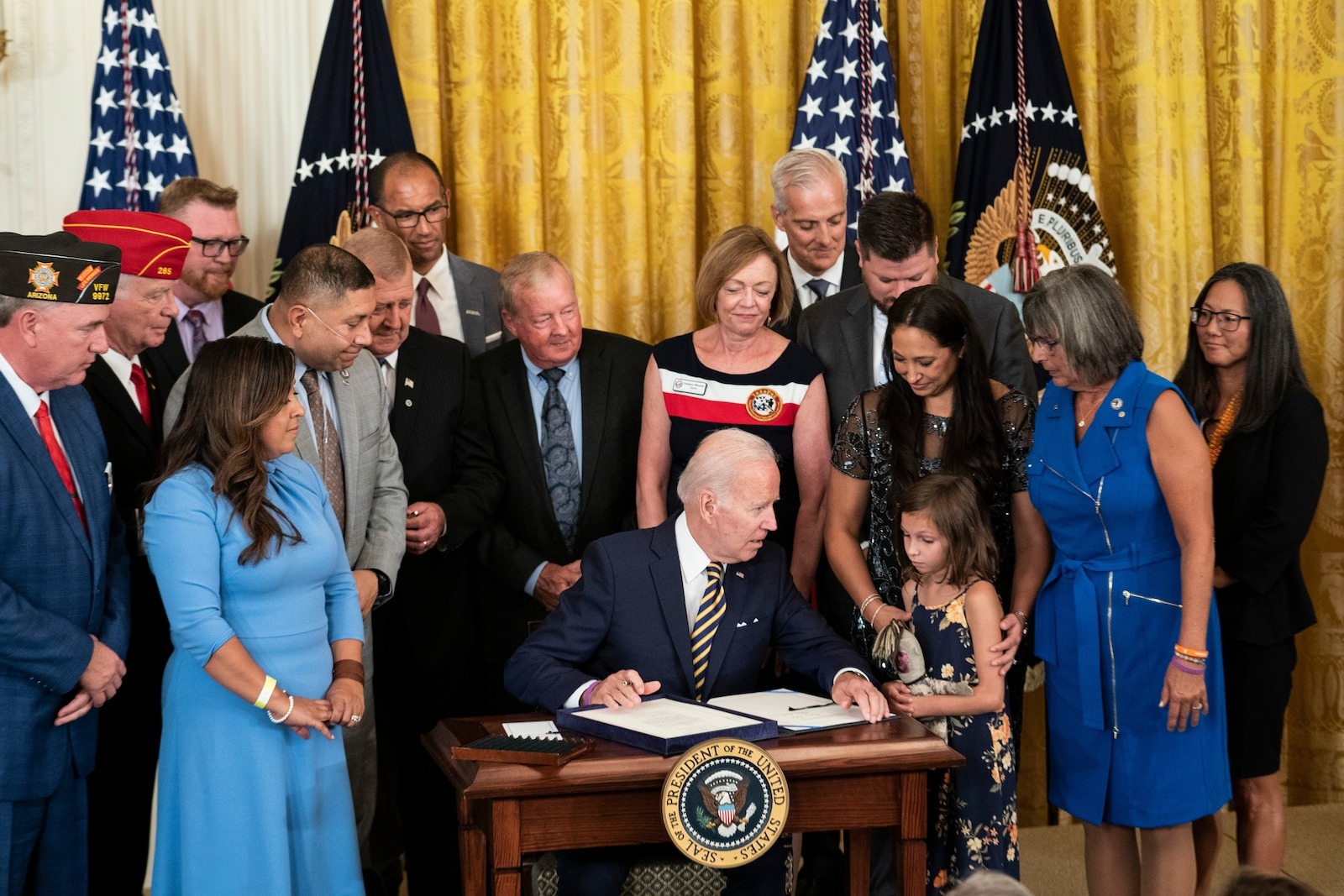
President Joe Biden signs the Pact Act at the White House in 2022. (Sarah Silbiger/For The Washington Post)
By 2024, more than 750,000 veterans with hypertensive vascular disease had their claims approved, a 61 percent increase in two years. Disability ratings for the condition range between 10 and 60 percent, depending on the severity of the symptoms.
Gade, the retired Army officer and author, called the Pact Act “a disaster” for enabling such claims: “Old men get high blood pressure. Old fat men get it worse.” He said veterans deserve medical care from VA for the condition but not disability payments.
“The system allows people to blame the government for the vicissitudes of regular life,” added Gade, who received two Purple Heart medals for combat wounds he suffered in Iraq, including the loss of his right leg.
He and other VA critics noted that some frequently claimed disabilities are easy to fake because there’s no reliable way to measure the severity of symptoms with objective medical tests.
Since 2001, for example, the number of veterans receiving compensation for migraines has multiplied by a factor of 23, from 47,000 to 1.1 million today.
The most-claimed disability by far is tinnitus, or ringing in the ears, another condition that is difficult to confirm with certainty. Last year, nearly 3.3 million veterans — more than half of those on disability — received benefits for it. By itself, tinnitus carries a 10 percent rating, which pays $176 a month, more with dependents.
Many veterans legitimately suffer from hearing loss; repeated exposure to gunfire and loud noises comes with the territory in the armed forces.
Yet, since 2001, the number of approved tinnitus claims has increased more than 20-fold, up from 162,000 cases. The spike has in part been driven by a thriving industry of paid consultants, sometimes called claims sharks. Many advertise their services in flashy online videos, sharing tips to inflate payouts for conditions that are difficult to disprove.
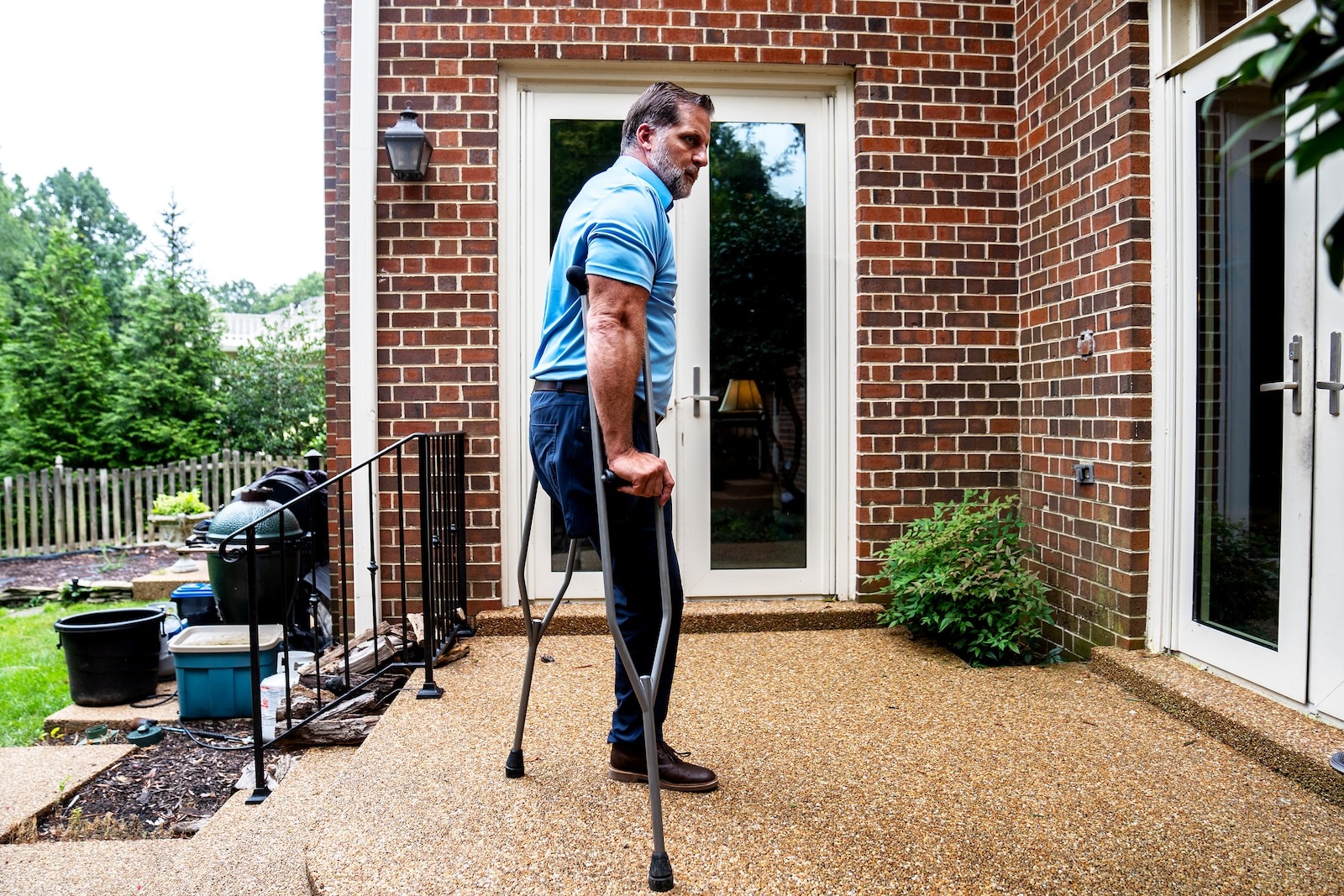
Daniel Gade, a retired Army officer who lost a leg in Iraq. (Demetrius Freeman/The Washington Post)
“A Tinnitus VA Rating Is A GOLD MINE & Here’s Why (No Proof!)” exclaims the title on a YouTube video posted last year by VA Claims Academy, a consulting firm. The video received 300,000 views in seven months.
Another ailment in the hard-to-disprove category: erectile dysfunction.
In 2024, 1 in every 10 disabled vets — 595,589 of them — held an approved claim for “penile deformity” with a “loss of erectile power,” VA figures show.
Erectile dysfunction is a common side effect for those with depression or PTSD, not to mention troops who suffered groin injuries. Since 2007, claims have shot up 611 percent.
For years, veterans who had it were granted a 20 percent disability rating. After studying the issue, however, VA changed its rules in 2021.
Now, in most cases, erectile dysfunction no longer counts toward a veteran’s disability rating. Instead, sufferers receive a special $136-per-month supplement for what VA calls “loss of a creative organ.”
Veterans say it’s common knowledge that VA approves the claim more or less automatically.
“It’s easy money,” said Scott Carow, a former Army physical therapist who treated patients at Fort Bliss in Texas. “It comes down to nothing more than your word. There’s nobody there in the bedroom with you.”
The primary responsibility for investigating fraud falls to its inspector general’s office, an independent watchdog with its own division of sworn law enforcement agents.
The office gets flooded with reports of fraud, waste and abuse at VA; last year, its hotline fielded more than 30,000 tips and complaints.
Yet the odds of getting nabbed are infinitesimal. Since 2020, the inspector general has opened an average of 63 investigations each year into suspected disability fraud — a tiny fraction of the more than 2 million claims that VA processes annually. It refers about 48 cases each year to prosecutors.
“Investigations, as far as I can tell, are pretty rare and criminal prosecutions are even rarer, in part because it’s very difficult to discover this fraud,” William Griesbach, a federal judge in Wisconsin, said in 2017 when he sentenced an Army vet to prison for defrauding VA of more than $200,000. “The government doesn’t have resources to chase after everybody.”
Agents generally only launch disability fraud investigations if they think they can obtain clear-cut, indisputable evidence — such as surveillance video — that someone has faked their condition, according to the inspector general’s office.
Crystel Riedling, a former Army sergeant from Lake City, Florida, was collecting more than $4,000 a month in compensation for the complete loss of the use of her right arm, anxiety and other ailments until a whistleblower contacted VA and reported that she was lying about the seriousness of her disabilities.
Federal agents placed Riedling, then 41, under surveillance and soon caught her on video with her adult daughter at Walt Disney World in Florida, using her arm normally. When the agents questioned her, she admitted that she had exaggerated her arm problems to get a 100 percent disability rating. “I know that this is completely wrong,” she wrote in a sworn statement.
Still, Riedling argued that she felt entitled to the money because of her stellar Army career, which included what she described as a soldier-of-the-year award when she was stationed at Fort Hood in Texas.
“I have letters of recommendation out the ying yang because I was good at what I did,” she said, according to a transcript of her interview. “… This is going to sound pretty shitty, but I guess to take that away from me I felt like I earned this.”
Prosecutors said she defrauded the government of nearly $300,000. A jury convicted her of theft of public money and making false statements. She was sentenced to six months of home detention. (Riedling did not respond to emails and texts from The Post seeking further comment.)
Daniel Kososki, an Army veteran from Wisconsin, received $150,000 for fraudulent disability claims after he said that paralyzing anxiety, blurry vision, and injuries to his head, back and leg from a 1980s car accident had transformed him into an anxious, depressed recluse who was unable to work.
In fact, he owned and ran a Costa Rican beach bar called Coconutz, where Facebook photos showed him lifting kegs over his head and performing motorcycle stunts. “Beer, bikes and boobs!!!” he enthused in one post.
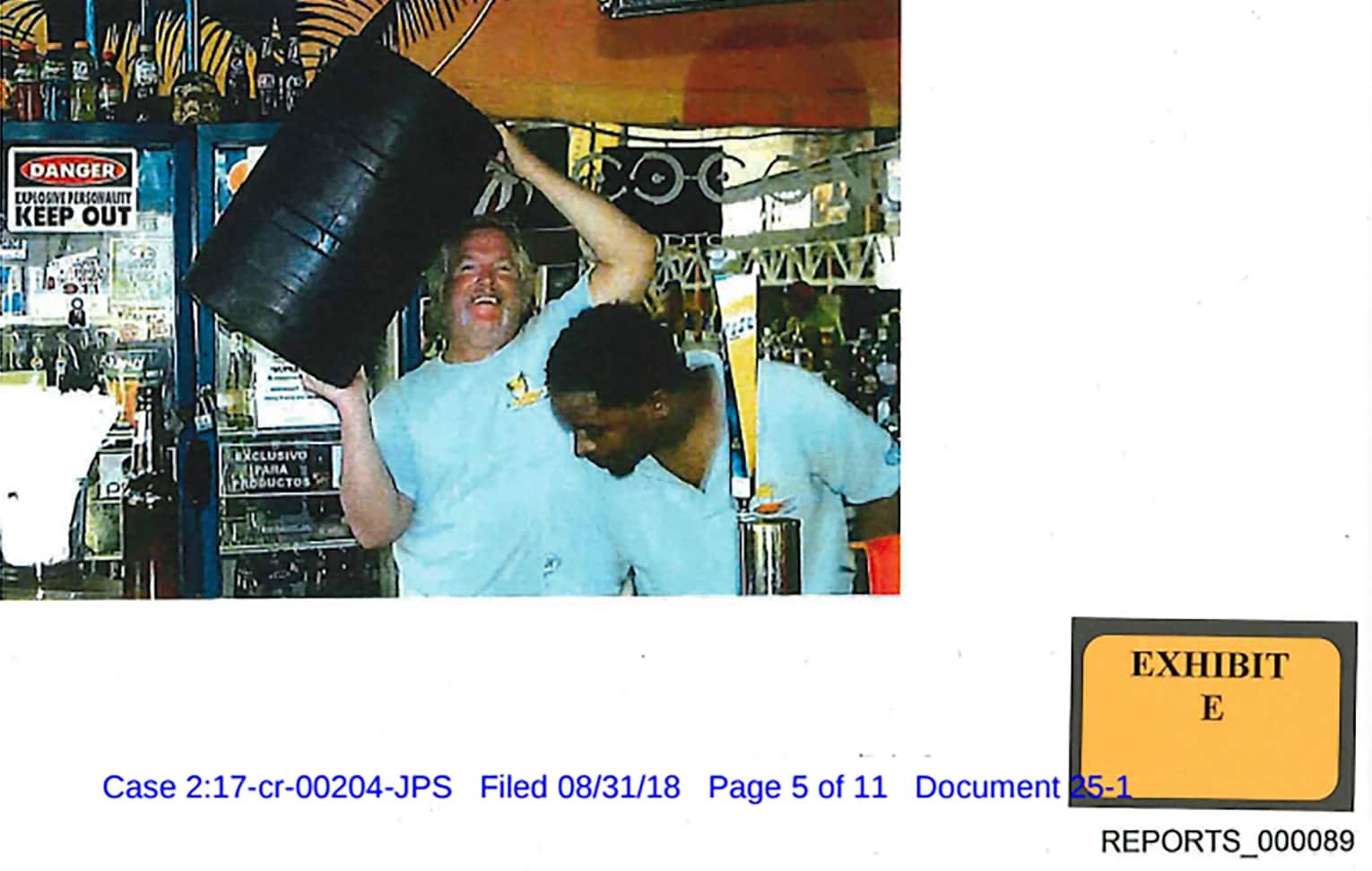
A social media photo that the Justice Department submitted in court documents shows Army veteran Daniel Kososki lifting a keg at his beach bar in Costa Rica. (Obtained by The Washington Post)
Confronted with his social media history, Kososki pleaded guilty to fraud in 2018 — 12 years after he first claimed he was unable to work. At his sentencing hearing, he argued that VA had foisted the money on him.
“I didn’t want it. I didn’t ask for it. They gave it to me. They said I could not deny it,” he said. The judge took a dim view and sent him to prison for a year. (“I know I have to be responsible for my actions. I just don’t understand it,” Kososki added when he was sentenced. Read the court transcript. He did not respond to emails from The Post seeking further comment.)
In some corners of VA, it’s an open secret that the disability program is easy to plunder. Court documents show the agency has been hit by a rash of inside jobs.
Anthony Medrano, a Marine veteran from Southern California, received $183,000 in disability benefits after he claimed he was homebound and needed a full-time caregiver. As a condition of receiving the extra assistance, Medrano had to certify repeatedly that he was unemployed.
In fact, Medrano continued to work the whole time — for VA. As a veteran service representative, he advised fellow vets how to apply for benefits. He also coached youth sports and posted Facebook videos of himself doing push-ups with a child on his back. (Using FOIA, The Post obtained the VA inspector general’s investigation into Medrano. Read some of the documents.)
It took five years for VA to discover Medrano was one of its own employees and not as frail as he pretended to be. In 2021, he pleaded guilty to fraud and was sentenced to eight months in prison. In a court filing, an attorney for Medrano called his actions “the worst mistake of his life.” (Medrano did not respond to an interview request from The Post placed through his attorney. Read his plea agreement with prosecutors.)
In Arkansas, a federal jury convicted another VA service representative of using his insider knowledge to defraud the agency of about $25,000. Darold Maxfield Sr., an Army veteran, was sentenced to five months in prison for forging his medical records so he could receive a 100 percent disability rating. (The Post reviewed court exhibits and transcripts from Maxfield Sr.’s 2023 trial. Read the transcript from his sentencing. His appellate attorney did not respond to requests for comment.)
His son got busted for a similar ruse. Darold Maxfield Jr., who also served in the Army before going to work for VA, pleaded guilty to defrauding the government of $91,000 after investigators discovered that he, too, had forged a doctor’s report so he could get a higher disability rating. (Using FOIA, The Post obtained the VA inspector general’s investigation into Maxfield Jr. Read some of the documents.)
In that case, Maxfield Jr. falsely claimed he had PTSD, fabricating a story about witnessing the gruesome death of a cadet at the U.S. Military Academy at West Point. “I’d just like to say that I’m deeply regretful and remorseful,” he told the judge. He got four months in prison. (Maxfield Jr. did not respond to an interview request from The Post placed through his attorney. Read the court transcript from his sentencing hearing.)
Other VA employees have been charged with running kickback schemes from within the agency.
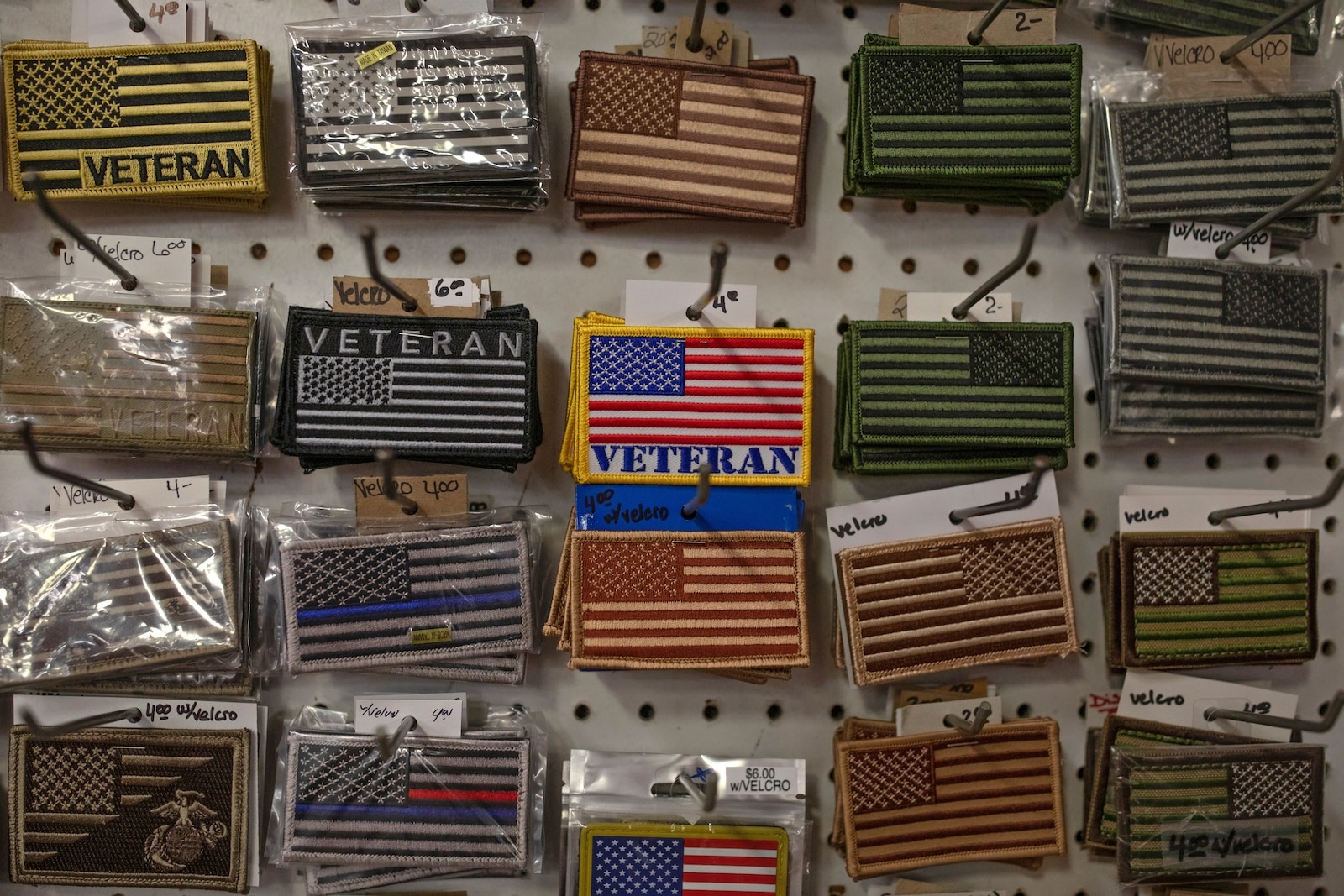
Commemorative patches at a Saigon Sam’s Military Surplus store near Camp Lejeune. (Madeline Gray/For The Washington Post)
In May, a federal grand jury indicted Ángel Carrer Rivera, a VA supervisor in Puerto Rico, on charges of leading a conspiracy to approve fraudulent disability claims for veterans in exchange for cash. Nine other defendants who do not work for VA were also charged. All have pleaded not guilty. (Carrer’s attorney did not respond to emails from The Post seeking comment. Read the indictment.)
As veterans flood the system with dubious and false claims, it has given rise to another type of fraud in which VA employees solicit bribes to help people skip the backlog.
In July, for example, Michael Darrah, 47, a veterans service representative in Providence, Rhode Island, pleaded guilty to pocketing nearly $30,000 to expedite claims for veterans whose disability cases were legitimate but had languished for months.
Darrah, a former cop who had been fired from a Massachusetts police department for extorting drivers during traffic stops, offered to “grease the wheels” to deliver benefits if veterans or family members would pay him up-front through cash apps or with gift cards, court records show.
In one instance, Darrah shook down an old Army buddy for $3,385 to submit a disability claim on his behalf. In text messages, the friend complained as Darrah kept asking him for more money but reluctantly agreed to make the payments via Venmo. (Darrah’s attorney did not respond to emails from The Post seeking comment. His sentencing is scheduled for December. Read the indictment.)
The app asked for a subject line for the payment. The friend wrote: “crooked shit.”
Have a tip about VA’s disability benefits program? You can securely contact Post reporters on Signal: Caitlin Gilbert at caitlingilbert.24, Craig Whitlock at craigwhitlock.99 and Lisa Rein at 202-821-3120.
About this story
Reporting by Craig Whitlock, Lisa Rein and Caitlin Gilbert. Additional reporting by Nate Jones. Design and development by Agnes Lee and Allison Mann. Design editing by Betty Chavarria and Junne Joaquin Alcantara. Video editing by Joy Sung. Photo editing by Max Becherer. Graphics editing by Eric Lau. Editing by Lisa Gartner, David Fallis, Meghan Hoyer and Wendy Galietta. Additional editing by Kim Chapman. Additional support from Jordan Melendrez Dowd, Chris George, Whitney Leaming, Steven Rich and KC Schaper.
Source (Archive)
October 6, 2025 at 5:00 a.m. EDT
(Illustration by Deena So'Oteh/For The Washington Post)
Military veterans are swamping the U.S. government with dubious disability claims — including cases of brazen fraud totaling tens of millions of dollars — that are exploiting the country’s sacred commitment to compensate those harmed in the line of duty, according to a Washington Post investigation.
Taxpayers will spend roughly $193 billion this year for the Department of Veterans Affairs to compensate about 6.9 million disabled veterans on the presumption that their ability to work is impaired. VA officials say most veterans’ disability claims are legitimate.
Yet The Post found that millions of the claims are for minor or treatable afflictions that rarely hinder employment, such as hair loss, jock itch and toenail
fungus. (The federal budget for fiscal year 2025, which ended Sept. 30, projected that VA would spend $193 billion on disability compensation. The Trump administration has requested $220 billion from Congress for fiscal 2026.)
About 556,000 veterans receive disability benefits for eczema, 332,000 for hemorrhoids, 110,000 for benign skin growths, 81,000 for acne and 74,000 for varicose veins, the most recently available figures from VA show. Individual payouts for such mundane conditions vary, but collectively they cost billions of dollars a year. (The figures for eczema and hemorrhoids are from fiscal year 2024. The statistics for skin growths, acne and varicose veins are from fiscal 2023, the most recent year that VA has made data available for these conditions.)
In contrast, far fewer veterans receive compensation for certain combat-related injuries. About 10,900 service members who have suffered “severe” or “penetrating” brain injuries since 2000 are eligible for benefits. Fewer than 1,700 receive disability payments for losing limbs during the wars in Afghanistan and Iraq.
A silhouette sculpture at the American Veterans Disabled for Life Memorial, near the National Mall in D.C., pays tribute to the sacrifices made by service members. (Demetrius Freeman/The Washington Post)
The Post analyzed 25 years of government data on disability claims and sued VA and the Justice Department under the Freedom of Information Act, forcing the agencies to disclose thousands of pages of internal records and dozens of surveillance videos. The Post also interviewed scores of current and former U.S. officials and visited military bases around the country to speak with veterans. (The Post filed its FOIA lawsuit against the Department of Veterans Affairs in September 2024 and later added the Executive Office for U.S. Attorneys as a defendant. Read the amended legal complaint.)
The investigation exposed an increasingly costly disability program prone to rampant exaggeration and fraud, which make it harder for veterans with legitimate claims to get their benefits processed. Bipartisan political indifference and a weak array of checks and balances have compounded the dysfunction.
Veterans’ advocates, for-profit companies and VA itself encourage vets to file as many claims as possible to milk the system. The documents and data obtained by The Post spotlighted other obvious signs of waste and abuse, as well as an internal awareness and tolerance of such problems.
How The Post investigated VA’s disability benefits program
The Post analyzed 25 years of government data on disability claims and sued VA and the Justice Department under the Freedom of Information Act.
(Video by Joy Sung/The Washington Post; Cover art by CJ Riculan/For The Washington Post)
Critically, VA has failed to update antiquated rules that provide outsize benefits for some easily manageable ailments. For instance, VA typically pays veterans diagnosed with sleep apnea, a common breathing disorder, more than a combat vet with a leg amputated below the knee. (Disability ratings for sleep apnea vary, depending on the severity of the condition. But veterans who need to use a continuous positive airway pressure (CPAP) machine generally receive a 50 percent rating. Those with a leg amputated below the knee generally are rated as 40 percent disabled.)
The easy-to-manipulate regulations have turned the disability program into a rich target for con artists, who are typically prosecuted only in the most egregious and flagrant cases.
Last year, a grand jury indicted an Army veteran on charges of conspiring to defraud the government of $1.1 million by pretending to be paralyzed. According to prosecutors, she spent some of the money on Caribbean vacations and gambling jaunts to Las Vegas. She has pleaded not guilty. In June, a Vietnam War veteran pleaded guilty to ripping off VA by claiming to be blind for 29 years. In fact, he could see well enough to drive and repeatedly renewed his license. The Justice Department said he defrauded taxpayers of nearly $1.2
million. (The attorney for the Vietnam veteran who pretended to be blind, Paul Lesslie Thompson, has filed court papers arguing that the total loss to VA was only $281,000. He did not respond to emails seeking comment. Thompson is scheduled to be sentenced Oct. 23.)
In August, a peripatetic former soldier from Walla Walla, Washington, was arrested on charges of swindling VA of $244,000 by professing to be paraplegic even though he was agile enough to hunt elk and get into fistfights that drew the police. When VA officials began investigating, he vanished in a canoe and faked that he died by drowning in the North Woods of Maine, authorities said. After a year of searching, a fugitive task force finally nabbed him at an Amtrak station in Missouri. (The former soldier, Gregory P. Heimann Jr., has not yet entered a plea in the case, federal court records show. His attorney did not respond to a request for comment. Read the affidavit and criminal complaint filed by a special agent from VA’s Office of Inspector General.)
A Post review of 70 fraud prosecutions since 2017 shows VA regularly falls victim to half-baked schemes. In three cases, men who never served a day in uniform fooled the department into thinking they were disabled war heroes; two of them also lied that they were held captive by the enemy, records show.
Since retaking office in January, President Donald Trump has sought to slash spending and root out fraud across the government, dismantling entire agencies in the process. But the White House has promised not to curtail veterans’ benefits, and the U.S. DOGE Service has largely spared VA from the deep cuts it has imposed elsewhere.
Disability payments to veterans are tax-free and typically last for life. Last year, disabled vets received $25,046 on average, VA figures show. The money comes on top of free or subsidized medical care provided by VA.
Under the law, disabilities must be connected to military service to qualify for compensation but do not need to arise from combat. Military work can be hazardous outside a war zone, with many troops injured during training.
Veterans can — and increasingly do — file claims for multiple ailments. Last year, each disabled veteran received, on average, benefits for a combination of about seven injuries and illnesses, up from 2.5 per person in 2001. The Post found that it has become common for veterans to submit claims for 20 or more disabilities each.
Over the past quarter-century, veterans have flooded VA with an escalating number of claims. In 2001, veterans received benefits for a total of nearly 6 million disabilities. By last year, that figure had risen to 41.7 million, a sevenfold increase.
VA officials and independent analysts note that injuries and wounds from the grinding wars in Afghanistan and Iraq, as well as other overseas military operations, have contributed to the torrent of claims.
Army soldiers watch as trash burns in a pit near a base in Afghanistan in 2012. A 2022 law, the Pact Act, makes it easier for veterans to claim benefits based on exposure to airborne toxic substances in war zones. (Lorenzo Tugnoli/For The Washington Post)
Thanks to advances in triage care, more troops survive serious combat wounds that would have been fatal in the past. In addition, with high suicide rates among those who have served in uniform, VA and the Defense Department have placed greater emphasis on mental health, encouraging vets to seek care for depression and post-traumatic stress.
Against that backdrop, presidents and lawmakers from both parties have committed to spending whatever is necessary to compensate disabled veterans, acknowledging that they made extraordinary sacrifices that can never be adequately repaid.
The Post presented VA officials with a detailed summary of this story and a list of questions, which they declined to answer. (The Post also sought an interview with VA Secretary Douglas A. Collins. VA officials did not respond to the request.)
Instead, VA press secretary Pete Kasperowicz provided a statement. “The extraordinarily liberal Washington Post never met a government program it didn’t love — until now,” he wrote. “Unbelievably, the far-left Washington Post believes many Veterans don’t deserve the VA benefits they’ve earned.
“Our message to the out-of-touch liberal activists peddling this garbage story is simple: America’s Veterans earned their VA benefits, and it should be easier — not harder — to get them. Under President Trump, we are improving VA so it’s faster and more convenient for Veterans to get what our nation owes them.”
‘A flawed system’
The surge in disability claims has come as the population of living veterans has shrunk by about one-third, from 26 million in 2001 to 17.6 million today. And in other critical ways, VA’s compensation system has failed to keep up with medical advances and changes in the workplace.The current disability program was designed 80 years ago to provide a safety net for unemployable veterans wounded or injured during World War II. Today, the vast majority of disabled veterans under age 65 still work and collect paychecks from full-time jobs, records show.
According to the most recent available figures from the Bureau of Labor Statistics, the unemployment rate for disabled veterans last year was 4.1 percent, about the same as the population at large. In 2023, more than 100,000 disabled veterans — roughly 1 in 60 — reported an income of $250,000 or higher, according to a Post analysis of VA and census data. (According to this analysis of U.S. Census Bureau microdata from IPUMS USA, the number of veterans making more than $250,000 who received a 70 percent disability rating or higher increased by over 400 percent between 2012 and 2023. This was the highest increase across income brackets. Bureau of Labor Statistics data also shows that the overall unemployment rate for individuals with disabilities was 7.5 percent, nearly double that of veterans with disabilities.)
Other public disability programs help only people who certify that they are incapacitated or severely impaired in their ability to work. The Social Security Administration, which provides disability aid to more than 15 million people, limits benefits to those who cannot hold a job or are unable to earn more than $19,440 a year.
The Post’s investigation found that Congress and VA have made it easier to cheat and take advantage of the system.
Supporters of the Pact Act demonstrate outside the Capitol in 2022, calling on lawmakers to pass the legislation to expand disability benefits for veterans. (Yasin Ozturk/Anadolu Agency/Getty Images)
Since 2001, under public pressure to improve care for veterans, lawmakers from both parties have approved a succession of bills lowering the standard of proof for disability claims. The biggest came in 2022, when Congress passed legislation known as the Pact Act, which made it simpler for generations of veterans to assert that their ailments were caused by exposure to airborne toxic substances and other environmental hazards while serving in war zones.
The Pact Act has helped many veterans receive compensation for cancer and other serious illnesses diagnosed years or even decades after they left the military, by presuming the conditions are connected to their service. But the law also has led to the approval of a skyrocketing number of claims for treatable respiratory and digestive conditions.
The number of veterans receiving benefits for disabilities such as tinnitus and post-traumatic stress disorder has grown exponentially since 2001.
Claims for ailments such as irritable bowel syndrome and hay fever have also jumped in recent years.
Last year, for instance, 680,834 veterans were categorized as disabled for allergic rhinitis, or hay fever, VA figures show. That’s up from 30,705 in 2006 — a 22-fold increase. Payouts for allergic rhinitis can range between $176 and $750 a month.
Claims for irritable bowel syndrome have also soared; since 2013, approved cases have risen 400 percent. Cases of hiatal hernia, a condition that causes heartburn and acid reflux, have increased tenfold since 2005.
For many of the most common disabilities, including migraines, depression and back pain, there is no conclusive way to determine whether a veteran is telling the truth about the severity of their symptoms. Under federal law, VA must give a veteran the benefit of the doubt and approve their claim when evidence is evenly split.
“My belief is that this is a flawed system. Many of these conditions are hard to measure,” said David Shulkin, a physician who served as VA secretary for 14 months during the first Trump administration and as undersecretary of health for nearly two years under President Barack Obama. “The vast majority of veterans are trying to follow the rules, but the process leads to ambiguity and concern.”
Authorities have known for years that some veterans who don’t genuinely need help are gaming the disability program, according to documents and interviews.
“One inherent problem [VA] must contend with, is that it operates on an honor system with its veterans,” Justice Department prosecutors wrote in a 2021 court filing for a case involving an Army veteran who defrauded VA of more than $200,000. “… The result is that some veterans can, and unfortunately some veterans do take advantage.” (The agency “will always err on the side of the veteran because it’s historical mission and purpose is to reintroduce the veteran into society after having served our country and make that veteran whole again,” prosecutors added. Read the court filing.)
A sign at a bus stop in the Capitol Hill neighborhood of D.C. encourages veterans to apply for disability benefits. (Demetrius Freeman/The Washington Post)
Alex Morrow, an Army vet from Colorado Springs who hosts a popular physical fitness podcast, acknowledged that it is “extremely common” for veterans to stretch the truth when applying for disability. He blamed the system for creating incentives to exaggerate.
“Many veterans see those checks as validation of their service and the sacrifice they made,” he told The Post. “They are sitting at a table and at that table is a stash of cash. I’m not going to tell them not to claim it. It shouldn’t be a crime to claim something.”
Embellished and bogus claims are clogging the system and making it harder for veterans with bona fide injuries to get the help they deserve, according to judges and prosecutors who have handled fraud cases. For the past two decades, VA has been overwhelmed by a persistent backlog of applications. As of Sept. 27, VA reported it was processing nearly 635,000 claims, of which 134,000 had been pending for more than four months.
“There is already a backlog in the system, and … [it] can be notorious to get your legitimate claims through,” Coreen Mao, a federal prosecutor, said during the 2022 sentencing of an Army veteran in Maryland who cheated VA out of $370,000 by faking memory loss and paralysis.
“Committing fraud on the program makes it harder for all of the other veterans … to get the services that they need in a timely manner.” (“And, of course, it can work to undermine public confidence in … the important work that the VA does,” Mao added. Read the court transcript.)
‘Get to yes’
For decades after the Vietnam War, veterans and lawmakers accused VA of being unresponsive and hostile to those with disabilities. Many veterans publicly complained that the agency’s bureaucratic mindset forced them to wait too long for medical care and compensation.Since 9/11 and the wars that followed, however, the pendulum has swung the other way.
During the Biden administration, VA went to new lengths to make it as easy as possible for veterans to obtain disability compensation and other benefits. Across the country, the department blanketed buses and billboards with ads encouraging vets to apply. It hosted temporary clinics at conventions and sporting events where vets could walk in, file claims and get same-day approval.
Agency leaders embraced an unofficial slogan to emphasize how keen they were to grant requests, saying they would do everything in their power to “get to yes.” Internal tracking reports charted record jumps in authorized claims.
Joshua Jacobs, who served as VA undersecretary for benefits for two years under President Joe Biden, told The Post it was important for the agency to bend over backward to help veterans given its past failings. He denied that VA had opened the door to a wave of fraudulent or specious claims, saying that, if anything, more disabled vets deserve compensation.
“We have a duty to assist. So unlike other federal programs, the goal here is not to be adversarial,” Jacobs said. “The thing that keeps me up at night is not that we’re being too generous. It’s that we’re not meeting enough veterans, we’re not delivering the benefits that they’ve earned.”
The $193 billion that VA will spend this year on disability compensation is about $8 billion more than what it costs to run the entire Army. Adjusted for inflation, that is more than six times what VA spent on the disability program in 2001.
VA headquarters in D.C. (Demetrius Freeman/The Washington Post)
Proposals to curtail disability benefits rarely get far in Washington because veterans groups wield enormous political clout. In March, the Trump administration drew up plans to cut the Veterans Affairs workforce by 15 percent, or about 83,000 employees, describing the department’s overhead costs as bloated.
Though VA Secretary Douglas A. Collins promised to leave disability and health care benefits intact, the proposal generated a backlash among advocacy groups and bipartisan criticism in Congress. By July, Collins abandoned the proposal and said VA would try to eliminate 30,000 jobs instead, mostly through attrition and early retirement.
In interviews, several former claims processors and health care providers said that VA leaders have ignored systemic waste and fraud in the disability program since the George W. Bush administration because they fear the political consequences that would result if they scrutinized claims more closely.
“If you’re a politician and you go against veterans and say we shouldn’t be funding them as much, you’re pretty much committing political suicide,” said Shea Wilkes, an Army veteran who is a clinical social worker at the VA hospital in Shreveport, Louisiana.
Vince Hancock, who worked as a disability ratings specialist for VA for 12 years before retiring in 2022, said processors faced constant pressure to approve questionable claims.
“Our job was not to look for the truth, to figure out what’s true about the claim, but to grant what we could,” he said. “Honestly, I granted some that I personally didn’t believe.”
Paul Mitchell, a Navy veteran from Greenville, South Carolina, who worked for the agency as a claims processor for 13 years until he retired in 2019, said he was “really gung ho” about his job at first because he wanted to help others who had served their country. But he became disillusioned by those trying to bilk the system.
Some vets, he said, improbably claimed up to 75 disabilities. “At some point it seemed like it really was just a game,” he added. “The veterans would say, ‘The government is handing out money; get in line.’”
In some cases that led to criminal prosecution, veterans faked their injuries with a melodramatic flair.
Zachary Barton, a former Army medic from Florida, conned the government into giving him $245,000 to which he was not entitled between 2017 and 2021, court records show. When he went to VA appointments, he parked in a spot reserved for disabled people and hobbled inside with a cane. Smelly and unbathed, he wore a diaper and a T-shirt that read “Not All Heroes Wear Capes.” (Using FOIA, The Post obtained the VA inspector general’s investigation into Barton. Read some of the documents.)
A relatively young man in his 30s, Barton claimed to suffer from a long list of ailments: urinary incontinence, post-traumatic stress disorder (PTSD), depression, erectile dysfunction, spinal degenerative disease and a neurological disorder that caused one side of his face to droop. He said he could barely lift 10 pounds.
When a VA staffer remarked that Barton actually looked pretty strong — in reality, he was a competitive bodybuilder on steroids with a scant 4 percent body fat — the Iraq War veteran replied that he had “good genetics.”
The scam worked until an anonymous whistleblower tipped off VA in 2019. Federal investigators searched online and found Barton bragging on Facebook and Instagram under the name “Zach Ryan” about being a weightlifting champion. Undercover agents placed him under surveillance and followed him to two gyms.
They observed him doing 650-pound leg presses, a dozen reps at a time. (Federal agents conducted surveillance on Barton while he worked out at two gyms in Colorado Springs. Read their reports.)
Social media photos contained in documents from the VA inspector general’s office show former Army medic Zachary Barton flexing for the camera. (Obtained by The Washington Post)
When investigators later knocked on Barton’s door to question him, he clung to his routine of feebleness at first, insisting that the most exercise he got was from playing video games on the couch.
Confronted with evidence to the contrary, the former medic eventually confessed to inventing his disabilities and fabricating stories about serving in combat. He admitted to investigators that he had “gamed the system” and that it “got out of control,” calling himself “selfish” and “a shitbag.” (Read investigators’ notes from their interview of Barton.)
Barton pleaded guilty to theft of government property and was sentenced to a year in prison and ordered to repay the government $245,000. His attorney, Daniel Forman, told The Post that Barton’s conviction “scared him straight” and that he has revamped his life. “This was probably the best thing that ever happened to him,” Forman said.
A growing demand
VA assigns veterans a disability rating — on a scale of zero to 100 percent — based on the combined severity of their injuries and illnesses. The higher the rating, the more compensation they receive. Those with dependents qualify for extra.On paper, there are more severely disabled veterans than ever.
More than 1.5 million veterans held a 100 percent rating last year, double the figure from 2019 and nearly nine times as many as in 2001. Each received, on average, $49,645 in disability compensation. (According to data from the Veterans Benefits Administration, the 100 percent rating became the most common rating in 2021 and is now awarded nearly twice as often as the next most common rating (10 percent).)
Veterans categorized as 100 percent disabled often still hold normal, full-time jobs. Most have an assortment of ailments — such as arthritis, diabetes, scars or a deviated septum — that by themselves are not incapacitating but that add up to a 100 percent rating under VA rules.
Lawmakers have approved a host of extra benefits for veterans who are 100 percent disabled, tacitly encouraging former service members to claim multiple ailments and inflate their rating.
In addition to receiving free medical care and prescription drugs from VA, those permanently rated as 100 percent disabled pay nothing for dental treatment and don’t have to repay federal student loans. Their spouses and children also get free health care and up to $60,000 each for college or trade school.
In many states, 100 percent disabled vets are entitled to numerous other perks, including free license plates, complimentary hunting and fishing permits, and property tax deductions.
Disabled veterans of all ratings also benefit from hiring preferences, especially when applying for federal jobs. About 2 percent of U.S. adults are disabled vets, but they account for about 16 percent of the federal civilian workforce. (Overall, veterans (disabled and nondisabled) accounted for 28 percent of the federal workforce during fiscal year 2023, the most recent data available, according to a July 2025 report from the Office of Personnel Management.)
To qualify for disability compensation, veterans must show that their illness or injury is connected to their military service. In most cases, medical records documenting that they were treated for the condition while in uniform, or within a year of leaving the armed forces, are required.
In recent years, however, Congress and VA have relaxed requirements for some common conditions. For PTSD, veterans do not need to demonstrate that they received medical care while in the service; notes from a current therapist or “buddy letters” from military colleagues can be enough to support a claim. (Veterans receive “presumptive,” or streamlined, approval for PTSD claims if they can verify they served in combat.)
Significantly, veterans do not need to prove that military duty caused their sickness or injury, only that it occurred or worsened while they were in the service. Lingering health problems from off-duty accidents — a kitchen mishap, even a bar fight — can be eligible for disability compensation.
Daniel Gade, a retired Army lieutenant colonel and Iraq combat veteran who is the co-author of the 2021 book “Wounding Warriors: How Bad Policy Is Making Veterans Sicker and Poorer,” cited the case of a soldier who received disability benefits for a brain injury suffered while driving drunk. “It undermines the integrity of the system,” Gade, who also has served as commissioner of the Virginia Department of Veterans Services, said in an interview.
The average disability rating has climbed steadily over the years in part because VA rules allow veterans to appeal decisions they disagree with — again and again and again.
Veterans whose claims are initially denied can seek more favorable rulings from regional VA offices, the Board of Veterans’ Appeals and the U.S. Court of Appeals for Veterans Claims. Most veterans who appeal receive free representation from VA-certified attorneys.
In recent years, VA has made it easier for veterans to appeal claims rejected by regional offices and to submit additional evidence. Social media influencers and for-profit claims advisers have also become more visible online in encouraging vets to file appeals, repeatedly if necessary.
Vehicles parked outside the offices of Disabled American Veterans near Camp Lejeune in North Carolina. The nonprofit group transports veterans to VA facilities. (Madeline Gray/For The Washington Post)
A review of the docket for the Board of Veterans’ Appeals, which decides tens of thousands of cases annually, shows that all sorts of claims can pay off in the end.
One veteran appealed VA’s denial of his claim for depression, arguing that his mood disorder had been triggered by several other disabilities, including cases of hemorrhoids, genital herpes and genital warts that he had contracted two decades earlier while on active duty.
At a hearing, the veteran complained that he was in “constant pain” because of those conditions, as well as a gouty right foot, and that his depression was exacerbated by his previously granted claims for erectile dysfunction, sleep apnea and PTSD, documents show.
The board was sympathetic. In a 2023 ruling, it determined that his chronic pain and other issues were “likely the cause of his depressive disorder” and that he was entitled to more money, along with the undisclosed amount he already had been receiving for the rest of his problems. (Read the Board of Veterans’ Appeals ruling in the case.)
In another case, a Marine Corps veteran won a decision from the board last year that granted him a 30 percent disability rating for a case of genital and oral herpes he contracted when he was in the service more than a decade earlier.
The board ruled that he also deserved compensation for major depressive disorder, in part because he reported witnessing the “violent death” of another Marine while stationed in the United States. He also alleged that other service members had injured him during hazing incidents.
The veteran said he had been further traumatized by “fear of enemy action” while serving on a ship in the Middle East because his vessel had been fired upon but he was not allowed to return fire. (Read the Board of Veterans’ Appeals ruling in the case.)
Outdated and inconsistent
VA’s modern rating system for disabilities — rules guiding how much the government pays out for injuries and illnesses — was created in 1945, during an era when most Americans earned a living on the farm, in factories or from other forms of manual labor.Since then, VA and Congress have taken some steps to modernize the standards, but many regulations remain outdated and inconsistent.
Sleep apnea, a breathing disorder, wasn’t identified in medical literature until mid-century. Today, sleep apnea can be treated effectively by wearing a breathing mask at night. Most people with the condition have no trouble holding a job.
Yet VA, clinging to decades-old rules, considers most veterans who are prescribed a sleep apnea mask to be 50 percent disabled. That rate entitles them to $1,102 per month in tax-free payments, more if they have dependents.
Sleep apnea is now one of VA’s most frequently claimed disabilities. Last year, 659,335 vets received compensation for it. That’s about 11 times the number who did in 2009, VA figures show.
In comparison, VA generally considers combat veterans who had their legs amputated below the knee to be 40 percent disabled. At that rate, they receive $774 per month, more with dependents.
Some disabled veterans told The Post they are baffled by what VA pays them.
Carol Ramsey, a 78-year-old Air Force veteran and physician from Colorado, said she receives about $34,000 a year in compensation for her 90 percent disability rating, mostly because she had a hysterectomy while on active duty to address a medical condition.
She said that she never considered herself disabled and that her hysterectomy didn’t affect her ability to earn a living. “I wasn’t going to put in for it,” she added, explaining that a veterans service organization advised her to submit the claim. “But it would have been foolish of me to turn down the benefit.” Still, Ramsey said she thinks it’s unfair that combat-wounded veterans receive less than her: “Nobody ever shot at me.”
Michael Spinelli, an Air Force veteran from Pennsylvania who processed disability claims for VA for 26 years, said the department just “wants to give, give, give.” He criticized the VA rating schedule for “making a mockery of the ones who really do deserve it” by failing to distinguish between combat veterans “with body parts missing” and those “who never saw a bullet.”
“There’s some ridiculous stuff that’s got nothing to do with military service, where family [medical] history is more likely to be the issue,” added Spinelli, who left his VA job in 2019.
The honor system
Federal fiscal analysts have long been skeptical of the billions of dollars VA spends to compensate veterans for illnesses associated with aging, genetics or poor diet.In 1989, the Government Accountability Office (GAO), a research arm of Congress, found that 19 percent of disabled veterans were being compensated for “ordinary diseases of life.” A study by GAO doctors “found no evidence that any aspect of military service caused or aggravated these diseases,” a category that included hemorrhoids, arteriosclerotic heart disease, multiple sclerosis, Crohn’s disease and uterine fibroids.
The study, however, led to no legislative changes, and the issues persisted. In 2018, the nonpartisan Congressional Budget Office calculated that VA could save $33 billion over a decade by ending disability payments for seven of the “ordinary” diseases the GAO had flagged almost 30 years earlier.
Instead of cutting back, lawmakers and VA have expanded eligibility for some everyday afflictions. For instance, the 2022 Pact Act made it far easier for veterans to claim compensation for hypertensive vascular disease, which can be a consequence of unmanaged high blood pressure.
President Joe Biden signs the Pact Act at the White House in 2022. (Sarah Silbiger/For The Washington Post)
By 2024, more than 750,000 veterans with hypertensive vascular disease had their claims approved, a 61 percent increase in two years. Disability ratings for the condition range between 10 and 60 percent, depending on the severity of the symptoms.
Gade, the retired Army officer and author, called the Pact Act “a disaster” for enabling such claims: “Old men get high blood pressure. Old fat men get it worse.” He said veterans deserve medical care from VA for the condition but not disability payments.
“The system allows people to blame the government for the vicissitudes of regular life,” added Gade, who received two Purple Heart medals for combat wounds he suffered in Iraq, including the loss of his right leg.
He and other VA critics noted that some frequently claimed disabilities are easy to fake because there’s no reliable way to measure the severity of symptoms with objective medical tests.
Since 2001, for example, the number of veterans receiving compensation for migraines has multiplied by a factor of 23, from 47,000 to 1.1 million today.
The most-claimed disability by far is tinnitus, or ringing in the ears, another condition that is difficult to confirm with certainty. Last year, nearly 3.3 million veterans — more than half of those on disability — received benefits for it. By itself, tinnitus carries a 10 percent rating, which pays $176 a month, more with dependents.
Many veterans legitimately suffer from hearing loss; repeated exposure to gunfire and loud noises comes with the territory in the armed forces.
Yet, since 2001, the number of approved tinnitus claims has increased more than 20-fold, up from 162,000 cases. The spike has in part been driven by a thriving industry of paid consultants, sometimes called claims sharks. Many advertise their services in flashy online videos, sharing tips to inflate payouts for conditions that are difficult to disprove.
Daniel Gade, a retired Army officer who lost a leg in Iraq. (Demetrius Freeman/The Washington Post)
“A Tinnitus VA Rating Is A GOLD MINE & Here’s Why (No Proof!)” exclaims the title on a YouTube video posted last year by VA Claims Academy, a consulting firm. The video received 300,000 views in seven months.
Another ailment in the hard-to-disprove category: erectile dysfunction.
In 2024, 1 in every 10 disabled vets — 595,589 of them — held an approved claim for “penile deformity” with a “loss of erectile power,” VA figures show.
Erectile dysfunction is a common side effect for those with depression or PTSD, not to mention troops who suffered groin injuries. Since 2007, claims have shot up 611 percent.
For years, veterans who had it were granted a 20 percent disability rating. After studying the issue, however, VA changed its rules in 2021.
Now, in most cases, erectile dysfunction no longer counts toward a veteran’s disability rating. Instead, sufferers receive a special $136-per-month supplement for what VA calls “loss of a creative organ.”
Veterans say it’s common knowledge that VA approves the claim more or less automatically.
“It’s easy money,” said Scott Carow, a former Army physical therapist who treated patients at Fort Bliss in Texas. “It comes down to nothing more than your word. There’s nobody there in the bedroom with you.”
Ripe for fraud
In practice, VA does little to deter cheaters and criminals.The primary responsibility for investigating fraud falls to its inspector general’s office, an independent watchdog with its own division of sworn law enforcement agents.
The office gets flooded with reports of fraud, waste and abuse at VA; last year, its hotline fielded more than 30,000 tips and complaints.
Yet the odds of getting nabbed are infinitesimal. Since 2020, the inspector general has opened an average of 63 investigations each year into suspected disability fraud — a tiny fraction of the more than 2 million claims that VA processes annually. It refers about 48 cases each year to prosecutors.
“Investigations, as far as I can tell, are pretty rare and criminal prosecutions are even rarer, in part because it’s very difficult to discover this fraud,” William Griesbach, a federal judge in Wisconsin, said in 2017 when he sentenced an Army vet to prison for defrauding VA of more than $200,000. “The government doesn’t have resources to chase after everybody.”
Agents generally only launch disability fraud investigations if they think they can obtain clear-cut, indisputable evidence — such as surveillance video — that someone has faked their condition, according to the inspector general’s office.
Crystel Riedling, a former Army sergeant from Lake City, Florida, was collecting more than $4,000 a month in compensation for the complete loss of the use of her right arm, anxiety and other ailments until a whistleblower contacted VA and reported that she was lying about the seriousness of her disabilities.
Federal agents placed Riedling, then 41, under surveillance and soon caught her on video with her adult daughter at Walt Disney World in Florida, using her arm normally. When the agents questioned her, she admitted that she had exaggerated her arm problems to get a 100 percent disability rating. “I know that this is completely wrong,” she wrote in a sworn statement.
Still, Riedling argued that she felt entitled to the money because of her stellar Army career, which included what she described as a soldier-of-the-year award when she was stationed at Fort Hood in Texas.
“I have letters of recommendation out the ying yang because I was good at what I did,” she said, according to a transcript of her interview. “… This is going to sound pretty shitty, but I guess to take that away from me I felt like I earned this.”
Prosecutors said she defrauded the government of nearly $300,000. A jury convicted her of theft of public money and making false statements. She was sentenced to six months of home detention. (Riedling did not respond to emails and texts from The Post seeking further comment.)
Daniel Kososki, an Army veteran from Wisconsin, received $150,000 for fraudulent disability claims after he said that paralyzing anxiety, blurry vision, and injuries to his head, back and leg from a 1980s car accident had transformed him into an anxious, depressed recluse who was unable to work.
In fact, he owned and ran a Costa Rican beach bar called Coconutz, where Facebook photos showed him lifting kegs over his head and performing motorcycle stunts. “Beer, bikes and boobs!!!” he enthused in one post.
A social media photo that the Justice Department submitted in court documents shows Army veteran Daniel Kososki lifting a keg at his beach bar in Costa Rica. (Obtained by The Washington Post)
Confronted with his social media history, Kososki pleaded guilty to fraud in 2018 — 12 years after he first claimed he was unable to work. At his sentencing hearing, he argued that VA had foisted the money on him.
“I didn’t want it. I didn’t ask for it. They gave it to me. They said I could not deny it,” he said. The judge took a dim view and sent him to prison for a year. (“I know I have to be responsible for my actions. I just don’t understand it,” Kososki added when he was sentenced. Read the court transcript. He did not respond to emails from The Post seeking further comment.)
In some corners of VA, it’s an open secret that the disability program is easy to plunder. Court documents show the agency has been hit by a rash of inside jobs.
Anthony Medrano, a Marine veteran from Southern California, received $183,000 in disability benefits after he claimed he was homebound and needed a full-time caregiver. As a condition of receiving the extra assistance, Medrano had to certify repeatedly that he was unemployed.
In fact, Medrano continued to work the whole time — for VA. As a veteran service representative, he advised fellow vets how to apply for benefits. He also coached youth sports and posted Facebook videos of himself doing push-ups with a child on his back. (Using FOIA, The Post obtained the VA inspector general’s investigation into Medrano. Read some of the documents.)
It took five years for VA to discover Medrano was one of its own employees and not as frail as he pretended to be. In 2021, he pleaded guilty to fraud and was sentenced to eight months in prison. In a court filing, an attorney for Medrano called his actions “the worst mistake of his life.” (Medrano did not respond to an interview request from The Post placed through his attorney. Read his plea agreement with prosecutors.)
In Arkansas, a federal jury convicted another VA service representative of using his insider knowledge to defraud the agency of about $25,000. Darold Maxfield Sr., an Army veteran, was sentenced to five months in prison for forging his medical records so he could receive a 100 percent disability rating. (The Post reviewed court exhibits and transcripts from Maxfield Sr.’s 2023 trial. Read the transcript from his sentencing. His appellate attorney did not respond to requests for comment.)
His son got busted for a similar ruse. Darold Maxfield Jr., who also served in the Army before going to work for VA, pleaded guilty to defrauding the government of $91,000 after investigators discovered that he, too, had forged a doctor’s report so he could get a higher disability rating. (Using FOIA, The Post obtained the VA inspector general’s investigation into Maxfield Jr. Read some of the documents.)
In that case, Maxfield Jr. falsely claimed he had PTSD, fabricating a story about witnessing the gruesome death of a cadet at the U.S. Military Academy at West Point. “I’d just like to say that I’m deeply regretful and remorseful,” he told the judge. He got four months in prison. (Maxfield Jr. did not respond to an interview request from The Post placed through his attorney. Read the court transcript from his sentencing hearing.)
Other VA employees have been charged with running kickback schemes from within the agency.
Commemorative patches at a Saigon Sam’s Military Surplus store near Camp Lejeune. (Madeline Gray/For The Washington Post)
In May, a federal grand jury indicted Ángel Carrer Rivera, a VA supervisor in Puerto Rico, on charges of leading a conspiracy to approve fraudulent disability claims for veterans in exchange for cash. Nine other defendants who do not work for VA were also charged. All have pleaded not guilty. (Carrer’s attorney did not respond to emails from The Post seeking comment. Read the indictment.)
As veterans flood the system with dubious and false claims, it has given rise to another type of fraud in which VA employees solicit bribes to help people skip the backlog.
In July, for example, Michael Darrah, 47, a veterans service representative in Providence, Rhode Island, pleaded guilty to pocketing nearly $30,000 to expedite claims for veterans whose disability cases were legitimate but had languished for months.
Darrah, a former cop who had been fired from a Massachusetts police department for extorting drivers during traffic stops, offered to “grease the wheels” to deliver benefits if veterans or family members would pay him up-front through cash apps or with gift cards, court records show.
In one instance, Darrah shook down an old Army buddy for $3,385 to submit a disability claim on his behalf. In text messages, the friend complained as Darrah kept asking him for more money but reluctantly agreed to make the payments via Venmo. (Darrah’s attorney did not respond to emails from The Post seeking comment. His sentencing is scheduled for December. Read the indictment.)
The app asked for a subject line for the payment. The friend wrote: “crooked shit.”
Have a tip about VA’s disability benefits program? You can securely contact Post reporters on Signal: Caitlin Gilbert at caitlingilbert.24, Craig Whitlock at craigwhitlock.99 and Lisa Rein at 202-821-3120.
About this story
Reporting by Craig Whitlock, Lisa Rein and Caitlin Gilbert. Additional reporting by Nate Jones. Design and development by Agnes Lee and Allison Mann. Design editing by Betty Chavarria and Junne Joaquin Alcantara. Video editing by Joy Sung. Photo editing by Max Becherer. Graphics editing by Eric Lau. Editing by Lisa Gartner, David Fallis, Meghan Hoyer and Wendy Galietta. Additional editing by Kim Chapman. Additional support from Jordan Melendrez Dowd, Chris George, Whitney Leaming, Steven Rich and KC Schaper.
Source (Archive)


