Archive / Link
The origin of the anti-Jewish slur “kike” has been a source of dispute among etymologists practically since it first emerged in the early 20th century.1 A number of competing theories have been raised over the years, including the following:
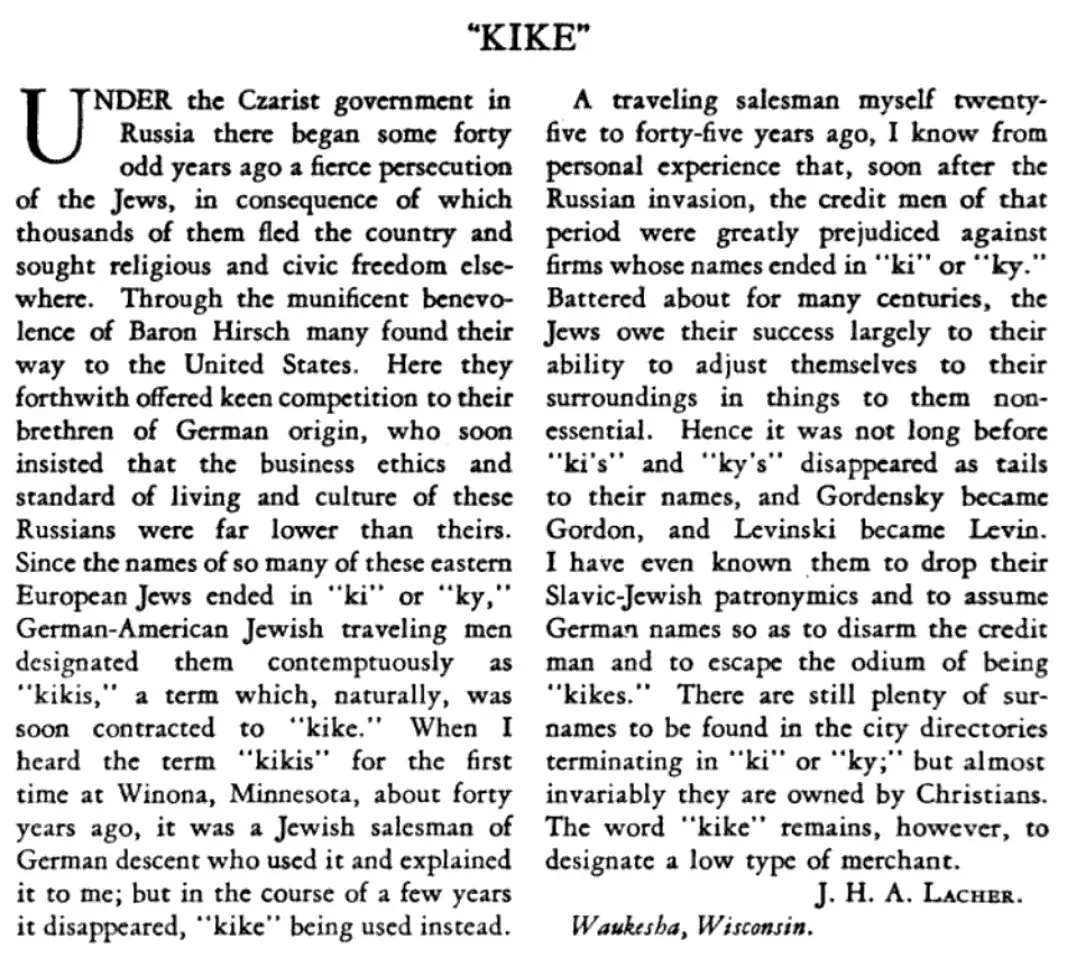
According to Lacher, the epithet was actually coined by German Jews to be used against their coreligionists from the East. This would make sense: German Jewish snobbery toward the so-called Ostjuden is well-known and extended from Berlin to New York to, apparently, Winona, MN. As far as kike is concerned, Allen (1983) writes that “there is agreement that it was originally an ingroup term used by the early-arrived ‘German’ Jews to denominate the Ashkenazic Jews who arrived around the turn of the last century.”2 One illustrative anecdote is cited in Tamony (197 :
:
The specific etymology Lacher gives, on the other hand, is a different story altogether. After all, the theory requires a suffix like “-sky” lose its “S,” reduplicate, and then alter its vowels to produce kike. Liberman notes that “[g]iven such freedom of phonetic change, almost any combination of sounds can be shown to become any other,” which is something Lacher provides no actual evidence for in this case. While still occasionally being cited, most authorities in the decades since evidently haven’t bought it.
Ellis Island
Among laymen, one other theory stands out: that the slur dates back to Ellis Island. According to the popular conception, illiterate Jews, when asked to write an “X” in lieu of their signature, would instead draw a circle, associating the X with a Christian cross. The word for circle in Yiddish being “kikel,” these immigrants were soon being referred to as kikes by the workers. From there the word enters the common lexicon, at some point gaining a negative connotation.
This particular etymology comes from Leo Rosten’s 1968 classic, The Joys of Yiddish. According to Rosten:
Secondly, multiple authors have pointed out that “kikel” (more properly transliterated kaykl) is not an ordinary Yiddish word for “circle,” which more properly would be krayz or rod. While it’s nonetheless true that this less common term is recorded in some Yiddish dictionaries, surely it’s a stretch to believe that a word used by a small minority of illiterate Jewish immigrants would somehow escape the Island and find its place in modern parlance; numerous authors have thus taken issue with Rosten’s view.3
But Rosten continues along a related line of thought:
The origin of the anti-Jewish slur “kike” has been a source of dispute among etymologists practically since it first emerged in the early 20th century.1 A number of competing theories have been raised over the years, including the following:
- that it comes “perhaps from Ike or Ikey, familiar forms of the male forename Isaac,” if you look up the word on Google
- that it “derives from the personal name Hayyim, usually transcribed in German as Chaim”
- that it was “modeled on hike Italian, itself modeled on mike Irishman, short for Michael”
- that it “derives from the Latin caeca (‘blind’) [pr. “kike-ah”], a common traditional Christian defamation of Jews”
- that it’s corrupted from the Irish “Ciabhóg, a person adorned with a forelock or sidelock”
Lacher’s Theory
The theory that used to have the most currency was that the word had to do with the names of many Jews of Eastern European background. Originally put forth by JHA Lacher in 1925, it goes as follows: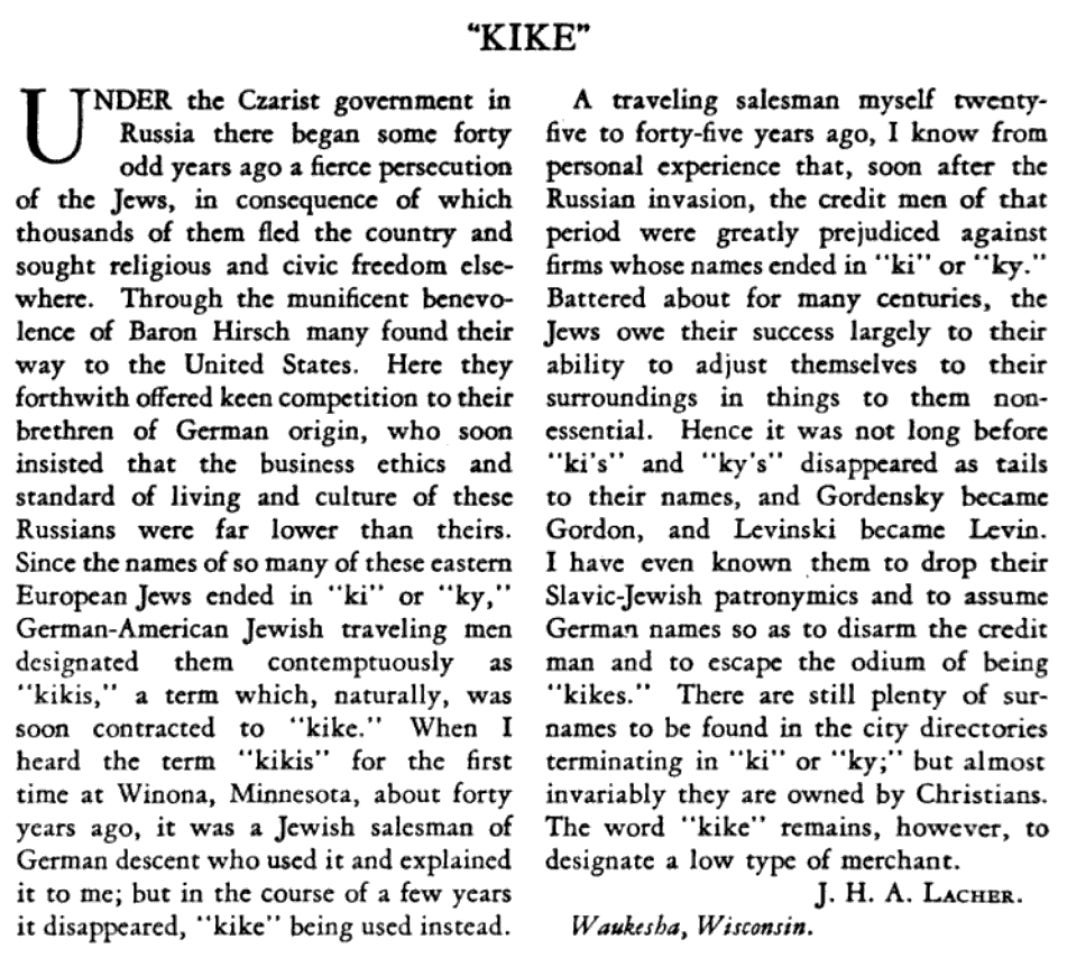
According to Lacher, the epithet was actually coined by German Jews to be used against their coreligionists from the East. This would make sense: German Jewish snobbery toward the so-called Ostjuden is well-known and extended from Berlin to New York to, apparently, Winona, MN. As far as kike is concerned, Allen (1983) writes that “there is agreement that it was originally an ingroup term used by the early-arrived ‘German’ Jews to denominate the Ashkenazic Jews who arrived around the turn of the last century.”2 One illustrative anecdote is cited in Tamony (197
:The specific etymology Lacher gives, on the other hand, is a different story altogether. After all, the theory requires a suffix like “-sky” lose its “S,” reduplicate, and then alter its vowels to produce kike. Liberman notes that “[g]iven such freedom of phonetic change, almost any combination of sounds can be shown to become any other,” which is something Lacher provides no actual evidence for in this case. While still occasionally being cited, most authorities in the decades since evidently haven’t bought it.
Ellis Island
Among laymen, one other theory stands out: that the slur dates back to Ellis Island. According to the popular conception, illiterate Jews, when asked to write an “X” in lieu of their signature, would instead draw a circle, associating the X with a Christian cross. The word for circle in Yiddish being “kikel,” these immigrants were soon being referred to as kikes by the workers. From there the word enters the common lexicon, at some point gaining a negative connotation.
This particular etymology comes from Leo Rosten’s 1968 classic, The Joys of Yiddish. According to Rosten:
But there are a couple of problems with this explanation. Firstly, immigrants were not actually expected to sign forms at Ellis Island. All personal information germane to immigration officials was handed over in the passenger logs called Manifests collected by shipping lines. As such this appears akin to the myth of Ellis Island’s arbitrary name-changes.1. The word kike was born on Ellis Island, when Jewish immigrants who were illiterate (or could not use Roman-English letters), when asked to sign the entry-forms with the customary "X," refused and instead made a circle. The Yiddish word for "circle" is kikel (pronounced KY-kel), and for "little circle," kikeleh. Before long the immigration inspectors were calling anyone who signed with an "O" instead of an "X" a kikel or kikeleh or kikee or, finally and succinctly, kike.
Secondly, multiple authors have pointed out that “kikel” (more properly transliterated kaykl) is not an ordinary Yiddish word for “circle,” which more properly would be krayz or rod. While it’s nonetheless true that this less common term is recorded in some Yiddish dictionaries, surely it’s a stretch to believe that a word used by a small minority of illiterate Jewish immigrants would somehow escape the Island and find its place in modern parlance; numerous authors have thus taken issue with Rosten’s view.3
But Rosten continues along a related line of thought:
His full explanation, then, is that such everyday interactions developed a popular association between the Jewish immigrants of the turn of the last century and the words they used for “circle.” Indeed, this is corroborated by at least two early attempts to etymologize kike, which likely served as the inspiration for Rosten’s argument:2. Jewish storekeepers on the Lower East Side, and peddlers who went far out into the hinterlands with their wares, conducted much of their trade on credit; and these early merchants, many of whom could not read or write English, would check off a payment from a customer, in their own or the customer's account book, with a little circle ("I'll make you a kikeleh")—never an "X" or a cross. . . .
And so those who drew kikelehs, whether on Ellis Island or Avenue B, in Ohio or Kansas or wherever the hardy peddlers traveled into the Mid- and far West, came to be known as "kike men" or "kikes." Dr. Shlomo Noble informs me that the miners of northeastern Pennsylvania would say, "I bought it from the kike man," or "The kike man will be coming around soon."
- Recorded in a 1933 book, Gotthard Deutsch relates the story of an illiterate Jewish drummer (an old term for traveling salesman) who came to be known as a “kike” due to his substituting of written language with a peculiar system of inscribed “kikels.”
- In a letter to the editor for The American Israelite from 1914, a reader conversely opines: “It seems probable that drummers called the Russian Jew, who unable to sign his name in English made his handmark in the form of the traditional Kykala, a Kyke. The term undoubtedly originated as drummer slang.”
Last edited:


 Pharisees skinwalking as Jews and people should wake up to that fact.


