Historical images - Images that made history

  • ⚙️ Performance issue identified and being addressed.
  • Want to keep track of this thread?
    Accounts can bookmark posts, watch threads for updates, and jump back to where you stopped reading.
    Create account
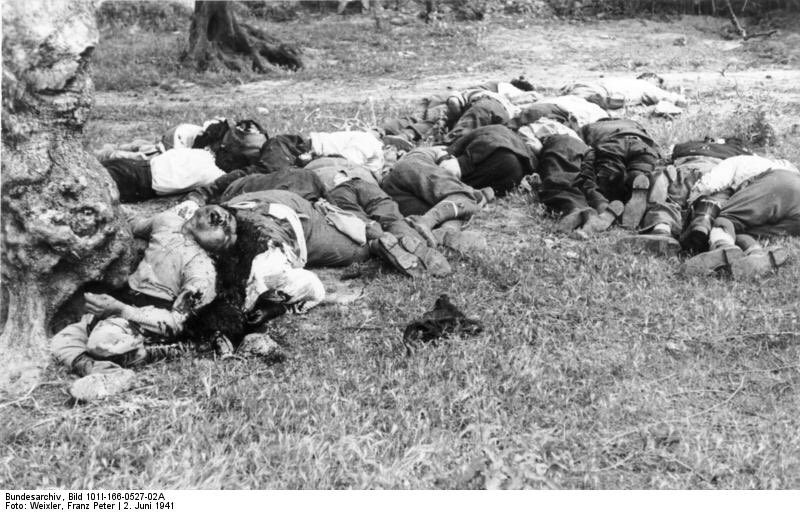
Exactly 80 years ago, young men of the village of Kondomari in Crete were executed by German paratroopers. These were among many murders that took place on the island in 1941 as a way of punishing local civilians for their resistance. In Kondomari however, there was a German war photographer (Franz-Peter Weixler) present and he took a series of photos that survived the end of the war.
kondomari.jpg

kondomari3.jpg

kondomari4.jpg

kondomari5.jpg
Wikipedia has some information about the photographer's later life too. He was apparently dismissed from Wehrmacht for leaking some of the photos. After the war, he gave a report on the massacre in Nuremberg. And ten years later, he decided to return to Crete:
According to a documentary of the Greek TV network NET, he returned to Kondomari in 1955 where he was received by the villagers according to their traditional custom of hospitality. Realizing that there was no apparent hostility towards him, Weixler told them that he had been following orders on the day of the massacre. However, despite their apparent calmness, the villagers were tense and at some point, one of the survivors stood up and told his fellow villagers that the formal requirements of hospitality had been observed and they should leave. Thus, the assembled villagers immediately left the spot, leaving the photographer on his own.
 
Last edited:
sophia.jpg

Sophia Schliemann wearing jewelry from the Priam's treasure, excavated by her husband, a businessman and a pioneer archaeologist Heinrich Schliemann. He's known for both discovering and likely also destroying a good chunk of the legendary Troy. He used dynamite and it is believed that he dug through the "Homer's Troy" on a site that had multiple levels of settlement remains.
A fascinating story and a fascinating character - contemporary historians tend to criticize him and have some good reasons. I learned about him because a guy from a history podcast I listen to dislikes him and brings him up often as a bad example.
heinrich.jpg
troy.jpg

Heinrich Schliemann and a photo from the excavation of Hisarlik - now believed to be Troy.
 
A lot of early archeology and paleontology was harmed by the fact it's practitioners wanted to use TNT to get to the "good" stuff faster.... instead of careful digging.

A lot of history was literally blown to bits in a mad rush to find it and is indeed considered to have been sloppily done to the point of near-useless to modern science.

It also wasn't uncommon for archeologists to destroy sites by blowing them up/burying them when they were done with their expeditions to prevent anyone else from coming in and stealing "their" glory by finding a fancier trinket or bone.... the rivalry between Dr. Jones and "evil" counterparts across the Indy films is a direct call-back to this era of aggressive militarized archeology that was more like treasure hunting than science. Complete with bribery, theft, hired goons and occasionally murder...

See: The Bone Wars
 
Last edited:
shostakovich_fireman.jpg

Legendary Soviet composer Dmitri Shostakovich serving as a volunteer firefighter during the siege of Leningrad, 1941.
 
Picture from the Polytechnique massacre of 1989
adb3c5635858e000fb6a4f98bed1c1cf.jpeg
The killer last words were to call the victims feminists and that he hated feminists
 
terranova.jpg

Robert Falcon Scott (standing in the middle) and his party at the South Pole, 18 January 1912. After arrival, they found a Norwegian flag there - Roald Amundsen had reached the pole weeks earlier. None of the party made it back, Edgar Evans died first as a result of both frostbites and a head injury from a fall and Lawrence Oates committed suicide, as he was incapable of going on. There are some speculations today that Edward Wilson and Henry Bowers could have lived, but they chose to stay with Scott whose foot got too bad to continue, only 11 miles from a depot that would have saved them. I first heard the hypothesis in this documentary, not sure if true. Scott has become England's national hero and I'd say more people know details of the Terra Nova Expedition than they know about the one lead by Amundsen.

pole-scott.jpg

The worst has happened. All the day dreams must go.

oates.jpg

Lawrence Oates
At night Oates was worse and we knew the end had come.... He slept through the night before last, hoping not to wake; but he woke in the morning yesterday. It was blowing a blizzard. He said, "I am just going outside and may be some time." He went out into the blizzard and we have not seen him since.... We knew that poor Oates was walking to his death, but though we tried to dissuade him, we knew it was the act of a brave man and an English gentleman. We all hope to meet the end with a similar spirit, and assuredly the end is not far.... (from Scott's diary)
Oates's sacrifice has inspired a number of books and paintings, including a John Charles Dollman's one titled A Very Gallant Gentleman.
doll.png


Today I also discovered a pretty cool piece of music dedicated to him.
 
Last edited:
IIRC, he volunteered for that flight to spare Yuri Gagarin, since he knew Soyuz 1 would be a suicide mission, and also demanded to have an open casket to force the leadership to see what they had done.
Talk about doing someone a solid.

His last audio transmission.

 
Back
Top Bottom