Navigation
Install the app
How to install the app on iOS
Follow along with the video below to see how to install our site as a web app on your home screen.
Note: This feature may not be available in some browsers.
More options
Style variation
You are using an out of date browser. It may not display this or other websites correctly.
You should upgrade or use an alternative browser.
You should upgrade or use an alternative browser.
Historical images - Images that made history
- Thread starter Monika H.
- Start date
-
Want to keep track of this thread?
Accounts can bookmark posts, watch threads for updates, and jump back to where you stopped reading.
Create account


ditto
kiwifarms.net
- Joined
- Aug 17, 2019
Yet I would have sex with him.
Last edited:
![LinkinParkxNaruto[AMV]](http://uploads.embed.kiwifarms.st/data/avatars/l/61/61177.jpg?1699571951)
- Joined
- Jul 28, 2020
The photo was taken on June 4 (1962) by Hector Rondón Lovera, photographer of Caracas, for the Venezuelan newspaper “La Republica”. It won the World Press Photo of the Year and the 1963 Pulitzer Prize for Photography. The original title of work is “Aid From The Padre”.
Navy chaplain Luis Padilla gives last rites to a soldier wounded by sniper fire during a revolt in Venezuela (communist uprising against then president Romulo Betancourt). Braving the streets amid sniper fire, to offer last rites to the dying, the priest encountered a wounded soldier, who pulled himself up by clinging to the priest’s cassock, as bullets chewed up the concrete around them. Rondon shot the government soldier crawling his way up Navy chaplain Luis Padilla’s robe as Padilla looks in the direction of the rebel sniper fire. Government forces quickly took control of the town and over two days pounded the remaining rebels, that had taken cover in the Solano Castle, into submission. A handful that weren’t captured or killed were able to escape into the jungle”.
In the background is a carnicería (a butcher’s shop). In Spanish, a carnicería means both a “butcher’s shop” and “slaughter, carnage”. The phrase “fue una carnicería” (English equivalent: “it was carnage”) is so common in the Spanish language. The parallel really catches one’s eye and draws the horror of the scene even further.
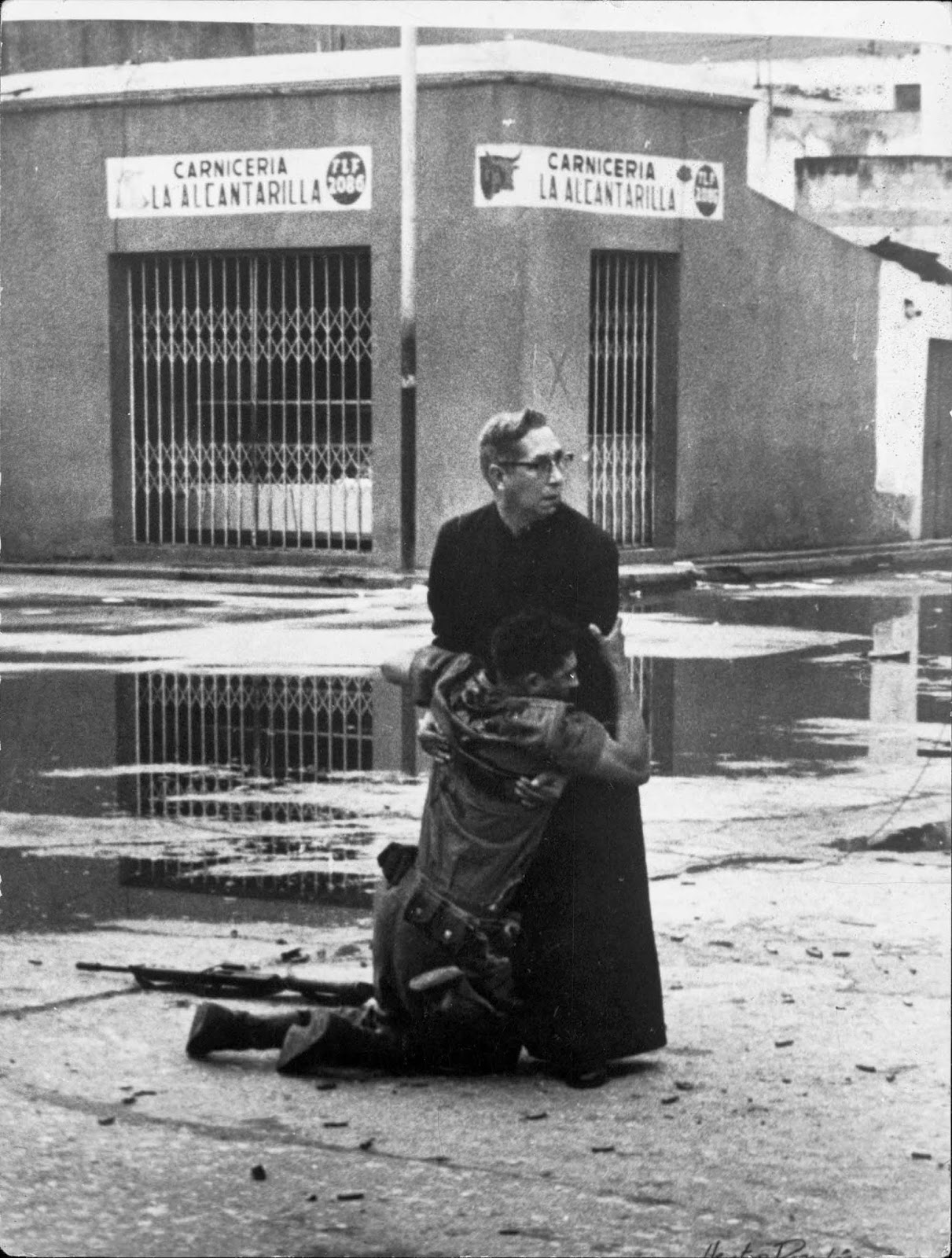
Navy chaplain Luis Padilla gives last rites to a soldier wounded by sniper fire during a revolt in Venezuela (communist uprising against then president Romulo Betancourt). Braving the streets amid sniper fire, to offer last rites to the dying, the priest encountered a wounded soldier, who pulled himself up by clinging to the priest’s cassock, as bullets chewed up the concrete around them. Rondon shot the government soldier crawling his way up Navy chaplain Luis Padilla’s robe as Padilla looks in the direction of the rebel sniper fire. Government forces quickly took control of the town and over two days pounded the remaining rebels, that had taken cover in the Solano Castle, into submission. A handful that weren’t captured or killed were able to escape into the jungle”.
In the background is a carnicería (a butcher’s shop). In Spanish, a carnicería means both a “butcher’s shop” and “slaughter, carnage”. The phrase “fue una carnicería” (English equivalent: “it was carnage”) is so common in the Spanish language. The parallel really catches one’s eye and draws the horror of the scene even further.

- Joined
- Jul 12, 2014
A soda ad from 1955.

I'm not sure what year this one is from, but I thought I'd share this one.

I'm not sure what year this one is from, but I thought I'd share this one.

- Joined
- Oct 8, 2019
I don't know if I should be horrified or fascinated by the pony spread...

- Joined
- Sep 18, 2018
Fake ad credited to a Chris ShapanI'm not sure what year this one is from, but I thought I'd share this one.
View attachment 2116164
Here is another Dickman fake ad he made

- Joined
- Feb 20, 2018

Major General Horatio Gordon Robley with his collection of tattooed Maori heads, 1895.
I don't know if anyone noted this, but there is an entire episode on this photo and Major General Robley as part of the Black Sheep podcast.
Podcast Pt 1
Podcast Pt 2
It's worth a listen and gives a bit of context around how Robley helped preserve Moko as an art form.

- Joined
- Sep 25, 2014
Reminded of the radio broadcast that happened when this occurred.
EDIT: Reminded of this just now!
Last edited:


- Joined
- Dec 16, 2019
A picture of Waffen-SS and Wehrmacht co-operation in Yugoslavia.
On the right is SS-Obergruppenführer und General der Waffen-SS Artur Phleps, who commanded the 7th Waffen-SS Gebirgsjager (Mountain troops) Division, considered by Tito and his partisans the most dangerous of their enemies. He served Austria-Hungary in World War one, being a Transylvanian German. When the empire ended with the war, he went home and spent the 20's and 30's in the Romanian army. After basically calling the Romanian government and royal court incompetent, corrupt retards, he was put in reserve and retired. Unsatisfied, he received permission to join the Wehrmacht in 1940 but instead joined the Waffen-SS. He was moved to Yugoslavia in 1941 to create a regiment of Waffen-SS mountain troops from the local German Balkans, which he commanded until his death under mysterious circumstances in 1944.
Second to the left, the taller gentleman, is Kurt Waldheim, serving as a Wehrmacht interpreter for Phleps to his Italian allies, who Phleps hated. During one heated conversation with an Italian commander, he told Waldheim "Listen Waldheim, I know some Italian and you are not translating what I am telling this so-and-so". Allegedly, being in intelligence, he had a hand in some war crimes in the area. Waldheim would survive the war, and not only came out ok, he was eventually elected president of Austria. And how did he get enough prestige to get elected president?
He was the UN Secretary-General for 9 years before he got elected.
Oops.

- Joined
- Dec 29, 2017
Babe Ruth was the first American ever fitted with an electronic voicebox. He was dying of throat cancer (too many cigars) and the bat in his right hand was all that was keeping him from falling over.

- Joined
- Oct 13, 2020
Two geniuses visited Brazil, and more specifically the state of Ceará in the Northeastern region, in different periods of time.

One was Albert Einstein, who came to the city of Sobral in 1919 to observe a solar eclipse.
According to Einstein himself, the visit was the most important piece that put together his Relativity Theory. He famously said: "The problem that my mind formulated was answered in the luminous skies of Brazil."


Revolutionary filmmaker Orson Welles also visited the state of Ceará. More precisely, he went to the Mucuripe beach, where at the time only had a modest fishermen's village as its sole human occupation. The idea was to record some of these fishermen lost at sea, enduring mid-sea storms and lack of resources for about a week until they finally returned home, hailed as heroes. It would be part of an ambitious anthology film called "It's All True", which would also feature feats of unsung hard workers from around the globe.
Sadly, the project never went ahead. And since his time, the Mucuripe beach became part of the sprawling city of Fortaleza, with the fishermen forced to dislocate to other nearby places, since the beachside area was too valuable as real estate speculations to be owned by such humble people.
One was Albert Einstein, who came to the city of Sobral in 1919 to observe a solar eclipse.
According to Einstein himself, the visit was the most important piece that put together his Relativity Theory. He famously said: "The problem that my mind formulated was answered in the luminous skies of Brazil."
Revolutionary filmmaker Orson Welles also visited the state of Ceará. More precisely, he went to the Mucuripe beach, where at the time only had a modest fishermen's village as its sole human occupation. The idea was to record some of these fishermen lost at sea, enduring mid-sea storms and lack of resources for about a week until they finally returned home, hailed as heroes. It would be part of an ambitious anthology film called "It's All True", which would also feature feats of unsung hard workers from around the globe.
Sadly, the project never went ahead. And since his time, the Mucuripe beach became part of the sprawling city of Fortaleza, with the fishermen forced to dislocate to other nearby places, since the beachside area was too valuable as real estate speculations to be owned by such humble people.
- Joined
- Jul 12, 2014