Historical images - Images that made history

  • Want to keep track of this thread?
    Accounts can bookmark posts, watch threads for updates, and jump back to where you stopped reading.
    Create account
media-380079.jpg


B-17G-10-DL, BK-H, serial number 42-37781 "Silver Dollar" of the 546th Bomb Squadron, 384th Bomb Group goes down after losing its tail.
Hit by bomb drop from above by upper combat box airplane from 379BG which knocked off its tail, crashed March 9th, 1944,
Missing Air Crew Report 3005.

Pilot: Merlin H. Reed, 19 combat missions, KiA
Co-pilot: Bruce M. Rininsland KiA
Navigator: Pete Gudyka, 21 combat missions, KiA
Bombardier: John L. Heiss, 16 combat missions, KiA
Flight engineer/top turret gunner: Robert O. Johnson, 16 combat missions, KiA
Radio Operator: Robert F. Wellman, 20 combat missions, KiA
Waist gunner: Joseph Jacobson, 11 combat missions, KiA
Tail gunner: Emmett F. Hardy KiA
Ball turret gunner: Arthur John Osepchook, 21 combat missions, PoW, transferred to the USAF in 1947 and retired as Master Sergeant. Passed away October 16th, 2018, Ozark MI
Waist gunner: John J. Plotz, POW, passed away September 14th, 2002, Riverside National Cemetery, Riverside California
 
I love old graffiti and doodles.

Alexamenos+Graffiti.jpg

The earliest physical depiction of the crucifixion: "Alexamenos worships his god". Essentially a 3rd century reddit neckbeard shitpost.

7205025-Viking--Graffiti--at-the-Hagia-Sophia-0.jpg

Graffiti left by a Norse mercenary in the Hagia Sofia, Constantinople.
img_4893.jpg

img_4894.jpg

4-1.jpg

Graffiti left by crusaders inside the Church of the Holy Sepulchre in Jerusalem.

p05mw9b0.jpg


Doodles by Onfim, a 7 year old Russian boy living in the 13th century. Writing lessons (and doodles) written on tree bark
 
I love old graffiti and doodles.

Alexamenos+Graffiti.jpg

The earliest physical depiction of the crucifixion: "Alexamenos worships his god". Essentially a 3rd century reddit neckbeard shitpost.

7205025-Viking--Graffiti--at-the-Hagia-Sophia-0.jpg

Graffiti left by a Norse mercenary in the Hagia Sofia, Constantinople.
img_4893.jpg

img_4894.jpg

4-1.jpg

Graffiti left by crusaders inside the Church of the Holy Sepulchre in Jerusalem.

p05mw9b0.jpg


Doodles by Onfim, a 7 year old Russian boy living in the 13th century. Writing lessons (and doodles) written on tree bark
Stuff like this is what made me so fascinated by history. People are people, no matter the time period.
 
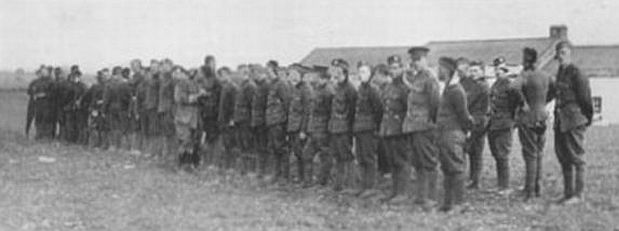
May 22nd, 1915

Members of the 7th Battalion of the Royal Scots, Territorial Force (British Army Reserves) line up for roll call.

QuintinshillILN2.jpg


Only 58 men and 7 officers are present.


The remainder of the 500-man unit had been either killed or injured earlier that morning.

While this kind of decimation is sadly expected of WWI era troop formations, the loss of life in this case was from a rail accident. Due to a signalling error, the troop train carrying them to port for deployment to Galipoli had collided with a stopped local passenger train at Quininshill, Scotland. Only minutes later, while dazed and wounded men were just beginning to extricate themselves, a 3rd passenger train on a parallel track, unable to stop in time, crashed into the wreckage as well, mowing down some survivors where they stood.

Fires started almost immediately from the locomotive's hot coals catching the wooden passenger coaches alight and were further fed by punctured gas cylinders used to light the cars. The heap of engines and coaches was turned into an inferno that killed hundreds before rescue could arrive. Unconfirmed reports persist to this day that officers used their sidearms to shoot trapped men being burned alive to end their suffering. Others could only be freed by amputating arms and legs on-the-spot.

The death toll from all 3 trains, military and civilian alike, was staggering.

226 was the official count, but it may have been even higher. With the master roll of the Scots being destroyed by fire, and the total number of passengers on the other trains not known definitively, it's possible that some bodies were incinerated completely, and never recovered.


The signalmen who'd caused the error were tried for manslaughter and would ultimately be convicted and serve a year in prison. Many believe they were simply convenient scapegoats when the real issue was the overly-congested nature of the Scottish rail system, swollen by wartime demands for extra trains to move troops and coal for ships of the Royal Navy on top of maintaining peacetime-levels of passenger service. The deaths on that day seemed to have been grimly accepted as just more horrific casualties of a war that would near-consume a generation as upon release, both signalmen were apparently welcomed back to the community and returned to working on the railroad.


The Quintinshill disaster remains the worst rail accident to strike the UK to this day.
 
Last edited:
That reminds me, my Jr high school (1989) librarian looked a lot like Lech Walesa, to the point that for Halloween that year, he wore a knit beanie and "Solidarity" T-shirt. I still remember that years later (obviously) so it made a big impression on little ol' me not realizing just how much the world was about to change after having spent Grade School assured that barring WWIII, communism was always going to be our enemy....
 
That reminds me, my Jr high school (1989) librarian looked a lot like Lech Walesa, to the point that for Halloween that year, he wore a knit beanie and "Solidarity" T-shirt. I still remember that years later (obviously) so it made a big impression on little ol' me not realizing just how much the world was about to change after having spent Grade School assured that barring WWIII, communism was always going to be our enemy....
It still is, but in a much worse way
 
I'd like to tell a story about a painting of Queen Charlotte of Great Britain. She was the wife of Mad King George III. It was completed by Allan Ramsay, a Scottish painter, in 1761.
Charlotte_Sophia_of_Mecklenburg-Strelitz_by_studio_of_Allan_Ramsay.jpg
I first learned about the painting after I saw my mom watching a made for TV movie about Prince Harry and Meghan Markle called Harry and Meghan: A Royal Romance. At one point in the movie, Queen Elizabeth II is showing the portrait above to Meghan and Harry, reporting that Queen Charlotte was in fact partially African in descent.

Here is another portrait of the queen that same year by another artist. See something different?

Johann_Georg_Ziesenis_-_Queen_Charlotte_when_Princess,_Royal_Collection.jpg
The movie states that portraits like these were all lies to cover up the true visage of the Queen. Literal whitewashing. However, the truth of the matter is much more interesting.

Queen Charlotte was directly related to Madragana, a Moorish woman who converted to Christianity and became the mistress the King of Portugal in the 13th century. Contrary to Western media over the last few centuries, Moors are not black. Here's a 14th century painting of several Moorish kings located in the Emirate of Grenada, modern day southern Spain
1920px-Moorish_ceiling_at_the_Sala_de_los_Reyes,_Alhambra.jpg
Each parental pairing with Madragana's descendants was exclusively with white Europeans, so even if she was black, its unlikely any physical features would remain.

Not only this, but some scholars believe that Madragana wasn't even a Moor but a Mozarab; Spaniards living in Muslim Spain who adopted Moorish culture but remained Christian.


You see, Mr Ramsay wasn't just a painter, but an ardent abolitionist who abhorred the slave trade. He emphasized the non-existent African features in his painting and had copies sent throughout the colonies to gain political support for banning slavery.

A much more interesting tale than the drivel espoused by a Lifetime movie.
 
Italian WWI pontoon monitor Monte Sabotino, formerly the Austro-Hungarian harbor dredging lighter Tina, after reconstruction in 1918. The ship, which in total displaced just 570 tons, was rebuilt to carry an 84-ton 381 mm 40 caliber cannon originally intended to arm a Francesco Caracciolo-class superdreadnought. A 350-hp Tosi diesel engine allowed it to (barely) move under its own power at 6 knots.

1594605231971.png
 
Italian WWI pontoon monitor Monte Sabotino, formerly the Austro-Hungarian harbor dredging lighter Tina, after reconstruction in 1918. The ship, which in total displaced just 570 tons, was rebuilt to carry an 84-ton 381 mm 40 caliber cannon originally intended to arm a Francesco Caracciolo-class superdreadnought. A 350-hp Tosi diesel engine allowed it to (barely) move under its own power at 6 knots.

View attachment 1444426
"Giuseppe, I really question this entire concept, I mean half the boat is taken up by a cannon and-"
"BLOW ME LUIGI WE'RE GOING AFTER THE CROATS"
 
Back
Top Bottom