Historical images - Images that made history

  • ⚙️ Performance issue identified and being addressed.
  • Want to keep track of this thread?
    Accounts can bookmark posts, watch threads for updates, and jump back to where you stopped reading.
    Create account
March 1st, 1982, just another beautiful day on the planet Venus, as photographed by the Soviet Venera 13 lander.

The outside temperature that day was measured at a balmy 885 degrees Fahrenheit, with a local atmospheric pressure about eighty-seven times as heavy as here on Earth. Although only designed to take pictures and samples for 30 minutes (at which point the probe was projected to be destroyed by the planet's sulfuric-acid rain), Venera 13 managed to hold on for 127 minutes before succumbing.

There was a brief moment of excitement for the possibility of life (somehow) when a dark object appeared to be moving across the ground in the series of images, but this was later dismissed as being one of the probe's camera lens caps that had rolled through the shot after being ejected.

The Soviet space program was relegated in the consciousness of most people to "also-ran" status when the Race to the Moon was won by the US Apollo program, but, they proved much more successful when it came to getting a craft to make a surface landing on Venus, as at least a dozen successful flyby, atmospheric and hard-surface landing probes were sent there from the early 60's and into the early 80's. Just about everything we definitively know about the surface condition of our closest planetary neighbor comes from that series of probes as what was really below the thick cloud cover couldn't be penetrated by light-based terrestrial telescopes and wouldn't be fully topographically mapped until radar-based imaging was used.

file-20190820-170906-dr7spy.png


Fun Fact - When compared to the other major planets of the solar system, Venus rotates backwards on it's axis. Scientists aren't sure why, but have theorized that it became tidally locked to the Sun, much like how the Moon is with Earth, and then was sent the "wrong" way by the torque effect of high-speed atmospheric wind currents, which have been measured as being as fast as 220mph, about as fast as a race car that just would have barely qualified for the Indy 500 this year.
Dumping some venus images if anyone wants more
20150305_veneracombof45a.jpg
PIA00200.jpg
PIA00233.jpg
20150305_venera14last.jpg
20180113_uvi_20160620_134349_283_l2b_v10_PseudoRGB.jpg
venera14.jpg
venera13.jpg
 

Attachments

  • 20150305_venera14pan1supresbb45.png
    20150305_venera14pan1supresbb45.png
    749.4 KB · Views: 232
  • 20150305_venera14panhorizonn1gooda.jpg
    20150305_venera14panhorizonn1gooda.jpg
    58.1 KB · Views: 245
  • 20150823_Venera13_FINAL_UnmSpsc.jpg
    20150823_Venera13_FINAL_UnmSpsc.jpg
    428.4 KB · Views: 238
May 18, 1995.

Shawn Nelson, army veteran steals a tank and goes on a rampage in San Diego.


img.jpg


At dusk, approximately 6:30 PM on Wednesday, May 17, 1995, Nelson drove his Chevrolet van to the California Army National Guard Armory on Mesa College Boulevard in the Kearny Mesa neighborhood of San Diego. Although the gate to the vehicle yard was usually locked after 5:00 p.m., employees at the armory were working late, and left the gate open. The vehicle yard was completely deserted.

Nelson likely used a crowbar to break open the tank hatches. The tanks involved started with a push button and did not require an ignition key. The first two tanks he broke into would not start. As he lowered himself into the third tank, a 57-ton M60A3, he was finally noticed by a guardsman, who approached the tank. Nelson started the vehicle, and with little chance of stopping him, the guardsman rushed to a phone and called police. As ammunition was kept in another building, none of the vehicle's weapons could be loaded or used by Nelson.

Nelson led police on a 23-minute, televised chase through the streets of the Clairemont neighborhood of San Diego. Police agencies involved in the chase included the San Diego Police Department, San Diego County Sheriff's Department, the California Highway Patrol, and due to the tank being stolen from the armory, possibly military police as well. Phillip Cady was the first police officer on the scene of the tank chase. The tank had a top speed of 30 miles per hour (48 km/h), making the chase slow compared to police chases involving automobiles. The 57-ton tank easily plowed through road signs, traffic lights, utility poles, fire hydrants and crushed approximately 40 parked vehicles, including an RV. The damage to utility poles knocked out power to at least 5,100 San Diego Gas & Electric customers in the Linda Vista neighborhood.

From the armory, Nelson traveled along neighborhood streets, eventually turning north on Convoy Street, west on to Balboa Avenue (then signed as State Route 274), and entered Interstate 805 heading south.While on I-805 he attempted to knock down a pedestrian bridge by running into the supports, but gave up after he failed to topple it with the first few hits. Nelson then drove the tank onto the State Route 163 freeway heading southbound, resulting in the freeway being closed and thousands of motorists being stuck. At least one news article speculated he may have been headed to Sharp Memorial, which he had unsuccessfully sued in 1990 and partially blamed for his mother's death. After Nelson attempted to cross into the northbound lanes of State Route 163, the tank became caught on the concrete median barrier, where it also lost one tread.

After the tank was immobilized, four police officers climbed onto the tank. San Diego Police officer Paul Paxton, a gunnery sergeant at the time with the Marine Corps Reserve, opened the hatch using bolt cutters. The officers ordered Nelson to surrender, but he said nothing and began rocking the tank back and forth in attempt to free it from the median. Officer Paxton's partner, Richard Piner, leaned in and shot Nelson. The bullet entered through Nelson's neck.

Nelson later died at Sharp Memorial Hospital. Despite the widespread property destruction, Nelson was the only fatality in the incident.

Aftermath:

sdut-a-firefighter-jumps-from-what-i-20160824.jpg


TM2.jpeg


An article about the chase:

TM3.jpg
 
After the tank was immobilized, four police officers climbed onto the tank. San Diego Police officer Paul Paxton, a gunnery sergeant at the time with the Marine Corps Reserve, opened the hatch using bolt cutters. The officers ordered Nelson to surrender, but he said nothing and began rocking the tank back and forth in attempt to free it from the median. Officer Paxton's partner, Richard Piner, leaned in and shot Nelson. The bullet entered through Nelson's neck.

Nelson later died at Sharp Memorial Hospital. Despite the widespread property destruction, Nelson was the only fatality in the incident.

I always thought it was sad they shot him, even though there was no way they could have known the tank was unarmed, and they couldn't really let him escape in it because it was extremely dangerous just as a vehicle, and if he'd continued on the rampage it's likely he eventually would have killed someone.

His story is rather sympathetic, even if not completely sympathetic and he was an asshole in some respects too, I mean in addition to going on a rampage in a tank.

He's somewhat similar to the Killdozer guy, although the fact that that guy didn't actually kill anyone other than himself had more to do with accident than that he wouldn't have given the chance.

This is Marvin Heemeyer's Killdozer.

1569386468653.png
 
https://kiwifarms.net/attachments/tm2-jpeg.947925/

Wow.... someone still owned a Cadillac Cimmaron in 1995? :P (Automotive sperging ahead) , it was just a Chevy Cavalier with a Caddy grille, tail lamps and pricetag, produced only in the vain hopes that late 80's yuppies looking for their first luxury car would buy a Cadillac instead of, say, a BMW 3-series, if a "small" one could be introduced to the Cadillac lineup, it ended up one of the biggest flops GM ever built as it was overpriced, underpowered and utterly not what the market wanted.

It was the last gasp of the design philosophy that American luxury cars could always sell on name and didn't have to chase trends, they were wrong.

The late 80's where also when what had been seen as semi-luxury cars for decades prior (Pontiac, Mercury) also hit the skids and really didn't ever recover, just selling on brand loyalty until the dawn of the 21st Century when their last loyalists aged-out of buying cars and they finally were axed. They couldn't compete with luxury imports like Mercedes and Infiniti, and couldn't be just another 'economy' marque in an already-crowded field that was just duplicating itself, putting slightly different grilles and emblems on otherwise identical chassis.
 
Last edited:
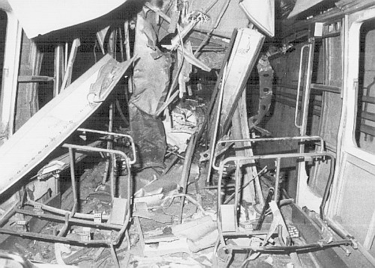
One of the Santiago (Chile) Metro's oldest trains (NS-74 N°3029) which got severely damaged by the far-left winged group "Manuel Rodríguez Patriotic Front", in June 16 (1986). The group attacked Tobalaba Station with bombs, which killed 1 person and injured 6 others.

Eq0T338.jpg

m6AMA15.jpg

z1.jpg

z2.jpg

z4.jpg


4 years later, the train got completely repaired and until now it's still circulating (with a plaque that conmemorates the terrorist attack and reconstruction). Despite that, the incident isn't mentioned in the Museum of Memory and Human Rights and the MRPF's members went scot-free.

S0IXRVT.jpg

31-0.jpg


EDIT: I've forgot to add a small detail.
 
Last edited:
Garlinski-Albina.png

wpa-poster-1936-41.jpeg
Von-Phul-Phil.png
Sara-Cleo.png
C3TKXI2IMI7TLMXWTPKOOZ2XIY.jpg
3.png

WPA and WW2 propaganda is a seriously underappreciated kind of art. Nothing has ever seriously encapsulated an era like it did and it's influence lingered on for decades.
 
Rare 1984 photo of Kim Il Sung’s tumor. It apparently appeared in the late 70s and had grown to the size of a baseball by the late 80s. What's worse, its close proximity to his brain and spinal cord made it inoperable. North Korean reporters and photographers were instructed to never show the tumor in official pictures and videos, so they were forced to always show Kim from the same ¾ left angle. As the tumor continued to grow, it became increasingly difficult to hide and North Korean state media resorted to airbrushing it out of official photos.

The guy on the right is Janos Kadar, the communist leader of Hungary from 1956 to 1988.
kim_il_sung_tumor_1980s.jpg
 
Rare 1984 photo of Kim Il Sung’s tumor. It apparently appeared in the late 70s and had grown to the size of a baseball by the late 80s. What's worse, its close proximity to his brain and spinal cord made it inoperable. North Korean reporters and photographers were instructed to never show the tumor in official pictures and videos, so they were forced to always show Kim from the same ¾ left angle. As the tumor continued to grow, it became increasingly difficult to hide and North Korean state media resorted to airbrushing it out of official photos.

The guy on the right is Janos Kadar, the communist leader of Hungary from 1956 to 1988.
kim_il_sung_tumor_1980s.jpg
Heard of it, never saw the actual picture until today. Good job sir
 
The desk of Albert Einstein. The photo was taken on April 1955, merely hours after the scientist had died.

desk.jpg
 
https://kiwifarms.net/attachments/tm2-jpeg.947925/

Wow.... someone still owned a Cadillac Cimmaron in 1995? :P (Automotive sperging ahead) , it was just a Chevy Cavalier with a Caddy grille, tail lamps and pricetag, produced only in the vain hopes that late 80's yuppies looking for their first luxury car would buy a Cadillac instead of, say, a BMW 3-series, if a "small" one could be introduced to the Cadillac lineup, it ended up one of the biggest flops GM ever built as it was overpriced, underpowered and utterly not what the market wanted.

It was the last gasp of the design philosophy that American luxury cars could always sell on name and didn't have to chase trends, they were wrong.

The late 80's where also when what had been seen as semi-luxury cars for decades prior (Pontiac, Mercury) also hit the skids and really didn't ever recover, just selling on brand loyalty until the dawn of the 21st Century when their last loyalists aged-out of buying cars and they finally were axed. They couldn't compete with luxury imports like Mercedes and Infiniti, and couldn't be just another 'economy' marque in an already-crowded field that was just duplicating itself, putting slightly different grilles and emblems on otherwise identical chassis.
If the Cimmaron was the final nail in the coffin, the Catera was proof they weren't trying anymore. Hell, I saw Cimmarons well into the early 2000s.
 
Halloween during WW2:

8Krz1cU.png


B0R5lax.jpg

A group of japanese-american evacuees in California. Also, japaniggo-face makeup.


kL8TvcO.jpg

hxbeG5Q.jpg

R5YhsBP.jpg


No propaganda is complete without some spoopy dose.
 
If the Cimmaron was the final nail in the coffin, the Catera was proof they weren't trying anymore. Hell, I saw Cimmarons well into the early 2000s.

In the last 5 years, by rough reckoning, I've seen ONE Catera, and Four Cimmarons, none of which were in that bad a shape, the Catera had it's clear coat flaking off and the bumper covers were loose....


August 13th, 1948. Fire crews work to extinguish a burning C-54 Skymaster. The USAF cargo plane had overrun the runway at Berlin's Tempelhof airport upon landing, catching fire as it crashed through a perimeter fence and into a wooded area. The plane had been participating in the Berlin Airlift, a massive logistical effort to supply the city of West Berlin with food and coal by air after the Soviets had shut all road, rail and canal access in June of 1948 in a bid to push the western allies out of their designated post-war control zones of the city. That left 3 designated air corridors and two airports (Tempelhof and an RAF base) as the only means to bring in the roughly 3,500 tons of supplies the city needed per day. The massive humanitarian operation would last nearly a year, ending only when the Soviets relented in May of 1949.

45-514-1.jpg


Though the aircraft pictured was destroyed, all 4 crew aboard managed to walk away from the accident. Others would not be so lucky. Crashes and ground accidents would claim 25 aircraft and 101 lives from all the participating nations.

The final numbers are astounding, over 270,000 flights flown and 2.3 million tons of supplies delivered, on a route that was frequently shrouded in fog and a final approach that required planes to clear a five story apartment block at the end of the runway by sometimes as little as 50 feet. It's amazing the casualty rates weren't even higher.
 
Last edited:
Back
Top Bottom