He was a ranked sergeant who is the official mascot of the 102nd Infantry Regiment and was assigned to the 26th Division in World War I. He served for 18 months and participated in seventeen battles on the Western Front. Wikipedia
The last known photo of the RMS Titanic. Three days before the sinking that killed 1,514 passengers.
According to Time Magazine this photo was taken by Irish Jesuit priest Francis Browne who sailed with the ship for the first leg of its journey, from Southampton (England) to Cobh (Ireland) then called Queenstown. The priest would have stayed for the remainder of the transatlantic journey too, having received an offer of a ticket from a wealthy family he befriended while on board. When Browne reached Cobh, however, he received a note from his clerical superior, ordering him to return to his station immediately rather than sail on with Titanic.
A photo of the body recovery from of the Titanic sinking.
One more:
Victims of the Titanic aboard the CS Mackay that were buried at sea.
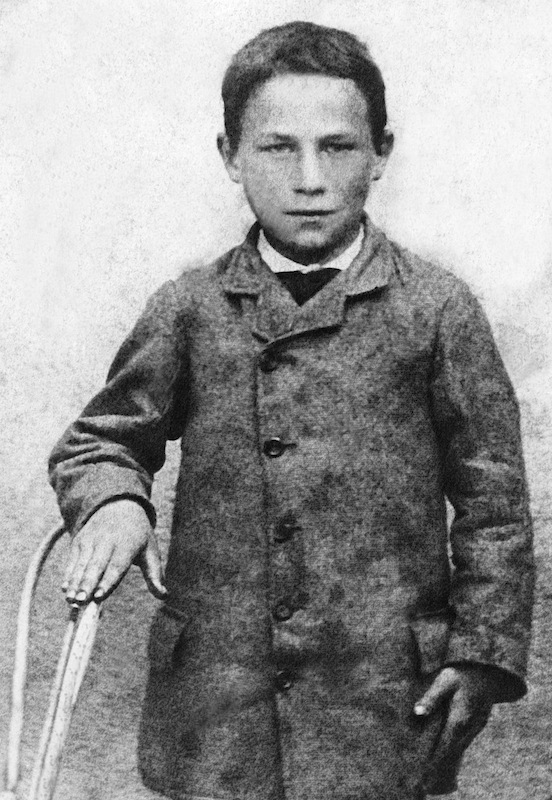
1885: Joseph Meister, the first person to be saved from the Rabies illness by Louis Pasteur's vaccination.
One hot July morning in 1885, feverish little Joseph Meister was dragged by his frantic mother through the streets of Paris in search of an unknown scientist who, according to rumors, could prevent rabies. For nine-year-old Joseph had been bitten in 14 places by a huge, mad dog and in a desperate attempt to cheat death, his mother had fled from their home town in Alsace to Paris. Early in the afternoon Mme Meister met a young physician in a hospital. “You mean Pasteur,” he said. “I’ll take you there.”
Bacteriologist Louis Pasteur, who kept kennels of mad dogs in a crowded little laboratory and was hounded by medical criticism, had never tried his rabies vaccine on a human being before. But moved by the tears of Mme Meister, he finally took the boy to the Hotel-Dieu, had him injected with material from the spinal cord of a rabbit that had died from rabies. For three weeks Pasteur watched anxiously at the boy’s bedside. To his overwhelming joy, the boy recovered.
A photo of a kitty near 2 tanks, which was taken shortly after Pripyat's population evacuated from the city in 1986.
Shortly after the Chernobyl NPP explosion, people from affected areas (not just Pripyat and Chernobyl) weren't allowed to evacuate with their pets and cattle due to the fact that the animals could've had their furs contaminated with radioactive dust and spread radiation in non-affected areas, so the pets and cattle were left behind with food available for the 3-day evacuation. Sadly, a lot of days passed and the animals either died due to starvation, high radiation exposure, or killed by exterminators (A liquidator said they've found animals suffering and in pain due to radiation, so they didn't only kill them quickly to avoid further contamination, but also to put out of their misery). Those that survived became feral or were even adopted by samosely.
Except he fired MacArthur and gave us North Korea and Communist China, which were two skips right to Vietnam. The only good thing about him was he wasn't FDR, and the only good thing he did was stop the White House from literally collapsing because it was in utter disrepair.
IIRC, it was a sweatshop fire in NYC during the 1910s that resulted in fire escape regulations. The result of this collapse was the slumlord owner's negligence.
This is taken from a german WW2 tank crew manual. These pamphletes are well known for explaining in quite humoristic ways how to handle different combat situations. They exist for tanks, fighters, infantry... and they often contain neat little rhymes to make the lesson more memorable.
I'll translate:
Upper left: "Motto: conserve Ammo, one cart full is enough for a Ritterkreuz"
Speech bubble on the left: "Man! 5 grenades and 5 kills, quite an achievement!"
The big block of text explains when to use certain boardweapons.
Handgun: [fire] from hatches on Guests on the back
SMG: [fire] the hatches on ditches and foxholes in dead corners
[Can't decipher]: [fire/maybe throw] from hatches into ditches and hidden targets
Smoke Screen: in case of fire, when the gun jams, when you want to retreat orderly, when the situation becomes precarious and it stinks
Hull-mounted MG: up to 200m against man, horse and carriage
Turret-mounted MG: up to 400m against man, horse and carriage (and when there's more, even further). Houses, to pin down enemies for the infantry
Canon:
HE without time delay: Creates shrapnel 20m to the sides and 10m in the front. Better shoot to the side than to behind. Tried-and-true against Antitank guns, artillery, treads, [tank] view-ports. Sets everything on fire and flips cars upside down.
HE with time delay: Mine at direct hit: Penetrates and explodes wooden bunkers, houses, shelters, forests and young tanks.
Rebounding shots: On a flat hit, it bounces off, flies another 50m and explodes in a height of 4 to 8m above positions, that can't be seen or otherwise shot at.
Panzergranate 39: Pops tanks and bunkers at 2000m
Panzergranate 40: pops heavy tanks at 1500m (deviates). Only use after Panzergranate 39 didn't penetrate. Attention! Higher build-up of pressure! From 600 to 1000m, you have to reduce elevation by 100m, from 1100 to1500m always 200m less elevation!
HL-Granate: Against the most heavy tanks at 1000m (deviates a lot). It makes giant holes, but flies slow. Therefore, you have to increase the elevation by 1 for every shot (ie: instead of 600, you adjust to 750m). Do not use when there's camouflage, protective nets in front of the target. Otherwise it'll explode prematurely!
Text below the image of a grenade with many arrows: "So, shoot less, hit more! It will please Reichsminister Speer."
He was a ranked sergeant who is the official mascot of the 102nd Infantry Regiment and was assigned to the 26th Division in World War I. He served for 18 months and participated in seventeen battles on the Western Front. Wikipedia
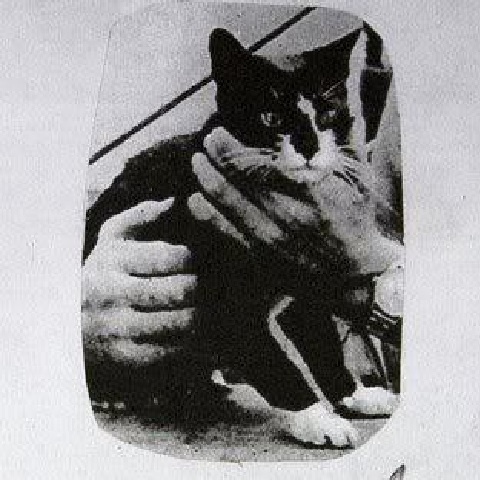
Supposedly, this cat was first on the Bismarck when it sank the Hood and was itself destroyed by the British Navy May 21st, 1941. The cat survived, clinging to a board and was picked up by the Destroyer HMS Cossack, the Crew named him Oscar. The HMS Cossack was sunk by a Torpedo Octobre 24th the same year. Again, the cat survived and ended up on the Carrier HMS Ark Royal... which was sunk November 14.
The cat then was retired and lived in Belfast for another 14 years. Due to his troubled, albeit continued, maritime history, the cat earned the name "Unsinkable Sam".
A photo of a kitty near 2 tanks, which was taken shortly after Pripyat's population evacuated from the city in 1986.
Shortly after the Chernobyl NPP explosion, people from affected areas (not just Pripyat and Chernobyl) weren't allowed to evacuate with their pets and cattle due to the fact that the animals could've had their furs contaminated with radioactive dust and spread radiation in non-affected areas, so the pets and cattle were left behind with food available for the 3-day evacuation. Sadly, a lot of days passed and the animals either died due to starvation, high radiation exposure, or killed by exterminators (A liquidator said they've found animals suffering and in pain due to radiation, so they didn't only kill them quickly to avoid further contamination, but also to put out of their misery). Those that survived became feral or were even adopted by samosely.
This is the Mesa, Arizona LDS temple. On January 21, 1937, it snowed down in the desert--now hard to believe can ever happen even though the Superstition Mountains can of course get snow. The picture's featured in the book "Latter-Day Saints in Mesa" by D.L. Turner, which states:
"The January 1937 Snowstorm in Mesa was so unusual that many family albums from this period have images of snowmen in front yards and snow covered buildings – the high school, churches, homes and even the temple. The snow lasted nearly a week and local camera stores nearly ran out of film."
Looking it up, the January 1937 Snowstorm occurred in many places in the West and along the Pacific coast so it's not just an isolated phenomenon, but it was a big deal for Arizona.
Went looking for more pictures from that time-period, but all I got is this of Coolidge (Pinal County) in February 1937: