Historical images - Images that made history

  • 🏰 The Fediverse is up. If you know, you know.
  • Want to keep track of this thread?
    Accounts can bookmark posts, watch threads for updates, and jump back to where you stopped reading.
    Create account
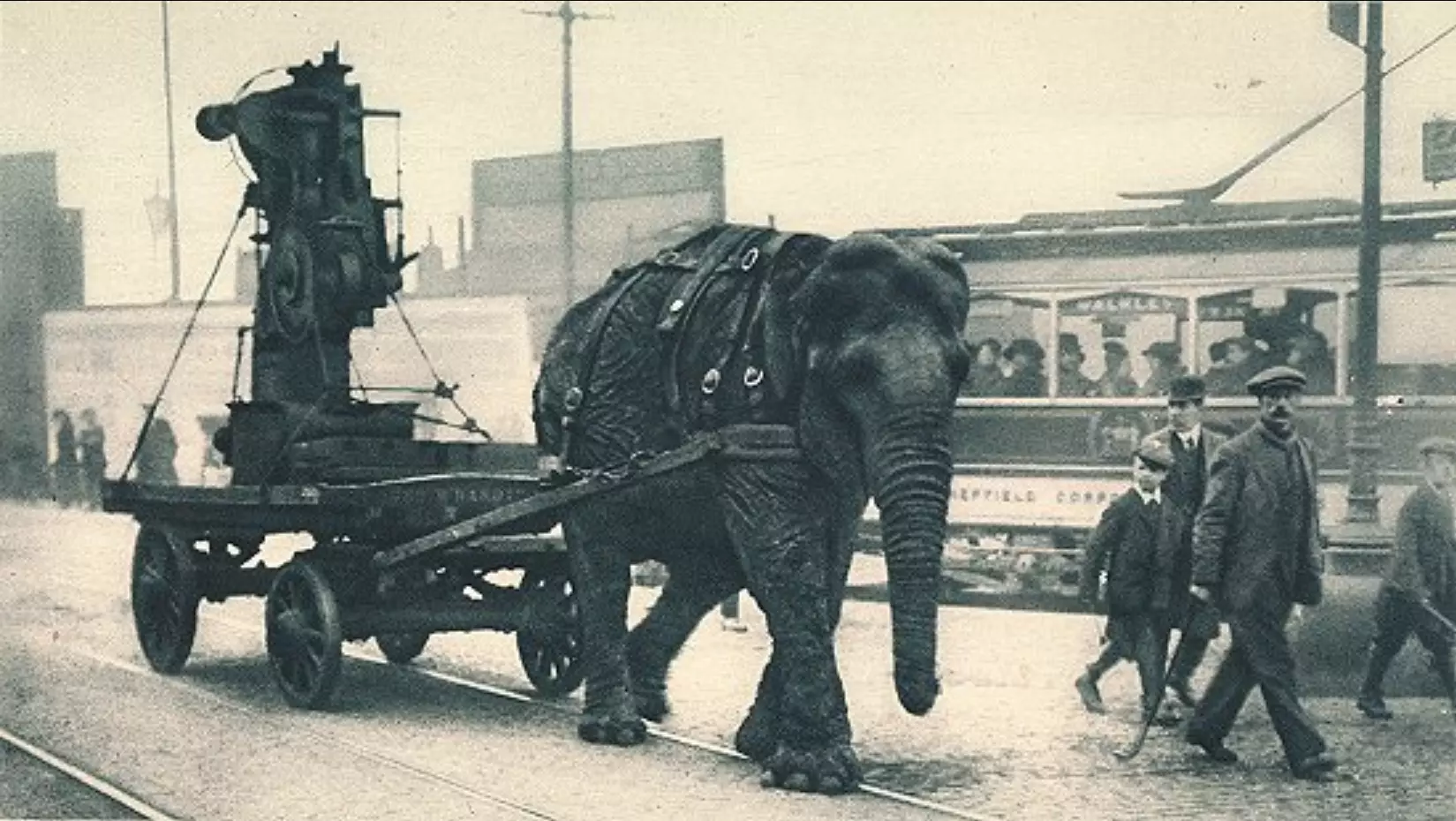
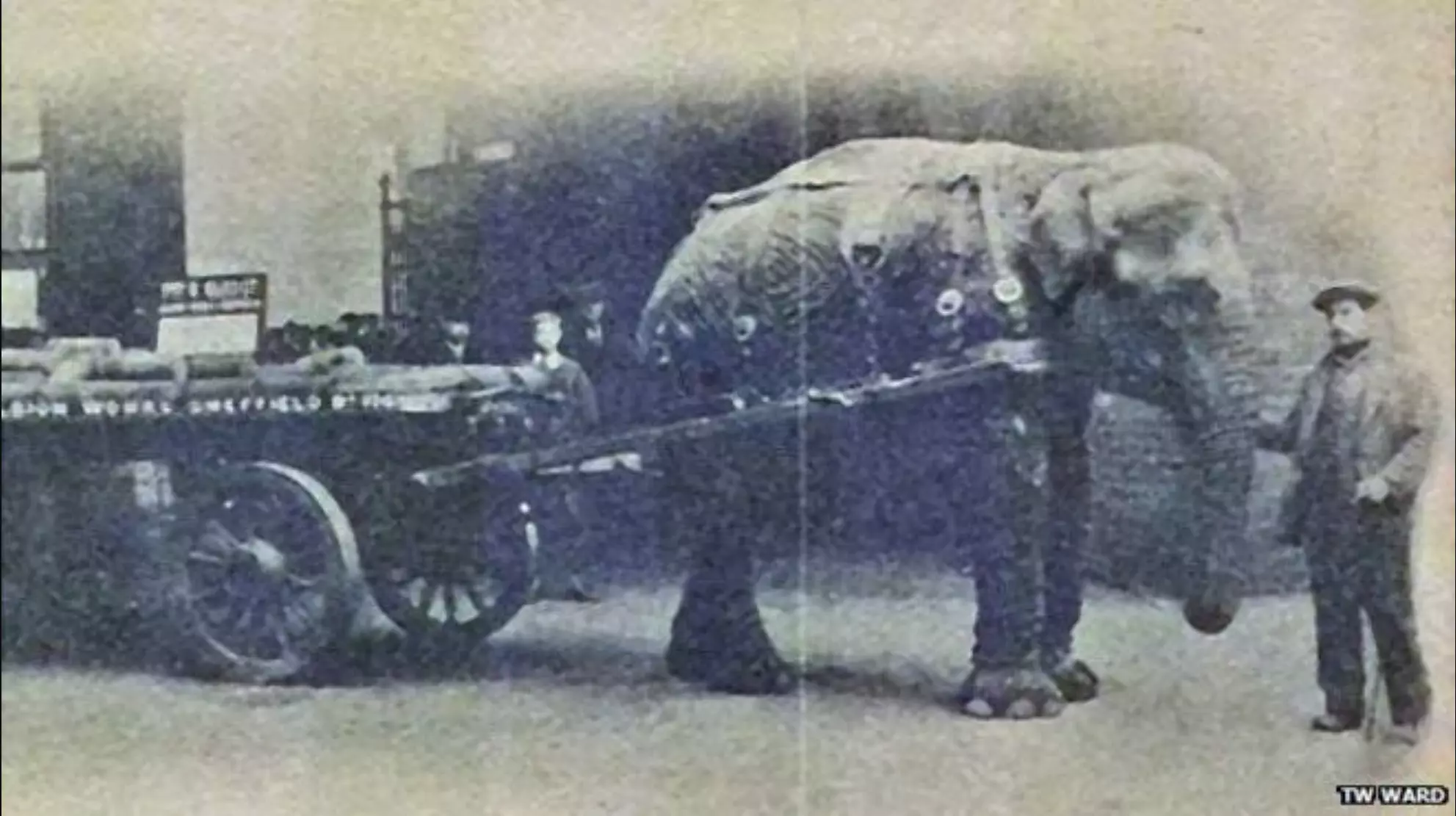
Lizzie the Elephant pulling carts during World War I in Sheffield, Britain.
Screenshot_2663.webp
Screenshot_2664.webp
 
Lizzie the Elephant pulling carts during World War I in Sheffield, Britain.
View attachment 7811109
View attachment 7811110

I've heard stories of Lizzie for years, she was really well liked by the people of Sheffield and there was talk towards the end of the War and just after of using more Elephants as essentially super strength tractors but because of the economic slump and advances in ICE technology during an after the war the idea never went anywhere.

On her own she could pull as much as a team of Shire Horses (so 4/5 horses) and was easyer to care for, sadly one thing that didn't help her was Cobbled Streets her ankles apparently suffered even with the bespoke leather boots they got her to protect her feet it was far too irregular underfoot for her an caused her some significant pain.

Nobody is really sure what happened to her after the War as well so that makes it a bit sad the two most popular theories are She went back to the Circus she was bought from, or that she joined a team of other elephants that where used to Plough fields (this is the one I find most likely, not looked into it but it tracks).

Before any one asks Why elephants where not used like this before in the UK / Europe, simply because it didn't - Dray horses the big ones used for pulling heavy loads are relatively recent from around the mid 16th Century an horses have been domesticated for around 3000 years, they have always been used to pull carts an people but Oxen where the choice for heavy loads from the Roman era till the 16th century, oddly enough about the same time the Destria fell out of common use an as a play thing of Royalty an the Gentry and there is evidence to suggest that's where those larger horses originated from to become Shire Horses, so the idea wasn't that old in the grand scheme of things because there where other options, same happened with Elephants as tractors.
 
Patsy Ann, an English Bull Terrier, was born in Portland, Oregon on October 12, 1929 and came to Juneau as a pup. She died in Juneau on March 30, 1942. On the following day, a small crowd watched as her coffin was lowered into Gastineau Channel just a short distance from where her sculpture now sits, watching and waiting with eternal patience, whether shrouded in fog, bathed in sunshine or covered with snow.

pasnow.webp

Because of her unerring sense of the imminent arrival of each ship that visited Juneau and her faithful welcome at wharfside, Juneau Mayor Goldstein dubbed Patsy Ann “Official Greeter of Juneau, Alaska” in 1934.

Patsy Ann was stone deaf (from birth), but she somehow “heard” the whistles of approaching ships — long before they came into sight — and headed at a fast trot for the wharf. She was never wrong. In fact, on one memorable occasion, a crowd was given erroneous information and gathered at the wrong dock. Patsy Ann gazed at the crowd for a long moment, then turned and trotted to the correct dock.
patsyannonship.webp

Between ship’s visits, Patsy Ann made the rounds of her friends at local businesses. She had a vast number of friends, most of whom slipped her bits of food, including a daily candy bar from one fan. Patsy Ann was as much a fixture of beer parlors and hotel lobbies as any paying guest.

Old Juneau’s Ambassador was the most famous canine west of the Mississippi, more photographed than Rin Tin Tin.
postcardpa.webp

During the 1930’s her image adorned post cards sold by curio shops and for many visitors, she was the highlight of their visit to Juneau. Local author Carl Burrows published a “little book” in 1939, simply titled Patsy Ann.

Her distinctive gait slowed over the years due to rheumatism brought on by unscheduled dives into the cold waters of the Gastineau Channel and she grew overweight from the high living of the ships’ cooks. Still, she always headed for the docks, on the double, whenever steamship whistles shook old Juneau’s boardwalks.

Of no fixed address, Patsy Ann spent most of her nights in the Longshoreman’s hall where, surrounded by kindred souls, she could run safely down the alleys of her bull terrier dreams. Fittingly, it was there she died gently on March 30, 1942. The next day, a crowd gathered as her tiny coffin was lowered into Gastineau channel.

Patsy Ann captured the hearts of Juneau’s citizens with her dignity, honesty, and devotion to her duties as “Official Greeter of Juneau, Alaska”.
paships.webp

Fifty years after her death, her statue was commissioned by the Friends of Patsy Ann – founded by June Dawson – and installed on the wharf she knew so well.

Sculpted by New Mexican artist Anna BurkeHarris, clippings of dog hair from all over the world were included in the bronze at the time of casting, symbolically uniting the spirit of dogs everywhere.

On July 3, 1992 at 7:30 p.m., Patsy Ann, in her new incarnation, was presented to the world under blue skies with a balmy breeze in the air. Patsy Ann sits at North 58 degrees, 17 minutes and 91 seconds North Latitude and 134 degrees, 24 minutes and 17 seconds West Longitude.

Each year, hundreds of thousands of tourists visit Juneau from cruise ships and are welcomed on the dock by Patsy Ann, as they would have been in the 1930’s.
pastatuecommerce-1-1536x966.webp

They are encouraged to “greet her and touch her and in leaving, carry with you the blessings of friendship through your life’s journey”.

May her Spirit Live Forever
 
wanrong-photo-prince-of-japan-visit-1930s-d2cb13-640.webp
The last known candid picture of the Chinese Empress in the 1930s. Afterwards she wasn't seen that often and was kept locked away due to her opium addiction
 
1756563558445.webp

One of Ingrid Bergman's last photos at the age of 67. Yesterday was Ingrid Bergman's birthday (and time of death), August 29, 1915 to August 29, 1982.

110 years old. What a legend.
 
As always, I'm late.

On the 2nd of September, 1870, the combined forces of the North German Confederation, Baden, Bavaria, Hesse-Darmstadt and Württemberg beat the French Empire at Sedan, the most decisive battle of the Franco-Prussian war. A staggering 100000 Frenchmen were captured, among them the Emperor of the French, Napoleon III., himself.

In the wake of the French defeat, the Second French Empire was overthrown and replaced by the Third French Republic. While the war continued for another three months, it was already decided in the German's favor after Sedan.

Since, the victory over France was what ultimately lead to the founding of the German Empire, this "Sedan day" became a national holiday and was celebrated until the German Empire was destroyed in 1918.

This is a picture of the Brandenburg Gate during the festivities in 1895. The banner, loosely translated says "What a fortunate turn of events by the grace or God".

I seem to have browser problems, I hope the image is coming through.
It appears that my shit's fucked, so let me try again:

1000061833.webp
 
Last edited by a moderator:
1757016627916.webp Somethings+Got+To+Give+in+1962+%252832%2529[1].webp
Marilyn Monroe and Clark Gable film The Misfits together. This would be the last completed film before they both passed away. Monroe was fired from the movie Something's Got To Give as seen in the second image.
 
What old I-5 signs in California looked like warning motorists about illegal migrants entering the US. After Operation Gatekeeper in 1995, there was no need to replace them, though the last of them fell apart from disrepair by 2018 and none were replaced.

W54_Special_CA-San_Ysidro_-vector.webp
 
What old I-5 signs in California looked like warning motorists about illegal migrants entering the US. After Operation Gatekeeper in 1995, there was no need to replace them, though the last of them fell apart from disrepair by 2018 and none were replaced.

View attachment 7969913
So that's where the "Refugees welcome"-image is from.
 
1759073844046.webp
The American fair in Japan as American culture took off in the 1950s during and after the occupation.
 
Back
Top Bottom