If you ask a Brazilian about 4th of July, most people will actually say "Oh yeah, that's when we beat the US in the 1994 World Cup round of 16."
>smug George Costanza face
>”yeah, by only one goal”
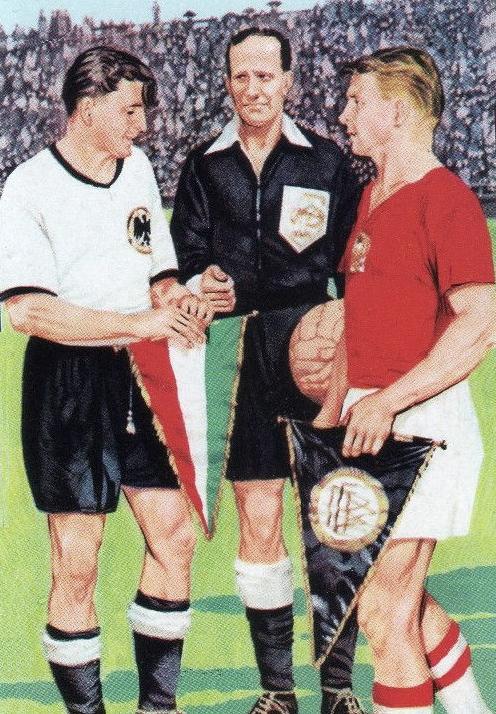
But anyway, The Fourth of July is also host to a great football match, the so called “Miracle of Bern”, the 1954 World Cup Final between favorites Hungary and relative underdogs West Germany.
During the 1950s, Hungary were widely considered the best football team in the world, and burned through the cup with a 32 match winning streak to ver the previous four years; most notably being the first team to defeat England at Wembly (doing so twice: 6-3 and 7-1), and defeating opponents Germany 8-3 in the group stages. Indeed they automatically qualified for the World Cup because Poland withdrew from the match due to the impossibility of winning.
Germany on the other hand were not well regarded. Due to the Second World War, and the three states emerging due to the occupation, a German team had not played in a World Cup since 1938. The entire squad was semi-professional and had only played a handful of friendly matches prior to qualification.
In the lead up to the final, Hungary soundly trashed their opponents; scoring a record 17 goals in the group stages, and defeating both Brazil and Uruguay 4-2. Germany did notably defeat cup hopefuls Yugoslavia 2-0, and gave an impressive performance against Austria, beating them 6-1.
Before the match, Hungarian manager Sebes replaced several key players; right winger Budai, due to exhaustion, and switched left winger Toth to the right. Germany on the other hand had experimented with their squad over the course of the tournament, and had their formula set in stone. Also key was weather; it rained throughout the match, something which the West German team called “Fritz Walter weather” due to his strengths in adverse conditions. The West German team also had cleats designed by Adidas specifically designed for rain.
The match started with Hungary scoring 2 goals. A close range goal in the sixth minute, followed quickly by a long shot two minutes later. However Germany scored two minutes later. And in the eighteenth minute scored the equalizer.
The match quickly died down, with Hungary dominating opportunities to score, but were met with fantastic saving or goal posts. Germany only managed a single chance at goal during the rest of the first half.
The second half was again dominated by Hungary, who were only thwarted by the goalkeeper Turek. Again, Germany’s only reasonable chance at goal came at the 72nd minute, which was quickly shut down. However, through a poor clearance and a clever feign, Helmut Rahn who scored the equalizer, scored a the third goal for Germany in the 84th minute.
Hungary quickly struck back with an apparent equalizer two minutes later, which was disallowed due to an offside; which led to the final score of 3-2 to West Germany.
The match had serious ramifications for both countries. For West Germany, it renewed a sense of patriotism lost since the Second World War. Joachim Fest, the famous biographer of Adolf Hitler and Albrecht Speer considered the match the true beginning of post war Germany. The team who played the match went onto considerable fame, which would lead to three more World Cup victories in 1972, 1990 and 2014 as a unified Germany.
The ramifications for Hungary however was disastrous. Immediately following the match, riots broke out through Budapest, which would lead to the 1956 uprising. The manager of the team Sebes was immediately fired, and both the radio announcer for the match and the goalkeeper were charged with espionage and placed under house arrest. The goalkeeper Grosics spoke of the situation, “
Hundreds of thousands of people poured into the streets in the hours after the match. On the pretext of football, they demonstrated against the regime ... in those demonstrations, I believe, lay the seeds of the 1956 uprising.”
The celebrated “Golden Team” never played again, in the 1958 World Cup only 4 players remained, and despite still being considered strong contenders, were eliminated from the group stages. Hungary has never appeared in a World Cup final since.
The match is however not without controversy; due to several members of the German team falling ill to jaundice afterwards, and one member later dying of cirrhosis; a shared dirty needle is strongly implicated; this was explained by a coach as a glucose and vitamin c injection. But glucose and vitamin C was rarely injected in sport. The most likely scenario was that the team was injected with Pervitin, an amphetamine commonly used in post war sport, which was still legal. This has never been proven.
In 1990, after the fall of the Iron Curtain, Germany hosted a rematch with the original players, which led to regular annual reunions. The last surviving member of the match passed away in 2015.