FUTURE OF TRANSPORTATION
By Eric A. Taub
Oct. 5, 2022
This article is part of our series on the Future of Transportation, exploring innovations and challenges that affect how we move about the world.
Communication is key to any good relationship. But when it comes to vehicles and their owners, silence largely prevails.
Except for a few vague warning lights on the dashboard and side mirrors — and a few sensor-based sounds in some recent models and, of course, car horns — drivers know nothing about what the vehicles and pedestrians around them are about to do. A dangerous obstruction in the roadway, two cars about to move into the same lane, or a bicycle coming out of a blind alley up ahead are a few potential surprises, with the driver finding out about them often too late — sometimes with deadly results.
Yet by later this decade much of such surprises is expected to change. Manufacturers are developing systems generically known as C-V2X — shorthand for cellular vehicle-to-everything technology — for vehicles to communicate with each other and pedestrians, cyclists, construction workers (via wearable sensors or smartphones) and road infrastructure elements, like traffic lights.
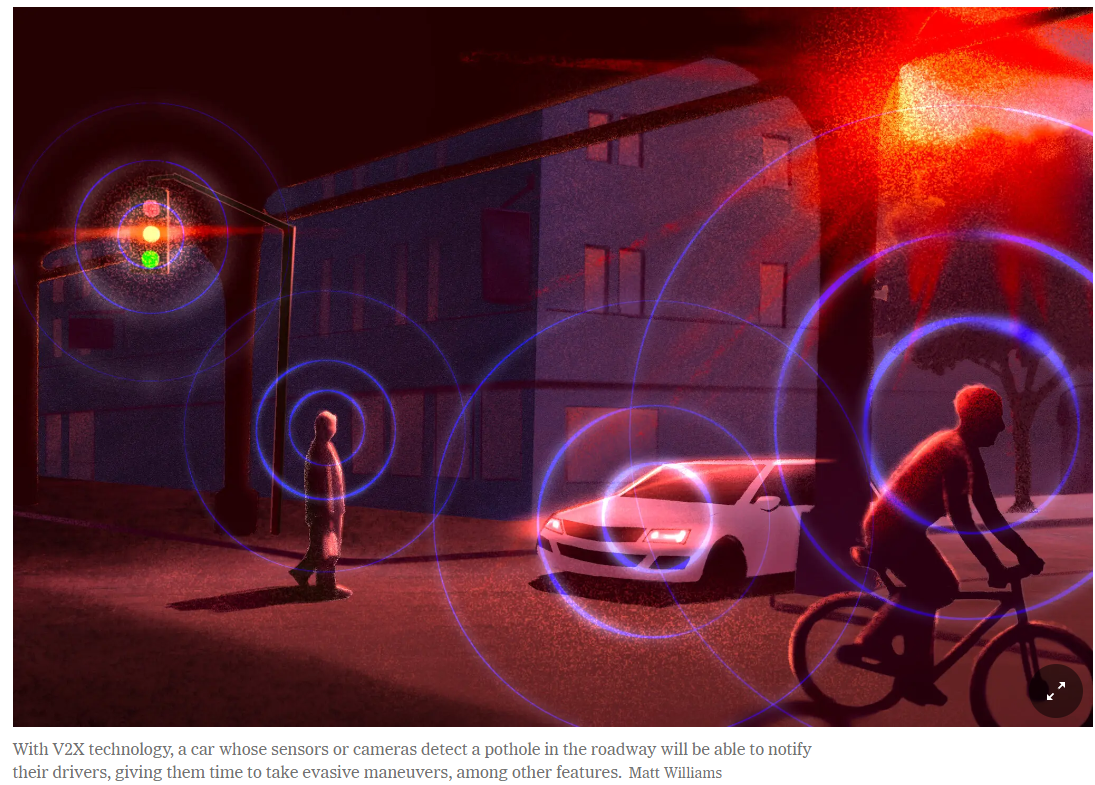
With V2X technology, a car whose sensors or cameras detect a pothole in the roadway will be able to notify their drivers, giving them time to take evasive maneuvers. Highway workers will be alerted to an oncoming vehicle that’s traveling too close to them. School bus drivers will be warned against letting children off if a vehicle fails to stop. And bicyclists (and drivers) will be made aware of each other before possible collisions.
“While passive safety such as seatbelts and active safety from such things as lane departure warning has improved occupant safety, fatalities outside the vehicle are growing,” said Anupam Malhotra, senior director of connected services for Audi of America. “We’re now working to provide cooperative safety, sharing safety-related information with others.”
Audi has spearheaded work in V2X technology, collaborating with the Virginia Department of Transportation and in Alpharetta, Ga., on tests that feature vehicles that can communicate with school buses, highway workers and cyclists. C-V2X test vehicles were able to detect stopped school buses, vehicles running a red light, construction workers in the roadway, and bicyclists in blind spots or attempting to turn in front of a turning vehicle. And those vehicles and people could, in turn, detect the C-V2X vehicle.
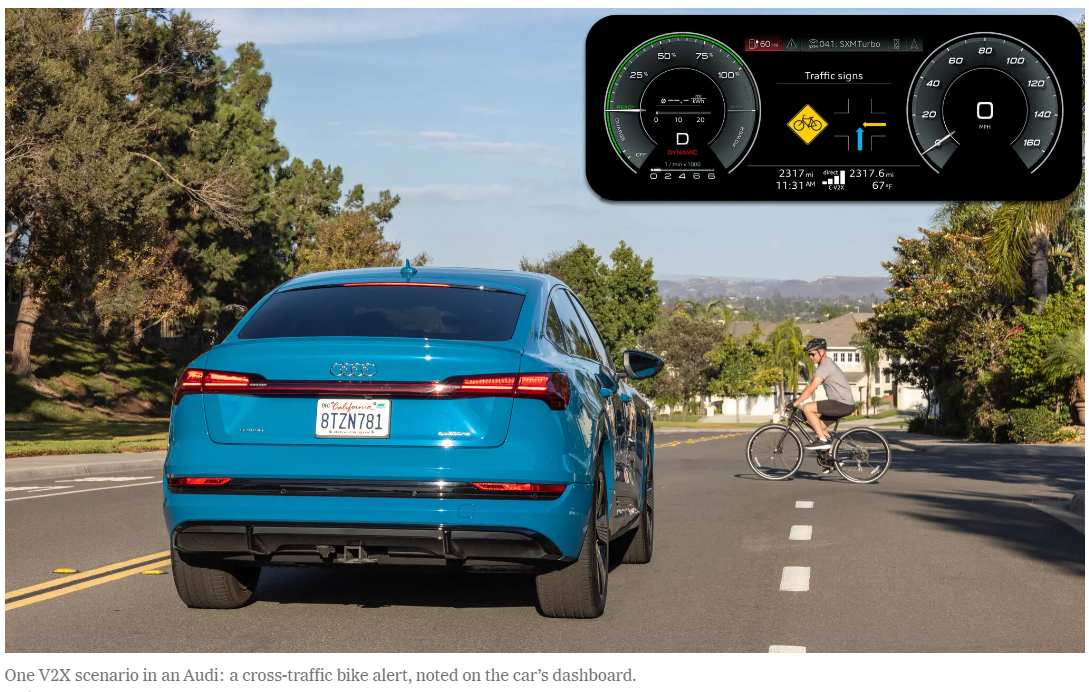
In a recent demonstration of the technology at Audi’s offices in Oxnard, Calif., a bicyclist equipped with a V2X sensor drove across the path of an Audi e-tron. Before the cyclist was visible to the driver, a warning sound and icon appeared on the instrument panel, giving the driver time to brake.
In addition to increased safety, vehicle communication can reduce driver anxiety. Some Audi vehicles in 103 U.S. cities, using a different technology, can already communicate with traffic lights, with a countdown to a green light appearing on the instrument panel. Simply knowing when the light will change can make driving in stop-and-go traffic less stressful.
These alerts and warnings can be conveyed on a vehicle’s instrument panel, a hand-held device placed in a jacket, or even on a smartphone. And it will be relatively easy for car manufacturers to incorporate automatic emergency braking into the V2X system.
V2X technology could also be used for so-called “dynamic geofencing,” said Johannes Springer, the director general of the 5G Automotive Association, a cross-industry organization developing transportation services. For example, when excess emissions are detected in the atmosphere, a hybrid vehicle that is tracked traveling within a virtual perimeter could be instructed to drive only in electric mode, he said.
“I can’t imagine future vehicles without V2X technology,” said Ram Iyer, senior vice president for connectivity at Harman International, a supplier of vehicle technology. “Because the human attention span is decreasing, you’ll look for these technologies to save your life.”
V2X technology is expected to appear in vehicles as soon as the 2025 model year. But until there’s a large population of vehicles capable of communicating, the handful that can will largely be talking to themselves.
Some vehicles in China already offer V2X in certain locations and with limited features, such as warnings about possible collisions, blind spots, loss of control and traffic jams. And in Europe, certain Volkswagen models offer a different form of V2X technology, known as Car2X; those vehicles can network directly with other VWs, informing each other of critical traffic situations, including broken-down cars and approaching ambulances.
While many manufacturers have committed to offering V2X technology, there are still hurdles to overcome, beyond the necessity of reaching a critical mass. The U.S. government had initially recommended a mandate of V2X technology for new vehicles, but the recommendation was rescinded during the Trump administration. And some of the spectrum that the Federal Communications Commission had assigned for V2X communications was reallocated for other uses. The F.C.C. said that C-V2X technology was rendered unnecessary by the increasing ubiquity of in-vehicle sensors and cameras, a position with which the Alliance for Automotive Innovation, an industry trade group, disagrees.
“We’ve had a 10-year battle with the F.C.C. for radio spectrum,” said Hilary Cain, vice president of technology, innovation, and mobility policy at the alliance. “Now technical rules for C-V2X still need to be finalized. But V2X is very important because unlike traditional vehicle sensors, C-V2X can see around corners and through things.”
To communicate, the industry will initially employ LTE cellular technology; to avoid transmission delays, vehicles will speak to each other directly, not through cellular transmission towers. Eventually, the system will switch to 5G standards, allowing for faster communication.
One piece of positive news: V2X safety features will not cost extra.
“I’ve never heard of any auto company planning to profit off of this safety technology,” Ms. Cain said. “And it’s a cooperative technology. All vehicles will be able to communicate with each other, regardless of make.”
“V2X is a very important feature in vehicles; it will make an enormous contribution to safety,” said Maite Bezerra, a smart mobility and automotive industry analyst at ABI Research, a technology intelligence firm in London.
“There are so many accidents today that could be prevented. And with advanced warnings of traffic jams and red lights reducing sudden braking, fuel efficiency will also be improved.”
While manufacturers and governments around the world see the value of V2X, none have mandated its use. In China and Europe, V2X will become part of their New Car Assessment Program, or N.C.A.P., with models receiving points for including V2X systems.
In the United States, the F.C.C. has not yet promulgated final rules governing V2X standards. A number of automakers — including Audi, Ford, Jaguar Land Rover — as well as several state departments of transportation and equipment manufacturers have filed a request to the F.C.C. for a waiver, which if granted, will allow C-V2X technology to be offered. The waiver request, filed last December, has not yet been acted on.
But the industry is not waiting. Audi, for example, is working with bicycle and equipment manufacturers to offer V2X transponders for cyclists and expects to begin offering V2X in its 2025 model year vehicles.
“We’re currently including V2X in the development of our vehicle architecture, as we can’t wait, and we need to be ready,” said Mark Dahncke, Audi of America’s director of product communications.
“The first person who sends us a letter saying, ‘You saved my life,’ will make it all worth it.”
Hello, Fellow Car. We’ve Got a Problem. Let’s Talk. / https://archive.ph/nZufq
A system called C-V2X — cellular vehicle-to-everything technology — will allow vehicles to communicate with each other, with a goal to save lives in the process.By Eric A. Taub
Oct. 5, 2022
This article is part of our series on the Future of Transportation, exploring innovations and challenges that affect how we move about the world.
Communication is key to any good relationship. But when it comes to vehicles and their owners, silence largely prevails.
Except for a few vague warning lights on the dashboard and side mirrors — and a few sensor-based sounds in some recent models and, of course, car horns — drivers know nothing about what the vehicles and pedestrians around them are about to do. A dangerous obstruction in the roadway, two cars about to move into the same lane, or a bicycle coming out of a blind alley up ahead are a few potential surprises, with the driver finding out about them often too late — sometimes with deadly results.
Yet by later this decade much of such surprises is expected to change. Manufacturers are developing systems generically known as C-V2X — shorthand for cellular vehicle-to-everything technology — for vehicles to communicate with each other and pedestrians, cyclists, construction workers (via wearable sensors or smartphones) and road infrastructure elements, like traffic lights.
With V2X technology, a car whose sensors or cameras detect a pothole in the roadway will be able to notify their drivers, giving them time to take evasive maneuvers. Highway workers will be alerted to an oncoming vehicle that’s traveling too close to them. School bus drivers will be warned against letting children off if a vehicle fails to stop. And bicyclists (and drivers) will be made aware of each other before possible collisions.
“While passive safety such as seatbelts and active safety from such things as lane departure warning has improved occupant safety, fatalities outside the vehicle are growing,” said Anupam Malhotra, senior director of connected services for Audi of America. “We’re now working to provide cooperative safety, sharing safety-related information with others.”
Audi has spearheaded work in V2X technology, collaborating with the Virginia Department of Transportation and in Alpharetta, Ga., on tests that feature vehicles that can communicate with school buses, highway workers and cyclists. C-V2X test vehicles were able to detect stopped school buses, vehicles running a red light, construction workers in the roadway, and bicyclists in blind spots or attempting to turn in front of a turning vehicle. And those vehicles and people could, in turn, detect the C-V2X vehicle.
In a recent demonstration of the technology at Audi’s offices in Oxnard, Calif., a bicyclist equipped with a V2X sensor drove across the path of an Audi e-tron. Before the cyclist was visible to the driver, a warning sound and icon appeared on the instrument panel, giving the driver time to brake.
In addition to increased safety, vehicle communication can reduce driver anxiety. Some Audi vehicles in 103 U.S. cities, using a different technology, can already communicate with traffic lights, with a countdown to a green light appearing on the instrument panel. Simply knowing when the light will change can make driving in stop-and-go traffic less stressful.
These alerts and warnings can be conveyed on a vehicle’s instrument panel, a hand-held device placed in a jacket, or even on a smartphone. And it will be relatively easy for car manufacturers to incorporate automatic emergency braking into the V2X system.
V2X technology could also be used for so-called “dynamic geofencing,” said Johannes Springer, the director general of the 5G Automotive Association, a cross-industry organization developing transportation services. For example, when excess emissions are detected in the atmosphere, a hybrid vehicle that is tracked traveling within a virtual perimeter could be instructed to drive only in electric mode, he said.
“I can’t imagine future vehicles without V2X technology,” said Ram Iyer, senior vice president for connectivity at Harman International, a supplier of vehicle technology. “Because the human attention span is decreasing, you’ll look for these technologies to save your life.”
V2X technology is expected to appear in vehicles as soon as the 2025 model year. But until there’s a large population of vehicles capable of communicating, the handful that can will largely be talking to themselves.
Some vehicles in China already offer V2X in certain locations and with limited features, such as warnings about possible collisions, blind spots, loss of control and traffic jams. And in Europe, certain Volkswagen models offer a different form of V2X technology, known as Car2X; those vehicles can network directly with other VWs, informing each other of critical traffic situations, including broken-down cars and approaching ambulances.
While many manufacturers have committed to offering V2X technology, there are still hurdles to overcome, beyond the necessity of reaching a critical mass. The U.S. government had initially recommended a mandate of V2X technology for new vehicles, but the recommendation was rescinded during the Trump administration. And some of the spectrum that the Federal Communications Commission had assigned for V2X communications was reallocated for other uses. The F.C.C. said that C-V2X technology was rendered unnecessary by the increasing ubiquity of in-vehicle sensors and cameras, a position with which the Alliance for Automotive Innovation, an industry trade group, disagrees.
“We’ve had a 10-year battle with the F.C.C. for radio spectrum,” said Hilary Cain, vice president of technology, innovation, and mobility policy at the alliance. “Now technical rules for C-V2X still need to be finalized. But V2X is very important because unlike traditional vehicle sensors, C-V2X can see around corners and through things.”
To communicate, the industry will initially employ LTE cellular technology; to avoid transmission delays, vehicles will speak to each other directly, not through cellular transmission towers. Eventually, the system will switch to 5G standards, allowing for faster communication.
One piece of positive news: V2X safety features will not cost extra.
“I’ve never heard of any auto company planning to profit off of this safety technology,” Ms. Cain said. “And it’s a cooperative technology. All vehicles will be able to communicate with each other, regardless of make.”
“V2X is a very important feature in vehicles; it will make an enormous contribution to safety,” said Maite Bezerra, a smart mobility and automotive industry analyst at ABI Research, a technology intelligence firm in London.
“There are so many accidents today that could be prevented. And with advanced warnings of traffic jams and red lights reducing sudden braking, fuel efficiency will also be improved.”
While manufacturers and governments around the world see the value of V2X, none have mandated its use. In China and Europe, V2X will become part of their New Car Assessment Program, or N.C.A.P., with models receiving points for including V2X systems.
In the United States, the F.C.C. has not yet promulgated final rules governing V2X standards. A number of automakers — including Audi, Ford, Jaguar Land Rover — as well as several state departments of transportation and equipment manufacturers have filed a request to the F.C.C. for a waiver, which if granted, will allow C-V2X technology to be offered. The waiver request, filed last December, has not yet been acted on.
But the industry is not waiting. Audi, for example, is working with bicycle and equipment manufacturers to offer V2X transponders for cyclists and expects to begin offering V2X in its 2025 model year vehicles.
“We’re currently including V2X in the development of our vehicle architecture, as we can’t wait, and we need to be ready,” said Mark Dahncke, Audi of America’s director of product communications.
“The first person who sends us a letter saying, ‘You saved my life,’ will make it all worth it.”


