
LowlyPheasent
kiwifarms.net
- Joined
- Mar 9, 2024
Shading it some probably isn't a bad idea. I don't think they like full sun.My newly-planted heritage raspberry plant seems to not be coping with the heat well. Less sun? More water?
Follow along with the video below to see how to install our site as a web app on your home screen.
Note: This feature may not be available in some browsers.
Shading it some probably isn't a bad idea. I don't think they like full sun.My newly-planted heritage raspberry plant seems to not be coping with the heat well. Less sun? More water?

This is a continuation of my post asking for help with my apple trees. https://kiwifarms.net/threads/gardening-and-plant-thread.10883/post-19028329I'll get some pics of what's going on later. They're staked with bungee cords atm. it allows them to move a little bit without going too much.

Bungee cords aren't strong enough to stake a tree properly. Your placement of the T posts is fine but switch out the bungees for 3 sections of rope, tie them at each post and loop them around the tree to the same post. To keep the ropes from rubbing bark off, the easiest thing to use is old garden hose cut to 6-8" pieces and make sure they're around the tree when you tighten the rope.Most of my apple trees are strung up like so:
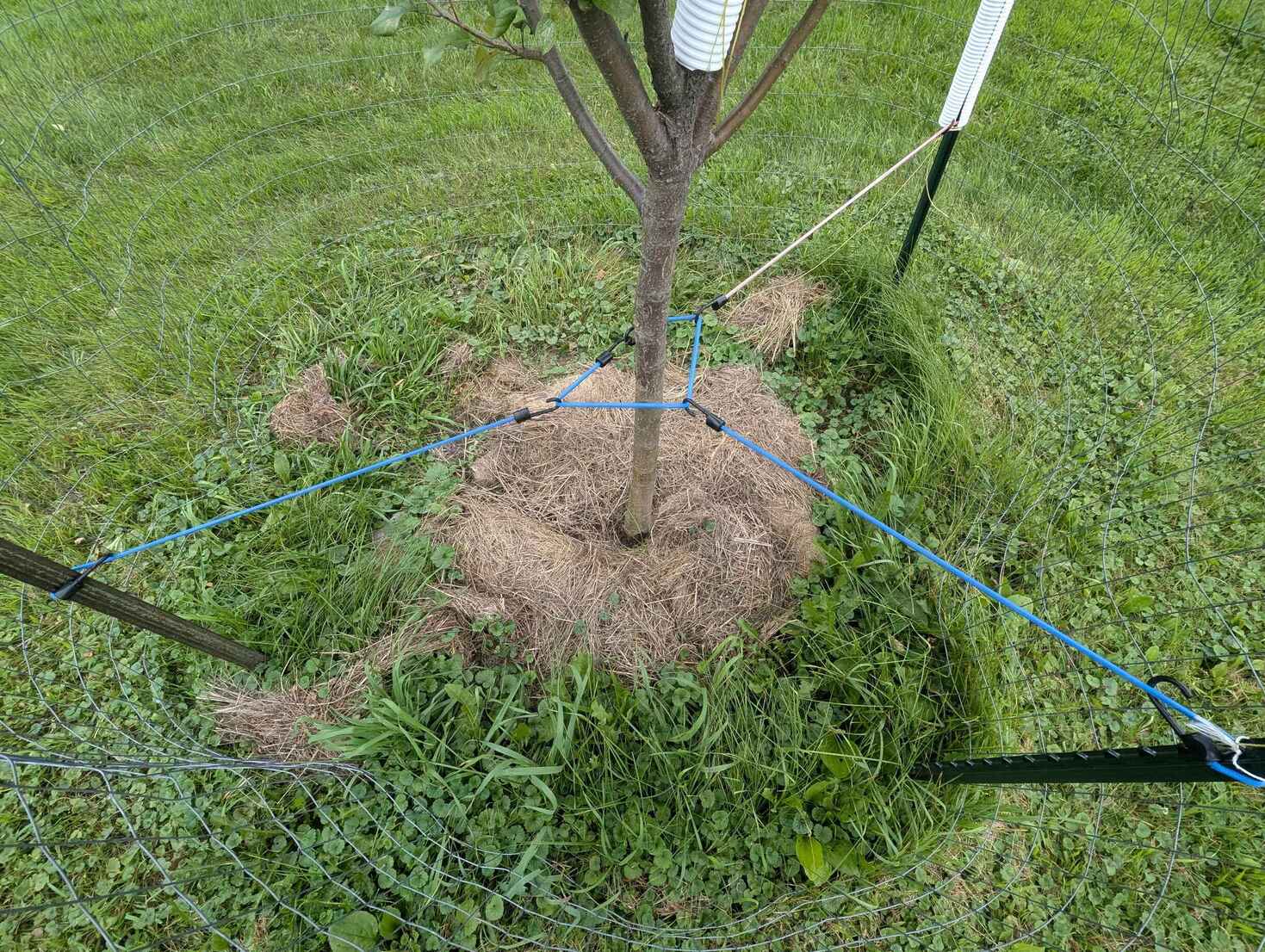
Held more or less in place with bungees, and each gets a small circle of hay mulch. I regularly remove these plants you see around them. This was taken shortly before weed whipping.
This is because in heavy winds they like to tip. Like I said, in the first post the root ball for these guys looks fine:
The traps work rather well. I've found you need to move them to the problem once they're depleted, as the smell of dead beetles repels them away. Haven't tried with the apple trees, but have tried in other parts of the garden.For the beetles, have you tried pheromone traps placed a hundred-ish feet away?
looks like it's sulfur and pyrethrin. I've had good experiences with pyrethrin before. Maybe I'll try it out..I would suggest Bonide Orchard Spray
I'm confused by this- I was told the tree needs to be able to lean a little bit so it doesn't become dependent on the ties.Bungee cords aren't strong enough to stake a tree properly.
Looking at the splotches on these leaves makes me think it is rust. This is a fungal infection which can really hit apple trees. Rust can infect apples, crab apples, cedars, junipers, etc. Some of the trees can even be asymptomatic carriers which then perpetuate the issue for the other plants that struggle to fight it off. Had this issue with a cedar transmitting to apple trees and they've been pretty well fucked ever since while a pre-existing apple tree and the cedar were fine. Hit it with some fungicide and see if that helps. Culling transmitting plants may aslo help minimize how much you have to treat trees, sucks losing those plants but if you end up having to treat them every year and you end up with no harvest the ornamental shits better off going than the apples.
I've staked a lot of trees and haven't had that problem. Don't pull the ropes super tight and it'll have some movement still, then remove them once the roots are more established, max 1 year.I'm confused by this- I was told the tree needs to be able to lean a little bit so it doesn't become dependent on the ties.

In the second picture it almost looks like the string trimmer has damaged the very base of the tree. If this is the case then the tree may have a lot of trouble going forward. I have had some trees cling to life after being damaged during trimming for quite a few years, but they never really thrive after that. I moved trimmer damaged maple to a really good area and it started growing like a weed, but 10 years later the lasting damage of the trimmer is evident on it's trunk, it never managed to close the wound. I have had another tree come back after a string damage as well, and it did close it's wound. Toss up really.This was taken shortly before weed whipping.
when I got the property a year ago, they had those plastic collars made of corrugated plastic drainage pipe. I took all that off as they seemed to be applying pressure around the trunk. though this should also have mostly protected them from the trimmer. I've never gotten the weed whipper close to the base without the plastic pipe for protection.The apple tree itself looks strange, very top heavy, the lower trunk almost looks thinner than the branching sections.
luckily 50 lb of hay is like 4 bucks. I'll give more cover asap.I usually have double/triple the amount of ground covered away from the tree, about a 6ft diameter circle.
I took 4 lb off my each last February. I'll do a bit more this next year. I want to keep them about 10-12 feet tall.Maybe a pruning is in order to reduce how top heavy it is?
Ok, that explains the strange growth. Maybe it just needs more time to thicken out after the damage. Make sure at the very base of the tree the hay isn't pushed up too high on the trunk, sometimes it traps moisture and bugs, I usually make sure there a little air gap. It could help loosen the soil over time, the worms will move in under the hay, and start to break it down and do their thing, also beneficial fungi/more weed and grass suppression.they had those plastic collars made of corrugated plastic drainage pipe. I took all that off as they seemed to be applying pressure around the trunk.
yep! when I replenish the hay it looks like a donut with the root ball in the middle.Make sure at the very base of the tree the hay isn't pushed up too high on the trunk
If you have enough trees to trim around I'd recommend a rotary scissor attachment, 1 blade is stationary while the other rotates so you can put it right up against the trees without cutting them. Stihl and Milwaukee make them for their respective power head systems and there are generic options on Amazon that fit any regular string trimmer. They're also nice for regular trimming too since they aren't flinging everything at you.Careful with the sting trimmer the damage really adds up over time, personally I use a pair of garden scissors around the trees I care about, rather than trying to get right up close with the trimmer.
That's how I did it, trees would only get staked if it was necessary or if a customer requested it. I always had to stake more often when using an auger, probably from it loosening up too much soil and not being a perfect fit for the root ball like you can get with hand digging. I used a slow release fertilizer that I don't recall the name of, it wasn't really necessary for decorative trees but it helps fruit trees more in my experience.I personally have never had a staked tree do well, they always end up crooked. Even a large fresh transplant by a professional tree service never gets staked if it's planted correctly. I've only ever put manure, and then a thick layer of mulch around my trees, no experience using commercial fertilizer. I usually have double/triple the amount of ground covered away from the tree, about a 6ft diameter circle.


You might need one of those 3D printed orchid pots and then just "abandon" it for a while. Neglect it and it might come back.Could this be the potting job being bad and the roots getting too dry as a result? Am I fucked?
What sort of pot do you mean? The one I repotted it into has a glass bit on the bottom filled with water and then the water goes up via a wick to a larger pot. I made sure to fill the wood mix a bit higher than it was in the previous pot and spread the roots a bit more. My current plan is pretty much that, leaving it alone in it's new pot.You might need one of those 3D printed orchid pots and then just "abandon" it for a while. Neglect it and it might come back.
This is the opposite. It's a pot with a lot of holes in it. You fill it with moss/orchid bark and just submerge it once in a while.What sort of pot do you mean? The one I repotted it into has a glass bit on the bottom filled with water and then the water goes up via a wick to a larger pot. I made sure to fill the wood mix a bit higher than it was in the previous pot and spread the roots a bit more. My current plan is pretty much that, leaving it alone in it's new pot.

Haskap is somewhat popular where I live as well, I had never heard of them until recently! They are quite tasty, I hear the birds get the ripe ones quickly if you aren't paying attention.This may only be of interest to fellow cold-weather zone inhabitants, but I was harvesting my haskap (aka honeyberries) and it’s looking like a great crop this year.
For some reason, hardly anyone has heard of these but they are amazing so I’m going to post some pics.
View attachment 6176194
View attachment 6183511
Where I live there are a limited number of perennial fruit plants that can survive the winter. Short season apples, some pears, raspberries, strawberries, some hardy sour cherries. Most of them have to be babied and coddled a bit to survive.
Edible honeysuckle is an exception. Native to Siberia, it thrives in the cold weather, the deer leave it alone, and it’s quite tasty. Like a tart cross between blueberry and raspberry.
The flowers have lived through -10 frosts, they are the first things to flower in spring, and the first fruit to ripen in late June to early July.
I planted these 12 years ago, they are 5 to 7 feet tall. Love ‘em. I have to net them or the cedar waxwings will eat every single berry before they ripen.
View attachment 6183543
View attachment 6183553

Cedar waxwings will find your haskap plants and eat every single berry, and they will remember to come back every year and bring their friends. Netting is required.Haskap is somewhat popular where I live as well, I had never heard of them until recently! They are quite tasty, I hear the birds get the ripe ones quickly if you aren't paying attention.
This is actually meant to stop the voles from ringing the small trees by eating the tender young bark in winter under the snow. By the time the trees get a few years older this should be less of a risk.they had those plastic collars made of corrugated plastic drainage pipe.
yep. definitely a lot of voles where I'm at. I'll place em back on for winter. Good call.voles
I wasn't able to dry any of these bales and got to clean up ~500 bales/$2500 worth of ruined hay instead, very cool!I may be able to dry it out and sell as cow quality but at this point the other 400 bales are trash.
