If you’d like to debate
Anita Sarkeesian about whether or not male privilege exists, we’ll make this easy for you: She’s not interested. It’s been a decade since her groundbreaking web series,
Tropes vs. Women in Video Games, kicked off a firestorm of discussion and criticism around the treatment of female characters. It’s been almost as long since Sarkeesian found herself in the eye of the
Gamergate storm, where she faced an onslaught of harassment for her efforts.
If it were up to her, she’d never speak about any of it again. Problem is, she has to.
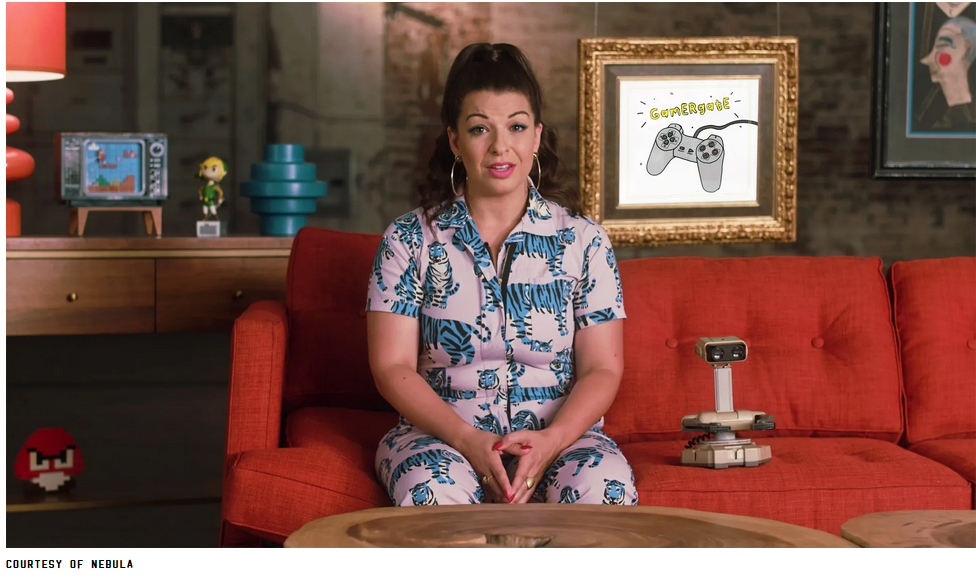
That’s because, for Sarkeesian, historical context is important. She hears echoes of Gamergate in modern online harassment and disinformation campaigns, and to not point out those similarities would be remiss. Her new series,
That Time When, is a map to the crossroads between pop culture and politics. Over its nine episodes she covers everything from
Star Trek to the Satanic Panic of the 1980s, which she investigates in this week’s episode. But it culminates with Gamergate, even if it’s a period Sarkeesian would like to never revisit. “I didn’t just live through this history, I was part of this history,” she says. “I’m really tired of talking about it.”
Hollywood, video games, TV—lots of industries have evolved in the past decade. So have the politics of the day. People now understand media representation better than they did before. But there has also been fallout, like when
Obi-Wan Kenobi star Moses Ingram started
receiving racist messages on social media following the show’s launch, or when Kiki Farms users organized
stalking campaigns. These things have precedents. “Moments when pop culture and politics collide are about regressive, puritanical control over women’s bodies, over culture, over challenges to the status quo or perceived progressive shifts,” Sarkeesian says.
That Time When, like
Tropes—like all of her work—aims to make those connections.
Much of
That Time When,
which is currently running on streaming service Nebula, focuses on the past few decades, but one episode goes back to the early 1900s and the movies of filmmaker Lois Weber. There’s an episode dedicated to the Chicks (formerly the Dixie Chicks) getting canceled, one on racial politics and the
impact of Star Trek on Black public figures. There’s even one on another famous “-gate”—Nipplegate, when Janet Jackson’s breast was temporarily exposed during a Super Bowl halftime performance.
One installment, about the panic that ensued when Ellen DeGeneres came out on her primetime TV show, features rhetoric that is eerily reminiscent of what’s going around in the debate over trans rights. Same goes for the talking points around “traditional” family values and reproductive rights that surfaced when TV character Murphy Brown became a single mother in the early ’90s.
Even so-called cancel culture isn’t new, but rather a tactic long weaponized by the right, Sarkeesian notes. She points to the episode in her series focused on the Chicks. In 2003, at a show in London, lead singer Natalie Maines voiced her opposition to the Iraq War, a statement that got the band blacklisted for years. What makes that episode important, Sarkeesian says, is the recognition that the term “cancel culture” is itself “manufactured and perpetuated by the right” to discredit progress on the left.
The point is to show that while these cultural moments remain different, they’re also cyclical. Knowing that can help people anticipate the next wave, although Sarkeesian warns those tides are more rapid now because of the speed of social media and internet discourse. That the series closes with Gamergate—a culture war that shaped the modern playbook for harassment and online disinformation campaigns, and even paved the way for political figures pivotal to Donald Trump’s presidency—feels inevitable.
The episode was challenging for Sarkeesian, but also proves her point about history repeating itself. “The strategies that they used to attack us got integrated into a political campaign and have become a kind of baseline for how online attacks happen,” she says. “I think Gamergate is an incredibly notable thing on its own. It’s a part of our understanding of how internet culture exists, how communities form and what they form around.”
Unlike the other episodes in the series, the Gamergate episode is one Sarkeesian has personal experience with. After her Kickstarter campaign to fund
Tropes launched in 2012, her examination of the treatment of women characters in games made her a lightning rod, a feminist bogeyman “ruining” video games with her pesky critiques.
When Gamergate was at its peak a couple years later, Sarkeesian was a constant target of threats and harassment. It’s easy to understand why she doesn’t want to relive it. But she also hopes doing so can give a chapter in her life an ending. “This feels a little bit like a wrap-up of all the work I’ve been doing into this package for people, so I can say, ‘Here is my take on this, this is what you get. Stop asking me about it,’” she says. A true season finale.


