
- Joined
- Nov 14, 2022
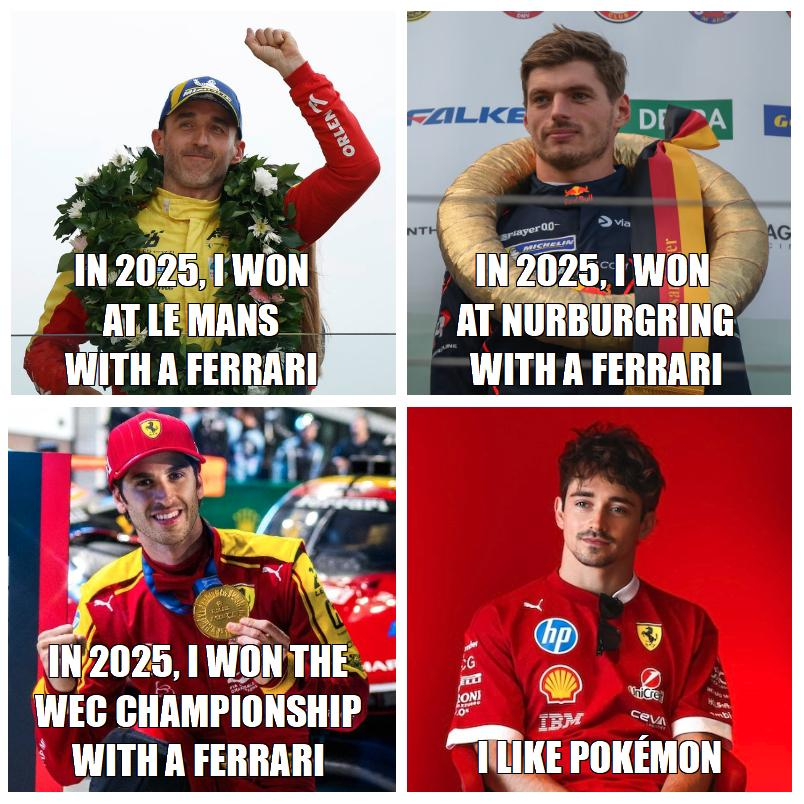
Some memes





Follow along with the video below to see how to install our site as a web app on your home screen.
Note: This feature may not be available in some browsers.


The ground effect worked until someone complained that they weren't effortlessly winning anymore.I will call it now, this ruleset will be gone by 2030. Just like the completely overhyped ground effect nonsense, nothing is going to fix the racing in F1 because nothing can.


DRS also did that, why go for the risky overtake into a corner when you can just wait for the next straight to be gifted the pass. I'm hoping losing that and going to tools that anyone can use anytime will mean they have to go for it in corners.The actual problems with racing are more related to there being little to no reward in taking risks on track
No one cares if a spec series is regulated to hell because that’s the whole point. F1 is supposed to be an engineering competition, but it isn’t because you’re not actually allowed to do anything anymore.I have no idea what any of that has to do with 'Europe'. American racing is even more regulated and always has been, with everything sacrificed for 'the show'. BoP, complete spec cars, random safety cars to make everything but the last few laps redundant etc. There is no engineering in American racing in any sense of the word and there hasn't been since arguably CART in the late 90s.

The root cause of all issues in F1 is the modern European elite's love regulating everything fun out of the world
Let’s be honest here though: if F1 was not so Euro-centric, we wouldn’t be hearing all this bullshit about sustainability, which is the mantra that has led the FIA and F1 down this weird road of no refueling and EV experimentation. I’m not even necessarily saying that Americans would have better priorities with making good regulations, but we certainly wouldn’t be trying to fit square pegs (“environmentalism”) into round holes (an expensive sport about using lots of oil and rubber).I have no idea what any of that has to do with 'Europe'.
You should actually pay attention to the details of the cars, if you don't believe this sport isn't an engineering competition already. As for the "sustainability" you have to understand that the last thing FIA wants for the sport to become a fiscal arms race because the good times of the 90's and 2000's ended with the 2008 market crash. They want a stable grid where at least in theory, the manufacturers who answer to shareholders can justify staying in.No one cares if a spec series is regulated to hell because that’s the whole point. F1 is supposed to be an engineering competition, but it isn’t because you’re not actually allowed to do anything anymore.
Also, the FIA flat out said that the current regs are for “sustainability” reasons. Can’t get much more Eurocrat than that.
IIRC the real reason for dropping refueling was that the refueling equipment was very heavy and shipping them across the world was expensive. Safety was the official reason but that was secondary compared to finance. And we do know what American pressure looks like because the grid girls were dropped because Liberty Media thought they were "sexist".Let’s be honest here though: if F1 was not so Euro-centric, we wouldn’t be hearing all this bullshit about sustainability, which is the mantra that has led the FIA and F1 down this weird road of no refueling and EV experimentation. I’m not even necessarily saying that Americans would have better priorities with making good regulations, but we certainly wouldn’t be trying to fit square pegs (“environmentalism”) into round holes (an expensive sport about using lots of oil and rubber).
Grid girls are dumb though. I want to see cars and racing, not hoes.And we do know what American pressure looks like because the grid girls were dropped because Liberty Media thought they were "sexist".
There’s a difference between coming up with new designs like six-wheelers and fan cars and slightly changing the shape of the body in a way that isn’t obvious to anyone who isn’t an expert in aerodynamics. Modern F1 only allows innovation in a handful of areas that get smaller and smaller every year.You should actually pay attention to the details of the cars, if you don't believe this sport isn't an engineering competition already.
That’s a fundamental difference in culture: enforced mediocrity versus booms and busts.As for the "sustainability" you have to understand that the last thing FIA wants for the sport to become a fiscal arms race because the good times of the 90's and 2000's ended with the 2008 market crash. They want a stable grid where at least in theory, the manufacturers who answer to shareholders can justify staying in.
The teams back in 2000's operated with a much bigger budget, with Toyota and Honda capping out at half a billion per year. Ferrari operated at around 400 million. The smallest teams operated at around 120ish million a year. The whole reason why the current reg mindset was implemented in the aftermath of that crash was that there was a serious risk of the sport's own existence because the car companies that backed the teams themselves were in fiscal turbulence.That’s a fundamental difference in culture: enforced mediocrity versus booms and busts.
Ironically, if they weren’t so heavily regulated, the costs would be lower because you’d be rewarded for thinking outside the box instead of having to grind to optimize the last little bit out of the existing design.
Also, there’s tons of money in F1, it just all goes to the athletes and executives instead of to engineering.
Front axle recuperationLMP1 cars with more advanced and more open hybrid concepts did the lift and coast thing a decade ago at Le Mans, for the same reason. They were only allowed to use a set amount of fuel per lap, and lifting before braking is simply the best way to save fuel. Corner exit is just way more important for a fast lap than late braking. Plus you get the hybrid boost on corner exit. The racing did not suffer, in fact the opposite. The stretch from 2013-2017 had some of the best racing ever seen in endurance racing.
But the rules were just much better thought out. Porsche and Toyota used two hybrid systems working in tandem to recover as much energy as possible while Audi stuck with just the one system on the front wheels. This difference in execution created differences between car strengths and weaknesses on different parts of the track, which always improves racing. F1 can't do that because there's too many stakeholders and you always end up with a huge compromise that everyone will hate.
I will call it now, this ruleset will be gone by 2030. Just like the completely overhyped ground effect nonsense, nothing is going to fix the racing in F1 because nothing can.

>326 km/h.Analysts of top speeds during testing, with the heavy caveat of we don't know what map they had/how much they were pushing.
View attachment 8560217
The real test will be how this performance is drawn out when you consider the battery management during the race, but it's heartening to see Red Bull looking healthy and Cadillac performing at least not as bad as other teams, which is going to turn some heads when the racing starts.Analysts of top speeds during testing, with the heavy caveat of we don't know what map they had/how much they were pushing.
View attachment 8560217