L - A
A 1,000-year-old seed discovered in a cave in the Judean desert has sprouted, grown and reached maturity, and appears to have medicinal qualities.
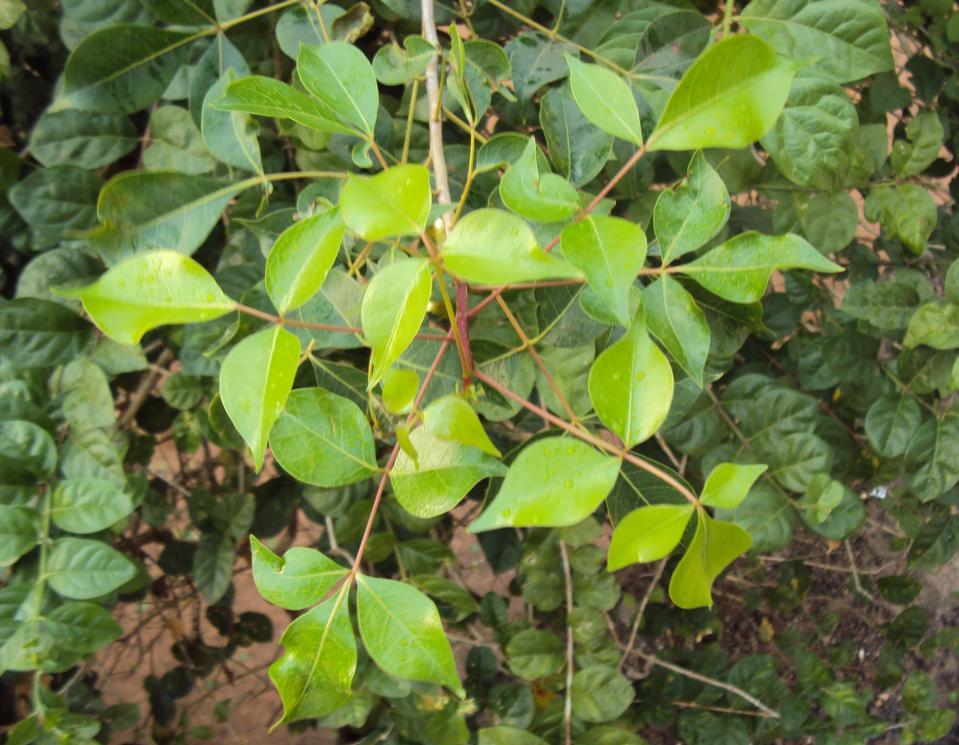
Commiphora caudata leaves. This tree may be a close relative to “Sheba”, a young Commiphora tree ... [+]
Vinayaraj via a Creative Commons license
A mysterious ancient seed recovered during archaeological excavations of a cave near Jerusalem has grown into a tree that may be the source of a medicinal balm mentioned in the Bible, according to a newly published study.
The seed was discovered in a Judean Desert cave in the late 1980s, and radiocarbon analysis indicated it was approximately 1,000 years old. The seed likely survived from a now-extinct population of trees that existed in the Southern Levant, a region comprising modern-day Israel, Palestine and Jordan, and is the first of its kind to be found there.
Tests suggested that the 2 cm long (slightly less than 1 inch; Figure 1a) seed was still viable, so the research team planted and carefully tended it. It took around five weeks to sprout. Now, 14 years later, the tree has reached maturity (Figure 1). Researchers named their tree “Sheba” to honor of the Queen, Sheba, who brought the balsam root from Arabia to King Solomon as a gift.
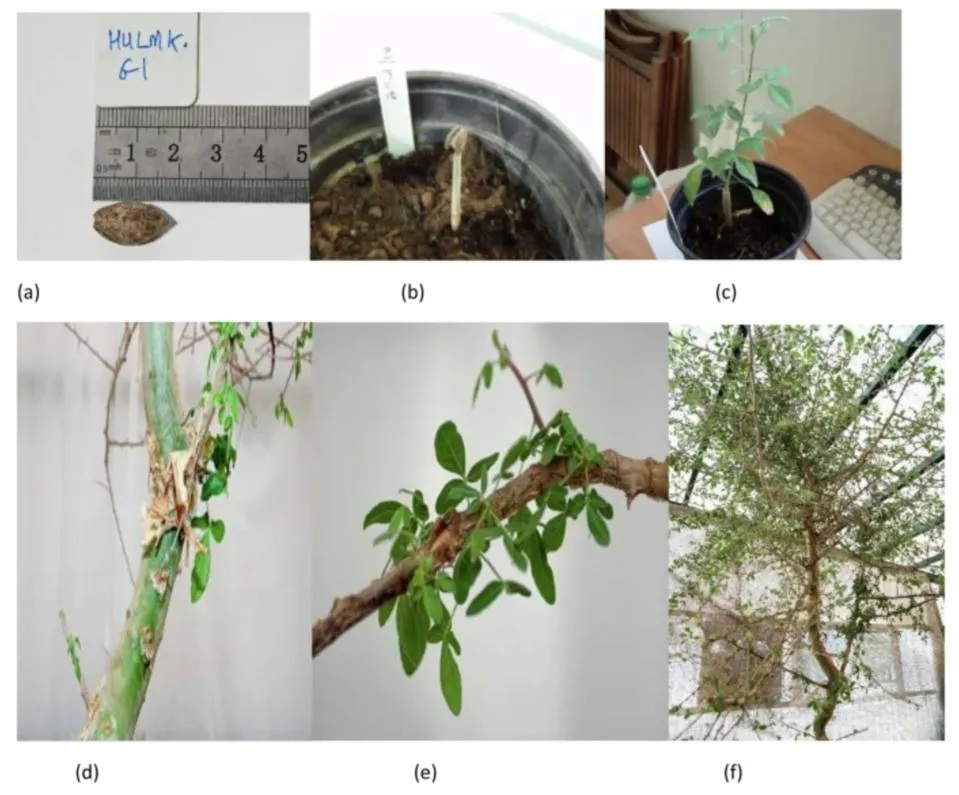
F I G U R E 1 : (a) ancient seed prior to planting (b) developing seed at 5 weeks showing epicotyl and developing cotyledons covered by seed coat (c) seedling (6 months) (d) peeling bark (12 years) (e) leaves showing fine hairs (12 years) (f) mature tree (12 years). Permission for the use of pictures shown in Fig. 1 (a) and (c-f) was provided by Mr Guy Eisner and for Fig. 1 (b) by Dr Elaine Solowey.
doi:10.1038/s42003-024-06721-5
“Sheba” is approximately 3 m (10 feet) tall, its bark is pale green-brown and peels in thin, papery sheets revealing a dark green, possibly photosynthetic, bark below. “Sheba” is deciduous, shedding its leaves during the cooler months of December through April.
“‘Sheba’, an unknown Commiphora species with a unique genetic fingerprint, may represent an extinct taxon once native to this region whose resin ‘tsori’ mentioned in Biblical texts was valuable, associated with healing but not described as fragrant,” summarized the researchers in their study.
DNA analysis revealed that “Sheba” is a unique species of Commiphora, which are distributed across Africa, Madagascar and the Arabian Peninsula and known for their aromatic gum resins. With approximately 190 scientifically described species known, the drought-resistant Commiphora is the most species-rich genus of flowering plants in the frankincense and myrrh family, Burseraceae. Historically, these highly fragrant species provided highly prized aromatic resins that served as the basis for various fragrances, incenses and for medicinal uses.
However, GC-MS analysis has detected minimal fragrance from the leaves, bark and resin, indicating that “Sheba” is probably an extinct species of Commiphora that instead creates a resinous healing extract. Indeed, wounding the bark produces a small amount of clear oleoresin, which has been used to reduce inflammation in human patients. The researchers also found an oil, a type of squalene, also with antioxidant properties that may have been applied topically to lubricate and protect the skin.
Because the seed was found in a cave, it is likely that the people living in the region planted these trees, suggesting that they were aware of its medicinal qualities. Thus, the research team proposes that resin from the tree might be the mysterious “tsori,” a medicinal compound mentioned several times in the bible. Tsori was highly prized in the ancient world and was exported throughout the Roman Empire. Previous research suggested that in addition to its healing properties, tsori was used as a perfume and incense, for embalming, and even as an antidote to poisons.
That said, currently, it is unclear what species “Sheba” belongs to, because the tree has not flowered, and therefore hasn’t produced the reproductive material scientists need to carry out more detailed species-level analyses. At this time, it is not clear if “Sheba” will ever flower.
Nonetheless, the researchers concluded that “Sheba” represents an extinct lineage of trees that was once widespread and common throughout the Levant but seems to have disappeared by the 9th century. Of course, this points to the important question: why did these trees go extinct?
A 1,000-year-old seed discovered in a cave in the Judean desert has sprouted, grown and reached maturity, and appears to have medicinal qualities.
Commiphora caudata leaves. This tree may be a close relative to “Sheba”, a young Commiphora tree ... [+]
Vinayaraj via a Creative Commons license
A mysterious ancient seed recovered during archaeological excavations of a cave near Jerusalem has grown into a tree that may be the source of a medicinal balm mentioned in the Bible, according to a newly published study.
The seed was discovered in a Judean Desert cave in the late 1980s, and radiocarbon analysis indicated it was approximately 1,000 years old. The seed likely survived from a now-extinct population of trees that existed in the Southern Levant, a region comprising modern-day Israel, Palestine and Jordan, and is the first of its kind to be found there.
Tests suggested that the 2 cm long (slightly less than 1 inch; Figure 1a) seed was still viable, so the research team planted and carefully tended it. It took around five weeks to sprout. Now, 14 years later, the tree has reached maturity (Figure 1). Researchers named their tree “Sheba” to honor of the Queen, Sheba, who brought the balsam root from Arabia to King Solomon as a gift.
F I G U R E 1 : (a) ancient seed prior to planting (b) developing seed at 5 weeks showing epicotyl and developing cotyledons covered by seed coat (c) seedling (6 months) (d) peeling bark (12 years) (e) leaves showing fine hairs (12 years) (f) mature tree (12 years). Permission for the use of pictures shown in Fig. 1 (a) and (c-f) was provided by Mr Guy Eisner and for Fig. 1 (b) by Dr Elaine Solowey.
doi:10.1038/s42003-024-06721-5
“Sheba” is approximately 3 m (10 feet) tall, its bark is pale green-brown and peels in thin, papery sheets revealing a dark green, possibly photosynthetic, bark below. “Sheba” is deciduous, shedding its leaves during the cooler months of December through April.
“‘Sheba’, an unknown Commiphora species with a unique genetic fingerprint, may represent an extinct taxon once native to this region whose resin ‘tsori’ mentioned in Biblical texts was valuable, associated with healing but not described as fragrant,” summarized the researchers in their study.
DNA analysis revealed that “Sheba” is a unique species of Commiphora, which are distributed across Africa, Madagascar and the Arabian Peninsula and known for their aromatic gum resins. With approximately 190 scientifically described species known, the drought-resistant Commiphora is the most species-rich genus of flowering plants in the frankincense and myrrh family, Burseraceae. Historically, these highly fragrant species provided highly prized aromatic resins that served as the basis for various fragrances, incenses and for medicinal uses.
However, GC-MS analysis has detected minimal fragrance from the leaves, bark and resin, indicating that “Sheba” is probably an extinct species of Commiphora that instead creates a resinous healing extract. Indeed, wounding the bark produces a small amount of clear oleoresin, which has been used to reduce inflammation in human patients. The researchers also found an oil, a type of squalene, also with antioxidant properties that may have been applied topically to lubricate and protect the skin.
Because the seed was found in a cave, it is likely that the people living in the region planted these trees, suggesting that they were aware of its medicinal qualities. Thus, the research team proposes that resin from the tree might be the mysterious “tsori,” a medicinal compound mentioned several times in the bible. Tsori was highly prized in the ancient world and was exported throughout the Roman Empire. Previous research suggested that in addition to its healing properties, tsori was used as a perfume and incense, for embalming, and even as an antidote to poisons.
That said, currently, it is unclear what species “Sheba” belongs to, because the tree has not flowered, and therefore hasn’t produced the reproductive material scientists need to carry out more detailed species-level analyses. At this time, it is not clear if “Sheba” will ever flower.
Nonetheless, the researchers concluded that “Sheba” represents an extinct lineage of trees that was once widespread and common throughout the Levant but seems to have disappeared by the 9th century. Of course, this points to the important question: why did these trees go extinct?


