UN Duterte Megathread - Following the exploits of a president straight out of the DC universe

  • Want to keep track of this thread?
    Accounts can bookmark posts, watch threads for updates, and jump back to where you stopped reading.
    Create account
So if you haven't been following the news, Rodrigo Duterte, the President of the Philippines, is constantly stirring shit up. The biggest controversy about him by far is how he has repeatedly encouraged citizens to murder drug users (not even dealers, users). You see, the Philippines has a massive drug problem and drug addicts are despised for fueling the drug trade.

Just yesterday, a top UN official claimed said that Duterte should be investigated for murder, as he boasted that he had personally killed three suspected criminals. Today, Duterte responded to this statement... by threatening to raze the headquarters of the United Nations in New York City in response to those accusing him of human rights violations.

This is just a small sample of how crazy this dude is. I would not at all be surprised to learn that he himself does meth or snorts coke or something.
 
Somebody PLEASE put him and Justin Trudeau in a room together.
They should fight in MMA match, give Trudeau a chance to demonstrate his boxing skill and Duterte a chance to demonstrate his murdering skill.
 
They should fight in MMA match, give Trudeau a chance to demonstrate his boxing skill and Duterte a chance to demonstrate his murdering skill.
How about a poetry slam? Trudeau can finally put that substitute drama teacher experience to use.
 
Oh, THIS GUY. This guy is amazing. For a TL;DR summary of his recent antics:

His solution to hs countrys drug problem was to say "Drug users and dealers are scum. Kill them on sight."

He then went on to brag about how he personally hunted down and killed several druggies and dealers, with "Cut a man open like a salmon while looking him in the eyes" levels of ridiculousness in his details.

He capped it off by telling his citizens "If I can kill them, so can you!"


The UN had an ambassador suggest that someone investigate him for murder due to these statements.

His response was a mix of crazed philipino and the Navy Seal copypasta, with highlights including "You think you can talk to me like this you son of a bitch?", "I pay your bills, you sons of whores!", and "If you want me to, I'll come to America and burn down your UN, you bastards!"

A cheeky little guy. Sure to bring us entertainment in 2017.
 
Looks like DU30 is ready to start that alliance with Putin:

http://www.newsweek.com/philippines-duterte-open-russian-navy-joint-drill-538791?rx=us
President Rodrigo Duterte of the Philippines is open to the possibility of running joint military drills with Russia, his spokesman said Thursday, days after the Russian navy sent two ships on a goodwill visit to the country’s capital, Manila.

Duterte, who was elected last year on a heavily anti-drug platform, has become increasingly hostile towards the U.S. since taking office. He has also indicated he intends to pursue a tighter relationship with China and Russia.


Russia sent its Pacific Fleets deputy commander Eduard Mikhailov to Manila on Tuesday to strengthen defense ties between the two countries.


At a briefing in the presidential palace on Thursday, Duterte’s spokesman, Ernesto Abella, said: “The goodwill visit by the Russian Navy will contribute to the strengthening of friendship with the Philippine Navy.”
“It also is an indication that our maritime cooperation can further be enhanced to enable diplomacy and camaraderie.”

Duterte is set to visit the Russian ships tomorrow, according to Abella, as he is currently in Davao.
 
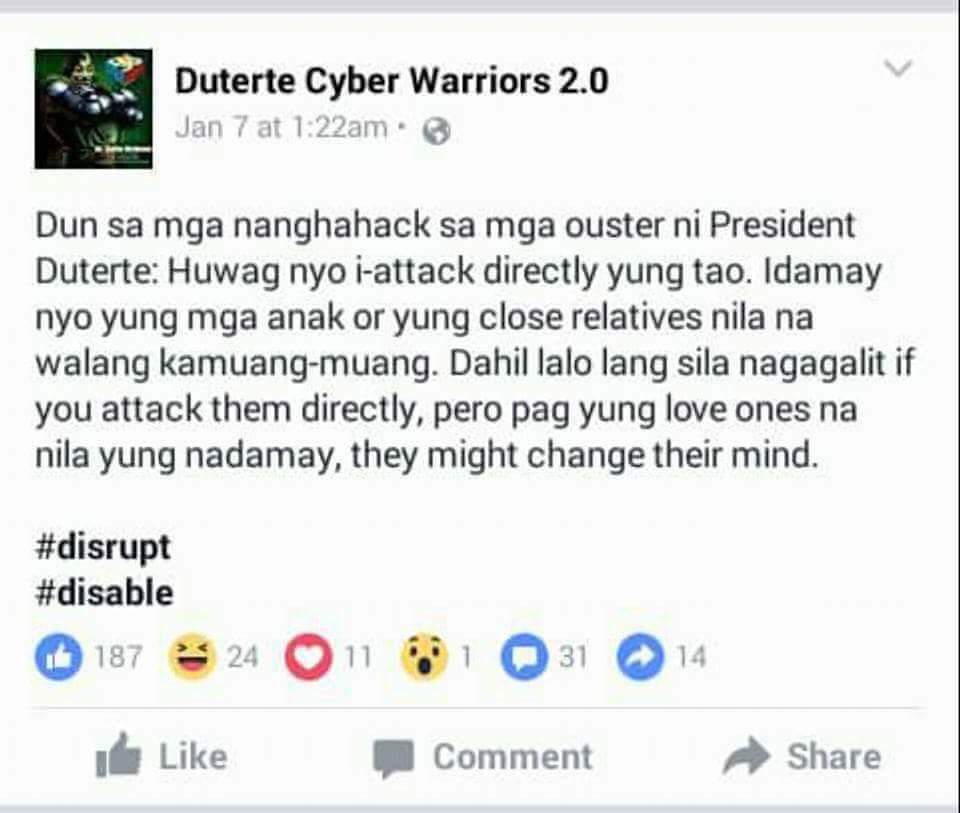
I'm more interested in his fanatics now. They seem to swarm around Facebook and post aggressively like a zealot.

BUojObY.jpg

Here they are in their natural habitat trying to be anonymoose and acting like script kiddies. In the nutshell the post says they should stop hacking the ones who disagree with Duterte directly and focus on their families and friends so that way they'll stop for sure.

Yes, Duterte's followers are rabid as the left and right and if weren't for them not speaking english they would have probably had their own thread here in community watch.

EDIT: Changed the wrong linked picture
 
Last edited:
I'm more interested in his fanatics now. They seem to swarm around Facebook and post aggressively like a zealot.

BUojObY.jpg

Here they are in their natural habitat trying to be anonymoose and acting like script kiddies. In the nutshell the post says they should stop hacking the ones who disagree with Duterte directly and focus on their families and friends so that way they'll stop for sure.

Yes, Duterte's followers are rabid as the left and right and if weren't for them not speaking english they would have probably had their own thread here in community watch.

EDIT: Changed the wrong linked picture
Fucking pinoys, lol
 
Honestly his policies have been hilarious and effective. I would not want to live under his regime, though.

Yeah I kinda like this dude lol. Naturally I wouldn't want to live under him or in the Philippines in general, as I am an American and therefore have standards. Still though, this guy rules!

Oh, THIS GUY. This guy is amazing. For a TL;DR summary of his recent antics:

His solution to hs countrys drug problem was to say "Drug users and dealers are scum. Kill them on sight."

He then went on to brag about how he personally hunted down and killed several druggies and dealers, with "Cut a man open like a salmon while looking him in the eyes" levels of ridiculousness in his details.

His response was a mix of crazed philipino and the Navy Seal copypasta, with highlights including "You think you can talk to me like this you son of a bitch?", "I pay your bills, you sons of whores!", and "If you want me to, I'll come to America and burn down your UN, you bastards!"

A cheeky little guy. Sure to bring us entertainment in 2017.

Lmao!!!! He's perfect!
 
Now his big moral crusade has extended to getting all Filipino women access to contraceptives. The less crack-babies conceived in the womb, the fewer they will have to be executed by the anti-junkie hit squads. Last time a Filipino president tried doing this kind of thing, the Supreme Court and Catholic Church teamed up to shoot it down, but maybe Duterte will be able to force it through.
 
Yeah I'm dying to see how the birth control thing plays out. It's like he's got a checklist of every possible group to piss off.
 
Honestly it seems a pretty tame and sensible proposal compared to just about every other policy he advocates, but since the Philippines is so staunchly Catholic, I don't think he will have much success getting the government to mandate distribution of contraceptives.
 
Duterte is hilarious in the same way North Korea is; he's so cartoonishly evil you can't help but laugh sometimes at how unbelievably deplorable he is.

Yeah I'm dying to see how the birth control thing plays out. It's like he's got a checklist of every possible group to piss off.

I'm on good terms with a pinoy who immigrated to my town a few years ago, and according to them Duterte has lost a lot of support recently with all the controversial policies. His Department of Finance just passed a bill to start taxing the 13th month bonus check, and people have been especially up in arms about it.
 
Now the Japanese PM wants to offer support in his drug fight:

https://www.yahoo.com/news/japan-pm-first-foreign-leader-visit-dutertes-philippines-083932533.html


Japanese Prime Minister Shinzo Abe offered support for Philippine President Rodrigo Duterte's controversial drug war on Thursday as the pair met in Manila for talks that also focused on territorial rows with China.

Abe's two-day visit to the Philippines is the first by a foreign leader since Duterte took office last year, highlighting Japan's importance as the Southeast Asian nation's top trading partner and foreign aid donor.

Abe is also intent on maintaining Japan's strong ties with the Philippines as Duterte shakes up his nation's foreign policy with a shift away from the United States, both nations' longtime ally, in favour of China and Russia.

The trip began with a warm welcome by Duterte at the presidential palace, with the Philippine leader then winning much sought-after backing for his drug war that has claimed about 6,000 lives and raised concerns of mass extrajudicial killings.

"On countering illegal drugs, we want to work together with the Philippines to think of relevant measures of support," Abe said afterwards, according to an interpreter.

Abe said Japan would help with drug treatment programmes and facilities.

Duterte, who has railed against US President Barack Obama and European politicians for criticising his drug war, highlighted Abe's offers of support.

"As the Philippines pursues its campaign to destroy the illegal drug trade apparatus, we welcome the expression of interest of Japan to support measures to address the tremendous social cost of drug addiction," Duterte said.

- Controversial crackdown -

Duterte won last year's elections in a landslide after vowing that 100,000 people would be killed in an unprecedented crackdown against illegal drugs.

Since then police have reported killing 2,180 people in anti-drug operations. More than 3,000 others have been killed in unexplained circumstances.


Often masked assailants break into shanty homes and kill people who have been tagged as drug traffickers or drug users.

Rights groups have warned of a breakdown in the rule of law with police and hired assassins operating with complete impunity.

While using foul language to hit back at Obama and other critics, Duterte has praised the leaders of China and Russia for "not interfering" in his drug war.

At a Thursday dinner, Duterte signalled the Philippines' ties with Japan were much stronger than with the United States, its mutual defence partner and former colonial ruler.

"Japan is a friend closer than a brother. That means Japan is a friend unlike any other," Duterte said.

Bilateral trade, which totalled $18 billion in 2015, would continue to flourish, both leaders said.

Abe highlighted planned Japanese help for the Philippines to improve its out-dated infrastructure, particularly for the capital of Manila.

- Security co-operation -

With their two nations facing separate sea disputes with China, Duterte said he and Abe talked about boosting maritime security.

Japan and China are locked in a long-running row over uninhabited islets in the East China Sea, while Manila and Beijing have overlapping claims in the South China Sea.

The Philippines, which has a badly under-equipped military and coast guard, has looked in recent years to Japan for help on maritime security.

Japan last year gave the Philippines two large patrol vessels and said it would lease training aircraft, on top of 10 coast guard ships that Tokyo pledged to Duterte's predecessor, Benigno Aquino.

Duterte said both sides hoped Japanese delivery of these and other "key assets" would be fast-tracked.

"Capacity-building and assets acquisition and upgrading will be a centrepiece of this collaboration," he said, referring to security co-operation.

However unlike Aquino, Duterte has played down the maritime dispute with China while attracting billions of dollars in Chinese investments and help in his drug war.

Abe said Thursday he welcomed Duterte's overtures to China, but emphasised the South China Sea was a concern for all nations in the region.

"The issue of the South China Sea is linked directly to regional peace and stability, and is of concern to the entire international community," Abe said.
 
Now Duterte intends to target children(no, not the way you're probably thinking, or is he?):

https://www.yahoo.com/news/duterte-targets-philippine-children-bid-widen-drug-war-132029560.html

By Clare Baldwin and Andrew R.C. Marshall

MANILA (Reuters) - Before Rodrigo Duterte's bloody war on drugs had even begun, allies of the Philippines president were quietly preparing for a wider offensive. On June 30, as Duterte was sworn in, they introduced a bill into the Philippine Congress that could allow children as young as nine to be targeted in a crackdown that has since claimed more than 7,600 lives.

The bill proposes to lower the minimum age of criminal responsibility from 15 to 9 years old to prevent what it calls "the pampering of youthful offenders who commit crimes knowing they can get away with it."

"You can ask any policeman or anyone connected with the law enforcement: We produce a generation of criminals," Duterte said in a speech in Manila on December 12. Young children, he said, were becoming drug runners, thieves and rapists, and must be "taught to understand responsibility."

The move to target children signals Duterte's determination to intensify his drug war, which faces outrage abroad and growing unease at home. The president's allies say his support in Congress will ensure the bill passes the House of Representatives by June.

The House would approve the bill "within six months," said Fredenil Castro, who co-authored the legislation with the speaker of the House, Pantaleon Alvarez. It might face opposition in the Senate, but would prevail because of Duterte's allies there, added Castro.

National police chief Ronald Dela Rosa recently announced that he was suspending anti-narcotics operations, which have killed more than 2,500 people, while the force rids itself of corrupt cops. The announcement came after it emerged last month that drug squad officers had killed a South Korean businessman at national police headquarters.


The killing of drug suspects has continued, albeit at a slower pace, with most following the pattern of killings that police have blamed on vigilantes. Human rights monitors believe vigilantes have killed several thousand people and operate in league with the police – a charge the police deny.

Duterte has signaled he intends to continue his drug war. In late January, he said the campaign would run until his presidency ends in 2022.

'IN CAHOOTS WITH DRUG USERS'

Lowering the age of criminality was justified, Castro told Reuters, because many children were "in cahoots with drug users, with drug pushers, and others who are related to the drug trade." He said he based his support for the bill on what he saw from his car and at churches – children begging and pickpocketing. "For me, there isn't any evidence more convincing than what I see in every day of my life," he said.

A controversial bill to restore the death penalty, another presidential priority, is also expected to pass the House of Representatives by mid-year, according to Duterte allies in Congress.

Supporters of the bill to lower the age of criminality say holding young children liable will discourage drug traffickers from exploiting them. Opponents, including opposition lawmakers and human rights groups, are appalled at a move they say will harm children without evidence it will reduce crime.

There is also resistance inside Duterte's administration. A member of Duterte's cabinet who heads the Department of Social Welfare and Development opposes the move. And a branch of the police responsible for protecting women and children disputes the claim that children are heavily involved in the drug trade – a claim not supported by official data.

Opponents warn that lowering the age of criminality would further strain a juvenile justice system that is struggling to cope. At worst, they say, with a drug war raging nationwide, the bill could legitimize the killing of minors.

"What will stop them from targeting children?" said Karina Teh, a local politician and child rights advocate in Manila. "They are using the war on drugs to criminalize children."

IN THE FIRING LINE

The drug-war death toll includes at least 29 minors who were either shot by unidentified gunmen or accidentally killed during police operations from July to November 2016, according to the Children's Legal Rights and Development Center (CLRDC) and the Network Against Killings in the Philippines, both Manila-based advocacy groups.

Dela Rosa said the Philippine National Police "fully supports" the new bill. It is "true and supported by data" that minors are used by drug traffickers because they can't be held criminally liable, the police chief said in a submission to the House of Representatives.

Some police officers working on the streets agree with Dela Rosa. In Manila's slums, children as young as six act as lookouts for dealers, shouting "The enemy is coming!" when police approach, said Cecilio Tomas, an anti-narcotics officer in the city. By their early teens, some become delivery boys and then dealers and users, said Tomas.

Salvador Panelo, Duterte's chief legal counsel, said the bill would protect children by stopping criminals from recruiting them. "They will not become targets simply because they will no longer be involved," he said.

Child rights experts say the legislation could put children in the firing line. They point to the deadly precedent set in the southern city of Davao, where Duterte pioneered his hard-line tactics as mayor. The Coalition Against Summary Execution, a Davao-based rights watchdog, documented 1,424 vigilante-style killings in the city between 1998 and 2015. Of those victims, 132 were 17 or younger.

For all but three years during that period, Duterte was either Davao's mayor or vice-mayor. He denied any involvement in the killings.

CONTRADICTORY EVIDENCE

Althea Barbon was one of the children killed in the current nationwide drug war. The four year old was fatally wounded in August when police in an anti-narcotics operation shot at her father, the two Manila-based advocacy groups said. Unidentified gunmen shot dead Ericka Fernandez, 17, in a Manila alley on October 26, police said. Her bloody Barbie doll was collected as evidence. And on December 28, three boys, aged 15 or 16, were killed in Manila by what police said were motorbike-riding gunmen.

If the bill passes, the Philippines won't be the only country where the age of criminality is low. In countries including England, Northern Ireland and Switzerland it is 10, according to the website of the Child Rights International Network, a research and advocacy group. In Scotland, children as young as eight can be held criminally responsible, but the government is in the process of raising the age limit to 12.

Critics of the Philippines' bill say lower age limits are largely found in countries where the legal systems, detention facilities and rehabilitation programs are more developed.

Statistics from the police and the Philippine Drug Enforcement Agency (PDEA), the government's top anti-narcotics body, appear to contradict the Duterte camp's claim that there is a large number of young children deeply involved in the drug trade.

There were 24,000 minors among the 800,000 drug users and dealers who had registered with the authorities by November 30, according to police statistics. But less than two percent of those minors, or about 400 children, were delivering or selling drugs. Only 12 percent, or 2,815, were aged 15 or younger. Most of the 24,000 minors were listed as drug users.

The number of minors involved in the drug trade is "just a small portion," said Noel Sandoval, deputy head of the Women and Children's Protection Center (WCPC), the police department that compiled the data.

The WCPC is not pushing to lower the minimum age of criminal responsibility, said Sandoval, but if the age is to be lowered, his department recommends a minimum age of 12, not 9.

Between January 2011 and July 2016, 956 children aged six to 17 were "rescued nationwide from illegal drug activity," according to PDEA. They were mostly involved with marijuana and crystal methamphetamine, a highly addictive drug also known as shabu, and were handed over to the Department of Social Welfare and Development (DSWD). Of these, only 80 were under the age of 15.

MORE DETENTIONS

Asked for evidence that younger children are involved in the drug trade, Duterte's legal counsel Panelo said the president had data from "all intelligence agencies." Panelo declined to disclose those numbers.

Among the opponents of the bill is a member of Duterte's cabinet, Judy Taguiwalo, secretary of the DSWD. The legislation runs counter to scientific knowledge about child development and would result not in lower crime rates but in more children being detained, Taguiwalo wrote in a letter to the House of Representatives in October.

Hidden by a high wall topped with metal spikes, the Valenzuela youth detention center in northern Manila is already operating at twice its capacity. Its 89 boys eat meals in shifts – the canteen can't hold them all at once – and sleep on mats that spill out of the spartan dorms and into the hallways.

The government-run center, which currently houses boys aged 13 to 17 for up to a year, is considered a model facility in the Philippines. Even so, said Lourdes Gardoce, a social worker at the Valenzuela home, "It's a big adjustment on our part if we have to cater to kids as young as nine."

(Reporting by Clare Baldwin and Andrew R.C. Marshall. Edited by David Lague and Peter Hirschberg.)
 
Duterte apologizes to Germany for the hostage beheading by Islamic militants:

https://www.yahoo.com/news/philippine-president-apologizes-germany-over-beheading-102259915.html


MANILA, Philippines (AP) — Philippine President Rodrigo Duterte apologized to Germany on Tuesday for failing to save a German hostage, who was beheaded by Muslim militants, and said a massive offensive backed by fighter jets against the extremists was underway.

Philippine military officials said Jurgen Gustav Kantner was beheaded by Abu Sayyaf militants in the southern jungles after a ransom deadline lapsed Sunday. The militants circulated a video of the beheading Monday, but his remains have not been found.

In Germany, Chancellor Angela Merkel condemned "this abominable act, which shows once again how inhumane and without conscience these terrorists act," spokesman Steffen Seibert said in a statement. "We must all stand together to fight against them."

"I am very sorry that the hostage or a national of your country has been beheaded. I sympathize with the family. I commiserate with the German people," Duterte said in a news conference.

"We really tried our best. We have been there, the military operation has been going on for some time already but we have failed," he said, but he added the Philippine government did not surrender its policy of paying ransom, which he said would just enable the militants to grow in number.

Duterte outlined the steps his government has taken to quell a wave of kidnappings by Muslim militants, including a request he made to China to help patrol the international waters bordering the southern Philippines, Malaysia and Indonesia where many piracy incidents and abductions have happened.

"I asked China if it can contribute to patrolling because the might of China in terms of sea power is a huge one," he said, adding China has not responded to his request.

Military chief of staff Gen. Eduardo Ano told reporters that troops clashed with the Abu Sayyaf militants holding Katner a day before he was beheaded but about six gunmen managed to remove him from the battle scene near Sulu's Indanan town. The militants behind the beheading were led by a young commander, Moammar Askali, who uses the nom de guerre Abu Rami, Ano said.


An intelligence report seen by The Associated Press said Askali had wanted Kantner to be killed as they had announced they would but other militants wanted to wait out for a ransom payment, which officials said amounted to 30 million pesos ($605,000).

The Abu Sayyaf had claimed in November to have kidnapped Kantner and killed a woman sailing with him. A woman's body on a yacht was found later.

The Abu Sayyaf, named as a terrorist organization by the Philippines and the U.S., has more than 20 foreign and local hostages in its jungle encampments.

Duterte has ordered troops to destroy the group because its ransom kidnappings were endangering sea traffic in the waters bordering the southern Philippines, Malaysia and Indonesia. The three countries have made efforts to jointly shore up security but kidnappings have persisted.

___

Associated Press writer David Rising in Berlin contributed to this report.
 
I guess we can't blame him for this one. Giving terrorists money just makes them get better armed for their next kidnapping.
It is kind of cruel, but the effectiveness of a "no negotiating with terrorists" policy cannot be disputed. Compared to other countries' citizens, US nationals are relatively seldom targeted for hostage kidnapping operations by terrorist groups, since they know the US will never pay up.
 
It is kind of cruel, but the effectiveness of a "no negotiating with terrorists" policy cannot be disputed. Compared to other countries' citizens, US nationals are relatively seldom targeted for hostage kidnapping operations by terrorist groups, since they know the US will never pay up.

It is cruel, but paying them will only make sure they are well equipped when they try to kidnap their next victims. You only pay them when you know you can take them all out before they can claim another couple of victims.
 
Back
Top Bottom