UN Duterte Megathread - Following the exploits of a president straight out of the DC universe

  • Want to keep track of this thread?
    Accounts can bookmark posts, watch threads for updates, and jump back to where you stopped reading.
    Create account
So if you haven't been following the news, Rodrigo Duterte, the President of the Philippines, is constantly stirring shit up. The biggest controversy about him by far is how he has repeatedly encouraged citizens to murder drug users (not even dealers, users). You see, the Philippines has a massive drug problem and drug addicts are despised for fueling the drug trade.

Just yesterday, a top UN official claimed said that Duterte should be investigated for murder, as he boasted that he had personally killed three suspected criminals. Today, Duterte responded to this statement... by threatening to raze the headquarters of the United Nations in New York City in response to those accusing him of human rights violations.

This is just a small sample of how crazy this dude is. I would not at all be surprised to learn that he himself does meth or snorts coke or something.
 
A few updates, one of his health and the other a fluff piece:


Why does Netanyahu embrace oppressive Philippines president Duterte?
Even among strongmen, Duterte is uniquely repugnant. He has launched a brutal crackdown on political opponents and drug users, and has publicly pledged to kill millions in his country.
Answered his own question in the headline, yet feels an article is necessary. Hmm.
 
He’s got a point. Euro and American politicians, who are mostly white, have no idea how bad the situation there is. Their minds are too clouded by wishy washy bs about muh human rights of murderous drug dealing pieces of shit to view the situation objectively.

Euro and American politicians love people like duterte, only when it benefits them. They know what is happening there, their ancestors played a role in fucking up those countries. The human rights angle is virtue signalling on a international level.
 

Duterte orders end to recruitment of Filipinas for slavery
https://sneed.yimg.com/ny/api/res/1.2/WzbdFVAPTw4WcQQliJq86A--~A/YXBwaWQ9aGlnaGxhbmRlcjtzbT0xO3c9ODQ7aD04NA--/https://media-mbst-pub-ue1.s3.amazonaws.com/creatr-uploaded-images/2018-10/5762b2c0-d04f-11e8-bd3b-697a48058fee
Sunstar
28 November 2019


https://sneed.yimg.com/ny/api/res/1.2/dZQZ_611RCL_KwNXANcNnQ--~A/YXBwaWQ9aGlnaGxhbmRlcjtzbT0xO3c9ODAw/https://media.zenfs.com/en/sunstar_ph_3/a193e7ad8f452836217193db2073073c
PRESIDENT Rodrigo Duterte on Thursday, November 28, ordered the Department of Labor and Employment (Dole) and Department of Social Welfare and Development (DSWD) to come up with a structure designed to go after illegal recruiters of young Filipino women who end up becoming modern-day slaves in the Middle East.
"My orders are really to get them (recruiters). You should know where to fish for them and return them to the water, because they are fish," Duterte said in his speech during the awarding ceremony for the 2018 Presidential Award for Child-Friendly Municipalities and Cities at the Malacañan Palace on Thursday, November 28, 2019.
He pointed out that illegal recruitment is a non-bailable case.
In another speech during the awarding of the 2019 Model Overseas Filipino Worker (OFW) Family of the Year Award, Duterte warned recruiters that he considered them to be in the same league as drug dealers.
"Kayong mga recruiter, I am putting you on the same level as (those engaged in trading) shabu," he said.
In his first speech, Duterte recalled that when he was mayor of Davao City, three mothers related to him how their daughters were recruited to work in the Middle East. The three women lamented then that they had not heard from their daughters for four or five years. The girls were then aged 16 and 17.
Duterte warned that slavery is still allowed in the Middle East and some Arabs still practice this.
A Filipino woman hired as a household helper for one family often ends up providing household services to other family members of her employer, Duterte said.
In modern-day slavery in the Middle East, the President said "sexual abuse is always part of the territory."
"That's the reason why some of our countrymen just jump out of the window. They could not endure the degradation," Duterte said.
In 2018, Duterte ordered the Dole to enforce a total deployment ban of Filipino workers to Kuwait, following the brutal death of OFW Joanna Daniela Demafelis, who was found stored in a freezer in an abandoned apartment in the Arab nation.
The ban was later lifted, after the Philippines and Kuwait reached an agreement ensuring a more humane treatment of OFWs.
The Philippine Statistics Authority (PSA) reported in April 2019 that there were about 2.3 million overseas Filipino workers (OFWs) from April to September 2018.
One out of four, or 24.3 percent, OFWs worked in Saudi Arabia, which remained to be the top destination of OFWs during the period under review.
OFWs who worked in United Arab Emirates comprised 15.7 percent. Other top OFW destinations were Hong Kong (6.3 percent), Kuwait (5.7 percent), Taiwan (5.5 percent) and Qatar (5.2 percent). (MVI/SunStar Philippines)
 

Philippines president appoints transgender woman to government
Share4K
Tweet
Email
Share
4KSHARES
Rodrigo_Duterte_insert_courtesy_Dindi_Tan-600x400.jpg

Philippine President Rodrigo Duterte, first row, third from left, with Dindi Tan, first row, fourth from left. (Photo courtesy of Dindi Tan)

Philippine President Rodrigo Duterte has appointed a transgender woman to his government.
Dindi Tan, a long-time LGBTQ activist in the Philippines, is director of the country’s Department of Agrarian Reform. Tan had previously been the department’s assistant program manager.
Tan on Wednesday told the Washington Blade she is the first trans woman named to a position within the Philippine government.
“This is very big for our community here in the Philippines,” said Tan. “It sends a powerful message that the LGBT community is part of the government agenda and that the present administration remains committed to furthering equal rights for everyone.”

“By appointing LGBT leaders to positions of power in the bureaucracy, we will be able to incorporate our voices into the mainframe of the governmental processes,” added Tan.
Sass Rogando Sasot, a Philippine activist who lives in the Netherlands, is among those who applauded Tan’s appointment.
“Duterte just became the first president of the Philippines to appoint an out trans woman in a government position, and she’s a fucking fierce transgender rights advocate,” wrote Sasot on their Facebook page. “Dindi Tan, you just make history! Good luck with your work and make us proud!”
Duterte, who is the former mayor of Davao City, has been president of the Philippines since 2016.
Duterte, among other things, has publicly spoken in support of marriage rights for same-sex couples. Tan noted Duterte previously appointed CY Seguerra, a trans man, as chair of the country’s National Youth Commission.
The State Department in 2016 criticized Duterte for using an anti-gay slur to insult then-U.S. Ambassador to the Philippines Philip Goldberg. Human rights activists have also sharply criticized Duterte over his government’s anti-drug crackdown that has left more than 5,000 people dead.
 

Philippines president appoints transgender woman to government
Share4K
Tweet
Email
Share
4KSHARES
Rodrigo_Duterte_insert_courtesy_Dindi_Tan-600x400.jpg

Philippine President Rodrigo Duterte, first row, third from left, with Dindi Tan, first row, fourth from left. (Photo courtesy of Dindi Tan)

Philippine President Rodrigo Duterte has appointed a transgender woman to his government.
Dindi Tan, a long-time LGBTQ activist in the Philippines, is director of the country’s Department of Agrarian Reform. Tan had previously been the department’s assistant program manager.
Tan on Wednesday told the Washington Blade she is the first trans woman named to a position within the Philippine government.
“This is very big for our community here in the Philippines,” said Tan. “It sends a powerful message that the LGBT community is part of the government agenda and that the present administration remains committed to furthering equal rights for everyone.”

“By appointing LGBT leaders to positions of power in the bureaucracy, we will be able to incorporate our voices into the mainframe of the governmental processes,” added Tan.
Sass Rogando Sasot, a Philippine activist who lives in the Netherlands, is among those who applauded Tan’s appointment.
“Duterte just became the first president of the Philippines to appoint an out trans woman in a government position, and she’s a fucking fierce transgender rights advocate,” wrote Sasot on their Facebook page. “Dindi Tan, you just make history! Good luck with your work and make us proud!”
Duterte, who is the former mayor of Davao City, has been president of the Philippines since 2016.
Duterte, among other things, has publicly spoken in support of marriage rights for same-sex couples. Tan noted Duterte previously appointed CY Seguerra, a trans man, as chair of the country’s National Youth Commission.
The State Department in 2016 criticized Duterte for using an anti-gay slur to insult then-U.S. Ambassador to the Philippines Philip Goldberg. Human rights activists have also sharply criticized Duterte over his government’s anti-drug crackdown that has left more than 5,000 people dead.
Lady Bois unite
 

Duterte hosts LGBT party in Malacañang
By: Nestor Corrales - Reporter / @NCorralesINQ
INQUIRER.net / 08:17 AM December 18, 2019

MANILA, Philippines — President Rodrigo Duterte hosted a thanksgiving party for members of lesbian, gay, bisexual, transgender (LGBT) community in Malacañang on Tuesday.
duterte lgbt party
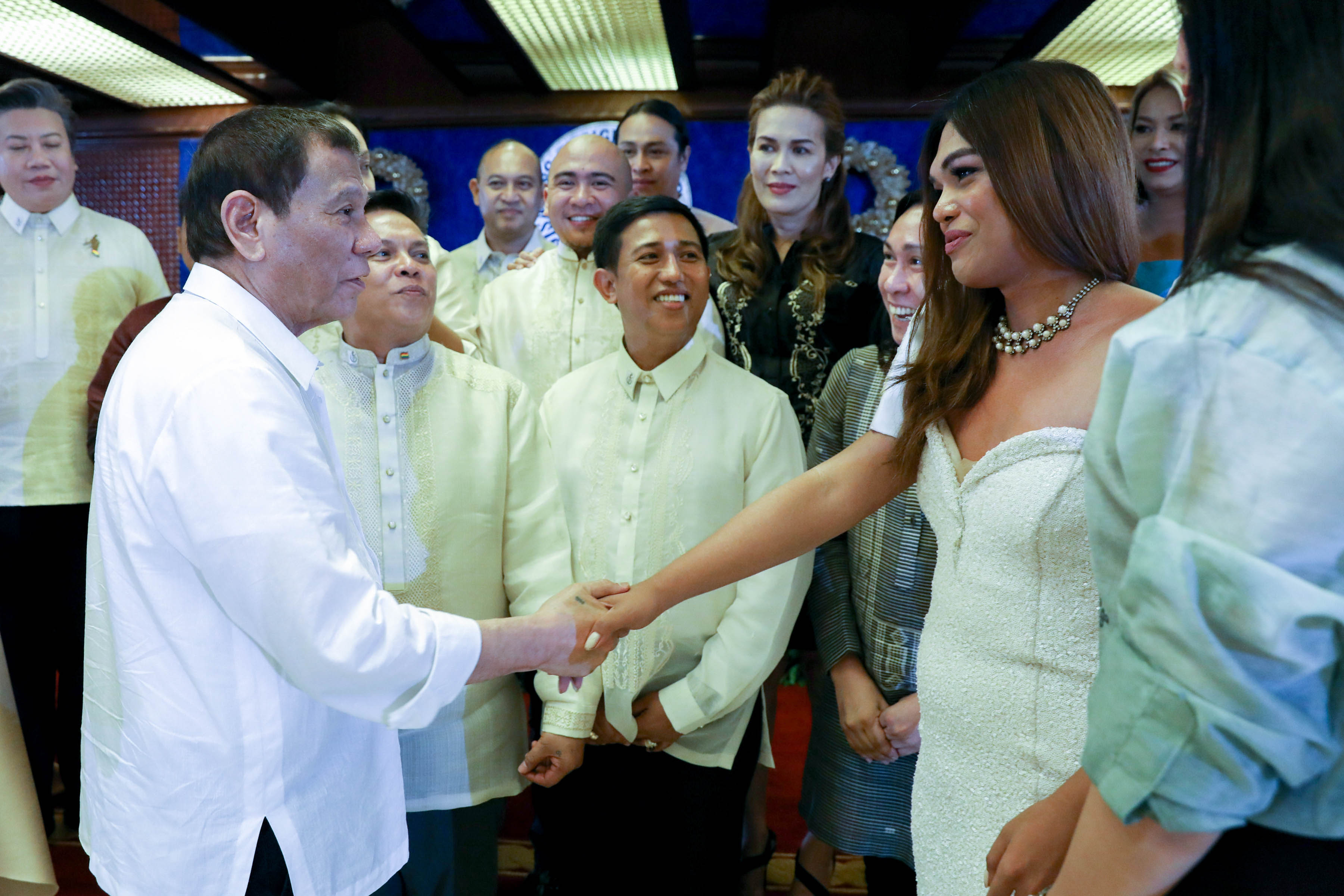
President Rodrigo Roa Duterte greets a member of the LGBT Pilipinas, Inc. during the thanksgiving gathering he hosted at the Malacañan Palace on December 17 ,2019. KARL NORMAN ALONZO/PRESIDENTIAL PHOTO
Duterte welcomed members of the LGBT Pilipinas, Inc. , and administered the oath of office of its national officers.
ADVERTISEMENT


The group was led by Gretchen Diez, the transgender woman who earlier figured in a controversy after she tried to enter a female toilet at a mall in Quezon City.
duterte lgbt party
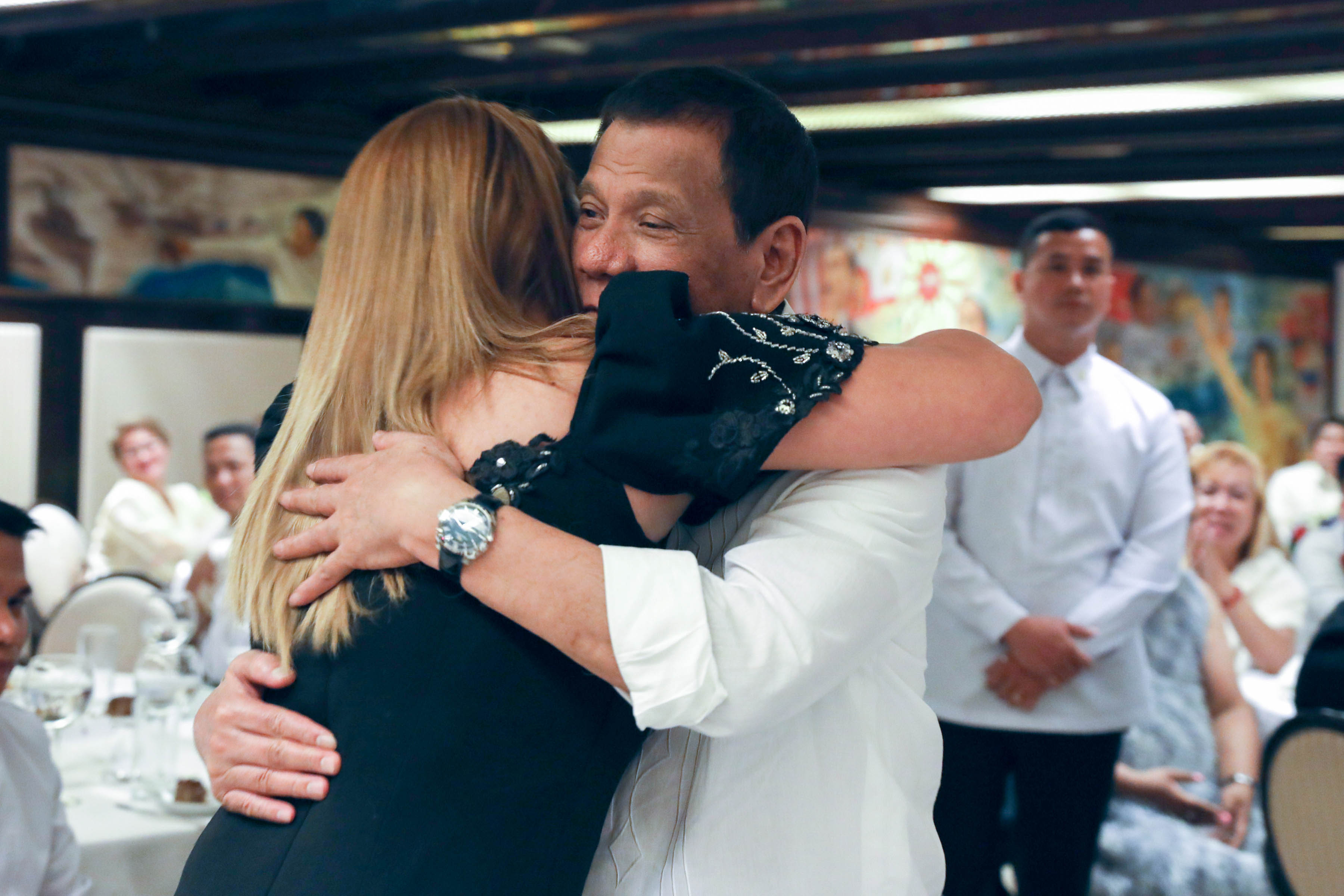
President Rodrigo Roa Duterte embraces a member of the LGBT Pilipinas, Inc. during the thanksgiving party he hosted at the Malacañan Palace on December 17, 2019. KARL NORMAN ALONZO/PRESIDENTIAL PHOTO
In his public speeches, Duterte has made conflicting remarks about members of the LGBT community.

In a campaign rally in April this year, the President said members of the LGBT community have nothing to be ashamed of as they too are created by God.
He even said in 2017 that he was in favor of same-sex marriage.


READ: Duterte favors same-sex marriage
But in a speech before the Filipino community in Tokyo, Japan in May this year, he implied that being gay is a disease that needs to be cured.
Malacañang had earlier said that Duterte would support an anti-discrimination bill but not the Sexual Orientation and Gender Identity Expression (SOGIE) Equality bill, which is pending in the Senate.
Presidential spokesperson Salvador Panelo said the proposed bill “discriminates.”
GSG


Read more: https://newsinfo.inquirer.net/1202705/duterte-hosts-lgbt-party-in-malacanang#ixzz68RuGkzJP
Follow us: @inquirerdotnet on Twitter | inquirerdotnet on Facebook
 
Duterte's Christmas message:


Duterte to Malaysia, Indonesia: Accept Rohingya refugees
1900051-1625464076.jpg

Rohingya Muslim men are transported from a court hearing on charges of illegally travelling without proper documents, in Pathein, Ayeyarwady, Myanmar. (Reuters/File)
Short Url
Updated 25 December 2019
ELLIE ABEN
December 25, 201900:25
8272

  • Philippines ready to accept migrating Rohingya from Myanmar
MANILA: President Rodrigo Duterte has urged Malaysia and Indonesia to accept Rohingya refugees fleeing persecution in the northern Rakhine province of Myanmar (Burma).
Duterte made the call on Monday as he expressed anew his solidarity with the persecuted minority group, reiterating his willingness to accept them in the Philippines.
“I am prepared. I have communicated my desire that if the Rohingya in Burma want to migrate, I will accept them,” the tough-talking president said in a speech Monday evening in Cotabato City where he led the distribution of Certificates of Land Ownership Award (CLOA) to Agrarian Reform Beneficiaries (ARB) in the Bangsamoro Autonomous Region in Muslim Mindanao (ARMM). A series of explosions that rocked Cotabato City and neighboring towns on Sunday night did not prevent Duterte from attending the event. “We have big lands. The people there are pitiful, the Muslims,” Duterte said, referring to the Rohingya refugees.
In his speech, Duterte pointed out that the Rohingya people are not accepted in Burma because of their religion.
“They’re from Sri Lanka, then they migrated (to Burma) ... but they are unwanted because the people there are Buddhists ... They (Rohingya people) are Muslims so they’re being executed,” according to Duterte. “So they became boat people and went to Australia. When they got there, Australia pushed them back (to Myanmar),” he continued.
FASTFACT
• The Philippines took in Vietnamese boat people fleeing the Vietnam war between 1975 to 1992.
Duterte then recalled how the Philippines took in Vietnamese boat people fleeing the Vietnam War between 1975 to 1992. “We accepted Vietnamese in the past, didn’t we? ... there in Palawan,” Duterte said, as he reiterated his openness to also accept the Rohingya people.
“Let’s take them in. Mindanao is big, there are fields where they can farm . . . Let’s teach them how to survive. We will accept the Rohingya refugees,” said the president.
Duterte then called on Malaysia and Indonesia, both Muslim majority countries, to do the same.
“Let’s share among us- Malaysia, Indonesia, Philippines,” he said.
In February this year, Duterte also offered Filipino citizenship to the Rohingya refugees.
“Those who really have nowhere else to go, I will accept them. I will make them Filipinos,” he said before a convention of municipal mayors at the Manila Hotel. In April last year, Myanmar criticized Duterte after the Philippine president said in a speech that we was willing to provide sanctuary for Rohingya fleeing what he called “genocide” in the Rakhine State.
Responding to his remarks, Myanmar government Zaw Htay said Duterte “doesn’t know
anything” about their country and that it was the “usual behavior” of the Philippine president “to
speak without restraint.”
Duterte later apologized to his Myanmar counterpart Aung San Suu Kyi for his genocide remark.

Well, Malaysia and Indonesia are mostly Islamic so, go for it. Maybe Bangsamoro can bring them in as well.

 
Some recent stories:


India and the Philippines: A New Chapter in Defense Ties?
While strategic interactions have traditionally been quite shallow, there are some indications of a more promising future for relations.
By Jeff M. Smith
January 09, 2020


India and the Philippines: A New Chapter in Defense Ties?

Credit: Flickr/meaindiaADVERTISEMENT


Despite the stark difference in size and population, on paper India and the Philippines would appear to make natural partners. They are both noisy Indo-Pacific democracies current ruled by controversial but popular leaders. The Philippines is a treaty ally of the United States while India is one of America’s closest strategic partners. Manila and Delhi are both engaged in active territorial disputes with Beijing, and both are (mostly) invested in the rules-based order. In practice, however, strategic interactions between Delhi and Manila have traditionally been quite shallow.

That’s true of many of India’s relationships in East and Southeast Asia, though it’s gradually changing under a reinvigorated “Act East” policy launched by Prime Minister Narendra Modi in 2014. In recent years Delhi has strengthened ties with traditional partners like Japan, Vietnam, and Singapore while conducting new forms of outreach to Indonesia, South Korea, and Australia. Is India looking to add the Philippines to the list? In 2019, there were two signals that suggest it might.

First, from May 2-8, 2019, the navies of the Philippines and India joined those from the United States and Japan in a quadrilateral joint sail through the contested South China Sea. India dispatched a destroyer and tanker for the exercise while the Philippines sent a patrol vessel. The ships, transiting from South Korea to Singapore, engaged in “formation exercises, communication drills, passenger transfers, and [a] leadership exchange.” The exercise overlapped with a U.S. freedom of navigation operation in the South China Sea challenging illegal Chinese claims there. While it was a low-level exercise from a technical standpoint, India’s participation carried geopolitical significance. Delhi has traditionally been reticent to join multi-participant naval exercises that could be interpreted as provocative toward China, particularly in contested seas.

Second, in December 2019, Filipino Defense Secretary Delfin Lorenzana announced that the Philippines was interested in purchasing from India two batteries of Brahmos missiles, an advanced cruise missile co-developed by Indian and Russian defense firms. Lorenzana suggested a contract would be forthcoming in 2020, “possibly on the first or second quarter,” saying the missile would be “the first Philippine weaponry with deterrent capability.” It would also mark the first Brahmos export deal for the Indian government, which has been unsuccessful in courting buyers, despite a decade of on-again-off-again talks with Vietnam.


I contributed to a study published earlier this year by the RAND Corporation, “The Thickening Web of Asian Security Cooperation: Deepening Defense Ties Among U.S. Allies and Partners in the Indo-Pacific.” It examined India’s defense and strategic ties with several East and Southeast Asian powers, including Japan, Australia, Philippines, Vietnam, Singapore, South Korea, and Indonesia. One of the early takeaways: India’s ties with the Philippines were among the least developed in the region. Indeed, India has formed “Strategic Partnerships” of varying character with all capitals in the study; the Philippines was the only exception.

Despite establishing diplomatic relations in November 1949 and signing a Treaty of Friendship in July 1952, relations between India and the Philippines were insubstantial through much of the 20th century. As my co-author, Greg Poling, wrote in the RAND study:

India historically has not played much role in Philippine strategic thinking, foreign policy, economics, or security cooperation. Elsewhere in Southeast Asia, religious and cultural linkages, shared British colonial legacies, and a large Indian diaspora helped maintain ties to the subcontinent throughout the twentieth century, even as New Delhi lacked an effective diplomatic or economic presence in the region. But none of those are major factors in Philippine society.

The pace of high-level political and defense exchanges did begin to increase in the 1990s following the launch of India’s “Look East” policy, with head-of-state exchanges in 1991, 1997, 2006, and 2007. Leaders from both countries also periodically met on the sidelines of major regional gatherings, including in 2007, 2012, and 2014.

During a 2006 meeting between the two countries’ presidents, they signed a Memorandum of Understanding (MoU) on Defense and Security Cooperation and established several high-level commissions and dialogues. By the mid-2010s the two had established a Joint Commission on Bilateral Cooperation, a Joint Committee on Defense Cooperation, a new foreign policy consultations and security dialogue, and a joint working group on counterterrorism. At a meeting of the joint defense committee in March 2017, the two discussed “significant regional security concerns,” including tensions in South China Sea and Indian Ocean piracy.

India and the Philippines have also begun holding regular intelligence exchange meetings on a range of sensitive issues. India trains Filipino foreign service officers at its Foreign Service Institute, and the two have begun conducting military training exchanges, including India hosting a 34-member Filipino military delegation for a week-long training course in 2016. The first exchange among their respective National Defense Colleges was conducted in India in 2013 and a delegation from the Indian College of Defense Management visited the Philippines the same year. Indian warships have also become frequent visitors to the Philippines on their regular deployments to the South China Sea.

In November 2017, the two countries witnessed a breakthrough when Modi became the first Indian leader to visit the Philippines in 36 years. In Manila, Modi attended the ASEAN and East Asian Summits and met with President Rodrigo Duterte, where the two signed an agreement to boost cooperation in defense and logistics. Two months later, Duterte was welcomed in Delhi for Republic Day celebrations along with the leaders of other ASEAN member states. The Filipino defense secretary traveled to Delhi in March 2018, and the Philippines participated in India’s annual Defense Expo the following month.

Despite this progress, and expressed interest from both sides, the two have found little success to date in boosting cooperation in defense sales or co-production. This is a least partly a product of broader problems afflicting India’s defense export industry and partly a product of the Philippines’ underdeveloped military capabilities, among the weakest in the region.

Notably, in 2015 an Indian firm bid on a $400 million contract to provide two light frigates for the Philippine Navy. India’s state-owned, Kolkata-based Garden Reach Shipbuilders and Engineers (GRSE) reportedly submitted the most competitive bid but “failed to meet financial requirements in post-qualification assessments by the Philippine Navy.” Specifically, the Philippine Navy insisted on paying in full on delivery of the warships and assessed GRSE “did not have adequate funds available” to construct the vessels without supporting payments. India’s defense ministry requested diplomatic intervention, but the deal failed to materialize.


Once second only to Vietnam in raising alarm about Chinese activities in the South China Sea, Manila has assumed a much more submissive demeanor toward Beijing since firebrand Rodrigo Duterte was elected president in 2016.

Prior to Duterte’s victory, India appeared to be drifting closer to the Philippines. In 2015, Indian External Affairs Minister Sushma Swaraj made an unusual reference to the South China Sea as the “West Philippine Sea” in a joint statement with her Filipino counterpart. A year later, India supported an UNCLOS Arbital Tribunal ruling that found in favor of the Philippines and invalidated many of China’s claims in the South China Sea. However, Duterte’s high-profile charm offensive toward Beijing — which included largely abandoning the Tribunal award — may have limited the room for strategic convergence with India on broader geopolitical questions.

Duterte, who has casually joked about raping women and called each of President Obama, the Pope, and God “son of a bitch” on different occasions, has openly courted Chinese President Xi Jinping since assuming office. In February 2019 Duterte explained that Xi was a “man of honor” while quipping the Philippines was “already a province…of China. The nearest [province] is Fujian.”


Notably, Duterte’s more benevolent views of Beijing are not shared by the Filipino public or military establishment. In a January 2019 Pulse Asia survey, 84 percent of Filipinos surveyed expressed trust in the United States; only 39 percent felt China was trustworthy. In a December 2019 Pew survey, 64 percent felt the United States could be relied upon as a dependable ally. Only 9 percent said the same for China while 62 percent saw it as the greatest threat to their country.

Nor has Duterte’s courtship of China delivered the benefits he anticipated. When the Filipino president visited Beijing in 2016, he signed 27 deals with Xi, including $24 billion in pledged Chinese investments. An assessment two years later found “barely any projects have materialized, prompting deep concerns that President Rodrigo Duterte has undermined the country’s sovereignty with little to show in return.” By one count, during Duterte’s first year in office, U.S. ($160 million) and Japanese ($600 million) investments in the Philippines dwarfed those of China ($31 million).

Meanwhile, provocative Chinese maritime activities in the Philippines maritime space have only increased. As one Filipino analyst summarized:

China now patrols Philippine seas and air space. Its coast guard controls entry into and the vicinity of Scarborough Shoal, 120 miles off Luzon. Paramilitary fleets increasingly are fishing in the Philippines’ 200-mile exclusive economic zone. Warships venture close to Zambales and Mindoro in the West Philippine Sea. Chinese aircraft regularly confront Philippine flights to Pag-asa Island in Palawan’s Kalayaan Island Group. Maritime research vessels are exploring the Philippine western seabed as well as Benham Rise off Cagayan, and Samar and Surigao in the east. All these are in breach of international law.
Even senior figures in the Duterte administration have begun to voice their dissatisfaction. In April 2019, Foreign Affairs Secretary Teodoro Locsin lamented: “What is disappointing is that despite our friendliness and uninterrupted friendship, China continually embarrasses our government by swarming all over OUR exclusive economic zone.” The same month Manila announced it would be blocking Chinese firms from bidding on purchasing the Philippines largest shipyard at Subic Bay over national security concerns.

Despite this pushback, Manila’s more China-friendly posture is unlikely to change so long as Rodrigo Duterte remains president. On the other hand, it’s possible that whoever succeeds him in 2022 will adopt a more traditional foreign policy posture less skeptical of the United States, more apprehensive about China, and potentially more enthusiastic about strengthening cooperation with India. In the meantime, more joint naval drills and an arms deal would provide India a much-needed win in the region and the Philippines a boost to its lagging military capabilities.

Jeff M. Smith is a Research Fellow at the Heritage Foundation.

Might as well, if India will be a superpower soon.

And


Philippines eyes more Japanese-funded infrastructure projects
January 10, 2020 | 12:31 am
FacebookTwitterLinkedIn
Font Size
  • A A A


Carlos-Dominguez-Toshimitsu-Motegi-011020.jpg

THE Philippine government is eyeing more Japan-funded infrastructure projects this year, as the two countries eased the approval process of loan agreements in a bid to fast-track the implementation of infrastructure projects under the administration’s “Build, Build, Build” program.
“As our ambitious ‘Build, Build, Build’ infrastructure program accelerates this year, we see more opportunities for financing and technical support from the Government of Japan,” Finance Secretary Carlos G. Dominguez III said during a bilateral meeting with Japanese Foreign Affairs Minister Toshimitsu Motegi on Thursday. A copy of Mr. Dominguez’s opening statement was provided to the media.
During the meeting, Mr. Motegi said the Japanese government is set to mobilize $3 billion in funding through its recently launched Overseas Loan and Investment Initiative for the Association of Southeast Asian Nations (ASEAN) in the next three years.
“Let us continue to jointly discuss how to formulate development projects that can be the subject under this initiative,” he said.
Mr. Motegi said the total funding already includes the $1.2 billion in overseas loans and investments for ASEAN members by Japan International Cooperation Agency (JICA).
He added that the two countries now “enjoy a broad based, multilayered development, including economy, infrastructure development, security, people-to-people exchanges.”


Meanwhile, Mr. Dominguez said the two countries have already agreed to shorten the approval process of loan agreements down to an average of three to four months.
“The high-level committee has shortened the approval process of our loan agreements to an average of three to four months. This demonstrates our shared commitment to work closely to ensure that the Filipino people get the benefit of these projects at the lowest possible costs and the soonest possible time,” the Finance chief said.
Japan has also committed to creating a masterplan to redevelop Subic Bay, which was once the biggest American naval base outside of the United States.
“With the Memorandum of Cooperation for this commitment signed last month in Hakone, we look forward to Japan’s swift creation of the action plan for this project,” Mr. Dominguez said.
“Given what we have achieved in developing the Clark special economic zone, I am confident that the full development of the Subic Bay will provide another important node for knowledge-based industries serving the whole of East Asia.”
To date, Japan is the country’s top source of official development assistance (ODA) with $8.63 billion in loans and grants as of September 2019, making up nearly half or 46% of the country’s total ODA loan portfolio.
Meanwhile, Japan has committed to providing an additional ¥4.4 billion (P2 billion) for the implementation of the second phase of the Metro Manila Priority Bridges Seismic Improvement Project.
“Just moments ago, Minister Motegi and I exchanged diplomatic notes on the Metro Manila Priority Bridges Seismic Improvement Project,” Foreign Affairs Secretary Teodoro L. Locsin, Jr. said in a briefing in Makati City, Thursday. “The project will reinforce our bridges, bringing them to superior seismic design specifications and making them resilient to large-scale tremors.”
The original loan agreement, worth ¥9.783 billion (P4.5 billion), was signed in August 2015.
The project is aimed at improving the resilience of two major bridges: Lambingan Bridge and Guadalupe Bridge. The additional loan will cover the increase in costs due to changes in construction technology for the Guadalupe Bridge, temporary detour bridges in Guadalupe, and additional work shifts for the construction period, among others.
Since President Rodrigo R. Duterte assumed office in 2016, 10 loan agreements have been signed between the Philippines and Japan.
This includes loans for the first phase of the Metro Manila Subway Project; the second New Bohol Airport Construction and Sustainable Environment Protection Project; Metro Rail Transit Line 3 (MRT3) Rehabilitation Project; the fourth phase of the Pasig-Marikina River Channel Improvement Project; and the North-South Commuter Railway Extension Project. — Beatrice M. Laforga and Charmaine A. Tadalan
 
Some updates, looks like DU30 is pissed at US again:


Philippine President Rodrigo Duterte threatens to end military deal with US over visa dispute
  • Leader angered by US decision to deny entry to senator and former police chief Ronald dela Rosa
  • ‘I am giving the government and the American government one month from now,’ Duterte said
Reuters

Reuters

Published: 7:34am, 24 Jan, 2020

Philippine President Rodrigo Duterte addresses troops in Quezon City in April 2018. Photo: AP


Philippine President Rodrigo Duterte addresses troops in Quezon City in April 2018. Photo: AP

Philippine President Rodrigo Duterte
warned the United States on Thursday he would repeal an agreement on deployment of troops and equipment for exercises if Washington did not reinstate the visa of a political ally.
Visibly upset, Duterte vented his anger over the US decision to deny entry to Ronald dela Rosa, a former police chief who is now a senator.
Dela Rosa said the US embassy in the Philippines did not explain why his visa had been cancelled but that he believed it was most likely because of allegations of extrajudicial killings during his more than two-year term as police chief.
Dela Rosa was the chief enforcer of Duterte’s anti-narcotics crackdown, which has resulted in deaths of more than 5,000 people, mostly small-time drug dealers. Police say victims were shot by officers in self-defence.
Philippine National Police chief Ronald dela Rosa holds an M60 machine gun during a gun show in Mandaluyong city in July 2017. Photo: Reuters

Philippine National Police chief Ronald dela Rosa holds an M60 machine gun during a gun show in Mandaluyong city in July 2017. Photo: Reuters
“If you do not do the correction, one, I will terminate the bases, the Visiting Forces Agreement (VFA). I will finish that son of a bitch,” Duterte said in a wide-ranging speech before former Communist rebels. “I am giving the government and the American government one month from now.”


The VFA, signed in 1998, accorded legal status to thousands of US troops who were rotated in the country for military exercises and humanitarian assistance operations.

Delfin Lorezana, Duterte’s defence minister, declined to comment when asked if he agreed with the president’s plan.

Duterte makes no secret of his disdain for the United States and what he considers its hypocrisy and interference, though he acknowledges that most Filipinos and his military have high regard for their country’s former colonial ruler.

The United States is the Philippines’ biggest defence ally and millions of Filipinos have relatives who are US citizens.
Last month, Duterte banned US senators Richard Durbin and Patrick Leahy from visiting the Philippines after they introduced a provision in the US Congress.
Tighter Philippines-US defence ties belie Duterte’s pro-Beijing stance
20 Oct 2019
1579980095842.png

The provision calls the ban on US entry to anyone involved in locking up Philippine senator Leila De Lima, a former justice minister and Duterte’s top critic who was jailed in 2017 on drug charges after leading an investigation into thousands of deaths during the anti-narcotics campaign.

She has won numerous awards from human rights groups, which consider her a prisoner of conscience.
The US Embassy in Manila could not immediately be reached for comment outside office hours.

There's always Russia I guess:


Philippines orders 12 helicopters from Russia—Duterte
By: Krissy Aguilar - Reporter / @KAguilarINQ
INQUIRER.net / 09:33 PM January 24, 2020

Duterte-Ptin-Nov-2017.jpg

President Duterte greets Russian President Vladimir Putin prior to the start of their bilateral meeting at the Vinpearl Da Nang Resort and Villas in Da Nang City, Vietnam on November 10, 2017. FILE PHOTO / ALBERT ALCAIN / PRESIDENTIAL PHOTO
MANILA, Philippines — The Philippines has ordered 12 helicopters from Russia for its military and assured the government will be prompt in paying for it, President Rodrigo Duterte said.
In an interview aired Friday by Russian television network RT, the President said he would not take advantage of the two countries’ ties to purchase the cargo choppers.


“We had our priorities. I was buying for 12 cargo helicopters, and you know we are not a rich country. However, we reprogrammed the funds of the government, how to budget it,” Duterte said.

“I’m sure that we’ll have to make the down payments and be prompt in our, you know, just because Russia is a friend, doesn’t follow that we abscond or we do not pay our debts,” he said.

“So, it’s still money and we, we’re really short of it actually. We’re not that rich. But we have placed the orders now. Twelve military helicopters — cargo choppers,” he continued.
Last year, it was reported that the government was eyeing to acquire 16 helicopters from Russia worth P12.7 billion.


Meanwhile, the President said the Philippines could be a prospect for Russian businesses, saying the distance between the two countries is not a hindrance to their “friendship.”
“I am sure Russia could come here, and look for viable businesses that can help Russia, your country. And we do not consider the distance as a limit. In our friendship, in our desire to be a partner of Russia and the rest of the eastern countries in trade and commerce,” Duterte said.
“We do not think that the distance is on the minus side, it’s a plus side and nothing can really be a hindrance if you really want to do it with another country,” he added.
 
Philippine leader pardons US Marine in transgender killing

1599508901297.png


MANILA, Philippines (AP) — The Philippine president pardoned a U.S. Marine on Monday in a surprise move that will free him from imprisonment in the 2014 killing of a transgender Filipino woman that sparked anger in the former American colony.

President Rodrigo Duterte said he decided to pardon Lance Cpl. Joseph Scott Pemberton because the Marine was not treated fairly after opponents blocked his early release for good conduct in detention.

A left-wing human rights group, Karapatan, immediately condemned the pardon as a “despicable and shameless mockery of justice and servility to U.S. imperialist interests.”


Pemberton was convicted of homicide and has been serving a prison term of six to 10 years for the killing of Jennifer Laude in a motel in Olongapo city, northwest of Manila. His lawyer, Rowena Garcia-Flores, told The Associated Press that Pemberton was already aware of Duterte’s decision when she called him.

“I heard the news,” Garcia-Flores quoted the 25-year-old Pemberton as saying. “I’m very happy.”

Meeting Pemberton in detention a few days ago, she said he expressed his willingness to apologize to the Laude family even belatedly. Pemberton would likely be removed from the Marines due to his conviction and plans to work in the U.S., Garcia-Flores added.

Presidential spokesman Harry Roque, who once served as a lawyer for the Laude family, said the presidential pardon would mean the immediate release of Pemberton from detention.

“The president has erased the punishment that should be imposed on Pemberton. What the president did not erase was the conviction of Pemberton. He’s still a killer,” Roque told reporters.

Laude’s family denounced Duterte’s action as a grave injustice, including to the LGBTQ community, family lawyer Virginia Suarez said.

Duterte is one of the most vocal critics in Southeast Asia of U.S. security policies. But on Monday he said, “If there is a time where you are called upon to be fair, be fair.”

Last week, the Regional Trial Court in Olongapo city, which handled Pemberton’s case, ordered authorities to release him early from detention for good conduct, but Laude’s family appealed, blocking the Marine’s early release. Roque said the Department of Justice was planning a separate appeal.

The court order rekindled perceptions that American military personnel who run afoul of Philippine laws can get special treatment under the allies’ Visiting Forces Agreement, which provides the legal framework for temporary visits by U.S. forces to the country for large-scale combat exercises.

Pemberton, an anti-tank missile operator from New Bedford, Massachusetts, was one of thousands of American and Philippine military personnel who participated in joint exercises in the country in 2014.

He and a group of other Marines were on leave after the exercises and met Laude and her friends at a bar in Olongapo, a city known for its nightlife outside Subic Bay, a former U.S. Navy base.

Laude was later found dead, her head slumped in a toilet bowl in a motel room, where witnesses said she and Pemberton had checked in. A witness told investigators that Pemberton said he choked Laude after discovering she was transgender.


In December 2015, a judge convicted Pemberton of homicide, not the more serious charge of murder that prosecutors sought. The Olongapo court judge said at the time that she downgraded the charge because factors such as cruelty and treachery had not been proven.

Pemberton has been serving his sentence in a compound jointly guarded by Philippine and American security personnel at the main military camp in metropolitan Manila. The place of detention was agreed to under the terms of the Visiting Forces Agreement, although Laude’s family had demanded that he be held in an ordinary jail.

Garcia-Flores said his detention was shortened by authorities under a Philippine law that allows the reduction of prison terms for good conduct. Suarez said the law cannot apply to Pemberton, who has been detained alone in a military camp and given other special privileges under the VFA.

The case has led to calls from some in the Philippines to end the U.S. military presence in the country, a former American colony with which Washington has a mutual defense treaty.
 
‘Only Duterte can curse’: Palace says Locsin sorry for Twitter rant vs China (Archive)

MANILA, Philippines (Updated 5:48 p.m.) — Foreign Affairs Secretary Teodoro Locsin Jr. has apologized for swearing at China on his Twitter account amid tensions over the West Philippine Sea, Malacañang said Tuesday.

Locsin, who posts freely and often on the social networking site, the day before told China to "get the fuck out" of Philippine waters. "Usual suave diplomatic speak gets nothing done," he also said then, in defense of his remarks.

"Before the press briefing, I spoke with Secretary Locsin and he informed me that he personally apologized to the Chinese ambassador and that the words he said were prompted by things that made him lose his temper," presidential spokesman Harry Roque said in Filipino.

"The message of the president is: In the area of diplomacy, there is no place for cursing," he added. "Only the president can curse, no one else can copy him."

Locsin has since disputed Roque's remarks, saying he apologized only to Chinese Foreign Minister Wang Yi and not China's envoy to the Philippines Huang Xilian.

Roque then launched into a rundown of China-assisted development projects under the Duterte administration.

Locsin earlier Tuesday issued a public apology to Chinese Foreign Minister Wang Yi on Twitter. "I won’t plead the last provocation as an excuse for losing it; but if Wang Yi is following Twitter then I’m sorry for hurting his feelings but his alone."

He also went on to effusively praise Wang, saying: "It’s been my elusive dream to copy until I attain in mind and manner the elegance of Wang Yi. His opinion alone matters."

Ties with China have considerably warmed under President Rodrigo Duterte.

The president himself is known to swear at international leaders and organizations but holds his fire for China, choosing instead to consistently express his gratitude to the regional power.

China insists on sovereignty over Panatag, tells Locsin to 'mind basic manners'
A day after Locsin's controversial remarks on social media, China's Foreign Ministry spokesperson Wang Wenbin urged a "certain individual from the Philippines" to "mind basic manners and act in ways that suit his status."

He also repeated China's claim that it has jurisdiction over Panatag (Scarborough) Shoal — which it calls Huangyan Island — and adjacent waters.

The Department of Foreign Affairs has repeatedly disputed this claim and, according to the 2016 arbitral ruling, Panatag is a traditional fishing ground.

In agreement with statements made by Duterte, Wang said "differences and disputes between the two countries on some issues should not affect the overall friendship and cooperation, which is also an important consensus reached by China and the Philippines on many occasions."

"China has always been and will remain committed to properly handling differences and advancing cooperation with the Philippines through friendly consultation, and will continue to provide assistance within its capacity to the Philippines in its efforts to fight the epidemic and resume economic development," he added.

Duterte now says he never mentioned China in 2016 campaign
Duterte during a public address aired Monday night incorrectly claimed that he never mentioned ties between China and the Philippines during his campaign for the presidency.

"I did not promise that I would pressure China. I never mentioned about China and the Philippines in my campaign because that was a very serious matter," he said to address criticism for the administration's policy on the West Philippine Sea. "I never, never in my campaign as president promised the people that I would retake the West Philippine Sea."

But Duterte took a hardline stance on China and its incursions in the West Philippine Sea — the part of the South China Sea in the Philippines' Exclusive Economic Zone — during his campaign, even saying he would ride a jet ski to the Spratlys to stake Manila's claim.

Two years into his presidency, he said the remark was just a joke, expressing surprise that people took it seriously.

Retired Supreme Court Justice Antonio Carpio on Tuesday called out Duterte for walking back his remarks, saying that candidate Duterte had issued a formal statement in support of the Philippines' arbitration case against China.

The government has played down the 2016 ruling in that case that said that China's sweeping claims over the South China Sea have no basis in international law.

"President Duterte cannot now say that he never discussed or mentioned the West Philippine Sea issue when he was campaigning for president. Otherwise, he would be admitting that he was fooling the Filipino people big time," Carpio added.

"There is a term for that — grand estafa or grand larceny. Making a false promise to get [16] million votes."

Lacson seeks review of Philippines-China ties
Citing China's "recent incursions and bullying" in the West Philippine Sea, Sen. Panfilo Lacson on Tuesday called for a review of the diplomatic ties between Manila and Beijing.

"What kind of friend — or benefactor — would take what is ours, bully us, and ignore our protests?" he questioned.

Lacson, who chairs the Senate defense panel, further noted that the issue of the West Philippine Sea should not be connected to other matters such as vaccine donations.

"We should have a united stand on the West Philippine Sea, and this should not be connected to any other issue except sovereignty and territorial integrity."

He also reiterated the call from several senators for stronger alliances with countries boasting strong militaries such as the United States, Australia, Japan, and nations in the European Union to maintain the balance of power in the region.

-------------------------------------------------------------------------------------------------------------------

Top diplomat Locsin swears at China online, tells nation to leave West Philippine Sea (Archive)

MANILA, Philippines — The Philippines' top diplomat unambiguously told Beijing where to go on Monday, as the government insisted Chinese vessels were still illegally lingering in the West Philippine Sea.

"China, my friend, how politely can I put it? Let me see... O... GET THE FUCK OUT," Foreign Secretary Teodoro Locsin tweeted.

The latest spat between Manila and Beijing over the resource-rich waters — which China claims almost entirely — flared up in March after hundreds of Chinese boats were spotted inside the Philippines' Exclusive Economic Zone.

China has refused repeated calls from the Philippines to withdraw the boats, and tensions have intensified as Manila steps up maritime patrols in the area.

Locsin frequently uses strong language on Twitter and defended his latest outburst by saying: "Usual suave diplomatic speak gets nothing done."

He also likened China to "an ugly oaf forcing your attentions on a handsome guy who wants to be a friend".

The order came as his foreign affairs department accused China's coastguard of "belligerent actions" against Filipino boats involved in maritime drills near the contested Panatag (Scarborough) Shoal.

China-controlled Panatag is one of the region's richest fishing grounds and a flashpoint between the two countries, which have rival claims.

The department said it has lodged a diplomatic protest over the Chinese vessels' actions towards the Southeast Asian country's coastguard during patrols and training exercises near the reef last month.

The department said the presence of the Chinese boats was a "blatant infringement of Philippine sovereignty".

China's embassy in Manila did not immediately respond to a request for comment.

Panatag Shoal is 240 kilometres (150 miles) west of the Philippines' main island of Luzon.

China seized it in 2012 and has subsequently ignored a 2016 international tribunal decision that declared its historical claim over most of the South China Sea, part of which is the West Philippine Sea, to be without basis.

Once-frosty ties between the two countries had warmed under President Rodrigo Duterte, who set aside the ruling in exchange for promises of trade and investment that critics say have largely not materialised.

Facing growing domestic pressure to take a harder line, Duterte said last week the Philippine maritime patrols would continue, insisting its sovereignty over the waters was not negotiable.

-------------------------------------------------------------------------------------------------------------------

Link to original tweet is still up.

https://twitter.com/teddyboylocsin/status/1389021070045290497

Archive
 
Facing growing domestic pressure to take a harder line, Duterte said last week the Philippine maritime patrols would continue, insisting its sovereignty over the waters was not negotiable
going to see how much of a BAMF Duterte really is.

also teddyboylocsin? Does he slip into Brothel Creepers and bop about to Hank Mizell of a weekend? Inquiring minds want to know.


With Duterte on his way out what becomes of this thread? Legacy thread? If Marcos wins will this thread also extend to his daughter who is Marcos' running mate?
 
Last edited:
Back
Top Bottom