By Eric Cortellessa | Photograph by Platon for TIME
December 5, 2024, 5:31 PM EST

Mar-a-Lago was quiet three days before Thanksgiving. Donald Trump’s Moorish palace seemed all but deserted late that morning, the seaside estate’s cavernous living room traversed intermittently by a junior staffer or silent aide. Totems to Trump were displayed everywhere. Framed magazines with him on the cover hung by the front door. On a table near the fireplace sat a cast-bronze eagle awarded him by the singer Lee Greenwood. In the men’s lavatory, a picture of him with Arnold Palmer hung near the urinals. Adorning a wall in the library bar, a painting titled The Visionary depicted Trump in a tennis sweater, trim and youthful. The empty rooms felt less like a millionaire members’ club than a museum.
By midafternoon, the President-elect’s imminent arrival had stirred signs of life. Discreetly placed speakers offered up selections from Trump’s personally curated 2,000-song playlist. A handful of transition honchos and soon-to-be Administration officials arrived, perching on overstuffed sofas and huddling in corners. Incoming chief of staff Susie Wiles conferred with Trump’s designated National Security Adviser, Mike Waltz. Vice President–elect J.D. Vance strode in with a retinue of staffers. An aide posted up near a window overlooking the patio, setting down Trump’s personal cell phone, which lit up occasionally with calls and texts from favored media personalities and Cabinet picks. You could sense Trump before you could see him, the small group of senior aides rising to their feet in anticipation.
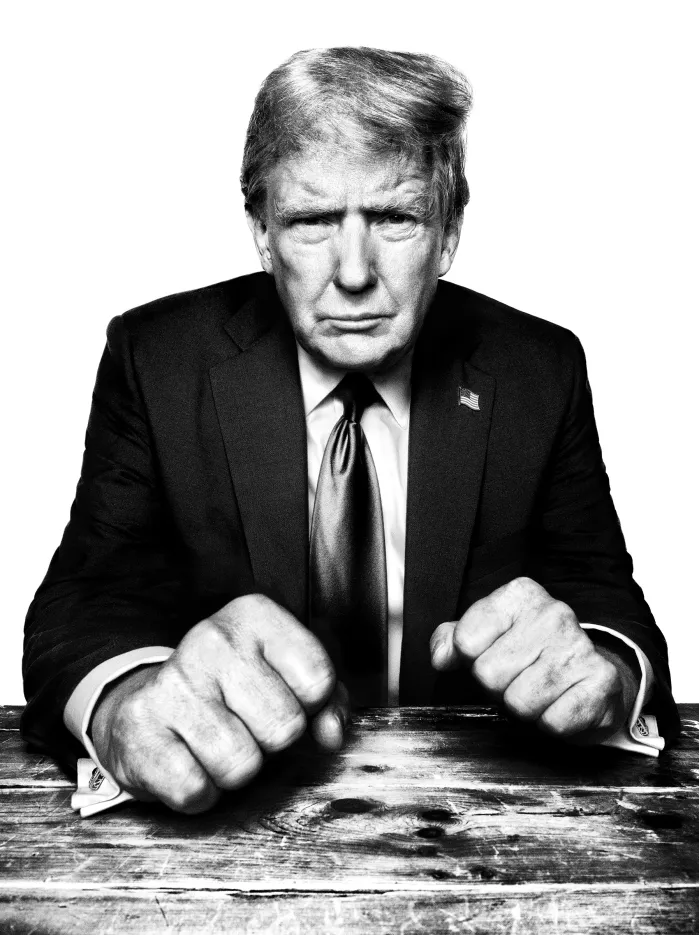
The world’s most powerful man entered with an air of unhurried bonhomie. Dressed in his trademark navy suit and red tie, Trump, 78, appeared a little older than he had some seven months earlier, when he last met with TIME—more subdued, less verbose, the same discursive speech patterns but with the volume turned down. Sitting under bright lights for a 30-minute photo session ahead of a 65-minute interview, he’s asked to explain the bruising on his right hand. “It’s from shaking hands with thousands of people,” he says.

The President-elect, pictured at Mar-a-Lago on Nov. 25 Platon for TIME
Trump’s political rebirth is unparalleled in American history. His first term ended in disgrace, with his attempts to overturn the 2020 election results culminating in the attack on the U.S. Capitol. He was shunned by most party officials when he announced his candidacy in late 2022 amid multiple criminal investigations. Little more than a year later, Trump cleared the Republican field, clinching one of the fastest contested presidential primaries in history. He spent six weeks during the general election in a New York City courtroom, the first former President to be convicted of a crime—a fact that did little to dampen his support. An assassin’s bullet missed his skull by less than an inch at a rally in Butler, Pa., in July. Over the next four months, he beat not one but two Democratic opponents, swept all seven swing states, and became the first Republican to win the popular vote in 20 years. He has realigned American politics, remaking the GOP and leaving Democrats reckoning with what went awry.
Trump has a ready explanation for his improbable resurrection. He even has a name for its climactic final act. “I called it 72 Days of Fury,” he says as the interview gets under way. “We hit the nerve of the country. The country was angry.” It wasn’t just the MAGA faithful. Trump harnessed deep national discontent about the economy, immigration, and cultural issues. His grievances resonated with suburban moms and retirees, Latino and Black men, young voters and tech edgelords. While Democrats estimated that most of the country wanted a President who would uphold the norms of liberal democracy, Trump saw a nation ready to smash them, tapping into a growing sense that the system was rigged.
If America was craving change, it is about to see how much Trump can deliver. He ran on a strongman vision, proposing to deport migrants by the millions, dismantle parts of the federal government, seek revenge against his political adversaries, and dismantle institutions that millions of people see as censorious and corrupt. “He understands the cultural zeitgeists,” says his 2016 campaign manager Kellyanne Conway, who remains a close adviser. “Donald Trump is a complicated person with simple ideas, and way too many politicians are the exact opposite.”

Trump takes the stage at the GOP Convention in Milwaukee on July 18 Jim Watson—AFP/Getty Images
Trump also promises to attack the sources abroad that he blames for the country’s malaise: economic interdependence, transnational criminals, traditional allies he sees as free riders on America’s long-running global beneficence. He believes he has tools to fight back: punitive tariffs, bare-knuckle negotiations, and threats to withdraw U.S. military, humanitarian, and economic support. Willing to upend the nation’s postwar role as a bulwark against authoritarianism, he promises to usher in a foreign policy rooted in “America First” transactionalism.
Much still stands in his way. The Republicans have narrow majorities in the House and Senate. A conservative Supreme Court may not bless all his boundary-pushing policies. Enduring institutional resistance inside the federal bureaucracy could thwart his designs. The public also remains a powerful check on any President. Trump has proved twice now that he can surf to power on anti-incumbent sentiment, a cult of personality, and divisive rhetoric, including racist and xenophobic attacks. He has yet to prove that he can enact the radical vision he campaigned on. Those closest to the President-elect say that he will surprise people by fulfilling his promises. “Most politicians don’t,” says Wiles, “and he will.”
Whether Trump can actually fix the root causes of Americans’ anger is another question. He will now have to contend with the same forces he rode to the White House—a globalized economy, mass migration, the rise of China—that have bedeviled predecessors from both parties and ousted incumbents around the world. He will also see just how far the nation is willing to let him go. If he succeeds, he could reshape the country. Along the way, he risks tearing down the constitutional norms and institutions that have seen America’s great experiment in democracy through 2 1⁄2 centuries.
Trump was in the private cabin of his plane, flying to an April 2 campaign rally in Grand Rapids, Mich., when he picked up a document Wiles had placed atop a stack of papers. The heading was not subtle: “How a national abortion ban will cost Trump the election.” Trump raised his eyebrows. “Kind of a nasty title, huh?” he said.

Trump campaign aides arrive in Fayetteville, N.C., ahead of an Oct. 4 rally Evan Vucci—AP

Trump gestures at supporters as he exits a campaign rally at Mullet Arena in Tempe, Ariz. on Oct. 24 Rebecca Noble—AFP/Getty Images
The episode was a turning point for an issue central to the race: whether Trump could find a position on abortion that would limit his electoral losses with women after playing a pivotal role in the fall of Roe v. Wade. That in turn was part of Trump’s larger challenge: how to offer change to everyone who wanted it, including voters put off by his positions or behavior. “There are not enough MAGA people to actually win an election,” a Trump campaign official tells TIME. “So who do you go get? How do you broaden that?”
Before he considered the memo, Trump had been on the verge of supporting a 16-week federal abortion ban. Conway had showed him polling that indicated barring the procedure after 16 weeks of pregnancy was more popular than doing so after 24. But Trump’s speechwriter and policy adviser, Vince Haley, had raised an objection on a late-March conference call, according to three people present: “Does he know that the 16-week ban will be stricter than existing law in a lot of the states?” There was a silence. “Probably not,” said Trump’s political director James Blair, who set to assembling a slide deck that argued such a ban would hurt Trump in the key states of Pennsylvania, Michigan, and Wisconsin, all of which offered women the opportunity to obtain the procedure until at least 20 weeks of pregnancy.
After flipping through Blair’s presentation on the plane, Trump perked his head up: “So we leave it to the states, right?” Advisers agreed. “Great,” Trump said. “We’ll do a video.” Within a few minutes, he was dictating his remarks to Haley. A few days later, Trump released the clip on his social media platform. For the rest of the race, a politician who had once asserted that “there has to be some form of punishment” for women who undergo abortions stuck to his stance of treating it as a states’-rights issue.

Trump backers, seen from Harris’ campaign bus, near Pittsburgh on Aug. 18 Julia Demaree Nikhinson—AP
The same month, Trump made another fateful decision: to end his crusade against vote by mail and early voting. For more than a year, senior advisers urged him to embrace a practice Trump had baselessly maligned as rife with fraud since the 2020 election. Several of his top lieutenants, including Wiles and Blair, were Florida operatives trained in the science of banking early votes. Wiles wrote Trump a memo showing the data on how spurning mail ballots cost Republicans in a series of razor-thin races in 2022. It would be self-defeating to oppose the practice, argued Wiles and Trump’s daughter-in-law Lara, whom he had handpicked as co-chair of the Republican National Committee (RNC).
Trump listened, but it took a visit from Rob Gleason, a former chair of the Pennsylvania Republican Party, to frame the matter in terms that made him agree. “Sir, your people are so excited to vote for you that they want to as soon as they can,” Gleason told him during an April meeting at Mar-a-Lago, according to two Trump officials familiar with the conversation. “They don’t want to wait. But you gotta tell them it’s OK. You gotta give them permission.” From then on, Trump promoted absentee and early voting, and directed the RNC to launch a mobilization drive targeting mail voters.
By the summer, Trump had the confidence of a man holding history in his hands. In late June, Joe Biden’s weak debate performance spurred an open revolt among panicking Democrats. On July 13, Trump survived the assassination attempt, prompting an outpouring of support and sympathy. To many Americans, his defiance in the aftermath of the shooting—rising bloodied, fist in the air, chanting “Fight!”—made him an inspirational figure for the first time. “A lot of people changed with that moment,” Trump tells TIME, sipping Diet Coke from a glass at Mar-a-Lago.

Platon for TIME
Trump’s strengthening position prompted Biden to drop out of the race and endorse Vice President Kamala Harris. Within a matter of days, Harris consolidated support, raised hundreds of millions of dollars, and galvanized a moribund Democratic base. In the wake of a successful Democratic National Convention, Trump’s inner circle experienced a creeping sense that he could lose. It was the moment of “maximal worry,” says Vance. “There was this sense of, Is this honeymoon with Kamala Harris going to last all the way until the election?”
Trump is a devotee of the Don Draper maxim: If you don’t like what’s being said, change the conversation. And so his team did. Trump’s son Don Jr. had long cultivated a rapport with Robert F. Kennedy Jr., whose independent campaign for the presidency in 2024 had garnered surprising levels of support, especially among disillusioned young men. Don Jr. worried Kennedy’s candidacy risked siphoning key votes, and he began clandestine negotiations as the conversations progressed. Trump Jr. and Wiles began coordinating with Kennedy’s campaign manager, his daughter-in-law Amaryllis Fox Kennedy, about removing him from the ballot in swing states and endorsing Trump. As Vance tells it, the pitch was simple: “You’re not going to win. You’re not going to have any effect on this race other than taking votes away from Donald Trump. So why don’t you actually join the team, set differences to the side, and focus on the big things that we care about?”
Once Kennedy bought into the plan, Wiles advised waiting to announce it until after the Democratic convention, believing it would stall Harris’ momentum. To Wiles, the endorsement was one of the campaign’s key moments. It neutralized the threat that Kennedy would peel off votes from Trump. But more importantly, “he allowed us to broaden the base of the party,” she says. “He was a key way to do that.”

Other new voters were devotees of Elon Musk, who endorsed Trump after the attack in Butler. Musk ended up pouring more than $250 million into supporting him, turning X into a de facto campaign organ, and serving as a key validator with the tech execs and corporate chieftains who had shied away from Trump for much of his time in the political arena. Now Musk will be among the array of billionaires with direct access to the Oval Office, creating a web of competing conflicts of interest.
To boost the contrast, the campaign maneuvered to portray Harris as too left-wing. It called attention to a questionnaire Harris filled out for the ACLU in 2019, during her last run for President, in which she supported taxpayer-funded sex-change operations for undocumented migrants held in detention. Trump’s adviser Taylor Budowich and admaker Pat McCarthy drummed up a line that would define his most influential campaign advertisement: “Kamala is for they/them. President Trump is for you.” The Trump campaign spent nearly $20 million to air the ad some 55,000 times in the first half of October, making it a key part of its closing message.
Strategists from both parties are divided over whether the Trump team’s blueprint made the difference in a close race, or if Harris’ headwinds—from pandemic-induced inflation to broad disquiet over Biden’s age—were just too much to overcome in a truncated campaign against the world’s most famous person. “We were up against a caricature of being dangerously liberal,” Harris campaign chief Jen O’Malley Dillon said at a Harvard Institute of Politics conference Dec. 6. The Vice President’s unwillingness to distance herself from her unpopular boss may have made as much of a difference as anything Trump did right. “It was a big looming negative hanging over us the whole time,” said Harris deputy campaign manager Quentin Fulks.

During his speech at the RNC, Trump discusses the attempt on his life in Butler, Pa. Morry Gash—AP
On election night, Trump campaign staff set up a war room in Trump’s office at Mar-a-Lago, poring over incoming returns as the candidate schmoozed in the club’s ballroom with Musk and UFC chief Dana White. After North Carolina and Georgia shifted into his column, Trump peeked in. “Anything concerning you?” he asked.
“Nope,” an aide replied. “Feel good.”
“Good,” Trump said. When he returned to the ballroom, the jubilant crowd was dancing to “YMCA” by the Village People—a Trump rally staple that has become a cultural touchpoint, with everyone from professional athletes to TikTok aficionados mimicking his signature moves. Trump stood for a moment, taking it all in, before turning to an aide and asking when they should head to the nearby convention center where he would give his victory speech.
The election gave Trump political capital to address the sources of American discontent at home and abroad. The question now is how he intends to spend it. By his own account, Trump will push the limits of presidential power and the law.
One of the first official acts of his presidency, Trump tells TIME, will be to pardon most of the rioters accused or convicted of storming the Capitol to block the certification of Biden’s victory. “It’s going to start in the first hour,” he says. “Maybe the first nine minutes.” Trump also plans early actions to reverse many of Biden’s Executive Orders and expand the drilling of oil on federal land.

The pro-Trump mob swarms the Inauguration Day stage, waving flags and chanting on Jan. 6, 2021 Nate Gowdy
Trump’s most aggressive moves will be on immigration enforcement. He vows to tighten the U.S. border with Mexico through a slew of Executive Orders, and aides say he would end the U.S. “catch-and-release” program and resume construction of a border wall. At the same time, he says, he will order U.S. law-enforcement agencies—and potentially the military—to embark on a massive deportation operation designed to remove more than 11 million undocumented migrants from the country. While the Posse Comitatus Act forbids the deployment of the military against civilians, Trump says he is willing to enlist the military to round up and deport migrants. “It doesn’t stop the military if it’s an invasion of our country,” he says. Pressed on how he would respond if the military refuses to carry out those orders, Trump says, “I’ll only do what the law allows, but I will go up to the maximum level of what the law allows.”
Trump tells TIME he doesn’t plan to restore the policy of separating children from their families to deter border crossings. But he doesn’t rule it out, either. “I don’t believe we’ll have to, because we will send the whole family back,” he says. “I would much rather deport them together.” Trump’s incoming border czar, Tom Homan, says “there is no deliberate policy being worked on to separate families.” But he also leaves open the possibility of children again being ripped from their parents. “You can’t say zero, it’s not going to happen,” Homan says.
For a mass-deportation operation of this scale, Trump’s advisers are planning to build more detention centers to hold migrants until they can be deported to their home countries, a process that can take weeks, months, or even years to negotiate with receiving governments. It’s not clear if all will be willing to take the migrants back. “We just don’t arrest an alien and remove them on the same day,” says Homan. “We’re going to need beds.” Trump says he will use access to the U.S. market as leverage to force foreign governments to cooperate. “I’ll get them into every country,” Trump says, “or we won’t do business with those countries.”

Trump at a section of the border wall in Sierra Vista, Ariz., on Aug. 22 Doug Mills—The New York Times/Redux
The operation would come at a steep cost. The nonprofit American Immigration Council estimates the tally for Trump’s mass-deportation plans could be upwards of $300 billion. Trump is likely to seek funding from Congress, according to aides. “It’s going to be expensive,” Homan says.
American taxpayers could bear the brunt in other ways. Economists say deporting many of the low-wage workers who bolster multiple industries could lead to higher prices. “If you eliminate the jobs of the people who are working on building houses, those who are also doing the accounting and the supervising and the personnel and running the company—those kinds of jobs disappear also,” says Douglas Rivlin of America’s Voice, a progressive group that supports immigration reform. “It’s a self-inflicted disaster.” That’s before factoring in the social and psychological costs to watching friends and neighbors rounded up and removed from their communities. “When you see the nightly news and there’s a raid at Joe’s Pizza,” adds Hiroshi Motomura, an immigration scholar at UCLA, “that becomes very real.”
Just how radical Trump can be depends in part on the buy-in of the Justice Department, which is set to be led by former Florida attorney general Pam Bondi, one of the defense attorneys on his first impeachment. Trump has vowed to seek retribution against his political enemies—saying the likes of Biden, former House Speaker Nancy Pelosi, Manhattan District Attorney Alvin Bragg, special counsel Jack Smith, and others would face investigation and potential prosecution. Trump was coy in his interview with TIME about whether his DOJ will target his domestic political adversaries, saying only that the decision will be left to Bondi if she’s confirmed. “That’s up to her,” he says. Either way, his victory spells the end of federal prosecutions that charged him with crimes ranging from election subversion to willfully retaining classified documents. (Trump denied the allegations.)

Trump at Manhattan criminal court during jury deliberations in his criminal hush money trial in New York, May 30 Mark Peterson—Pool/AP
To dismantle the federal bureaucracy, Trump has enlisted Musk and Vivek Ramaswamy to head a commission, dubbed DOGE, aimed at slashing the size of government. Musk and Ramaswamy have touted massive layoffs to the federal workforce, especially civil servants, and cuts to regulations on everything from the water we drink to the air we breathe. They promise to finish the job in time for the 250th anniversary of American independence, July 4, 2026.
Experts in government administration say the commission risks degrading the state’s ability to function. “It’s going to be harmful to the government’s capacity to carry out the missions that Congress has assigned by statute,” like administering Social Security and Medicare, says Peter Shane, a New York University law professor. If the Musk-Ramaswamy commission eliminates large numbers of civil servants, the government will likely have to rely on private companies instead. “There’s no guarantee,” says Shane, “that the contractors are going to be either cheaper or more competent.”
On the campaign trail, Trump said he would not order the DOJ to enforce the Comstock Act, a 19th century law that prohibits the mailing of abortion pills. When he spoke with TIME before Thanksgiving, Trump’s position on women’s reproductive rights changed in the span of a few sentences. First he left open the possibility that the Food and Drug Administration could reverse approvals for medication abortion, then said it was “highly unlikely,” before declaring, “We’re going to take a look at all of that.” Asked to clarify whether he was committed to preventing the FDA from stripping access to abortion pills, Trump replied, “It’s always been my commitment.”
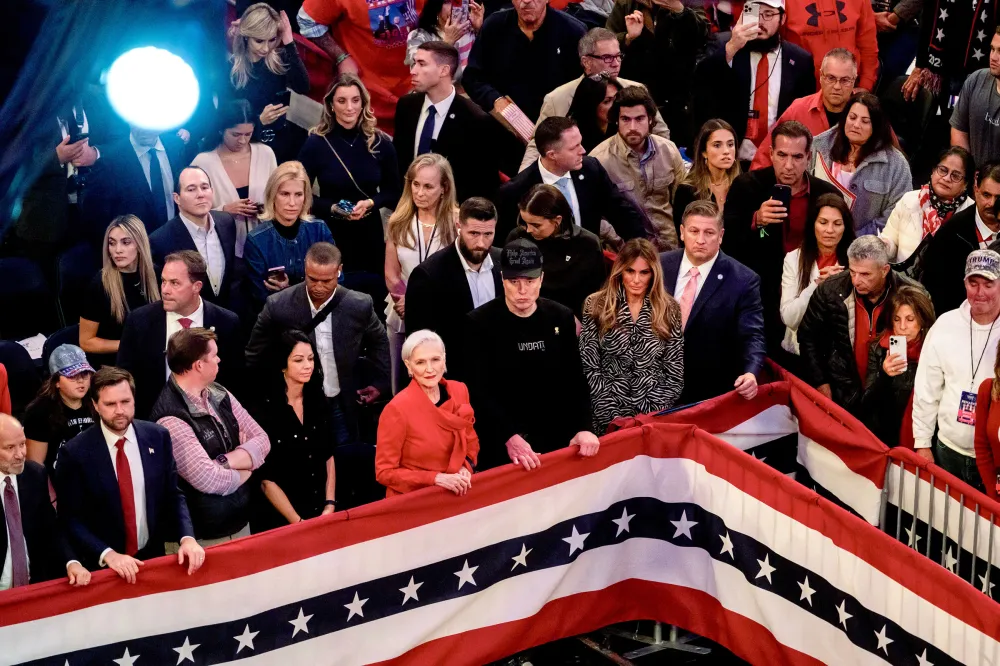
Former First Lady Melania Trump, center right, and Elon Musk, during a Trump campaign event at Madison Square Garden in New York, on Oct. 27 Adam Gray—Bloomberg/Getty Images
While Trump’s GOP will have majorities in the House and Senate, he has telegraphed few major legislative pushes beyond extending his first-term tax cuts and funding an immigration crackdown. Trump says he supports preserving the filibuster, which allows a minority in the Senate to block legislation. If that prevents the passage of bills through Congress, he says he will use executive action. “If I have even a little bit of trouble,” he says, “I go to an Executive Order because I can get it done.”
It was a glimpse of how Trump’s expansive view of executive power will shape his second term, when he meets with inevitable obstacles. “The idea of the imperial presidency is not new, but he’s taking it further than anyone,” says presidential historian Julian Zelizer of Princeton University. “He doesn’t care about the kind of restraints that still guided even Richard Nixon. None of that matters to him. So the potential is for an extraordinarily aggressive use of presidential power.”
For all the focus on Trump’s domestic agenda, much of the activity when TIME visited Mar-a-Lago was on foreign affairs. Waltz, the incoming National Security Adviser, ducked in and out of meetings, speaking with Vance and Steve Witkoff, the incoming special envoy to the Middle East. A source present in the national-security meetings says the goal was to ensure that America’s adversaries—and allies—were not tempted to take advantage of the handoff between administrations.
Many of Trump’s answers to the nation’s problems, including his immigration and trade policies, rely on successful diplomacy. “America First” may be both a campaign slogan and a governing North Star, but ending forever wars and boosting U.S. economic advantage requires working with others.
Trump’s plans threaten to upend relationships with allies and traditional trading partners by imposing a blanket tariff on all imports. Already, he has floated 25% tariffs on Mexico and Canada, a move that most economists predict will cause prices to rise. And he plans to increase tariffs on Chinese imports, aiming to coerce manufacturers to make their products in the U.S.
On the campaign trail, Trump liked to brag about brokering a peace agreement between Russia and Ukraine in 24 hours. In person, he acknowledged this is trickier than he let on. “The Middle East is an easier problem to handle than what’s happening with Russia and Ukraine,” he says. “The numbers of dead young soldiers lying on fields all over the place are staggering. It’s crazy what’s taking place.” Trump criticized Kyiv for launching U.S.-made missiles into Russian territory last month. “I disagree very vehemently with sending missiles hundreds of miles into Russia. Why are we doing that?” he says. “We’re just escalating this war and making it worse.” When pressed on whether or not he would abandon Ukraine, Trump says he would use U.S. support for Ukraine as leverage against Russia in negotiating an end to the war. “I want to reach an agreement,” he says, “and the only way you’re going to reach an agreement is not to abandon.”
In phone calls during the campaign, Trump told Israeli Prime Minister Benjamin Netanyahu to wind down the war in Gaza by the time of his Inauguration, a timeline that now looks highly unlikely. In Israel and the U.S., many suspect Netanyahu is prolonging the fighting to prevent snap elections that could result in his ouster. “He knows I want it to end,” Trump tells TIME. When asked whether he trusts Netanyahu going into a second term, Trump takes a second before answering, “I don’t trust anybody.”

President Volodymyr Zelenskyy of Ukraine, left, meets with Trump in New York, Sept. 27 Doug Mills—The New York Times/Redux

Trump meets with Prime Minister Benjamin Netanyahu of Israel at Mar-a-Lago on July, 26 Doug Mills—The New York Times/Redux
Trump also wants to expand the Abraham Accords he brokered between Israel and several Arab states to include Saudi Arabia. But he’s less specific on a resolution between Israel and the Palestinians. In his first term he put forth the most comprehensive plan for a two-state solution since President Bill Clinton and prevented Netanyahu from extending Israeli sovereignty over roughly 30% of the West Bank. But on Nov. 12, he nominated as incoming U.S. ambassador to Israel Mike Huckabee, a zealous supporter of the settlement movement who advocates for Israel’s annexing the West Bank.
The sudden collapse of Assad’s rule in Syria on Dec. 8 adds another layer of complexity to the Middle East. It brings to power a rebel group once affiliated with al-Qaeda, but also marks yet another setback for an Iran regime already weakened in Lebanon and Gaza. Some analysts fear the losses may make Iran more likely to push for a nuclear weapon. Since Trump pulled out of the Iran nuclear deal in 2018, Tehran has edged ever closer to acquiring a nuclear weapon. As of April, the International Atomic Energy Agency estimated that Tehran has enough weapons-grade uranium to build a bomb in a matter of weeks. Iran and its proxies have waged a multi-front war against Israel and have targeted U.S. assets in the region. During the presidential campaign, the Iranians plotted to assassinate Trump, according to federal charges brought in November by the Department of Justice. While the President-elect prides himself on not entering into any new wars in his first term, he leaves open the possibility that one may be necessary in a second. Asked about the chances of war with Iran, Trump pauses, then replies, “Anything can happen.”
By the time the dinner hour is approaching, the crowd has swelled in the ornate reception area at Mar-a-Lago, transforming it into a buzzing king’s court. Job seekers camp out on sofas, waiting to buttonhole Howard Lutnick, the Wall Street executive who co-chairs his transition. Lutnick, who is also Trump’s chosen Commerce Secretary, has been tasked by Trump with vetting Cabinet appointees for the trait Trump values most: loyalty.
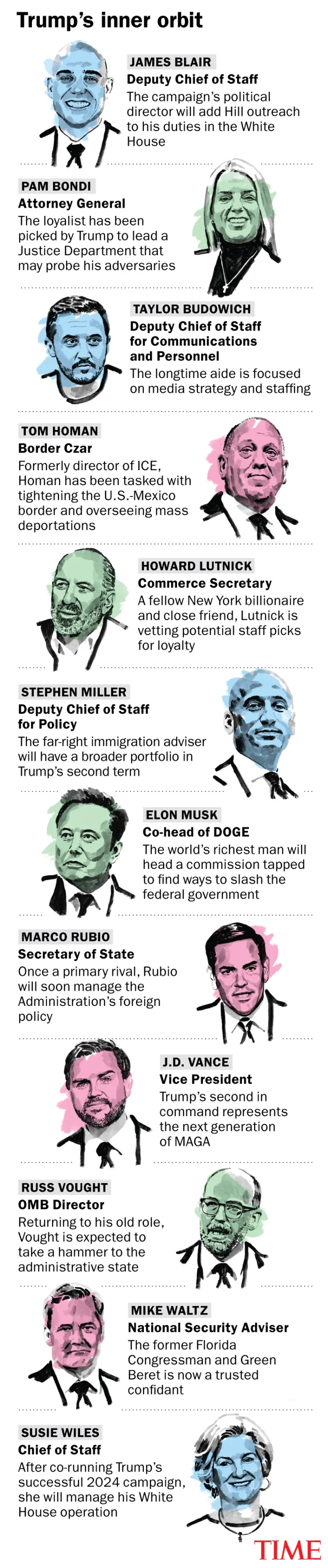
Illustrations by Sam Kerr for TIME; Source photos by Getty Images: Trump: Saul Loeb—AFP; Bondi, Musk, Vance: Andrew Harnik; Lutnick: Christopher Goodney—Bloomberg; Vought: Stefani Reynolds—Bloomberg; Homan: Bill Clark—CQ-Roll Call, Inc; Rubio: Chip Somodevilla; Walz: John Nacion; Miller: Tom Williams—CQ-Roll Call, Inc; Wiles: Jabin Botsford—The Washington Post; Twitter: Blair, Budowich
Trump has selected unconventional nominees who have demonstrated fealty to him and his agenda: Fox News host Pete Hegseth for Defense Secretary; Tulsi Gabbard to become the Director of National Intelligence; and Kash Patel as his FBI director. He rewarded Kennedy by nominating him to lead the Department of Health and Human Services, and chose a pro-union Labor Secretary in a nod to working-class voters while also installing billionaires in top positions to appease the donors who like Trump’s tax cuts and deregulation. The Cabinet taking shape reflects the fragmented coalition that powered him to victory, with Trump diehards mingling with mainstream choices like Senator Marco Rubio for Secretary of State and financier Scott Bessent at the Treasury Department.
As Trump gears up for his war on Washington, Washington’s institutions are carefully pushing back. Republican Senators forced Trump to abandon his first choice to run the Justice Department, the far-right former Congressman Matt Gaetz of Florida, recoiling at his bombastic style and allegations that he had sex with a 17-year-old girl. (Gaetz denies this.) When it became clear the votes weren’t there, Trump told Gaetz, “Matt, I don’t think this is worth the fight,” he tells TIME. In a matter of hours, he announced Bondi, another loyalist, as a replacement. Senators have expressed alarm at Hegseth’s lack of experience and allegations of sexual assault and alcohol abuse, which he denies. Some also worry about putting Gabbard at the helm of the U.S. intelligence community, given her prior positions in support of Russia and Assad’s Syria.
Trump says he will honor the Senate’s role in confirming or rejecting his appointments but does not rule out using recess appointments or installing acting agency heads to circumvent Senate approval. “I really don’t care how they get them approved,” he tells TIME, “as long as they get them approved.” Are recess appointments off the table? “No,” says a senior Trump adviser. “He’s not going to accept being d-cked around.”
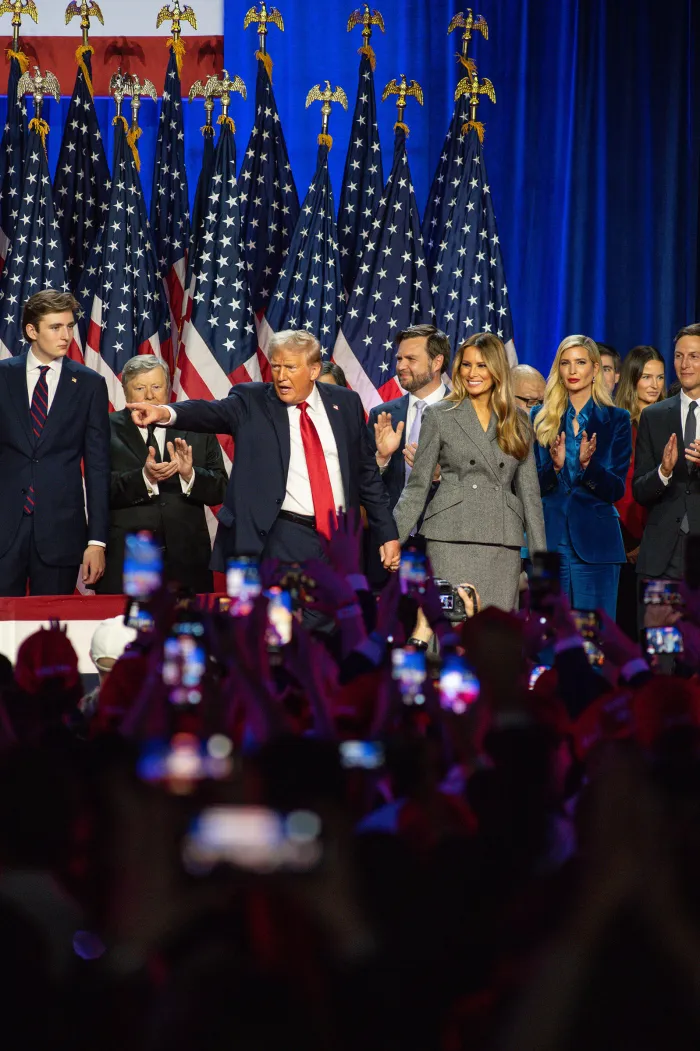
Trump during his Election Night Watch Party in West Palm Beach, Fla. on Nov. 6 David Butow for TIME
Trump says he will not ask members of his Administration to sign a formal loyalty pledge. “I think I will be able to, for the most part, determine who’s loyal,” he says. Anyone who gets crosswise with him, he says, will be gone in short order. That includes firing not only his own Cabinet secretaries and political appointees, but also civil servants who work in the Executive Branch. “If they’re not following my policies,” he says, “absolutely.”
Trump’s aggressive use of presidential powers will test the judiciary, the last line of defense against actions that threaten constitutional norms. His critics worry that even if the high court strikes the President’s actions, his Justice Department may not enforce the rulings. Trump and his aides are getting ready for an onslaught of lawsuits from groups challenging everything from his immigration measures and attacks on the federal bureaucracy to his attempts to withhold congressionally appropriated funds. “We’re constrained by realities of government and process in certain ways,” says a Trump official, “but he’s gonna try to do big sh-t.”
With unified control of Washington, there will be more pressure on Trump to deliver on his campaign promises to lower the cost of living, revive the manufacturing sector, reverse America’s trade deficit with China, and make peace abroad. Donald Kettl, an expert on government administration and former dean of the School of Public Policy at the University of Maryland, argues that Americans are not prepared for the level of disruption that Trump’s second stint in the White House is poised to bring, from potential changes to the education system to revisiting routine childhood vaccines, which Kennedy falsely linked to autism despite scientific evidence to the contrary. “The scale of change that we’re going to see is unprecedented, and the implications for government are enormous,” he says. Voters believe the government is wasteful and untrustworthy, Kettl adds, but if Trump follows through on his pledge to slash a wide range of programs, “you could end up with blowback very quickly that affects the lives of lots and lots and lots of ordinary Americans.”
Platon for TIME
By the end of Trump’s first term, voters were exhausted by the chaos, fed up with his antics, and frustrated by his management of an unprecedented global health crisis. He left office with low approval ratings. Trump’s victory in November may be partly the product of short memories. For his part, Trump puts faith in his negotiating abilities. “We can use the same words,” he says, “but maybe it’s a look in your eye that works.” Yet already, the President-elect is moving the goalposts on some of his pledges, like lowering the price of groceries. “It’s hard to bring things down once they’re up,” Trump says. “You know, it’s very hard.”
If his approach doesn’t work and Trump feels boxed in, critics worry he will become ever more extreme. To his closest aides, the President-elect’s unpredictable style will give him an edge over America’s competitors. “People are genuinely afraid that if they don’t listen to him, bad things can happen, and there are consequences for disregarding him,” Vance says. Faced with the challenges of governing, Trump seems almost wistful that his last campaign is behind him. “It’s sad in a way,” he says of his election win as the shadows begin to fall on the manicured lawns around his mansion. “It will never happen again.”
But a lot can happen in four years under President Donald J. Trump.
—With reporting by Leslie Dickstein and Simmone Shah/New York and Philip Elliott/Cambridge, Mass.
Source (Archive)
December 5, 2024, 5:31 PM EST
Mar-a-Lago was quiet three days before Thanksgiving. Donald Trump’s Moorish palace seemed all but deserted late that morning, the seaside estate’s cavernous living room traversed intermittently by a junior staffer or silent aide. Totems to Trump were displayed everywhere. Framed magazines with him on the cover hung by the front door. On a table near the fireplace sat a cast-bronze eagle awarded him by the singer Lee Greenwood. In the men’s lavatory, a picture of him with Arnold Palmer hung near the urinals. Adorning a wall in the library bar, a painting titled The Visionary depicted Trump in a tennis sweater, trim and youthful. The empty rooms felt less like a millionaire members’ club than a museum.
By midafternoon, the President-elect’s imminent arrival had stirred signs of life. Discreetly placed speakers offered up selections from Trump’s personally curated 2,000-song playlist. A handful of transition honchos and soon-to-be Administration officials arrived, perching on overstuffed sofas and huddling in corners. Incoming chief of staff Susie Wiles conferred with Trump’s designated National Security Adviser, Mike Waltz. Vice President–elect J.D. Vance strode in with a retinue of staffers. An aide posted up near a window overlooking the patio, setting down Trump’s personal cell phone, which lit up occasionally with calls and texts from favored media personalities and Cabinet picks. You could sense Trump before you could see him, the small group of senior aides rising to their feet in anticipation.
The world’s most powerful man entered with an air of unhurried bonhomie. Dressed in his trademark navy suit and red tie, Trump, 78, appeared a little older than he had some seven months earlier, when he last met with TIME—more subdued, less verbose, the same discursive speech patterns but with the volume turned down. Sitting under bright lights for a 30-minute photo session ahead of a 65-minute interview, he’s asked to explain the bruising on his right hand. “It’s from shaking hands with thousands of people,” he says.
The President-elect, pictured at Mar-a-Lago on Nov. 25 Platon for TIME
Trump’s political rebirth is unparalleled in American history. His first term ended in disgrace, with his attempts to overturn the 2020 election results culminating in the attack on the U.S. Capitol. He was shunned by most party officials when he announced his candidacy in late 2022 amid multiple criminal investigations. Little more than a year later, Trump cleared the Republican field, clinching one of the fastest contested presidential primaries in history. He spent six weeks during the general election in a New York City courtroom, the first former President to be convicted of a crime—a fact that did little to dampen his support. An assassin’s bullet missed his skull by less than an inch at a rally in Butler, Pa., in July. Over the next four months, he beat not one but two Democratic opponents, swept all seven swing states, and became the first Republican to win the popular vote in 20 years. He has realigned American politics, remaking the GOP and leaving Democrats reckoning with what went awry.
Trump has a ready explanation for his improbable resurrection. He even has a name for its climactic final act. “I called it 72 Days of Fury,” he says as the interview gets under way. “We hit the nerve of the country. The country was angry.” It wasn’t just the MAGA faithful. Trump harnessed deep national discontent about the economy, immigration, and cultural issues. His grievances resonated with suburban moms and retirees, Latino and Black men, young voters and tech edgelords. While Democrats estimated that most of the country wanted a President who would uphold the norms of liberal democracy, Trump saw a nation ready to smash them, tapping into a growing sense that the system was rigged.
If America was craving change, it is about to see how much Trump can deliver. He ran on a strongman vision, proposing to deport migrants by the millions, dismantle parts of the federal government, seek revenge against his political adversaries, and dismantle institutions that millions of people see as censorious and corrupt. “He understands the cultural zeitgeists,” says his 2016 campaign manager Kellyanne Conway, who remains a close adviser. “Donald Trump is a complicated person with simple ideas, and way too many politicians are the exact opposite.”
Trump takes the stage at the GOP Convention in Milwaukee on July 18 Jim Watson—AFP/Getty Images
Trump also promises to attack the sources abroad that he blames for the country’s malaise: economic interdependence, transnational criminals, traditional allies he sees as free riders on America’s long-running global beneficence. He believes he has tools to fight back: punitive tariffs, bare-knuckle negotiations, and threats to withdraw U.S. military, humanitarian, and economic support. Willing to upend the nation’s postwar role as a bulwark against authoritarianism, he promises to usher in a foreign policy rooted in “America First” transactionalism.
Much still stands in his way. The Republicans have narrow majorities in the House and Senate. A conservative Supreme Court may not bless all his boundary-pushing policies. Enduring institutional resistance inside the federal bureaucracy could thwart his designs. The public also remains a powerful check on any President. Trump has proved twice now that he can surf to power on anti-incumbent sentiment, a cult of personality, and divisive rhetoric, including racist and xenophobic attacks. He has yet to prove that he can enact the radical vision he campaigned on. Those closest to the President-elect say that he will surprise people by fulfilling his promises. “Most politicians don’t,” says Wiles, “and he will.”
Whether Trump can actually fix the root causes of Americans’ anger is another question. He will now have to contend with the same forces he rode to the White House—a globalized economy, mass migration, the rise of China—that have bedeviled predecessors from both parties and ousted incumbents around the world. He will also see just how far the nation is willing to let him go. If he succeeds, he could reshape the country. Along the way, he risks tearing down the constitutional norms and institutions that have seen America’s great experiment in democracy through 2 1⁄2 centuries.
Trump was in the private cabin of his plane, flying to an April 2 campaign rally in Grand Rapids, Mich., when he picked up a document Wiles had placed atop a stack of papers. The heading was not subtle: “How a national abortion ban will cost Trump the election.” Trump raised his eyebrows. “Kind of a nasty title, huh?” he said.
Trump campaign aides arrive in Fayetteville, N.C., ahead of an Oct. 4 rally Evan Vucci—AP
Trump gestures at supporters as he exits a campaign rally at Mullet Arena in Tempe, Ariz. on Oct. 24 Rebecca Noble—AFP/Getty Images
The episode was a turning point for an issue central to the race: whether Trump could find a position on abortion that would limit his electoral losses with women after playing a pivotal role in the fall of Roe v. Wade. That in turn was part of Trump’s larger challenge: how to offer change to everyone who wanted it, including voters put off by his positions or behavior. “There are not enough MAGA people to actually win an election,” a Trump campaign official tells TIME. “So who do you go get? How do you broaden that?”
Before he considered the memo, Trump had been on the verge of supporting a 16-week federal abortion ban. Conway had showed him polling that indicated barring the procedure after 16 weeks of pregnancy was more popular than doing so after 24. But Trump’s speechwriter and policy adviser, Vince Haley, had raised an objection on a late-March conference call, according to three people present: “Does he know that the 16-week ban will be stricter than existing law in a lot of the states?” There was a silence. “Probably not,” said Trump’s political director James Blair, who set to assembling a slide deck that argued such a ban would hurt Trump in the key states of Pennsylvania, Michigan, and Wisconsin, all of which offered women the opportunity to obtain the procedure until at least 20 weeks of pregnancy.
After flipping through Blair’s presentation on the plane, Trump perked his head up: “So we leave it to the states, right?” Advisers agreed. “Great,” Trump said. “We’ll do a video.” Within a few minutes, he was dictating his remarks to Haley. A few days later, Trump released the clip on his social media platform. For the rest of the race, a politician who had once asserted that “there has to be some form of punishment” for women who undergo abortions stuck to his stance of treating it as a states’-rights issue.
Trump backers, seen from Harris’ campaign bus, near Pittsburgh on Aug. 18 Julia Demaree Nikhinson—AP
The same month, Trump made another fateful decision: to end his crusade against vote by mail and early voting. For more than a year, senior advisers urged him to embrace a practice Trump had baselessly maligned as rife with fraud since the 2020 election. Several of his top lieutenants, including Wiles and Blair, were Florida operatives trained in the science of banking early votes. Wiles wrote Trump a memo showing the data on how spurning mail ballots cost Republicans in a series of razor-thin races in 2022. It would be self-defeating to oppose the practice, argued Wiles and Trump’s daughter-in-law Lara, whom he had handpicked as co-chair of the Republican National Committee (RNC).
Trump listened, but it took a visit from Rob Gleason, a former chair of the Pennsylvania Republican Party, to frame the matter in terms that made him agree. “Sir, your people are so excited to vote for you that they want to as soon as they can,” Gleason told him during an April meeting at Mar-a-Lago, according to two Trump officials familiar with the conversation. “They don’t want to wait. But you gotta tell them it’s OK. You gotta give them permission.” From then on, Trump promoted absentee and early voting, and directed the RNC to launch a mobilization drive targeting mail voters.
By the summer, Trump had the confidence of a man holding history in his hands. In late June, Joe Biden’s weak debate performance spurred an open revolt among panicking Democrats. On July 13, Trump survived the assassination attempt, prompting an outpouring of support and sympathy. To many Americans, his defiance in the aftermath of the shooting—rising bloodied, fist in the air, chanting “Fight!”—made him an inspirational figure for the first time. “A lot of people changed with that moment,” Trump tells TIME, sipping Diet Coke from a glass at Mar-a-Lago.
Platon for TIME
Trump’s strengthening position prompted Biden to drop out of the race and endorse Vice President Kamala Harris. Within a matter of days, Harris consolidated support, raised hundreds of millions of dollars, and galvanized a moribund Democratic base. In the wake of a successful Democratic National Convention, Trump’s inner circle experienced a creeping sense that he could lose. It was the moment of “maximal worry,” says Vance. “There was this sense of, Is this honeymoon with Kamala Harris going to last all the way until the election?”
Trump is a devotee of the Don Draper maxim: If you don’t like what’s being said, change the conversation. And so his team did. Trump’s son Don Jr. had long cultivated a rapport with Robert F. Kennedy Jr., whose independent campaign for the presidency in 2024 had garnered surprising levels of support, especially among disillusioned young men. Don Jr. worried Kennedy’s candidacy risked siphoning key votes, and he began clandestine negotiations as the conversations progressed. Trump Jr. and Wiles began coordinating with Kennedy’s campaign manager, his daughter-in-law Amaryllis Fox Kennedy, about removing him from the ballot in swing states and endorsing Trump. As Vance tells it, the pitch was simple: “You’re not going to win. You’re not going to have any effect on this race other than taking votes away from Donald Trump. So why don’t you actually join the team, set differences to the side, and focus on the big things that we care about?”
Once Kennedy bought into the plan, Wiles advised waiting to announce it until after the Democratic convention, believing it would stall Harris’ momentum. To Wiles, the endorsement was one of the campaign’s key moments. It neutralized the threat that Kennedy would peel off votes from Trump. But more importantly, “he allowed us to broaden the base of the party,” she says. “He was a key way to do that.”
Other new voters were devotees of Elon Musk, who endorsed Trump after the attack in Butler. Musk ended up pouring more than $250 million into supporting him, turning X into a de facto campaign organ, and serving as a key validator with the tech execs and corporate chieftains who had shied away from Trump for much of his time in the political arena. Now Musk will be among the array of billionaires with direct access to the Oval Office, creating a web of competing conflicts of interest.
To boost the contrast, the campaign maneuvered to portray Harris as too left-wing. It called attention to a questionnaire Harris filled out for the ACLU in 2019, during her last run for President, in which she supported taxpayer-funded sex-change operations for undocumented migrants held in detention. Trump’s adviser Taylor Budowich and admaker Pat McCarthy drummed up a line that would define his most influential campaign advertisement: “Kamala is for they/them. President Trump is for you.” The Trump campaign spent nearly $20 million to air the ad some 55,000 times in the first half of October, making it a key part of its closing message.
Strategists from both parties are divided over whether the Trump team’s blueprint made the difference in a close race, or if Harris’ headwinds—from pandemic-induced inflation to broad disquiet over Biden’s age—were just too much to overcome in a truncated campaign against the world’s most famous person. “We were up against a caricature of being dangerously liberal,” Harris campaign chief Jen O’Malley Dillon said at a Harvard Institute of Politics conference Dec. 6. The Vice President’s unwillingness to distance herself from her unpopular boss may have made as much of a difference as anything Trump did right. “It was a big looming negative hanging over us the whole time,” said Harris deputy campaign manager Quentin Fulks.
During his speech at the RNC, Trump discusses the attempt on his life in Butler, Pa. Morry Gash—AP
On election night, Trump campaign staff set up a war room in Trump’s office at Mar-a-Lago, poring over incoming returns as the candidate schmoozed in the club’s ballroom with Musk and UFC chief Dana White. After North Carolina and Georgia shifted into his column, Trump peeked in. “Anything concerning you?” he asked.
“Nope,” an aide replied. “Feel good.”
“Good,” Trump said. When he returned to the ballroom, the jubilant crowd was dancing to “YMCA” by the Village People—a Trump rally staple that has become a cultural touchpoint, with everyone from professional athletes to TikTok aficionados mimicking his signature moves. Trump stood for a moment, taking it all in, before turning to an aide and asking when they should head to the nearby convention center where he would give his victory speech.
The election gave Trump political capital to address the sources of American discontent at home and abroad. The question now is how he intends to spend it. By his own account, Trump will push the limits of presidential power and the law.
One of the first official acts of his presidency, Trump tells TIME, will be to pardon most of the rioters accused or convicted of storming the Capitol to block the certification of Biden’s victory. “It’s going to start in the first hour,” he says. “Maybe the first nine minutes.” Trump also plans early actions to reverse many of Biden’s Executive Orders and expand the drilling of oil on federal land.
The pro-Trump mob swarms the Inauguration Day stage, waving flags and chanting on Jan. 6, 2021 Nate Gowdy
Trump’s most aggressive moves will be on immigration enforcement. He vows to tighten the U.S. border with Mexico through a slew of Executive Orders, and aides say he would end the U.S. “catch-and-release” program and resume construction of a border wall. At the same time, he says, he will order U.S. law-enforcement agencies—and potentially the military—to embark on a massive deportation operation designed to remove more than 11 million undocumented migrants from the country. While the Posse Comitatus Act forbids the deployment of the military against civilians, Trump says he is willing to enlist the military to round up and deport migrants. “It doesn’t stop the military if it’s an invasion of our country,” he says. Pressed on how he would respond if the military refuses to carry out those orders, Trump says, “I’ll only do what the law allows, but I will go up to the maximum level of what the law allows.”
Trump tells TIME he doesn’t plan to restore the policy of separating children from their families to deter border crossings. But he doesn’t rule it out, either. “I don’t believe we’ll have to, because we will send the whole family back,” he says. “I would much rather deport them together.” Trump’s incoming border czar, Tom Homan, says “there is no deliberate policy being worked on to separate families.” But he also leaves open the possibility of children again being ripped from their parents. “You can’t say zero, it’s not going to happen,” Homan says.
For a mass-deportation operation of this scale, Trump’s advisers are planning to build more detention centers to hold migrants until they can be deported to their home countries, a process that can take weeks, months, or even years to negotiate with receiving governments. It’s not clear if all will be willing to take the migrants back. “We just don’t arrest an alien and remove them on the same day,” says Homan. “We’re going to need beds.” Trump says he will use access to the U.S. market as leverage to force foreign governments to cooperate. “I’ll get them into every country,” Trump says, “or we won’t do business with those countries.”
Trump at a section of the border wall in Sierra Vista, Ariz., on Aug. 22 Doug Mills—The New York Times/Redux
The operation would come at a steep cost. The nonprofit American Immigration Council estimates the tally for Trump’s mass-deportation plans could be upwards of $300 billion. Trump is likely to seek funding from Congress, according to aides. “It’s going to be expensive,” Homan says.
American taxpayers could bear the brunt in other ways. Economists say deporting many of the low-wage workers who bolster multiple industries could lead to higher prices. “If you eliminate the jobs of the people who are working on building houses, those who are also doing the accounting and the supervising and the personnel and running the company—those kinds of jobs disappear also,” says Douglas Rivlin of America’s Voice, a progressive group that supports immigration reform. “It’s a self-inflicted disaster.” That’s before factoring in the social and psychological costs to watching friends and neighbors rounded up and removed from their communities. “When you see the nightly news and there’s a raid at Joe’s Pizza,” adds Hiroshi Motomura, an immigration scholar at UCLA, “that becomes very real.”
Just how radical Trump can be depends in part on the buy-in of the Justice Department, which is set to be led by former Florida attorney general Pam Bondi, one of the defense attorneys on his first impeachment. Trump has vowed to seek retribution against his political enemies—saying the likes of Biden, former House Speaker Nancy Pelosi, Manhattan District Attorney Alvin Bragg, special counsel Jack Smith, and others would face investigation and potential prosecution. Trump was coy in his interview with TIME about whether his DOJ will target his domestic political adversaries, saying only that the decision will be left to Bondi if she’s confirmed. “That’s up to her,” he says. Either way, his victory spells the end of federal prosecutions that charged him with crimes ranging from election subversion to willfully retaining classified documents. (Trump denied the allegations.)
Trump at Manhattan criminal court during jury deliberations in his criminal hush money trial in New York, May 30 Mark Peterson—Pool/AP
To dismantle the federal bureaucracy, Trump has enlisted Musk and Vivek Ramaswamy to head a commission, dubbed DOGE, aimed at slashing the size of government. Musk and Ramaswamy have touted massive layoffs to the federal workforce, especially civil servants, and cuts to regulations on everything from the water we drink to the air we breathe. They promise to finish the job in time for the 250th anniversary of American independence, July 4, 2026.
Experts in government administration say the commission risks degrading the state’s ability to function. “It’s going to be harmful to the government’s capacity to carry out the missions that Congress has assigned by statute,” like administering Social Security and Medicare, says Peter Shane, a New York University law professor. If the Musk-Ramaswamy commission eliminates large numbers of civil servants, the government will likely have to rely on private companies instead. “There’s no guarantee,” says Shane, “that the contractors are going to be either cheaper or more competent.”
On the campaign trail, Trump said he would not order the DOJ to enforce the Comstock Act, a 19th century law that prohibits the mailing of abortion pills. When he spoke with TIME before Thanksgiving, Trump’s position on women’s reproductive rights changed in the span of a few sentences. First he left open the possibility that the Food and Drug Administration could reverse approvals for medication abortion, then said it was “highly unlikely,” before declaring, “We’re going to take a look at all of that.” Asked to clarify whether he was committed to preventing the FDA from stripping access to abortion pills, Trump replied, “It’s always been my commitment.”
Former First Lady Melania Trump, center right, and Elon Musk, during a Trump campaign event at Madison Square Garden in New York, on Oct. 27 Adam Gray—Bloomberg/Getty Images
While Trump’s GOP will have majorities in the House and Senate, he has telegraphed few major legislative pushes beyond extending his first-term tax cuts and funding an immigration crackdown. Trump says he supports preserving the filibuster, which allows a minority in the Senate to block legislation. If that prevents the passage of bills through Congress, he says he will use executive action. “If I have even a little bit of trouble,” he says, “I go to an Executive Order because I can get it done.”
It was a glimpse of how Trump’s expansive view of executive power will shape his second term, when he meets with inevitable obstacles. “The idea of the imperial presidency is not new, but he’s taking it further than anyone,” says presidential historian Julian Zelizer of Princeton University. “He doesn’t care about the kind of restraints that still guided even Richard Nixon. None of that matters to him. So the potential is for an extraordinarily aggressive use of presidential power.”
For all the focus on Trump’s domestic agenda, much of the activity when TIME visited Mar-a-Lago was on foreign affairs. Waltz, the incoming National Security Adviser, ducked in and out of meetings, speaking with Vance and Steve Witkoff, the incoming special envoy to the Middle East. A source present in the national-security meetings says the goal was to ensure that America’s adversaries—and allies—were not tempted to take advantage of the handoff between administrations.
Many of Trump’s answers to the nation’s problems, including his immigration and trade policies, rely on successful diplomacy. “America First” may be both a campaign slogan and a governing North Star, but ending forever wars and boosting U.S. economic advantage requires working with others.
Trump’s plans threaten to upend relationships with allies and traditional trading partners by imposing a blanket tariff on all imports. Already, he has floated 25% tariffs on Mexico and Canada, a move that most economists predict will cause prices to rise. And he plans to increase tariffs on Chinese imports, aiming to coerce manufacturers to make their products in the U.S.
On the campaign trail, Trump liked to brag about brokering a peace agreement between Russia and Ukraine in 24 hours. In person, he acknowledged this is trickier than he let on. “The Middle East is an easier problem to handle than what’s happening with Russia and Ukraine,” he says. “The numbers of dead young soldiers lying on fields all over the place are staggering. It’s crazy what’s taking place.” Trump criticized Kyiv for launching U.S.-made missiles into Russian territory last month. “I disagree very vehemently with sending missiles hundreds of miles into Russia. Why are we doing that?” he says. “We’re just escalating this war and making it worse.” When pressed on whether or not he would abandon Ukraine, Trump says he would use U.S. support for Ukraine as leverage against Russia in negotiating an end to the war. “I want to reach an agreement,” he says, “and the only way you’re going to reach an agreement is not to abandon.”
In phone calls during the campaign, Trump told Israeli Prime Minister Benjamin Netanyahu to wind down the war in Gaza by the time of his Inauguration, a timeline that now looks highly unlikely. In Israel and the U.S., many suspect Netanyahu is prolonging the fighting to prevent snap elections that could result in his ouster. “He knows I want it to end,” Trump tells TIME. When asked whether he trusts Netanyahu going into a second term, Trump takes a second before answering, “I don’t trust anybody.”
President Volodymyr Zelenskyy of Ukraine, left, meets with Trump in New York, Sept. 27 Doug Mills—The New York Times/Redux
Trump meets with Prime Minister Benjamin Netanyahu of Israel at Mar-a-Lago on July, 26 Doug Mills—The New York Times/Redux
Trump also wants to expand the Abraham Accords he brokered between Israel and several Arab states to include Saudi Arabia. But he’s less specific on a resolution between Israel and the Palestinians. In his first term he put forth the most comprehensive plan for a two-state solution since President Bill Clinton and prevented Netanyahu from extending Israeli sovereignty over roughly 30% of the West Bank. But on Nov. 12, he nominated as incoming U.S. ambassador to Israel Mike Huckabee, a zealous supporter of the settlement movement who advocates for Israel’s annexing the West Bank.
The sudden collapse of Assad’s rule in Syria on Dec. 8 adds another layer of complexity to the Middle East. It brings to power a rebel group once affiliated with al-Qaeda, but also marks yet another setback for an Iran regime already weakened in Lebanon and Gaza. Some analysts fear the losses may make Iran more likely to push for a nuclear weapon. Since Trump pulled out of the Iran nuclear deal in 2018, Tehran has edged ever closer to acquiring a nuclear weapon. As of April, the International Atomic Energy Agency estimated that Tehran has enough weapons-grade uranium to build a bomb in a matter of weeks. Iran and its proxies have waged a multi-front war against Israel and have targeted U.S. assets in the region. During the presidential campaign, the Iranians plotted to assassinate Trump, according to federal charges brought in November by the Department of Justice. While the President-elect prides himself on not entering into any new wars in his first term, he leaves open the possibility that one may be necessary in a second. Asked about the chances of war with Iran, Trump pauses, then replies, “Anything can happen.”
By the time the dinner hour is approaching, the crowd has swelled in the ornate reception area at Mar-a-Lago, transforming it into a buzzing king’s court. Job seekers camp out on sofas, waiting to buttonhole Howard Lutnick, the Wall Street executive who co-chairs his transition. Lutnick, who is also Trump’s chosen Commerce Secretary, has been tasked by Trump with vetting Cabinet appointees for the trait Trump values most: loyalty.
Illustrations by Sam Kerr for TIME; Source photos by Getty Images: Trump: Saul Loeb—AFP; Bondi, Musk, Vance: Andrew Harnik; Lutnick: Christopher Goodney—Bloomberg; Vought: Stefani Reynolds—Bloomberg; Homan: Bill Clark—CQ-Roll Call, Inc; Rubio: Chip Somodevilla; Walz: John Nacion; Miller: Tom Williams—CQ-Roll Call, Inc; Wiles: Jabin Botsford—The Washington Post; Twitter: Blair, Budowich
Trump has selected unconventional nominees who have demonstrated fealty to him and his agenda: Fox News host Pete Hegseth for Defense Secretary; Tulsi Gabbard to become the Director of National Intelligence; and Kash Patel as his FBI director. He rewarded Kennedy by nominating him to lead the Department of Health and Human Services, and chose a pro-union Labor Secretary in a nod to working-class voters while also installing billionaires in top positions to appease the donors who like Trump’s tax cuts and deregulation. The Cabinet taking shape reflects the fragmented coalition that powered him to victory, with Trump diehards mingling with mainstream choices like Senator Marco Rubio for Secretary of State and financier Scott Bessent at the Treasury Department.
As Trump gears up for his war on Washington, Washington’s institutions are carefully pushing back. Republican Senators forced Trump to abandon his first choice to run the Justice Department, the far-right former Congressman Matt Gaetz of Florida, recoiling at his bombastic style and allegations that he had sex with a 17-year-old girl. (Gaetz denies this.) When it became clear the votes weren’t there, Trump told Gaetz, “Matt, I don’t think this is worth the fight,” he tells TIME. In a matter of hours, he announced Bondi, another loyalist, as a replacement. Senators have expressed alarm at Hegseth’s lack of experience and allegations of sexual assault and alcohol abuse, which he denies. Some also worry about putting Gabbard at the helm of the U.S. intelligence community, given her prior positions in support of Russia and Assad’s Syria.
Trump says he will honor the Senate’s role in confirming or rejecting his appointments but does not rule out using recess appointments or installing acting agency heads to circumvent Senate approval. “I really don’t care how they get them approved,” he tells TIME, “as long as they get them approved.” Are recess appointments off the table? “No,” says a senior Trump adviser. “He’s not going to accept being d-cked around.”
Trump during his Election Night Watch Party in West Palm Beach, Fla. on Nov. 6 David Butow for TIME
Trump says he will not ask members of his Administration to sign a formal loyalty pledge. “I think I will be able to, for the most part, determine who’s loyal,” he says. Anyone who gets crosswise with him, he says, will be gone in short order. That includes firing not only his own Cabinet secretaries and political appointees, but also civil servants who work in the Executive Branch. “If they’re not following my policies,” he says, “absolutely.”
Trump’s aggressive use of presidential powers will test the judiciary, the last line of defense against actions that threaten constitutional norms. His critics worry that even if the high court strikes the President’s actions, his Justice Department may not enforce the rulings. Trump and his aides are getting ready for an onslaught of lawsuits from groups challenging everything from his immigration measures and attacks on the federal bureaucracy to his attempts to withhold congressionally appropriated funds. “We’re constrained by realities of government and process in certain ways,” says a Trump official, “but he’s gonna try to do big sh-t.”
With unified control of Washington, there will be more pressure on Trump to deliver on his campaign promises to lower the cost of living, revive the manufacturing sector, reverse America’s trade deficit with China, and make peace abroad. Donald Kettl, an expert on government administration and former dean of the School of Public Policy at the University of Maryland, argues that Americans are not prepared for the level of disruption that Trump’s second stint in the White House is poised to bring, from potential changes to the education system to revisiting routine childhood vaccines, which Kennedy falsely linked to autism despite scientific evidence to the contrary. “The scale of change that we’re going to see is unprecedented, and the implications for government are enormous,” he says. Voters believe the government is wasteful and untrustworthy, Kettl adds, but if Trump follows through on his pledge to slash a wide range of programs, “you could end up with blowback very quickly that affects the lives of lots and lots and lots of ordinary Americans.”
Platon for TIME
By the end of Trump’s first term, voters were exhausted by the chaos, fed up with his antics, and frustrated by his management of an unprecedented global health crisis. He left office with low approval ratings. Trump’s victory in November may be partly the product of short memories. For his part, Trump puts faith in his negotiating abilities. “We can use the same words,” he says, “but maybe it’s a look in your eye that works.” Yet already, the President-elect is moving the goalposts on some of his pledges, like lowering the price of groceries. “It’s hard to bring things down once they’re up,” Trump says. “You know, it’s very hard.”
If his approach doesn’t work and Trump feels boxed in, critics worry he will become ever more extreme. To his closest aides, the President-elect’s unpredictable style will give him an edge over America’s competitors. “People are genuinely afraid that if they don’t listen to him, bad things can happen, and there are consequences for disregarding him,” Vance says. Faced with the challenges of governing, Trump seems almost wistful that his last campaign is behind him. “It’s sad in a way,” he says of his election win as the shadows begin to fall on the manicured lawns around his mansion. “It will never happen again.”
But a lot can happen in four years under President Donald J. Trump.
—With reporting by Leslie Dickstein and Simmone Shah/New York and Philip Elliott/Cambridge, Mass.
Source (Archive)


 My nigga...