War Developing and Upcoming Military Technology - Something new at least 3 times a week.

  • Want to keep track of this thread?
    Accounts can bookmark posts, watch threads for updates, and jump back to where you stopped reading.
    Create account
So, Yesterday was an exciting day for our floating friends.

So, let's jump right into the news then:
Expeditionary Fast Transport Undergoes First Fast-Tracked Integrated Sea Trials
USNI said:
In a move designed to hasten the speed of Spearhead-class expeditionary fast transports (EPFs) joining the fleet, the shipbuilder completed a first-ever integrated builder’s and acceptance trials at sea for the future USNS Puerto Rico (T-EPF-11).

Screen Shot 2019-08-27 at 3.43.33 AM.png

Conducting integrated trials enabled builder Austal USA to demonstrate to the Navy Puerto Rico’s operational capability and mission readiness of all ship systems during a single two-day underway, according to the Navy.

Puerto Rico is one of the last EPFs being built by Austal. The future USNS Newport (T-EPF-12) is under construction at the Austal USA yard in Mobile, Ala. Two more, the future USNS Apalachicola (T-EPF-13) and the yet-unnamed EPF-14, are on contract with the yard. Total orders for the class are worth more than $2 billion, according to the company’s financial statements.

Navy officials have previously stated that their shift to a Distributed Maritime Operations concept relies on having more smaller ships, such as the EPF, which can fulfill several missions.

EPFs such as Puerto Rico will have a crew of 26 civilian mariners. With airline-style seating, an EPF can carry 312 troops for intratheater lift.

“The EPF program continues to be an example of stable and successful serial ship production,” Capt. Scot Searles, the Strategic and Theater Sealift program manager within the Program Executive Office for Ships, said in a statement. “I look forward to seeing EPF-11 deliver in the fall and expand the operational flexibility available to our combatant commanders.”

Though the EPF line as it stands today may be coming to an end, the company has made a pitch for the Navy to consider using the hull as an ambulance ship. The Navy included in its Fiscal Year 2020 unfunded priorities list a request for $49 million to convert the last ship on contract, EPF-14, into an Expeditionary Medical Transport through an engineering change proposal to the contract with Austal.
USNI are good guys, do good work.

Further reading related to headline:
UPI said:
Screen Shot 2019-08-27 at 3.48.39 AM.png
Aug. 26 (UPI) -- The U.S. Navy's Expeditionary Fast Transport ship USNS Puerto Rico finished its first integrated sea trials after two days in the Gulf of Mexico.

The ship, designated EPF 11, completed its trials on August 22, and then returned to the Austal USA shipyard in Mobile, Ala., where it was built, the Naval Sea Systems Command announced on Friday.

Integrated trials combine builder's and acceptance trials, allowing a demonstration of the ship's operational capability and mission readiness to the Navy's Board of Inspection and Survey.

"The EPF program continues to be an example of stable and successful serial ship production," Capt. Scot Searles, Strategic and Theater Sealift program manager, Program Executive Office Ships, said in a press release. "I look forward to seeing EPF 11 deliver in the fall and expand the operational flexibility available to our combatant commanders."

The USNS Puerto Rico is a non-combatant vessel designed to operate in shallow-draft ports and waterways.

The Spearhead-class of EPF ships specializes in versatility, with operational flexibility for a wide range of activities including maneuver and sustainment, relief operations in small or damaged ports, flexible logistics support, and rapid transport. The ships are capable of carrying vehicles including a fully combat-loaded Abrams Main Battle Tank.

The Puerto Rico is the 11th Spearhead-class expeditionary fast transport and after its commissioning will be operated by the Military Sealift Command.
Defense Blog said:
Screen Shot 2019-08-27 at 3.51.59 AM.png
Austal shipyard has announced that the U.S. Navy newest Expeditionary Fast Transport (EPF ) ship, the future USNS Puerto Rico (EPF11), has successfully completed acceptance trials.

The shipyard reported that acceptance trials, conducted in the Gulf of Mexico, were unique in that they integrated formal Builder’s Trials with Acceptance Trials for the first time on an EPF vessel.

“By combining the two at-sea trials into one event, there are great efficiencies gained, enabling reduced costs and a shorter completion schedule,” according to Austal.


Austal CEO David Singleton congratulated Austal USA for achieving this critical program milestone.

“The future USNS Puerto Rico successfully completed and passed all tests – a clean sweep – and returned from sea earlier than scheduled, a testament to the effort and expertise of Austal USA’s professional shipbuilding team and the U.S. Navy’s Board of Inspection and Survey (INSURV),” he said.

“These trials involved the execution of intense, comprehensive testing by the Austal-led industry team while underway, which demonstrated to the U.S. Navy the successful operation of the ship’s major systems and equipment. Sea trials are the last milestone before delivery of the ship. The future USNS Puerto Rico is scheduled for delivery to the U.S. Navy before the end of the year and is the eleventh Spearhead Class ship in Austal’s 14-ship EPF portfolio.

“The flexibility and versatility of the EPF is becoming increasingly evident. From serving as a mother ship to test unmanned aerial and undersea systems in the Atlantic to performing as command ships in Pacific Partnership 2019 (an exercise that includes more than 500 military and civilian personnel from more than 10 nations), the EPF fleet is proving to be a great asset to the future 355-ship US Navy,” Mr Singleton said.

Austal’s EPF program is mature with ten ships delivered and three more under construction in Mobile, Alabama, in addition to the future USS Puerto Rico. The Spearhead-class EPF is currently providing high-speed, high-payload transport capability to fleet and combatant commanders.

The EPF’s large, open mission deck and large habitability spaces provide the opportunity to conduct a wide range of missions from engagement and humanitarian assistance or disaster relief missions, to the possibility of supporting a range of future missions including special operations support, command and control, and medical support operations. With its ability to access austere and degraded ports with minimal external assistance, the EPF provides unique options to fleet and combatant commanders.

According to the Navy, the ships are capable of operating in shallow-draft ports and waterways, interfacing with roll-on/roll-off discharge facilities and on/off-loading a combat-loaded Abrams Main Battle Tank (M1A2). The EPF includes a flight deck for helicopter operations and an off-load ramp that allow vehicles to quickly drive off the ship. The ramp is suitable for the types of austere piers and quay walls common in developing countries. The ship’s shallow draft (under 15 feet) will further enhance littoral operations and port access. This makes the EPF an extremely flexible asset for support of a wide range of operations including maneuver and sustainment, relief operations in small or damaged ports, flexible logistics support or as the key enabler for rapid transport.

In addition to the EPF program, Austal has also received contracts for 19 Independence-variant Littoral Combat Ships (LCS) for the U.S. Navy. Ten LCS have been delivered, five ships are in various stages of construction and four are yet to start construction.
Further reading about the Spearhead-Class:


U.S. Navy awards General Dynamics with $1.6 billion contract for newest expeditionary ships
Defense Blog said:
Screen Shot 2019-08-27 at 3.58.39 AM.png
General Dynamics NASSCO, a business unit of General Dynamics, was awarded a contract from the U.S. U.S. Navy for newest expeditionary ships as part of Expeditionary Sea Base (ESB) program.

The contract, announced by the Department of Defense, is worth more than $1.6 billion and covers the construction of the sixth and seventh ships of the ESB program, as well as an option for ESB 8.

“We are pleased to be building ESB 6 and 7 for our Navy,” said Kevin Graney, president of General Dynamics NASSCO. “ESBs have proven to be affordable and flexible, and as the fleet has gained experience with the platform, we have worked with the Navy and Marines to develop even more capabilities and mission sets.”

According to General Dynamics, named after famous names or places of historical significance to U.S. Marines, ESBs serve as a flexible platform and a key element in the Navy’s airborne mine countermeasures mission, with accommodations for up to 250 personnel and a large helicopter flight deck. The ship’s configuration supports special warfare and Marine Corps task-organized units.

Work on the two new ships of the ESB program is scheduled to begin in the first quarter of 2020 and continue to the second quarter of 2023, providing the opportunity to sustain and grow the workforce along San Diego’s working waterfront. NASSCO’s unique location along the historic San Diego Bay provides shipbuilders and skilled tradespeople with unparalleled access to the nation’s leading maritime support businesses, and highly-trained employees allow NASSCO to build and repair some of the world’s greatest ships in the most efficient manner possible.

In 2011, the Navy awarded NASSCO with a contract to design and build the first two ships in the newly created MLP program, the USNS Montford Point and USNS John Glenn. The program expanded with three more vessels, the USS Lewis B. Puller, USNS Hershel “Woody” Williams and the Miguel Keith, configured as ESBs. Following the delivery of the first four ships to the U.S. Navy, the fifth ship, the Miguel Keith, is scheduled for delivery in the fourth quarter of 2019.

Further reading related to headline:
UPI said:
GenDyn to build two Expeditionary Sea Base ships under $1B contract
Screen Shot 2019-08-27 at 4.00.45 AM.png

Aug. 26 (UPI) -- General Dynamics will build two ships for the U.S. Navy under a $1.08 billion contract announced by the Defense Department.

The company's National Steel and Shipbuilding Co. subsidiary, headquartered in San Diego, will build the sixth and seventh ships in the Navy's Expeditionary Sea Base program, the Pentagon announced on Friday. The deal includes an option to build an eighth ship, which would push the contract's value to $1.63 billion.

The vessels are regarded as seagoing platforms used across a broad range of military operations supporting multiple operational phases.

"ESBs have proven to be affordable and flexible," Kevin Graney, president of General Dynamics NASSCO, said in a press release. "As the fleet has gained experience with the platform, we have worked with the Navy and Marines to develop even more capabilities and mission sets."

Acting as a mobile sea base, the ships, originally called Mobile Landing Platform Afloat Forward Staging Bases, are part of the critical access infrastructure to support deployment of forces and supplies. Their design is modeled after Alaska-class crude oil carriers, another General Dynamics NASSCO product.

The first two ships in the program were started in 2011. The USNS Montford Point was launched in 2012, and the USNS John Glenn was launched in 2013.

The contract announced on Friday is a fixed-price-incentive modification to a prior contract. Most of the work will be performed in San Diego, with January 2025 targeted as the completion date.
Further reading on the Expeditionary Sea Base ships:

U.S. Coast Guard Cutter Kimball returns to homeport after final sea trials
Defense Blog said:
Screen Shot 2019-08-27 at 4.07.16 AM.png
Coast Guard Cutter Kimball (WMSL 756) returns to its homeport in Honolulu after conducting final sea trials near Hawaii Aug. 20, 2019.

According to U.S. Coast Guard Pacific Area, Kimball, the seventh National Security Cutter built for the Coast Guard, is scheduled for a unique dual-commissioning ceremony with Coast Guard Cutter Midgett (WMSL 757), the eighth NSC, at both cutters’ new homeport in Honolulu Aug. 24, 2019.

Known as the Legend-class, national security cutters are capable of executing the most challenging national security missions, including support to U.S. combatant commanders. They are 418 feet in length, 54 feet in beam and 4,600 long tons in displacement.

They have a top speed of more than 28 knots, a range of 12,000 nautical miles, an endurance of up to 90 days and can hold a crew of up to 150. These new cutters are replacing the high endurance Hamilton-class cutters (378 feet) that have been in service since the 1960s.

While national security cutters possess advanced capabilities, over 70 percent of the Coast Guard’s offshore presence exists in the service’s aging fleet of medium endurance cutters. Many of these ships are over 50-years-old and approaching the end of their service life. Replacing the fleet with new offshore patrol cutters is one of the U.S. Coast Guard’s top priorities.

The Kimball’s namesake, Sumner Kimball, served as superintendent of the Revenue Marine, establishing a training school that would later become the U.S. Coast Guard Academy. Kimball then was general superintendent of the Life-Saving Service (LSS) from 1878 until the LSS merged with the Revenue Marine to become the U.S. Coast Guard in 1915. The ship’s motto is Lead, Train, and Save.
It is a nice little ship.

Speaking of which:
U.S. Coast Guard commissions two newest national security cutters
Defense Blog said:
The United States Coast Guard commissioned two newest Legend-class national security cutters, during a ceremony in Honolulu, Hawaii, Aug. 24.
Screen Shot 2019-08-27 at 4.13.43 AM.png
According to a statement released by U.S. Coast Guard District 14 Hawaii Pacific, the Coast Guard Cutter Kimball (WMSL 756) and the Coast Guard Cutter Midgett (WMSL 757) were ‘brought to life’ during the rare dual-commissioning ceremony at Base Honolulu where the two cutters homeport. The Kimball and Midgett are the seventh and eighth legend-class national security cutters in the Coast Guard’s fleet.

“These national security cutters will continue our 150 years of partnership and commitment to the Pacific region – since September 1849, when Revenue Cutter Lawrence sailed into Honolulu Harbor escorted by Native Hawaiians in outrigger canoes,” said Schultz. “In today’s complex geostrategic environment with rising great power competition, the importance and demand for a strong Coast Guard presence in the Pacific has never been greater.”

The Kimball and Midgett, along with the three fast response cutters also homeported in Honolulu, will further advance the Coast Guard’s longstanding commitment to safeguard the nation’s maritime safety, security, and economic interests through critical deployments across the Indo-Pacific region.

Advanced command-and-control capabilities and an unmatched combination of range, speed and ability to operate in extreme weather enable these ships to confront national security threats, strengthen maritime governance, support economic prosperity, and promote individual sovereignty.

From the Bering Sea and the Arctic to patrolling known drug trafficking zones off Central and South America to working to strengthen the capabilities of our partners across the Indo-Pacific, national security cutters deploy globally to conduct essential Coast Guard missions.

Known as the Legend-class, national security cutters are capable of executing the most challenging national security missions, including support to U.S. combatant commanders. They are 418 feet in length, 54 feet in beam and 4,600 long tons in displacement. They have a top speed of more than 28 knots, a range of 12,000 nautical miles, an endurance of up to 90 days and can hold a crew of up to 150. These new cutters are replacing the high endurance Hamilton-class cutters (378 feet) that have been in service since the 1960s.

The Midgett’s transit to Hawaii was punctuated by two interdictions of suspected low-profile go-fast vessels in the Eastern Pacific Ocean, the first July 25 and a second July 31. The boardings resulted in a combined seizure of over 6,700 pounds of cocaine, estimated to be worth over $89 million.

National security cutters are responsible for 40 percent of the 460,000 pounds of cocaine interdicted by the Coast Guard in the fiscal year 2018. National security cutter crews have interdicted more than 92,000 pounds of cocaine to date in the fiscal year 2019.

Midgett is named to honor all members of the Midgett family who served in the Coast Guard and its predecessor services. At least ten members of the family earned high honors for their heroic life-saving efforts. Among them, the Coast Guard awarded various family members seven gold lifesaving medals, the service’s highest award for saving a life, and three silver lifesaving medals.

The Kimball is the third ship to bear that name, in honor of Sumner Kimball, who served as superintendent of the Revenue Marine and as general superintendent of the Life-Saving Service from 1878 until the two organizations merged in 1915 to become the modern-day U.S. Coast Guard.

“As you take to the seas, you will write the next chapters of the Kimball and Midgett legacies,” said Schultz, addressing the commands and crews of the two cutters. “I charge you with carrying out the operations of these ships in such a manner as to be worthy of the traditions of self-sacrifice, inspirational leadership, and unwavering dedication to duty – traits exemplified by these cutters’ distinguished and storied namesakes.”

Screen Shot 2019-08-27 at 4.14.16 AM.png

Screen Shot 2019-08-27 at 4.14.07 AM.png

Screen Shot 2019-08-27 at 4.13.55 AM.png

Further reading on the Legend-Class:

Low-rate initial production begins for Raytheon Evolved SeaSparrow Missiles
New guidance system has dual mode active and semi-active radar

Raytheon said:
TUCSON, Ariz., Aug. 26, 2019 /PRNewswire/ -- The U.S. Navy awarded Raytheon Company (NYSE: RTN) a $190 million low-rate initial production contract for ESSM Block 2 missiles featuring a new guidance system with a dual mode active and semi-active radar.

This award follows the Navy's decision to shift from development to production on the enhanced intermediate-range, surface-to-air missile, placing the Block 2 variant on track for initial operating capability in 2020.

The ESSM missile is the primary ship self-defense missile aboard Navy aircraft carriers and large deck amphibious assault ships. It is an integral component of the Navy's layered area and ship self-defense capability for cruisers and destroyers.

"ESSM plays a critical role in protecting navy sailors worldwide and our international partners share our commitment to evolve this missile," said Dr. Mitch Stevison, Raytheon Strategic and Naval Systems vice president.

ESSM is the foundation of several allied navies' anti-ship missile defense efforts and is operational on almost 200 naval platforms worldwide.

The ESSM program is a cooperative effort managed by a NATO-led consortium comprising 12 nations: Australia, Belgium, Canada, Denmark, Germany, Greece, The Netherlands, Norway, Portugal, Spain, Turkey and the United States.
Further reading on Evolved SeaSparrow Missile Block 2:
TL;DR: Sea Sparrow has its own radar illuminator now.

US Naval News Roundout:
Pentagon’s Investor-Industry Matchmaking Program Will Focus on Small UAS in First Event

USNI said:
THE PENTAGON – The Defense Department’s effort to connect sources of capital with small companies that need investment will begin with a focus on those that design and manufacture small unmanned aerial systems, the Pentagon’s acquisition chief told reporters today.

The Trusted Capital Marketplace, which USNI News first reported on in April, will begin with a first meeting of investors and tech companies in October, Ellen Lord said today in a briefing at the Pentagon.

That meeting will target the small UAS industry sector due to concerns that China currently dominates the market, she said.

“It’s because of where we are right now in terms of having our entire U.S. marketplace eroded, and also because it’s very intuitive – people can understand what these small quadcopters are,” she said when asked why the Trusted Capital Marketplace would kick off with a focus on small UAS.
“So essentially we don’t have much of a small UAS industrial base because (Chinese company) DJI dumped so many low-priced quadcopters on the market and we then became dependent on them, both from the defense point of view and the commercial point of view. And we know that a lot of the information is sent back to China from those, so it is not something that we could use.”

By bringing investors to meet with companies interested in designing and building small fixed-wing or quadcopter UAS in the United States, the American industrial base could regain that capability and, once Defense Department needs are satisfied, potentially compete American drones against Chinese ones on the commercial market.

Since announcing the public-private partnership earlier this year, Lord said a team has stood up to begin managing the vetting requirements for the trusted sources of capital – ensuring that money funding sensitive defense capabilities doesn’t come with ties to China, Russia or other potential adversaries – as well as beginning industry outreach and the industry/capital matching process.

Lord previously thought that DoD might be able to set up a matchmaking website of sorts, where citizens or companies interested in spending money to help shore up gaps in defense capability or capacity could be paired with tech companies working on critical defense needs for which there may not be much potential for profit in the commercial world or who otherwise need a cash infusion to continue working in the defense sector.

Instead, Lord said today, an initial model pointed to a “complicated and expensive website” and caused her team to change plans, instead opting for a series of events around the country instead of working through a website.

Lord said her office already has a list of other topics for tech investment focus areas, and after the October event on small UAS she hoped to have another event with a different focus area in January and then again every few months afterwards.

“The idea is, we do not promise business to any of the businesses that would be there [at these events], but these are areas where we definitely have a strong demand signal,” she said.
“What we’re working on right now is, how we as DoD can invest a little bit in many of these companies as well, so they could be branded as having DoD contracts? We think that would be helpful,” she added.

Additionally, Lord said during her media briefing that the Office of the Secretary of Defense was standing up an “Intellectual Property Cadre” to look at both how to manage intellectual property and data rights between the government and industry and also how to protect IP from China and others who may steal that data. That organization should be formally stood up by October.

“They will develop DoD policy within the whole-of-government effort to address concerns on data rights,” she said.
“[Defense Secretary Mark] Esper, [Secretary of State Mike] Pompeo and the president have all spoken about the impact Chinese intellectual property theft is having on our national security, American commerce and our defense industry. Again, we need to go on the offense to protect our technology versus merely acting defensively.”

Despite the urgency of the Chinese theft issue, she said the organization would primarily focus on IP and data rights between the government and the contractors it works with. That continues to be a challenge, as the military services want to own data rights so they can re-compete a program later on, build their own spare parts through additive manufacturing, and so on, while companies want to keep those rights to ensure they make money throughout the life of a program.

“My experience says that typically we have problems with intellectual property when we don’t clearly define what is owned by industry and what will be owned by government at the outset of a program. So a lot of this really has to do with good program planning,” Lord said, adding that the group will leverage work the Army has already done on the topic and seek to establish policy that everyone can live with going forward.

Lord noted that the establishment of an intellectual property cadre was mandated by the 2017 National Defense Authorization Act and that her office has been in close contact with Capitol Hill as the group nears being stood up.
Six Major Navy Commands Now Using Cloud-Based System for Financial and Supply Management
USNI said:
THE PENTAGON – Navy Enterprise Resource Planning (ERP), the service’s financial and supply chain management system, has migrated to a cloud computing system following a 10-month program replacing a server-based system.

The Navy ERP migration to cloud computing is part of a larger three-year, $100-million effort to upgrade Navy computing systems, James Geurts, assistant secretary of the Navy for research, development and acquisition, said during a media briefing last week. The cloud-based Navy ERP gives some 72,000 Navy users better access to data, such as the availability of parts, the status of supplies and the ability to quickly run reports.

“My experience has been, anytime you can increase transparency and ability for users – wherever they are in the system – to get as close to real-time actual data, then that adds efficiencies across the board,” Geurts said.

Since Navy ERP is in the cloud, Geurts said future expansions, upgrades and connections to other Department of Defense systems should be relatively simple to accomplish.

“Now that it’s on a cloud-based system, it gives us tremendous flexibility technically and from a business standpoint for the future – both being important – so we weren’t locked into a particular IT infrastructure or business arrangement,” Geurts said.

The Navy ERP is a Systems, Applications and Products (SAP) high-performance analytic appliance (HANA) cloud-based platform, managed by the Program Executive Office for Enterprise Information Systems’ (PEO EIS) Navy Enterprise Business Solutions program management office. The Navy’s legacy system was a SAP server-based Oracle platform.

Moving to the cloud is an essential step for the Navy to take because it allows the sea service to simplify and modernize its financial reporting process, Thomas Harker, the assistant secretary of the Navy for financial management and comptroller, said during the Friday briefing. Cloud computing helps the commands update data quicker and run reports more frequently.

“For example, there is one we only run on Sundays because the system is not being used, and it would take five or six hours to do; and they can now do that in about 30 minutes, and they’re doing it daily now. So it’s one where that increased accuracy has helped us with operations,” Harker said.

The goal is for all Navy financial systems to consolidate into a single general ledger within the next couple of years. Doing so is essential to producing accurate financial information, obtaining a clean audit opinion and improving the service’s analytics capability.

Six major Navy commands are now using Navy ERP. Naval Air Systems Command (NAVAIR), Naval Supply Systems Command (NAVSUP), Naval Sea Systems Command (NAVSEA), the Office of Naval Research (ONR), Strategic Systems Programs (SSP) and the Naval Information Warfare Systems Command (NAVWAR, formerly SPAWAR) are all using Navy ERP.

“The magnitude of this accomplishment is incredible,” Navy Secretary Richard V. Spencer said in a statement. “The Navy ERP tech refresh is our largest system cloud migration to date and will enhance the performance of our force.”

Geurts said his team initially planned for a 20-month process to build the system and migrate the six major commands. The work was accomplished in 10 months.

“I am proud of the team efforts to accomplish this on an accelerated schedule, cutting the projected timeline nearly in half,” Spencer’s statement said. “The team managed this through innovative approaches to problem solving and close collaboration with integration teams, network engineers and industry partners.”

Putting the ERP in the cloud also adds a layer of protection to the data, Geurts said. The Navy now has only one cloud-based depository of data to protect instead of a myriad of computing hardware.

“I think it is a widely accepted practice, if you can move from many different disparate systems that you’ve got to independently always be checking and protecting and dealing with vulnerabilities and get that into a more coherent single system that reduces the attack surface and allows you to much more efficiently ensure that you’re always keeping that infrastructure safe,” Geurts said.

The process of setting up Navy ERP could prove to be an essential pathway to use in the future as the Navy considers moving other systems to the cloud, Geurts said. For example, the Navy could follow a similar acquisition strategy with the use of small businesses and a similar process used to migrate the data to the cloud. Advanced Solutions Inc., a small-tech firm, is the prime contractor for the Navy ERP migration.

“You’ve heard me talk last year about how we see small businesses having big impacts on the Navy; this is a great example of that,” Geurts said. “Last year we did over $15 billion to small businesses as primes, and this is a great example of a small business as a prime.”
USNI News Fleet and Marine Tracker: Aug. 26, 2019

Screen Shot 2019-08-27 at 4.29.55 AM.png
**Warning Format cancer.**
USNI said:
These are the approximate positions of the U.S. Navy’s deployed carrier strike groups and amphibious ready groups throughout the world as of Aug. 26, 2019, based on Navy and public data. In cases where a CSG or ARG is conducting disaggregated operations, the chart reflects the location of the capital ship.

Total U.S. Navy Battle Force:
290
Ships Underway
Deployed Ships UnderwayNon-deployed Ships UnderwayTotal Ships Underway
463379
Ships Deployed by Fleet
Fleet Forces3rd Fleet4th Fleet5th Fleet6th Fleet7th FleetTotal
312231556100
In Yokosuka, Japan
5693689.jpg

Chief Aviation Boatswain’s Mate (Handling) Reginald Hobson, from San Antonio, signals the landing of a CV-22 Osprey from the Air Force’s 21st Special Operations Squadron on the flight deck aboard the Navy’s forward-deployed aircraft carrier USS Ronald Reagan (CVN-76) during low-light flight operations on Aug. 22, 2019. US Navy Photo
The Ronald Reagan Carrier Strike Group (CSG) has returned to its homeport of Yokosuka, Japan, after its summer patrol.

Carrier Strike Group 5
5693732.jpg

Capt. Pat Hannifin, the commanding officer of the forward-deployed aircraft carrier USS Ronald Reagan (CVN-76), holds an all-hands call in the hangar bay on Aug. 23, 2019. US Navy Photo
Aircraft carrier
USS Ronald Reagan (CVN-76), homeported in Yokosuka, Japan

Carrier Air Wing 5

5692501.jpg

Aviation Ordnancemen transfer missiles onto a F/A-18E Super Hornet on the flight deck aboard the Navy’s forward-deployed aircraft carrier USS Ronald Reagan (CVN-76) during flight operations Aug. 22, 2019. US Navy Photo
CVW 5, based at Naval Air Facility Atsugi and Marine Corps Air Station Iwakuni in Japan, is embarked aboard Ronald Reagan and includes a total of nine squadrons and detachments:

  • The “Royal Maces” of Strike Fighter Squadron (VFA) 27 from Marine Corps Air Station Iwakuni, Japan
  • The “Diamondbacks” of VFA-102 from MCAS Iwakuni, Japan
  • The “Eagles” of VFA-115 from MCAS Iwakuni, Japan
  • The “Dambusters” of VFA-195 from MCAS Iwakuni, Japan
  • The “Shadowhawks” of Electronic Attack Squadron (VAQ) 141 from MCAS Iwakuni, Japan
  • The “Tiger Tails” of Carrier Airborne Early Warning Squadron (VAW) 125 from MCAS Iwakuni, Japan
  • The “Providers” of Fleet Logistics Support Squadron (VRC) 30 from Naval Air Facility Atsugi, Japan
  • The “Golden Falcons” of Helicopter Sea Combat Squadron (HSC) 12 Naval Air Facility Atsugi, Japan
  • The “Saberhawks” of Helicopter Maritime Strike Squadron (HSM) 77 from Naval Air Facility Atsugi, Japan
U.S. 7th Fleet has not named all the escorts for the Reagan CSG, but it includes Japan-based guided-missile cruisers USS Chancellorsville (CG-62) and USS Antietam (CG-54).

In the Sea of Japan
5639273.jpg

USS Wasp (LHD-1) transits the Coral Sea on Aug. 1, 2019. US Navy Photo
The Wasp Expeditionary Strike Group is underway between Korea and Japan.

In the Gulf of Aqaba
5689246.jpg

An MH-60S Knight Hawk Helicopter Sea Combat Squadron (HSC) 21 sits on the flight deck of amphibious assault ship USS Boxer (LHD-4) as the ship transits the Red Sea on Aug. 20, 2019. US Navy Photo
The Boxer Amphibious Ready Group (ARG) with 11th Marine Expeditionary Unit (MEU) is in the Gulf of Aqaba.

Amphibious Squadron 5 (PHIBRON 5) is the ARG commander. In addition to the Wasp-class USS Boxer (LHD-4), the ARG also includes Whidbey Island-class USS Harper’s Ferry (LSD-49) and San Antonio-class USS John P. Murtha (LPD-26).

The ARG includes the “Blackjacks” of Helicopter Sea Combat Squadron 21, Assault Craft Unit 5, Naval Beach Group 1, Beachmaster Unit 1, Fleet Surgical Team 5, and Tactical Air Control Squadron 11.

The Camp Pendleton-based 11th MEU comprises Battalion Landing Team 3rd Battalion, 5th Marines; Marine Attack Squadron 214 equipped with AV-8B Harriers; Marine Medium Tiltrotor Squadron 163 (Reinforced); and Combat Logistics Battalion 11.

In the North Arabian Sea
5695082.jpg

Cmdr. Shannon Walker, the supply officer aboard the aircraft carrier USS Abraham Lincoln (CVN-72), observes an MH-60S Knight Hawk helicopter attached to the “Nightdippers” of Helicopter Sea Combat Squadron (HSC) 5 transports cargo from the Abraham Lincoln to the fast combat support ship USNS Cesar Chavez (T-AKE-14) during a replenishment-at-sea on Aug. 23, 2019. US Navy Photo
The Abraham Lincoln Carrier Strike Group is underway in the North Arabian Sea. Tensions remain high in the area in and around the Strait of Hormuz.

Carrier Strike Group 12
5695070.jpg

Electrician’s Mate (Nuclear) 3rd Class Cameron Neeley helps sort mail by department in the hangar bay of the aircraft carrier USS Abraham Lincoln (CVN-72) during a replenishment-at-sea on Aug. 23, 2019. US Navy Photo
Aircraft carrier
USS Abraham Lincoln (CVN-72), homeported in Norfolk, Va. (shifting to San Diego, Calif., upon completion of deployment)

Carrier Air Wing 7

5689333.jpg

An F/A-18E Super Hornet attached to the ‘Pukin’ Dogs’ of Strike Fighter Squadron (VFA) 143 makes an arrested landing on the flight deck of the aircraft carrier USS Abraham Lincoln (CVN-72) on Aug. 21, 2019. US Navy Photo
CVW 7, based at Naval Air Station Oceana, Va., is embarked aboard Lincoln and includes a total of nine squadrons and detachments:

  • The “Fist of the Fleet” of Strike Fighter Squadron (VFA) 25 from Naval Air Station Lemoore, Calif.
  • The “Sidewinders” of VFA-86 from Naval Air Station Lemoore, Calif.
  • The “Jolly Rogers” of VFA-103 from Naval Air Station Oceana, Va.
  • The “Pukin’ Dogs” of VFA-143 from Naval Air Station Oceana, Va.
  • The “Patriots” of Electronic Attack Squadron (VAQ) 140 from Naval Air Station Whidbey Island, Wash.
  • The “Bluetails” of Carrier Airborne Early Warning Squadron (VAW) 121 from Naval Station Norfolk, Va.
  • The “Rawhides” of Fleet Logistics Support Squadron (VRC) 40 from Naval Station Norfolk, Va.
  • The “Night Dippers” of Helicopter Sea Combat Squadron (HSC) 5 from Naval Station Norfolk, Va.
  • The “Griffins” of Helicopter Maritime Strike Squadron (HSM) 79 from Naval Air Station North Island, Calif.
Destroyer Squadron 2

5696798.jpg

Aviation Structural Mechanic Airman Danny Alano, assigned to the ‘Grandmasters’ of Helicopter Maritime Strike Squadron (HSM) 46, inserts a hose into an airbrush to paint aboard the guided-missile destroyer USS Bainbridge (DDG-96) on Aug. 22, 2019. US Navy Photo
The leadership of DESRON 2 is embarked aboard Lincoln and commands the guided-missile destroyers that are operating as part of the CSG.

  • USS Bainbridge (DDG-96), homeported in Norfolk, Va.
  • USS Mason (DDG-87), homeported in Norfolk, Va.
  • USS Nitze (DDG-94), homeported in Norfolk, Va.
  • ESPS Méndez Núñez (F 104), Ferrol Naval Base, Spain
Guided-missile Cruiser

  • USS Leyte Gulf (CG-55), homeported in Norfolk, Va.
In the Western Atlantic
5698580.jpg

Sailors assigned to the amphibious assault ship USS Bataan (LHD-5), direct a Landing Craft, Air Cushion into to the ship’s well deck on Aug. 24, 2019. US Navy Photo
The amphibious assault ship USS Bataan (LHD-5) and 26th MEU are conducting an ARG/MEU exercise near Camp Lejeune, N.C. The ARGMEUEX provides essential and realistic ship-to-shore training, designed to enhance the integration of the Navy-Marine Corps team prior to deployment.

5698508.jpg

Sailor directs a T-45C Goshawk training aircraft, assigned to Training Air Wing (TW) 2, as it launches off the flight deck of the aircraft carrier USS John C. Stennis (CVN-74) in the Atlantic Ocean on Aug. 23, 2019. US Navy Photo
USS John C. Stennis (CVN-74) is underway off Jacksonville, Fla., conducting carrier qualifications for pilots in training.

In addition to these major formations, not shown are thousands of others serving in submarines, individual surface ships, aircraft squadrons, SEALs, Special Purpose Marine Air-Gro
 
So, from what I have heard, it was a problem with production and design.

Simply put, before WW2 Japan had little access to rubber. They produced very little of the valuable materials from the home islands and their colonies. This is a problem because self-sealing tanks use quite a lot of rubber, especially compared to the standard fuel tanks.

Besides the material cost, you had problems with the manufacturing of the systems themselves. Compared to making a fuel tank which doesn't self seal, the takes which do self seal are much more complicated. It seems absurd to say, but Japan was a nation which was just beginning its industrialization. As such, it has very wide discrepancies for what it could actually make and produce easily. Therefore, it wasn't just something that they could check a box on and have it made, there had to be actual government effort put into fielding said self sealing tank, which they did in the last half of the war.

They didn't focus on putting self sealing tanks into their Zeros because several Japanese design studies came back with very disappointing reports about early native self sealing tank designs. It was found that the hydro-static shock of a round impacting these early self sealing tank designs would just rupture that tank completely. That combined with middling results when the tanks didn't fail spectacularly put the top brass off of the idea for a long time.

Then comes the design considerations of the Japanese Zero. The fundamental concept was that Maneuverability was its Survivability. The going thought process was that if you were caught in the enemies guns, you were already dead, so one should focus on being able to avoid the kill box. In their minds it was better to not get hit, than to be able to survive the first 50 rounds of a 200 round burst of gunfire.

So, to put it all together:

Does self sealing fuel tanks help survivability? Sure, but it is only of moderate effectiveness when it works.

Well, can we make it easily? No, it will cost a lot to get production going, and the materials needed are going to have to be imported.

Would it be a net benefit to the vehicle? Well, We are already talking abut an aircraft that had no armor, few redundancies, and an extremely lightweight construction. Agility is it's strength and adding this system would only make it slower and heavier, and therefore less maneuverable.

Putting oneself into that frame of mind allows you to see why the Japs did what they did.

Of course, we now know today that a lot of the Japanese air doctrine was drawing off the wrong assumptions. In fact, one could call a many of the decisions stupid in hindsight. But before the war at least, there was a rational reason for why things were made the way they were.
_
But that is just what I have heard.
One of the caveats of the Zero was it's range. Although, it was mostly from the reduced weight.
 
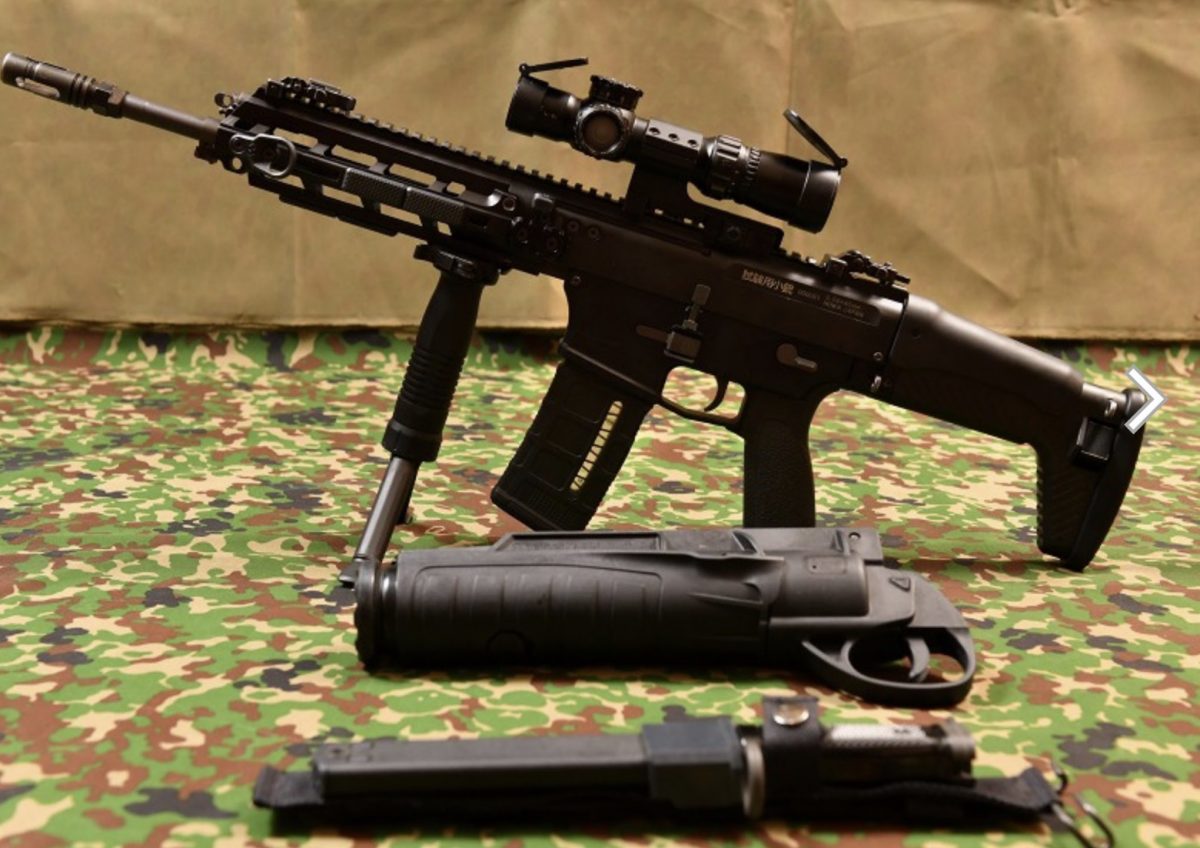
Are small arms outside of this? I thought it was interesting that the JSDF finally made an equipment change. Sidearm goes from Sig P220 ripoff to HK's {glock ripoff} Polymer 9.

In addition,HOWA finally made something new, by testing the standard crop of SCAR, AR, etc. and decided they'd be best off just making their own super original OC DO NOT STEAL rifle. The article I saw was in Jap but I'm not good at surfing their net, this guy has it third hand at least. Brand new, all original.
1594522783745.png

If this belongs here just let me know or delete it at leisure. I'm sure there are some other weebos interested in the JSDF.
 
Last edited:
Are small arms outside of this? I thought it was interesting that the JSDF finally made an equipment change. Sidearm goes from Sig P220 ripoff to HK's {glock ripoff} Polymer 9.

In addition,HOWA finally made something new, by testing the standard crop of SCAR, AR, etc. and decided they'd be best off just making their own super original OC DO NOT STEAL rifle. The article I saw was in Jap but I'm not good at surfing their net, this guy has it third hand at least.Brand new, all original.
Howa-Type-20-e1589880906202.jpg


If this belongs here just let me know or delete it at leisure. I'm sure there are some other weebos interested in the JSDF.
Anything Military related is welcome here. Small arms are definitely military related. The only thing I would exclude is discussions explicitly about civilian ownership, we have the Mega Rad Gun thread in general for that. So your post should be good, at least by my calculus.

Your image seems to be a bit broken though.

Thanks for the information!
 
Worth pointing out that early US carrier planes didn't have self-sealing tanks or pilot armor for weight reasons. Later versions of the Wildcat and everything else afterwards got them when we finally had the horsepower and fuel capacity to not be overly hindered by their mass. Also, not every self-sealing design was the same. The single best material for tanks was rubber, since it could flex with kinetic impact and would be melted by the leaking gas to seal the hole up. German designs were a mixture of fabric and leather, with very little rubber. Said shortage of rubber also lead to their distinctive overlapping wheels for tracks, since that minimized rubber use. The most common self-sealing in the US was from Goodyear, and it used as much rubber as you'd expect. Of course, said tank could reliably take hits from everything of a 20mm and not leak, explode, or otherwise spontaneously ignite by successfully preventing fuel vaporization from anything but the most severe impacts, but it was also as heavy as you'd expect from all that rubber. US submarine batteries were similarly super-reinforced to not burst when subjected to stresses, which also meant in normal use they needed very little maintenance. Oh and as for production of synthetic rubber during WW2: synthetic rubber comes from petrochemicals, so obviously in order to meet the wartime demands the US by itself had to synthesize roughly double what had been naturally produced at the start of the war.
 
On the subject of aircraft, are we ever going to see the F/A-XX this side of 2050? There are no peers for it to fight, drones seem likely to replace human pilots altogether soon, and the F-35 and 22 seem sufficient for purpose going forward. I don't really think there's much room for a 6th gen aircraft in a world where only the US would even be interested in it, is all.
 
American Surveillance Aircraft Have Been Flooding Into The Airspace South Of Taiwan (Updated)
1.jpg


Online flight tracking software has shown a notable uptick in U.S. military aerial activity in the strategic Bashi Channel, which runs from the southern end of Taiwan to the northern tip of the island of Luzon in the Philippines, in recent weeks. A steady stream of U.S. Air Force KC-135 tankers has been seen flying in and out of this general area, which serves the main boundary between the Philippine Sea and the South China Sea. Particularly noteworthy, clusters of P-8A Poseidon and P-3C Orion maritime patrol aircraft, and EP-3E Aries II and RC-135V/W Rivet Joint intelligence-gathering planes having also been observed operating there on many occasions over the last month or so.

Just today, an RC-135W and a KC-135T were spotted flying in the area. Yesterday, an EP-3E and three separate P-8As flew in and around the channel. The day before that, a P-8A, a P-3C, an EP-3E, and an RC-135W had all been present at various times, with at least one KC-135R flying in support of the activity there.

USAF RC-135W is leaving the #SouthChinaSea around 18:40, whose coming trajectory is unclear, while USAF tanker KC-135T was detected in the same airspace earlier this day around 10:00, implying that the former might have come since then, July 9.
1.jpg
2.jpg
US Navy EP-3E (#AE1D91), again, approached the offshore airspace over Guangdong, as close as about 50nm, July 8. On the late evening of July 7 and early morning of July 8, three P-8As were also spotted near #BashiChannel. (one around 22 pm, another 3 am, the other 5 am)
4.jpg
5.jpg
6.jpg
7.jpg
1 EP-3E,1 P-3C, 1 P-8A, 1 RC-135W and 1 KC-135R, July 7. Also some reminders for media : 1) The US military conducts 3 to 5 sorties to the #SouthChinaSea every day, but not every time brings big news. 2) We collect and share this data for research purposes, not for making news.
8.jpg
9.jpg

"The US military conducts 3 to 5 sorties to the #SouthChinaSea every day," the SCS Probing Initiative noted in a Tweet on July 7. China's Peking University in Beijing hosts the SCS Probing Initiative, which is, perhaps unsurprisingly, one of the most active entities tracking American military aviation activity, as well as that of U.S. military ships, in the South China Sea and elsewhere in the Pacific. The project does also tracks other countries' military activities in the region, too.

Still, there does seem to have been a notable increase in U.S. military aerial activity in this one particular area since the end of June. One of the first major conflagrations came on June 24, when two P-8As, a P-3C, and an RC-135W were tracked in the Bashi Channel. Another major cluster aircraft, including 4 P-8As, an EP-3E, an RC-135W, and at least two KC-135s, also appeared in the area on July 3. In the intervening days, the SCS Probing Initiative watched smaller numbers of intelligence, surveillance, reconnaissance aircraft regularly move through the region, including one of the Air Force's two RC-135U Combat Sent electronic intelligence aircraft.

A total of four U.S. surveillance aircraft were operating near the #Bashi Channel from early morning till late afternoon on June 24. What a busy day! 2 P-8As, 1 P-3C and 1 RC-135W.
10.jpg
11.jpg
Very intense reconnaissance by EP-3E and RC-135U. It seems that RC-135U is going back, leaving a tortuous flight path, June 29.
12.jpg
13.jpg
USN EP-3E #AE1D8A is patrolling the #SouthChinaSea, USAF RC-135U #AE01D5 is heading for #SouthChinaSea from #Kadena, June 29.
14.jpg
15.jpeg
On, July 3, the US military just set a recent record for reconnaissance in the #SouthChinaSea today. A total of 6 large reconnaissance aircraft including 4 P-8As, 1 EP-3E and 1 RC-135W, plus 2 refuelling tankers. Maybe there were more which could not be seen with open source.
16.jpg
17.jpg
18.jpg


It's not clear what the exact reasons for this might be, but it is likely due to a confluence of factors.

Beginning in June, the People's Liberation Army Navy has conducted a number of significant naval exercises in the region. The PLAN's newest aircraft carrier, the Shandong, has taken part in at least some of those drills.

Then, at the beginning of July, the U.S. Navy sent two of its own Nimitz class aircraft carriers, the USS Nimitz and USS Ronald Reagan, into the South China Sea, the first dual-carrier exercise it had held there in some six years. Ticonderoga class cruisers and Arleigh Burke class destroyers escorted the flattops and American submarines would have been in the area keeping watch, as well. The two carriers' air wings trained together, as well as with a U.S. Air Force B-52 that had flown all the way to the area from Barksdale Air Force Base in Louisiana. The bomber landed on Guam after the conclusion of its long-range training mission.

19.jpg
{ An Air Force B-52 bomber flies together with Navy F/A-18E/F Super Hornets, EA-18G Growlers, and E-2 Hawkeye in the South China Sea in July 2020. }


The U.S. military has a clear interest in simply monitoring the Chinese drills in the region, as well as looking to gather any kind of intelligence about the technical capabilities of People's Liberation Army Navy aircraft and ships taking part and their tactics, techniques, and procedures. Similarly, observing how the Chinese military responds to American military maneuvers offers its own opportunities to gather additional intelligence.

The U.S. aircraft have been flying in the area in recent weeks are certainly equipped to collect a wide variety of information, from full-motion video via electro-optical and infrared cameras on the P-8As and P-3Cs to a host of signals and electronic intelligence via the sensors suites on the EP-3Es and RC-135s. The P-8As have significant SIGINT capabilities, as well. Depending on their configuration, P-8As and P-3Cs can carry powerful radar imaging systems, too.

China's response to the relatively rare dual-carrier exercise, in particular, was no doubt especially significant and would have provided a unique intelligence-gathering environment. Ensuring that the two carriers were able to operate in the South China Sea unmolested could easily have also driven requirements for additional intelligence, surveillance, and reconnaissance missions. Wanting to make sure opposing submarines, especially, did not get too close to the carrier strike groups would have called for the dedicated anti-submarine warfare capabilities of the P-8As and the P-3Cs, as well.

Look! China's Southern, Northern and Eastern Theater Commands held naval drills in the #SouthChinaSea, Yellow Sea and East China Sea, respectively, with the participation of 054A frigates & 052D guided missile destroyers.


Beyond these more immediate events in and around the South China Sea, there's definitely no shortage of potential items of interest for the U.S. military to point those sensors at in this region. The Bashi Channel serves as an important passageway from the South China Sea in the broader Pacific to the East, including for Chinese submarines. Earlier this year, there were reports that the PLAN had deployed two new Type 094 Jin class ballistic missile submarines, which would have brought the total size of the fleet to six subs.

The Type 094s are all are based at the sprawling Yulin Naval Base on Hainan Island in the northern end of the South China Sea. In May, a specially-configured P-8A carrying the powerful and secretive AN/APS-154 Advanced Airborne Sensor radar pod was observed flying around Hainan Island, including in international waters near Yulin. Chinese submarines, especially those packing ballistic missiles, would traverse the greater Luzon Strait after leaving their base on Hainan Island to move into the far less congested Philippine Sea and out into the greater Pacific. As such, this area is a critical submarine-hunting ground and natural choke point.

20.jpg
{ A P-8A equipped with the AN/APS-154 Advanced Airborne Sensor, as indicated by the red arrow. }


The activities of China's submarine fleets, which are growing in overall size and seeing the introduction of more modern designs, have been a major area of focus for the U.S. military and its allies in recent years. In June, the Japanese government took the unusual step of publicly disclosing that it had tracked a likely Chinese submarine sailing submerged in international waters between Amami-Oshima Island and Yokoate Island, which are situated to the north of Okinawa in the East China Sea.

All of this comes as U.S.-Chinese relations are at a particularly low point due to a host of issues, including the fallout from the COVID-19 pandemic. Authorities in Beijing recently imposed a new heavy-handed security law on Hong Kong, which has prompted the U.S. government, among others, to reassess its relationship with that semi-autonomous region. China's leaders have also taken an increasingly aggressive stance toward Taiwan in recent years, as officials in Taipei have sought to distance the island more from the mainland.

Though the United States does not have formal diplomatic relations with Taiwan, it nonetheless remains its principal ally and has responded to the pressure from Beijing by stepping its own Freedom of Navigation Patrols (FONOPS) in the Taiwan Strait, with aircraft and warships taking part in those operations. In early June, a Navy C-40A passenger transport took an unusual route over the island itself. Later in the month, the U.S. Army released rare video footage of Green Berets training with their Taiwanese counterparts.

There are no clear indications that the overall geopolitical situation in the region is set to take a more positive course in the near future, so it seems probable that we will see more U.S. military activity in this strategic area in the weeks and months to come.

Update: 4:45 PM EST—

Bloomberg is reporting that President Donald Trump's Administration is expected to make a major policy announcement regarding tensions with China in the South China Sea next week.

"The U.S. has raised concerns over China’s decision to conduct military exercises in the contested waters around the Paracel Islands," according to Bloomberg. "The Defense Department last week called the actions “unlawful,” and the U.S. plans to lay out its official position next week, said one of the people who spoke on condition of anonymity."

___________________________________________________
First of all, it is hilarious the the Chinese are complaining about the US conducting activities just outside the Chinese borders when the Chinese themselves are actively encroaching on all their neighbor's territory.

Secondly, this should tell people just how intently we are watching and tracking Chinese forces.

Thirdly, that's a lot concentrated recon power.
 
On the subject of aircraft, are we ever going to see the F/A-XX this side of 2050? There are no peers for it to fight, drones seem likely to replace human pilots altogether soon, and the F-35 and 22 seem sufficient for purpose going forward. I don't really think there's much room for a 6th gen aircraft in a world where only the US would even be interested in it, is all.
Well, the thing is, that your enemies capabilities are a moving target. By 2040, the Chinese (or whoever else) might very well have something which could start matching the F-22 and F-35s. by the time that comes around we want to be another generation ahead of that particular enemy aircraft. Stealth aircraft are this era's dreadnought race, and we are Great Britain in this metaphor.

As for if it will have a pilot or not, I think it probably will. It will probably have drone companions however. We will probably see it start getting serious funding after the production of the F-35 starts tapering off.
 
Forgive me if old news, but:

The brand new missile seeker can home in on radio and radar, which means it can also target anti-aircraft defenses – blasting a path through them for US airpower.
By SYDNEY J. FREEDBERG JR.on June 04, 2020 at 5:41 PM

Lockheed’s prototype Precision Strike Missile (PrSM) fires from an Army HIMARS launcher truck in its first flight test, December 2019.
WASHINGTON: The Army has begun testing a new multi-mode seeker — an upgrade for the Precision Strike Missile — even though the missile won’t enter service until 2023,
The upgraded seeker is expected to be part of a major program improvement planned for 2025.
The new multi-mode seeker was tested yesterday for the first time outside the lab. It should allow the upgraded missile, known as “Spiral One,” to hunt a variety of moving targets on land and sea, Army officials told reporters this afternoon.
Yesterday’s test was five years in the making. The Army launched an initiative in 2015 called the Land-Based Anti-Ship Missile (LBASM). The challenge? While the Army’s long-range artillery rockets and missiles can strike fixed coordinates with high accuracy, ships don’t stay still. If the Army was going to help the Navy and Air Force take on the Chinese navy, it needed to upgrade its missiles to strike moving targets.
That required a new sensor – or better yet, multiple sensors — to track the target in different ways and at different distances. After the missile arrives in the approximate area of the target, the “multi-mode seeker” initially listens for radio-frequency emissions from the enemy’s communications and radar. As the missile homes in on the target, the seeker turns on its infrared imaging mode to refine the precise point to strike.
The Army initially sought this multi-mode sensor to hunt Chinese ships in the Pacific. But it quickly realized the ability to track a mobile target by its radio emissions would also be invaluable for tracking down and destroying mobile radars, an essential piece of Russia anti-aircraft defenses in Europe. Using Army land-based missiles to blast a path for airstrikes from all the services is central to the evolving battle concept known as Joint All-Domain Operations, so this mission has become the focus, said the Army’s artillery modernization director, Brig. Gen. John Rafferty.

“Primarily, the PrSM Spiral One approach is against integrated air defense systems,” Rafferty told reporters.
The new multi-mode seeker was mounted under the wing of a small jet yesterday and flown over the Redstone Test Center in Alabama, where it hunted a target in the messy, cluttered terrain of the real world. The Army’s now crunching the data gathered to see if the seeker’s algorithms need refinement, said the Aviation & Missile Center’s Mike Turner, the primary science & technology advisor to Rafferty’s artillery modernization team.
That test was just the beginning, Turner said, with the seeker operating at “about half its capability.” This fall, he said, the jet will take it up for another test flight, but this time will function at full power against a more realistic target, at the much larger White Sands Missile Range.
“A few months after that,” Turner continued, the seeker will be installed on a “surrogate missile” for three further flight tests. If all goes as planned, the seeker will then be installed on actual PrSM missiles for final testing in 2025.

“We insert all the points along the flight path into a deep neural network that was trained to be able to predict the exact launch point and the location of the drone operator,” Eliyahu Mashhadi of Ben Gurion University says. Testing the model with the flight simulator, the team were able to locate and target the drone operator 78% of the time.

That upgrade is just one of many planned for PrSM, Rafferty emphasized. The base Precision Strike Missile entering service in 2023 will offer dramatically greater range – more than 500 km (313 miles) — than the Reagan-era ATACMS in current use. Spiral One in 2025 will add the ability to track moving targets on land and sea. Spiral Two, with no set date as yet, will focus on “enhanced lethality,” probably by developing an alternative warhead that can eject submunitions to strike multiple targets, like a formation of armored vehicles; that will require further seeker upgrades, Rafferty noted. Spiral Three will increase the missile’s range to 700-800 kilometers (438 to 500 miles). Despite the names, it’s possible that Spiral Three may actually enter service before Spiral Two, Rafferty said: The service will see how both the technology and the threat evolve.
In the near term, the challenge is just getting all the engineering and testing done without exposing the Army and industry workforce to COVID-19. That required some work to get done while wearing masks and other protective equipment, Rafferty said, but it got done. The dedication to staying on schedule while still protecting the people was “very inspiring,” Rafferty said.
“We don’t have time to wait,” he said. “There’s a pacing threat and the Army’s counting on us to deliver.”

This is a good move IMO. Future conflicts will no doubt involve the need for more than just aircraft to be able to target enemy SAM systems, and the ability to turn places like Japan, Australia and South Korea into points in a giant kill-box for the ChiCom navy would ideally help dissuade them from making grabs on their neighbors.
 
So, from what I have heard, it was a problem with production and design.

Simply put, before WW2 Japan had little access to rubber. They produced very little of the valuable materials from the home islands and their colonies. This is a problem because self-sealing tanks use quite a lot of rubber, especially compared to the standard fuel tanks.

Besides the material cost, you had problems with the manufacturing of the systems themselves. Compared to making a fuel tank which doesn't self seal, the takes which do self seal are much more complicated. It seems absurd to say, but Japan was a nation which was just beginning its industrialization. As such, it has very wide discrepancies for what it could actually make and produce easily. Therefore, it wasn't just something that they could check a box on and have it made, there had to be actual government effort put into fielding said self sealing tank, which they did in the last half of the war.

They didn't focus on putting self sealing tanks into their Zeros because several Japanese design studies came back with very disappointing reports about early native self sealing tank designs. It was found that the hydro-static shock of a round impacting these early self sealing tank designs would just rupture that tank completely. That combined with middling results when the tanks didn't fail spectacularly put the top brass off of the idea for a long time.

Then comes the design considerations of the Japanese Zero. The fundamental concept was that Maneuverability was its Survivability. The going thought process was that if you were caught in the enemies guns, you were already dead, so one should focus on being able to avoid the kill box. In their minds it was better to not get hit, than to be able to survive the first 50 rounds of a 200 round burst of gunfire.

So, to put it all together:

Does self sealing fuel tanks help survivability? Sure, but it is only of moderate effectiveness when it works.

Well, can we make it easily? No, it will cost a lot to get production going, and the materials needed are going to have to be imported.

Would it be a net benefit to the vehicle? Well, We are already talking abut an aircraft that had no armor, few redundancies, and an extremely lightweight construction. Agility is it's strength and adding this system would only make it slower and heavier, and therefore less maneuverable.

Putting oneself into that frame of mind allows you to see why the Japs did what they did.

Of course, we now know today that a lot of the Japanese air doctrine was drawing off the wrong assumptions. In fact, one could call a many of the decisions stupid in hindsight. But before the war at least, there was a rational reason for why things were made the way they were.
_
But that is just what I have heard.

That's some interesting shit. I knew Japan had a serious shortage of wartime-required materiel especially oil, rubber and metals which is why the moved so aggressively fast after disabling most of the U.S. Pacific fleet (except the targets they REALLY wanted, the carriers) and invaded and captured the resource-rich areas of Indo-China, the Phillipines and such, but had thought that yeah they were just stupid in their air doctrine, less fully aware of what they were doing and not that they were so direly short of required materials that they made their choices as they were forced to make them. Good food for thought.
 
Forgive me if old news, but:

The brand new missile seeker can home in on radio and radar, which means it can also target anti-aircraft defenses – blasting a path through them for US airpower.
By SYDNEY J. FREEDBERG JR.on June 04, 2020 at 5:41 PM

Lockheed’s prototype Precision Strike Missile (PrSM) fires from an Army HIMARS launcher truck in its first flight test, December 2019.
WASHINGTON: The Army has begun testing a new multi-mode seeker — an upgrade for the Precision Strike Missile — even though the missile won’t enter service until 2023,
The upgraded seeker is expected to be part of a major program improvement planned for 2025.
The new multi-mode seeker was tested yesterday for the first time outside the lab. It should allow the upgraded missile, known as “Spiral One,” to hunt a variety of moving targets on land and sea, Army officials told reporters this afternoon.
Yesterday’s test was five years in the making. The Army launched an initiative in 2015 called the Land-Based Anti-Ship Missile (LBASM). The challenge? While the Army’s long-range artillery rockets and missiles can strike fixed coordinates with high accuracy, ships don’t stay still. If the Army was going to help the Navy and Air Force take on the Chinese navy, it needed to upgrade its missiles to strike moving targets.
That required a new sensor – or better yet, multiple sensors — to track the target in different ways and at different distances. After the missile arrives in the approximate area of the target, the “multi-mode seeker” initially listens for radio-frequency emissions from the enemy’s communications and radar. As the missile homes in on the target, the seeker turns on its infrared imaging mode to refine the precise point to strike.
The Army initially sought this multi-mode sensor to hunt Chinese ships in the Pacific. But it quickly realized the ability to track a mobile target by its radio emissions would also be invaluable for tracking down and destroying mobile radars, an essential piece of Russia anti-aircraft defenses in Europe. Using Army land-based missiles to blast a path for airstrikes from all the services is central to the evolving battle concept known as Joint All-Domain Operations, so this mission has become the focus, said the Army’s artillery modernization director, Brig. Gen. John Rafferty.

“Primarily, the PrSM Spiral One approach is against integrated air defense systems,” Rafferty told reporters.
The new multi-mode seeker was mounted under the wing of a small jet yesterday and flown over the Redstone Test Center in Alabama, where it hunted a target in the messy, cluttered terrain of the real world. The Army’s now crunching the data gathered to see if the seeker’s algorithms need refinement, said the Aviation & Missile Center’s Mike Turner, the primary science & technology advisor to Rafferty’s artillery modernization team.
That test was just the beginning, Turner said, with the seeker operating at “about half its capability.” This fall, he said, the jet will take it up for another test flight, but this time will function at full power against a more realistic target, at the much larger White Sands Missile Range.
“A few months after that,” Turner continued, the seeker will be installed on a “surrogate missile” for three further flight tests. If all goes as planned, the seeker will then be installed on actual PrSM missiles for final testing in 2025.

“We insert all the points along the flight path into a deep neural network that was trained to be able to predict the exact launch point and the location of the drone operator,” Eliyahu Mashhadi of Ben Gurion University says. Testing the model with the flight simulator, the team were able to locate and target the drone operator 78% of the time.

That upgrade is just one of many planned for PrSM, Rafferty emphasized. The base Precision Strike Missile entering service in 2023 will offer dramatically greater range – more than 500 km (313 miles) — than the Reagan-era ATACMS in current use. Spiral One in 2025 will add the ability to track moving targets on land and sea. Spiral Two, with no set date as yet, will focus on “enhanced lethality,” probably by developing an alternative warhead that can eject submunitions to strike multiple targets, like a formation of armored vehicles; that will require further seeker upgrades, Rafferty noted. Spiral Three will increase the missile’s range to 700-800 kilometers (438 to 500 miles). Despite the names, it’s possible that Spiral Three may actually enter service before Spiral Two, Rafferty said: The service will see how both the technology and the threat evolve.
In the near term, the challenge is just getting all the engineering and testing done without exposing the Army and industry workforce to COVID-19. That required some work to get done while wearing masks and other protective equipment, Rafferty said, but it got done. The dedication to staying on schedule while still protecting the people was “very inspiring,” Rafferty said.
“We don’t have time to wait,” he said. “There’s a pacing threat and the Army’s counting on us to deliver.”

This is a good move IMO. Future conflicts will no doubt involve the need for more than just aircraft to be able to target enemy SAM systems, and the ability to turn places like Japan, Australia and South Korea into points in a giant kill-box for the ChiCom navy would ideally help dissuade them from making grabs on their neighbors.
Yeah, thanks for the good info.

I had caught some rumblings from earlier this year that they were going to be doing an Anti-Radiation Missile upgrade, but beyond hearing about the upgrade plan and roughly what they wanted to do with it, I had heard nothing.

This is also the first time I am hearing about plans for a sub-munition upgrade. just imagine stuffing a BLU-105 into the PrSM. Terrifying.
 

"Winning": Japan Choses Quiet Over Security

July 12, 2020: Because of poor planning Japan has decided to cancel the installation of two Aegis Ashore ABM (Anti-Ballistic Missile) systems. The decision to buy and install the two Aegis Ashore in two existing military bases was made at the end of 2017.This decision was encouraged by the fact that in 2016 the first Aegis Ashore system became operational in Romania. The second one became active by 2018 in Poland.

Unfortunately, Japan is not like Romania and Poland, two nations that suffered decades brutal Russian occupation. Japan has prospered greatly under the protection of the American military after World War II and developed some bad habits when it came to defense matters. What killed the Aegis project were several of those bad habits. First, as defense officials were working out the details the soon found they had had underestimated the cost of preparing the two Aegis Ashore sites. That cost was about 25 percent higher than estimated. Costs threatened to increase still more when civilians living near the two Aegis base areas discovered that there were side-effects from the use of Aegis missiles. Planners made some adjustments to the area Aegis would occupy but that was not enough to assure local civilians that the booster portion of the two stage SM missile would never fall in or near a populated area. In one Aegis Ashore site there were civilian concerns about living too close to the AESA radar Aegis uses to detect and track incoming missiles. Once the Japanese media and local politicians get hold of issues like this they stay active until the “threat” goes away. North Korean and Chinese missiles are seen as less of a threat. In Poland and Romania Russia is always seen as the primary threat and the side effects of using Aegis are not an issue.

Japan might still reconsider but it is more likely that the Aegis Ashore funds will be used to upgrade two existing Japanese destroyers to provide these ships with Aegis ABM capabilities. This is not as effective as Aegis Ashore which, as a land base, is cheaper to maintain and always available to defend against North Korean or Chinese ballistic missiles. Ships have crews and ships spend only about a third of their time at sea.

North Korean remains the primary threat to Japan. North Korea unwillingness to get rid of its ballistic missile and nuclear weapons program persists. As a result, Japan is still moving ahead to expand its ballistic missile defenses. Most of these will still be based on the Aegis system, which is normally installed on large (8,000 tons and up) warships. Japan has five of these Aegis anti-missile system destroyers with another due to enter service in 2021.

The Maya class destroyers are improved versions of the earlier Atago class destroyers. The Mayas also borrow much from the first four Japanese Aegis-ABM ships, the 9,500-ton Kongos, which were built during the 1990s and modeled on the American Burke class Aegis destroyers. The Kongos have 90 VLS (Vertical Launch System) cells for anti-aircraft/missile missiles as well as ASROC anti-submarine rockets (that carry an anti-submarine torpedo to, in effect, extend the range of the torpedo by 22 kilometers). Japanese Burke type destroyers also carry a five-inch gun and eight Japanese designed anti-ship missiles (similar to the American Harpoon). The Maya class has 96 VLS cells (as do Atagos) as well as more advanced electronics that enable the Mayas to link with the U.S. Navy CEC (Cooperative Engagement Capability) that allows real-time sharing of sensor and other data in real time between other CEC equipped ships and even shore-based systems like Aegis Ashore.

The two land-based Aegis Ashore anti-missile systems were not expected to be in service until 2024. At that point, Japan would have eight Aegis anti-missile systems and could have two more Aegis anti-missile destroyers by 2024 by upgrading the Aegis systems on two of the older destroyers. That upgrade is more likely now that Aegis Ashore has been cancelled. It appears that North Korea will continue to be a threat and how much more of a ballistic missile threat China becomes is still considered less of a problem. China has a long history of threatening but not acting. North Korea has demonstrated an ability to attack without warning, and did so in 2010. North Korea has always been less cooperative than China although the Chinese are still a threat.

What prompted the original Aegis Ashore order was the Japanese decision, in 2017, that it did not need the more expensive THAAD anti-missile system when it realized that two land-based Aegis systems on the main island could do the same job at less cost. That plus the Aegis equipped destroyers armed with the SM-3A anti-missile missile would enable those two land-based Aegis systems to protect all three of the home islands.

In addition, Japan has 24 Patriot anti-aircraft missile batteries that can also fire the PAC-3 anti-missile missile. The PAC-3 has one drawback, it only has an effective range of 30 kilometers against incoming missiles. The Aegis SM-3 anti-missile missile has a range of from 700 kilometers (older Block 1) to more than three times that for the later Block II models. This is why two Aegis land-based systems can protect most of Japan (the main island). The Patriot PAC-3 provides local defense for key targets (the capital and major military bases).

The first (Romanian) Aegis Ashore system appears to be as reliable as the original ship-based systems. This was expected because the East European Aegis Ashore system had never been to sea. In early 2014 the only land-based Aegis system in existence (in New Jersey) was taken apart, packed into sixty 60 18.2-meter (40 foot) shipping containers and sent to Romania where it was put back together and in 2015 was an operational anti-missile system by early 2016. After that two more ground-based Aegis systems were ordered; one in Poland and one in Hawaii (for testing and development). All three, including new Aegis components for two of them and needed missiles (24 per location) and launching hardware for all of them came out costing $767 million each. Then came the Japanese Aegis Ashore order, which were initially estimated to cost over two billion dollars for each system. Defense projects have always been more expensive in Japan because of local laws (no weapons exports) and customs (creating the maximum number of jobs with government projects).

The U.S. has long sought to put anti-missile systems in Eastern Europe to protect against ballistic missile attacks from Iran. Russia has opposed this and sees it as a subterfuge to weaken the effect of Russian ballistic missiles attacking European targets. Most Europeans don’t know what to make of that, but East European countries (like Romania and Poland) that spent 1945-89 as involuntary Russian vassal (or “satellite”) states, do see a need for protection from Russian missiles and Russian aggression and domination in general. Romanians and Poles considered Russian anger over Aegis Ashore as a benefit, not a problem.

It is different in East Asia where Japanese atrocities during World War II are still remembered. Japan, in turn, considers itself a victim of World War II and still insists it was trying to help its neighbors. The neighbors disagree and two of them, North Korea and China, openly threaten Japan with more nuclear attacks.

Meanwhile Aegis remains one of the most effective missile defense systems available. Aegis has achieved an 83 percent success rate during live test firings. As a result, many countries want Aegis ABM (Anti-Ballistic Missile) ships for protection from local ballistic missile threats. The Aegis system was designed to operate aboard warships. These are usually cruisers and destroyers that have been equipped with the special software that enables the Aegis radar system to detect and track incoming ballistic missiles. Currently, the U.S. Navy has about 40 ships with the Aegis anti-missile system. There are over 100 American and foreign warships equipped with Aegis, but less than half of them had the software mods and anti-missile missiles that enable them to shoot down ballistic missiles and low-orbit satellites. Converting an Aegis ship to Aegis ABM costs about $30 million, mainly for new software and a few new hardware items. This is seen as a safe investment and the U.S. expects to see most Aegis equipped ships to be upgraded to ABM versions in the 2020s.

To knock down ballistic missiles Aegis uses two similar models of the U.S. Navy Standard anti-aircraft missile, in addition to a modified version of the Aegis radar system, which can now track incoming ballistic missiles. The anti-missile missile is the RIM-161A, also known as the Standard Missile 3 (or SM-3). It has a range of over 500 kilometers and max altitude of over 160 kilometers. The Standard 3 is based on the anti-missile version of the Standard 2 (SM-2 Block IV). This SM-2 missile turned out to be effective against ballistic missile warheads that are closer to their target, as is its replacement, the SM-6. One test saw a SM-2 Block IV missile destroy a warhead that was only 19 kilometers up. An SM-3 missile can destroy a warhead that is more than 200 kilometers up. But the SM-3 is only good for anti-missile work, while the SM-2 Block IV and SM-6 can be used against both ballistic missiles and aircraft. The SM-2 Block IV also costs less than half what a SM-3 costs. SM-3 is not being replaced by instead constantly upgraded.

The SM-3 has four stages. The first two boost the interceptor out of the atmosphere. The third stage fires twice to boost the interceptor farther beyond the earth's atmosphere. Prior to each motor firing it takes a GPS reading to correct course for approaching the target. The fourth stage is the nine kg (20 pound) LEAP kill vehicle, which uses infrared sensors to close on the target and ram it.
______________________________________
This is a good piece on why Japan's Aegis ashore program was canceled, as well as general information about the system and it's counterparts.
 
That's some interesting shit. I knew Japan had a serious shortage of wartime-required materiel especially oil, rubber and metals which is why the moved so aggressively fast after disabling most of the U.S. Pacific fleet (except the targets they REALLY wanted, the carriers) and invaded and captured the resource-rich areas of Indo-China, the Phillipines and such, but had thought that yeah they were just stupid in their air doctrine, less fully aware of what they were doing and not that they were so direly short of required materials that they made their choices as they were forced to make them. Good food for thought.
Its also worth pointing out that the Japanese government itself didn't desire any sort of major conquests or war, at least initially. However, they had decided to put all their ultra-nationalist military officers overseas in the Kwangtung Army, safely away from the Home Islands where they couldn't start trouble, as had happened in the past. Of course, that just meant they were left unsupervised to cause trouble in mainland Asia, starting with the Mukden Incident and only escalating from there.
 
Two submarines share dry dock for simultaneous inactivations
View attachment 1.webp
{ Los Angeles-class fast-attack submarines USS Louisville (SSN-724), foreground, and USS Olympia (SSN-717) are moved into Dry Dock 5 July 9, 2020 to begin the inactivation process at Puget Sound Naval Shipyard & Intermediate Maintenance Facility in Bremerton, Washington. (U.S. Navy photo by Scott Hansen, PSNS & IMF) }

Two elderly Los Angeles-class submarines headed for decommissioning — USS Olympia (SSN 717), commissioned in 1984, and USS Louisville (SSN 724), commissioned in 1986, – both entered Dry Dock 5 at Puget Sound Naval Shipyard & Intermediate Maintenance Facility yesterday.

The two submarines are to be inactivated simultaneously. According to Cmdr. Jack Tappe, project superintendent, this brings both challenges and benefits.

“Most project teams have only one ship complement or crew to synchronize with,” said Tappe. “Our folks have had to coordinate communications and planning across two very different crews, and they have done this very well. Fortunately for us we have the benefit of having some very experienced folks on the Project Team.”

Tappe said the coordination among the project team and the leadership and crews of Olympia and Louisville has been very successful thus far.

“I am extremely proud of our ships’ crews and project team,” said Tappe. “I have never been with a team that has been able to pull two projects to the left by a month and dock early, even during our time of resource shortage and COVID-19 response. This win is due to the hard work and dedication of our friends in the shops and tech codes helping us out.”

Leaders from both ships agreed that efficient communications among all the stakeholders will be key to the continued success of the concurrent inactivation process.

“Transparency and good communications, early and often, are the key to this,” said Louisville’s Commanding Officer Cmdr. Chris Brown. “The inactivation is a team sport, so we’re working hand-in-hand with the project to make sure that all questions are answered in advance so that as we approach each milestone we’re ready to go.”

Olympia’s Commanding Officer Cmdr. Jim Steffen agreed.

“The key to a successful project is communication,” Steffen said. “We’ve already started off on the right foot with the project team. We’re fully integrated, and our goal is to keep communicating not just what’s happening today, but also what’s happening next week. If we can keep that up, this is going to be a smooth project.”

“I think the biggest part is understanding we are one team,” said Olympia’s Chief of the Boat Master Chief Arturo Plasencia. “As long as we’re moving in one direction toward one common goal; that will be the key to success here. We can help the shipyard with any manning shortfalls, and the shipyard can help us by providing us with various skills we don’t necessarily hold onboard, and teaching our Sailors some of those skills.”

Tappe said executing concurrent inactivations is more cost and time efficient than inactivating the ships one at a time.

“We save an enormous amount of time and money by conducting a dual inactivation,” Tappe said. “A single project team is deactivating two submarines at the same time. That is a significant cost savings in the way of personnel. Additionally, the team has identified key individuals to cover two submarines versus having one individual for each submarine.”

“We have one Chief Refueling Engineer responsible for defueling both submarines,” Tappe continued. “We can also surge the workforce between both submarines if necessary, so we have scheduled similar work within weeks of each other to maximize efficiency. By doing this we can also have one ship’s crew watch the other during their evolution, so they can learn from that evolution in as near real-time as possible before they begin their evolution.”

Passing lessons learned from one part of the team to the other, and to ship’s force, may also help streamline operations.

“I’m excited we’re going to run both projects concurrently,” Brown said. “Lessons learned from one unit can be immediately passed to the next. That way we’re able to minimize any delays and accelerate the timelines as we learn each new lesson.”

According to Tappe, capturing lessons learned in real time will assist not only with the concurrent inactivations, it can help future inactivation teams.

“We are hot washing many evolutions once they are completed instead of waiting for the end of availability,” Tappe said. “Our Risk Manager, Roxanne Minder, has been a key player in assisting with gathering the lessons learned from previous inactivation availabilities and documenting all our own lessons learned. We should have a significant amount of detail to turn over to the next SSN-688 inactivation team.”

“The crew will be involved in all aspects of the inactivation,” said Brown. “We’ve had many opportunities to expand their role. With COVID-19 mitigations, we were actually able to get them more involved than they would have been, to keep us on track.”

_____________________________________________
The Los Angeles-class Attack Submarines have served well. However, age and technology have started to over take them. USS Olympia and the USS Louisville are the oldest attack submarines in the fleet. The Olympia was one of the last of the 688 style hulls (SSNs 688-718), the Louisville and friends had an upgrade reactor that didn't require "refueling" and had 12 vertical launch tubes for Tomahawk missiles (SSNs 719-750).

Unfortunately, neither of these Submarines got the improvements of the 688i boats (SSNs 751-773). They have a quieter design, upgraded sonar, increased under ice capabilities, and mine laying technology

The fact of the matter is that the silencing technology is 35 years old in these boats, upgrading them to the new standards would require pulling out so much of the Submarines that it just would be worth it. After-all, one of the biggest contributors to noise on a nuclear boat, is the reactor itself and all the associated piping and mechanisms.
_
Here's a little chart I found on https://en.wikipedia.org/wiki/Los_Angeles-class_submarine (yes, I know its wikipedia). If this is relatively accurate, it definitely time to begin putting the early Los Angeles-class into retirement (SSNs 688-750).
1.png
 
Got a pair of stories for you all:
U.S. Army deploys Abrams tanks to Poland
View attachment 1.webp
The U.S. Army has begun deploying Abrams main battle tanks and Bradley fighting vehicles to Poland as part of the final phase of training linked to DEFENDER-Europe 20, July 14 – Aug. 22.

The Baltic Security has reported that the equipment, to include approximately 55 Abrams main battle tanks and Bradley fighting vehicles, was originally moved from Army Prepositioned Stock sites in Germany and Belgium to Bergen-Hohne Training Area, Germany, in February as part of the original DEFENDER-Europe 20 exercise. The equipment will move via commercial and military line-haul to Drawsko Pomorskie Training Area, Poland, for the second phase of the modified exercise.

As part of the training, the unit will also mount the Trophy system on Abrams tanks. Trophy is an active protection system that is designed to detect and defeat rocket propelled grenades, recoilless rifles and anti-tank guided missiles. The fielding of Trophy systems provides the U.S. Army’s logistics teams with the opportunity to assess and experience the dynamics of moving and installing the system in a field environment.


Approximately 550 Soldiers from the 2nd Battalion, 12th Cavalry Regiment, 1st Armored Brigade Combat Team, 1st Cavalry Division, out of Fort Hood, Texas, will participate in the exercise. The 1st Cavalry Division Headquarters (Forward) out of Poznan, Poland, will serve as mission command for the exercise while the 7th Army Training Command out of Grafenwoehr, Germany, will provide exercise control.

All appropriate COVID-19 prevention ad mitigation measures will be taken prior to and during the deployment to ensure the health and protection of participating armed forces and the local population.

DEFENDER-Europe 20 was designed as a deployment exercise to build strategic readiness in support of the U.S. National Defense Strategy and NATO deterrence objectives. In response to COVID-19, DEFENDER-Europe 20 was modified in size and scope. The first phase was linked exercise Allied Spirit, which took place at Drawsko Pomorskie Training Area, Poland, June 5-19, with approximately 6,000 U.S. and Polish Soldiers.
2.jpg
3.jpg


U.S. Army decided to mount active protection system on Abrams tanks
View attachment 4.webp

The U.S. Army has announced on 10 July that it is decided to mount Trophy active protection system on Abrams tanks which will deploy to Poland.

According to a press release issued Friday by the U.S. Army Europe, the fielding of Trophy systems provides the U.S. Army’s logistics teams with the opportunity to assess and experience the dynamics of moving and installing the system in a field environment.

“As part of the training, the unit will also mount the Trophy system on Abrams tanks,” it said in a statement. “Trophy is an active protection system that is designed to detect and defeat rocket propelled grenades, recoilless rifles and anti-tank guided missiles.”


In 2019, the Army has also mounted the Trophy system on Abrams during multinational exercise Justice Eagle 19 at Smardan Training Area, Romania.

The U.S. Army Europe officials said that Abrams was equipped with visual modifications to simulate having the Trophy active protection system take part in Saber Guardian 19.

”The visual modifications, which are the same size and weight of the actual system, are being used so that the unit can provide feedback to the Department of Defense concerning the impact of the system on vehicle maneuver, crew situation awareness, and ability to engage targets,” noted by U.S. Army Europe Public Affairs.
________________________________________________
Defender 2020 was supposed to be a reincarnation of ReForGer, a large scale exercise designed to ensure that NATO and the US specifically had the skills required to move an extremely large amount of forces very quickly to West Germany. The new exercise was/is focused around getting troops to Poland and friends instead of Germany because of the new reality of European political geography.

Many of the lessons to be learned by a Defender exercise can also be applied to rapidly deploying troops to someplace like Japan or South Korea. It is important that these exercises start getting carried out again because the last ReForGer was in 1993 and was a mere shadow of its former self. This means that the people practical hands on experience of moving several divisions over an ocean in a very short period of time have either been rotated out or up.

So Defender 2020 was supposed to be a medium scale mobility and campaign exercise to get practical experience back into the force, with a particular focus in the lower rank logistics teams. Unfortunately it had to be significantly scaled back due to the coronavirus. What does this means for the future Defender exercises? I don't know.

_
It is also interesting to note that while the Army has the new M1A2C (Formerly known as M1A2 SEPv3) which has the Trophy APS installed natively, the older variants of the Abrams seem to have the capability of mounting the Trophy APS as well. It is nice that they have an ability to be retrofitted on.

The Army is currently in the process of fielding its first brigade of the new M1A2Cs. The M1A2Cs have upgraded armor, management systems, auxiliary power systems, Trophy APS, and other upgrades. The M1A2Ds are expected to start delivery in 2021, and include upgrades to the Main Gun (most notably having the new Advance Muli-Purpose round), greatly improved sensor technology i.e. 3rd+ Generation FLIR, improved optics, and new/upgraded warning recievers, and other upgrades.
 
Well at least we know all that projection after the soviets fell about "peace for the forseeable future" we had in kids' magazines and books was wrong. I remember being crestfallen that there was a kind of belief that no one would have much need to push the envelope as much as they did in the cold war without the strong opponent. It's kinda weird to read those things, I found an old issue of some teen mag from the 90's writing about the raptor. There was a lot of optimism.
That's some interesting shit. I knew Japan had a serious shortage of wartime-required materiel especially oil, rubber and metals which is why the moved so aggressively fast after disabling most of the U.S. Pacific fleet (except the targets they REALLY wanted, the carriers) and invaded and captured the resource-rich areas of Indo-China, the Phillipines and such, but had thought that yeah they were just stupid in their air doctrine, less fully aware of what they were doing and not that they were so direly short of required materials that they made their choices as they were forced to make them. Good food for thought.
I wish I could find it, but I recently had a friend tell me about a book he read that mentioned the war from the Jap view point, and it talked about their reaction to seeing the Yank Seebees building an airfield by bulldozing it and adding all kinds of org and accoutrements, it dawning on him that they never did anything that labor intensive and professional grade. He said when they started lining up the aircraft and paving the airstrip, he understood they would lose the war regardless.

I really wanna find it, I have a guy working over there who's been tasked with obtaining oral histories if possible from the older generations. So far I only get snippets but I feel like their POV is very under-researched. They don't open up to yanks so much though.
 
I am going to go ahead and post a bunch of stuff in succession, not a lot of time today.

Shock-dissipating fractal cubes could forge high-tech armor
1.jpg

Tiny, 3D printed cubes of plastic, with intricate fractal voids built into them, have proven to be effective at dissipating shockwaves, potentially leading to new types of lightweight armor and structural materials effective against explosions and impacts.

“The goal of the work is to manipulate the wave interactions resulting from a shockwave,” said Dana Dattelbaum, a scientist at Los Alamos National Laboratory and lead author on a paper to appear in the journal AIP Advances.

“The guiding principles for how to do so have not been well defined, certainly less so compared to mechanical deformation of additively manufactured materials. We’re defining those principles, due to advanced, mesoscale manufacturing and design.”

Shockwave dispersing materials that take advantage of voids have been developed in the past, but they typically involved random distributions discovered through trial and error. Others have used layers to reverberate shock and release waves. Precisely controlling the location of holes in a material allows the researchers to design, model and test structures that perform as designed, in a reproducible way.

The researchers tested their fractal structures by firing an impactor into them at approximately 670 miles per hour. The structured cubes dissipated the shocks five times better than solid cubes of the same material.

Although effective, it’s not clear that the fractal structure is the best shock-dissipating design. The researchers are investigating other void- or interface-based patterns in search of ideal structures to dissipate shocks.

New optimization algorithms will guide their work to structures outside of those that consist of regular, repeating structures. Potential applications might include structural supports and protective layers for vehicles, helmets, or other human-wearable protection.

The research will be published in the July 2020 issue of AIP Advances, in the article “Shockwave dissipation by interface-dominated porous structures,” by D.M. Dattelbaum et al

____________________________________________
This is some really amazing stuff, I hope that it pans out and can be implemented well.
 
Back
Top Bottom