Rei is shit
kiwifarms.net
- Joined
- Oct 23, 2017
I'm ridin with biden if he gives us bay of pigs kino.
Follow along with the video below to see how to install our site as a web app on your home screen.
Note: This feature may not be available in some browsers.

Now AOC will be more pissed. She'll said "How dare you?" in the Greta way.View attachment 2371872

Statement by President Joseph R. Biden, Jr. on Continuing Crackdown in Cuba | The White House
I unequivocally condemn the mass detentions and sham trials that are unjustly sentencing to prison those who dared to speak out in an effort to intimidatet.co

Oh great, Cuba's going to end up a playground for woke corporate interests. That might actually be worse than communist isolationism.I for one look foward to Bay of Pigs part 2 femenist boogaloo with special guest starring of the dangerhairs.

The amazing part is the fact that Cuba has internet.
It's almost as if you tell people no enough times they stop taking you seriously. I can see why certain regimes want to censor the internet, it's too difficult to control the flow of information.They had people riding scooters around with cell phones that can become wireless hotspots back in the day. IIRC someone was arrested 8-15 years ago for smuggling in servers with internet archives for the month onto it. Cubans have been cheating their internet for years, so the gov’t probably gave up on it and let them have it.

Can we start trading "reporters" for people from Cuba who actually want to be here? I know the island is getting the shit end of that deal but fuck it, this can only improve both countries.
While we're at it, let's trade some "teachers" as well.Can we start trading "reporters" for people from Cuba who actually want to be here? I know the island is getting the shit end of that deal but fuck it, this can only improve both countries.
Some "expert" said that the whole world's population can live comfortably within the borders of Texas. You'd probably end up sending half the country there at this rate. That being said they don't even have enough food as it is. But if they'd like to try making it work so be it.While we're at it, let's trade some "teachers" as well.


Where were you when the US Marines established the first dilation station in Cuba?I for one look foward to Bay of Pigs part 2 femenist boogaloo with special guest starring of the dangerhairs.

Too late, it was established in Guantanamo Bay back in 2008. One of Obama's first actions as president, oddly enough.Where were you when the US Marines established the first dilation station in Cuba?

And then the Cuban government said these protestors are manipulated by globalists I presume?So after months of relative quiet, tensions are flaring up again. Anti-government protesters vow to march, government insists it won't happen.

And then the Cuban government said these protestors are manipulated by globalists I presume?
Authored by Katabella Roberts via The Epoch Times,
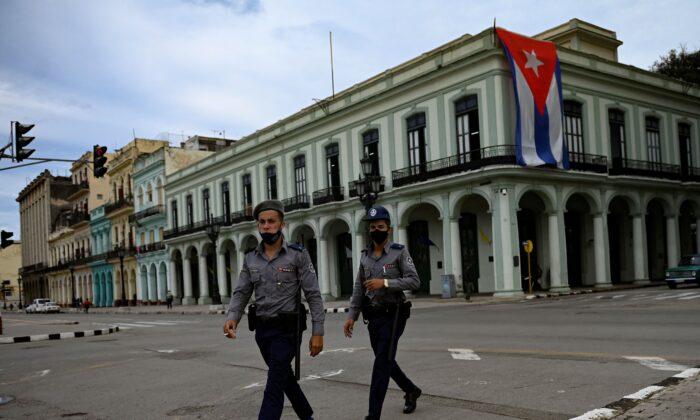
Cuba’s ruling Communist Party appears to have largely shut down anti-regime protests planned for Monday, while detaining and intimidating a number of activists, according to multiple reports.
Thousands of people were expected to take to the streets across the country this week as part of the “Civic March for Change” to demand greater political freedom and the release of jailed political activists.
The pro-democracy protests, organized by Archipelago, an opposition group headed by Cuban playwright Yunior García Aguilera, 39, have been banned by Cuba’s regime and leader Miguel Diaz-Canel.
On Sunday, Aguilera was blocked from leaving his own home after swarms of plainclothes police officers and regime supporters surrounded his apartment. His phone lines and Internet connection were also cut, the organizer told The Washington Post.
The activist waved a white rose from his apartment window and hung a sign reading “My house is blocked,” but regime supporters quickly raced to cover the side of his building and his windows with a giant Cuban flag, according to WaPo.
Human rights groups have also witnessed protest leaders being intimidated, threatened, and prevented from taking to the streets to demonstrate.
A number of activists have shared video footage online showing their homes being surrounded by pro-regime crowds chanting “traitor” and “mercenaries.” Cuban journalist and blogger Yoani Sánchez wrote on Twitter that her Internet had been cut off.“We’re seeing an increase in the number of people who are being detained, and an escalation in the use of intimidation and threats of violence,” Laritza Diversent, the founder of the Cubalex human rights group, told Bloomberg.
Spain’s state-run news agency, EFE, said its reporters in Cuba had their work permits revoked, prompting Madrid to demand that all their credentials be returned.
Monday’s planned protests followed unprecedented uprisings in July, which were the largest on the island since Fidel Castro’s 1959 revolution, Reuters reported. The summer protests against a lack of freedom and worsening economic conditions saw the country plunged into an Internet blackout.
More recently, Cuba has also seen growing frustrations amid ongoing food shortages and high food prices in the midst of worsening economic conditions in the country, further exasperated by the COVID-19 pandemic.
The Cuban regime has accused this week’s planned protests of being part of a destabilization campaign by the United States, which maintains a Cold War-era embargo on Cuba. U.S. officials have denied the allegations.
On Sunday, U.S. Secretary of State Antony Blinken condemned what he called “intimidation tactics” utilized by the Cuban regime to crackdown on the protests, which also coincide with the reopening of the country after 20 months of pandemic-related lockdowns, and said that Washington will pursue measures that support the Cuban people and seek “accountability” for the regime’s oppression.
Five years after his death, is Castro's revolution floundering?
Five years after Fidel Castro's death, the revolution he started in 1959 appears to be at an impasse, with Cuba's economy battered and an ever-larger part of its population clamoring for change.
The communist island has seen unprecedented protests in the last year as more and more citizens blame the one-party state for a variety of social and economic ills.
A younger generation of Cubans, the so-called "grandchildren" of the revolution, are demanding increased freedoms and rights, Western-style democracy and economic opportunities.
Bolstered by the recent arrival -- in 2018 -- of mobile internet and a social media explosion, younger Cubans have placed themselves in direct confrontation with a state that controls just about every aspect of public life and does not take kindly to dissent.
Unlike their predecessors, the new generation is not dazzled by the successes of "Fidelism," including a social welfare system with universal healthcare and education, Arturo Lopez-Levy of the Holy Names University in California told AFP.
Instead, they focus on the fact that it "left the country materially impoverished, with an archaic form of governance and limited space for debate and competition," he said.
"My generation is close enough to our grandparents to understand the history, but far removed enough to not be anchored in that history and to be able to think of the future," Raul Prado, a 35-year-old photographer, told AFP.
- 'Down with the dictatorship' -
Young Cubans today, many of them highly qualified but with limited opportunities, reject previous generations' knee-jerk resistance to the United States, hoping instead for relations to improve and for biting US sanctions, in place since 1962, to be lifted.
Five years ago, long lines of Cubans gathered to pay their respects and show gratitude to father of communist Cuba, saluting the remains of "El Comandante" along a journey of more than 900 kilometers (560 miles) from Havana to the eastern city of Santiago de Cuba, where a memorial shrine holds his remains.
The country was hit in July this year by the biggest protests in its history as thousands of people spontaneously took to the streets of several cities chanting 'Down with the dictatorship' and 'We want liberty'
Today, the picture is different.
Following other, smaller demonstrations in recent months, the country was hit in July this year by the biggest protests in its history as thousands of people spontaneously took to the streets of several cities chanting "Down with the dictatorship" and "We want liberty."
The authorities responded by arresting more than 1,200 people, hundreds of whom remain behind bars, with prosecutors requesting sentences of up to 30 years in a country where displays of public discontent are rare and risky.

That's the big weakness of these strongman authoritarian, usually communist, regimes. It requires the strongman to keep the regime together. once he dies, his successor either doesn't know how to keep it together, or his successor actually believed all the propaganda of his predecessor and utterly shits the bed.Sorry for the double post but there's an article about Castro's death 5 years later.
They probably would never say "globalists," they're more likely to say that it was the Western Imperialists.And then the Cuban government said these protestors are manipulated by globalists I presume?
MOSCOW (AP) — Russia raised the stakes Thursday in its dispute with the West over Ukraine and NATO’s expansion when a top diplomat refused to rule out a military deployment to Cuba and Venezuela if tensions with the United States escalate.
Deputy Foreign Minister Sergei Ryabkov said he could “neither confirm nor exclude” the possibility of Russia sending military assets to Latin America if the U.S. and its allies don’t curtail their military activities on Russia’s doorstep.
“It all depends on the action by our U.S. counterparts,” the minister said in an interview with Russian television network RTVI, citing Russian President Vladimir Putin’s warning that Moscow could take unspecified “military-technical measures” if the U.S. and its allies fail to heed its demands.
Ryabkov led a Russian delegation in talks with the U.S. on Monday. The negotiations in Geneva and a related NATO-Russia meeting in Brussels took place in response to a significant Russian troop buildup near Ukraine that the West fears might be a prelude to an invasion.
Russia, which annexed Ukraine’s Crimea Peninsula in 2014, has denied having plans to attack the neighboring country. The Kremlin reacted to the suggestion by accusing NATO of threatening its territory and demanding that the military alliance never embrace Ukraine or any other ex-Soviet nations as new members.
Washington and its allies firmly rejected the demand this week as a nonstarter, but the NATO and Russian delegations agreed to leave the door open to further talks on arms control and other issues intended to reduce the potential for hostilities.
A senior Biden administration official suggested Thursday that Ryabkov’s statement about Cuba and Venezuela had not changed Washington’s calculations.
“We are not going to respond to bluster. If Russia actually started moving in that direction, we would deal with it decisively,” said the official, speaking on condition of anonymity to discuss the ongoing negotiations.
Ryabkov last month compared the current tensions over Ukraine with the 1962 Cuban Missile Crisis — when the Soviet Union deployed missiles to Cuba and the U.S. imposed a naval blockade of the island.
That crisis ended after U.S. President John F. Kennedy and Soviet leader Nikita Khrushchev agreed that Moscow would withdraw its missiles in exchange for Washington’s pledge not to invade Cuba and the removal of U.S. missiles from Turkey.